

A curb bracelet is built from flat, twisted links that lie sleek against the wrist and layer beautifully. A Cuban bracelet uses rounded, tightly interlocked links that sit heavier and read as a statement piece. That difference in geometry drives everything else, weight, cost per length, drape, and what you can hang off it. A well-established jewellery retailer with physical stores in Kent has spent many years handling both styles, and the choice usually comes down to how bold you want your wrist to look.
TL;DR:
- A Cuban bracelet contains densely packed, rounded links that are heavier and more three-dimensional, making it suitable for statement pieces or supporting heavy pendants.
- A curb bracelet features flat, twisted oval links that lie flat against the skin, offering a lighter, more flexible, and versatile option for everyday wear and layering.
- Cost increases with weight, so wider Cuban links generally cost more than curb links of the same width, especially at larger sizes over 6mm.
- For a lighter, more flexible bracelet that layers easily or holds pendants well, choose curb; for bold, standalone statements or supporting heavier charms, opt for Cuban.
- Always verify metal purity, construction quality, and clasp strength when purchasing to avoid misrepresentations, especially with pre-owned or custom-designed pieces.
Table of Contents
- What is a curb bracelet? Link shape, sizes and finishes explained
- What is a Cuban bracelet? Link geometry and craftsmanship variants
- Curb vs Cuban: how they compare on the things buyers actually care about
- Choosing metal, finish and the right size for your wrist
- What to ask before you buy a curb or Cuban bracelet
- What a jeweller actually checks before selling a curb or Cuban piece
- So, curb or Cuban: the short answer
- What I’ve noticed watching people choose between the two
- How Blackwell Jewellers can help you get it right
- Sources
- FAQ
What is a curb bracelet? Link shape, sizes and finishes explained
A curb link starts life as an oval, then gets twisted and flattened so each link locks against its neighbours and lies flush. That’s what gives curb chains their sleeker, more flexible drape compared with rounder styles. Run your thumb along a curb bracelet and you’ll feel a slight ridge where each link twists, but the overall profile stays low and close to the skin.
That flatness matters more than it sounds. A low-profile chain moves with the wrist rather than sitting proud of it, which is why curb bracelets tend to feel unobtrusive under a shirt cuff or stacked with other pieces.
Curb bracelets come in a wide span of scales:
- Delicate curb: 2 to 3mm, worn solo or layered with thinner pieces.
- Everyday curb: 4 to 6mm, the most common width for daily wear.
- Statement curb: 10 to 15mm, closer in presence to a heavier chain than a bracelet.
Blackwell’s 18ct yellow gold double curb bracelet shows the style at its boldest, doubled links for extra density without losing that flat lie. For something more restrained, the 9ct yellow gold ID curb bracelet is the classic everyday version, finished in polished gold and sized for a plate or pendant to sit comfortably alongside it. Curb chains are typically available in yellow gold, white gold and sterling silver, with polished or diamond-cut finishes being the two most requested.
What is a Cuban bracelet? Link geometry and craftsmanship variants
Turn to a Cuban link and the geometry changes completely. Instead of flat ovals, you get wider, rounded links packed tightly together, often double-interlocked so each link locks into two neighbours rather than one. That density is the whole point.
More links per inch means more metal per inch, which is exactly why a Cuban bracelet feels heavier in the hand than a curb of the same nominal width. The rounded profile also gives it a three-dimensional look, catching light from more angles and reading as a deliberate, chunky piece rather than a subtle accessory.
Typical Cuban bracelet widths run:
- Mini Cuban: 3 to 5mm, popular for women’s bracelets and layering.
- Classic Cuban: 8 to 10mm, the width most people picture when they hear the name.
- Miami Cuban: 12mm and up, built for maximum presence.
Not all Cubans are made equal. Mass-produced versions can vary slightly link to link, while handmade construction holds tighter tolerances on shape and finish. Blackwell’s blog post on its handmade Cuban bracelet walks through exactly what separates a hand-formed platinum Cuban from a factory-cast one, and why that difference shows up in how the links catch light and wear over years, not just weeks.
Curb vs Cuban: how they compare on the things buyers actually care about
Put the two side by side and the differences aren’t subtle once you know what to look for.
| Factor | Curb | Cuban |
|---|---|---|
| Link shape | Flat, twisted oval | Rounded, densely interlocked |
| Weight per length | Lower | Higher, at the same width |
| Drape | Lies flat, very flexible | Stiffer, holds its shape |
| Visual presence | Subtle to moderate | Bold, three-dimensional |
| Pendant compatibility | Excellent, low profile lets pendants sit forward | Works, but competes visually with delicate pendants |
| Typical widths | 2 to 15mm | 3 to 12mm+ |
The link density is the mechanism behind almost every practical difference here. Tightly interlocked Cuban links resist twisting and tangling, which is why jewellers reach for that style when a bracelet needs to carry a heavy pendant or hold pavé stone settings without the chain flopping about. Curb links, being flatter and looser in their twist, move more freely, which makes them easier to layer but also a little more prone to catching if the solder joints aren’t finished well.
Cost tends to follow weight rather directly. At the same nominal width, a Cuban usually contains more metal than a curb, so expect the price gap to widen the wider you go. A 4mm curb and a 4mm Cuban might be close in price; a 10mm version of each usually isn’t.
Here’s a quick way to decide:
- Want something that layers or holds a small pendant? Go curb.
- Want a standalone piece that makes a statement on its own? Go Cuban.
- Working to a tighter budget at a larger size? Curb gives you scale without the metal weight cost.
- Buying for someone who dislikes heavy jewellery? Curb sits lighter and moves more naturally.
Pro Tip: If you’re torn, ask to try both in the same width side by side. Photos rarely show how differently they sit on skin, and width under about 4 to 5mm can make the two styles look almost identical until you feel the weight in hand.
Choosing metal, finish and the right size for your wrist
Metal choice changes weight, price and durability regardless of link style. 9ct gold is lighter and more affordable per gram than 18ct, while 18ct carries a richer colour and holds up slightly better against everyday knocks. Sterling silver gives you the look for less outlay but needs more frequent polishing, and platinum sits at the premium end for both curb and Cuban builds.
Finish matters just as much as metal:
- High polish: classic shine, shows scratches more readily over time.
- Diamond-cut: faceted sparkle, particularly striking on curb links.
- Rhodium plating: adds brightness and scratch resistance to white gold, but needs reapplying every couple of years.
For sizing, measure your wrist and add roughly 1 to 1.5cm for a comfortable fit that isn’t loose enough to swing. Blackwell’s curb bracelets span from delicate 2mm to statement 15mm pieces, which gives you a useful visual reference when judging scale in photos. Every pre-owned piece Blackwell sells is checked for its hallmark, then inspected and restored by an in-house jeweller before it goes back on sale.
What to ask before you buy a curb or Cuban bracelet
Work through this before you commit, whether you’re stood at a counter or scrolling online:
- What’s the exact metal weight and purity? A vague answer here is the first red flag.
- Is the link construction hollow or solid? Hollow links marketed as solid is one of the most common misrepresentations in the trade.
- What’s the clasp type, and is it rated for the bracelet’s weight? A heavy Cuban on a flimsy lobster clasp is asking for trouble.
- Is there a visible hallmark, and does it match the stated metal? No hallmark on a supposedly precious metal piece should stop you outright.
- What’s the return or repair policy if a link fails? Unclear answers here matter more than people think.
Red flags worth walking away from: solder joints that look uneven or blobby under light, a seller who won’t confirm gram weight, and any piece sold “as seen” with no route back for repair.
Pro Tip: If you want a specific width, finish or metal that isn’t sitting in a display case, bespoke commissioning is usually the better route than compromising on an off-the-shelf piece. Blackwell’s bespoke jewellery service builds curb and Cuban pieces to your exact spec, and its repairs team can also inspect an existing bracelet before you buy it second-hand elsewhere.
What a jeweller actually checks before selling a curb or Cuban piece
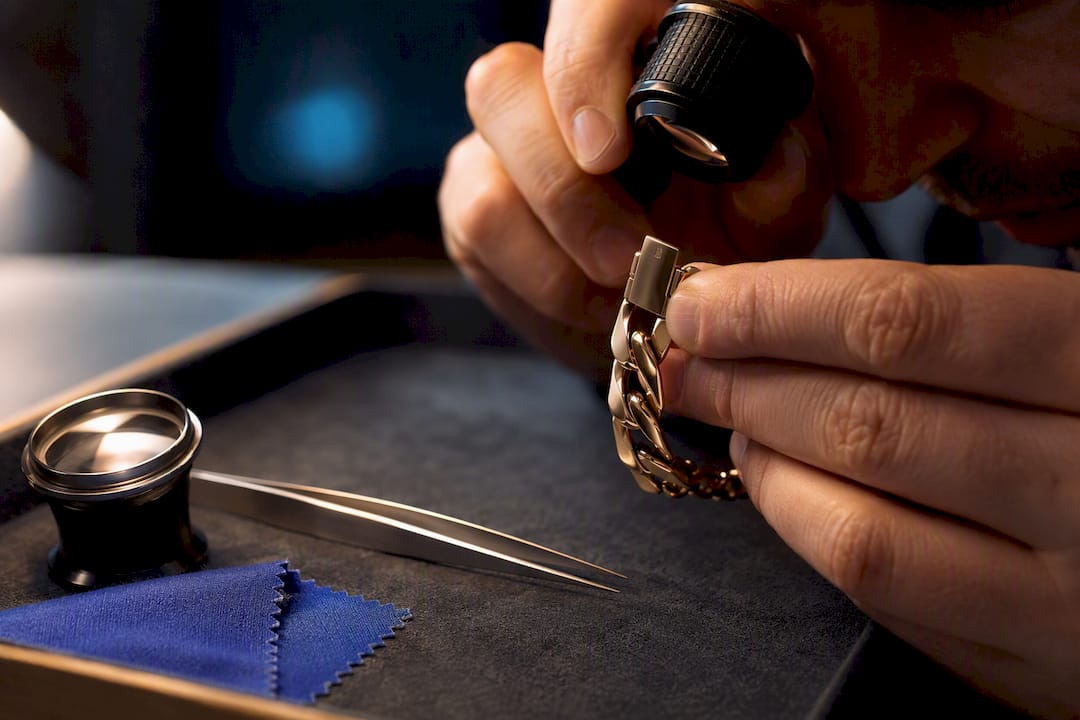
Uniformity is the first thing an experienced eye catches, every link the same shape, the same twist angle on a curb, the same roundness on a Cuban. Solder joints should be invisible or near enough, and the clasp should feel solid, not like an afterthought bolted on.
Hallmarks tell you purity and origin, but on pre-owned pieces they also confirm the bracelet hasn’t been misrepresented. Experienced jewellers authenticate and restore second-hand pieces before sale, which matters more with denser Cuban links where wear can hide inside the joints. A handmade Cuban or bespoke curb commands a premium because tighter tolerances in shaping and finishing take longer to achieve, and that extra time shows up in how the piece wears over years.
So, curb or Cuban: the short answer
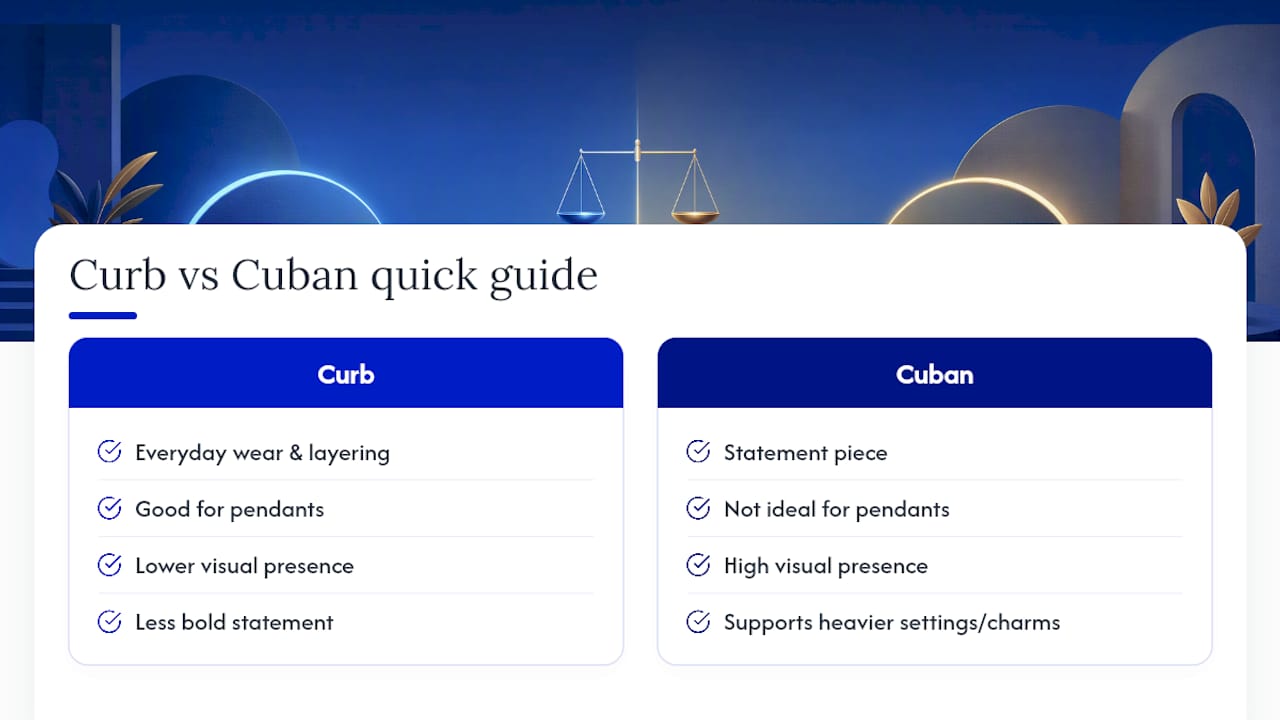
Pick curb for everyday wear, layering, and anything you’ll hang a pendant from. Pick Cuban when you want a bracelet that does the talking on its own, or when it needs to support a heavier setting or charm. Both hold up well with proper care, and the right one really depends on how much presence you want on your wrist. Try both in person if you can; the difference in hand is more obvious than any photo shows.
What I’ve noticed watching people choose between the two
Gift buyers lean curb almost every time, it reads as safe, versatile, and works whether the recipient dresses it up or down. Cuban tends to be a self-purchase, something people buy when they know exactly the look they want. Both need occasional professional attention: clasps wear, solder joints fatigue, and a proper inspection catches problems before a link actually fails.
— James
How Blackwell Jewellers can help you get it right
Whether you already know you want a curb or a Cuban, or you’re still deciding, Specialist jewellers provide services that generic online retailers can’t match: authenticated pre-owned pieces with full inspection history, bespoke commissions built to exact width and metal, and repairs teams who can service or restore existing bracelets.

If you want something no one else is wearing, the bespoke jewellery service will build a curb or Cuban bracelet to your own specification, gram weight and finish included. Prefer to buy with confidence rather than commission from scratch? Browse the second-hand collection, where every piece has been hallmark-checked and restored by an in-house jeweller before it goes on sale. And if you’ve already got a bracelet that’s lost its shine or a link that’s come loose, the jewellery repairs service can bring it back to wearable condition. Pop into one of the Kent stores or browse online to try a curb and a Cuban side by side before you decide.
Sources
- Cuban link chain — Wikipedia
- Curb chain: styles, sizes & buying guide — Goldzenn
- British Pearl Association — industry associations
FAQ
Which is better, curb link or Cuban link?
Neither is objectively better, they suit different goals. Curb suits everyday wear, layering and pendants because it lies flat and flexible, while Cuban suits statement pieces and heavier settings because of its dense, rigid construction.
Is curb the same as Cuban?
No. Curb links are flat, twisted ovals that lie sleek against the skin, while Cuban links are wider, rounded links packed tightly together for a thicker, more three-dimensional look. They share a family resemblance but behave very differently on the wrist.
Is curb the same as a Cuban link chain?
They’re related but distinct: many jewellers describe the Cuban as essentially a heavier, rounder evolution of the curb chain rather than a completely separate design. The core difference remains link shape and density.
What does a curb bracelet mean stylistically?
A curb bracelet generally signals understated, everyday jewellery, something you can wear daily, layer with other pieces, and pair with a pendant without it competing for attention. It’s the more versatile of the two styles for that reason.
Where can I see curb and Cuban bracelets side by side?
Blackwell Jewellers stocks both styles across its Kent stores and online, including the 18ct yellow gold double curb bracelet and the 9ct yellow gold Cuban bracelet, so you can compare weight and drape in person before choosing.