
Many UK buyers assume a diamond that glows under ultraviolet light is somehow flawed or suspicious. That assumption costs people money. The truth is that fluorescence is one of the most misunderstood properties in the gem world, and for those exploring pre-owned or vintage pieces, it can actually be a fascinating window into a stone’s geological past. Far from being a red flag, UV reactions reveal clues about origin, authenticity, and even hidden value. This guide unpacks the science, the grading language, and the practical steps you need to make confident, informed decisions.
Table of Contents
- Why diamonds glow under UV light
- Types of UV light and how diamonds react
- Interpreting the GIA fluorescence scale
- Fluorescence and value: myths, realities, and UK market tips
- DIY UV testing: practical steps and pitfalls
- Limits of UV testing and the importance of grading reports
- Connect with reputable jewellers for expert diamond guidance
- Frequently asked questions
Key Takeaways
| Point | Details |
|---|---|
| Fluorescence is common | Around a quarter to a third of natural diamonds glow under long-wave UV light. |
| UV tests are not definitive | Fluorescence offers clues, but cannot sole-handedly authenticate a diamond’s origin. |
| Best value found in the details | Fluorescent stones can present hidden value, especially in pre-owned markets. |
| Safety and skill matter | Proper gear and understanding UV types are vital for meaningful and safe testing. |
| Reports complete the picture | Combine grading reports with your UV findings for reliable verification. |
Why diamonds glow under UV light
When you hold a diamond under ultraviolet light and it glows, you are witnessing a process called fluorescence. It happens because of atomic impurities trapped inside the stone during its formation deep within the earth. The most common culprit is nitrogen, which forms what gemologists call luminescence centres. The most well-known of these is the N3 defect, which causes the characteristic blue glow seen in many natural stones.
“Fluorescence is not a manufacturing error or a sign of poor quality. It is a geological fingerprint, a record of the conditions under which a diamond formed over billions of years.”
Blue is by far the most common fluorescence colour, but stones can occasionally display white, yellow, or even green under UV. Crucially, 25 to 35% of natural diamonds show fluorescence under long-wave UV light, with around 95% of those glowing blue. That is a significant proportion of the natural diamond supply. When you are running diamond authenticity tests on a pre-owned piece, fluorescence is one of the first things worth checking.
Key facts about diamond fluorescence:
- Caused by trace impurities, most commonly nitrogen
- Blue is the dominant colour, seen in roughly 95% of fluorescing stones
- Fluorescence occurs in approximately a quarter to a third of all natural diamonds
- It is a geological trait, not a quality defect
- Intensity varies from faint to very strong
Types of UV light and how diamonds react
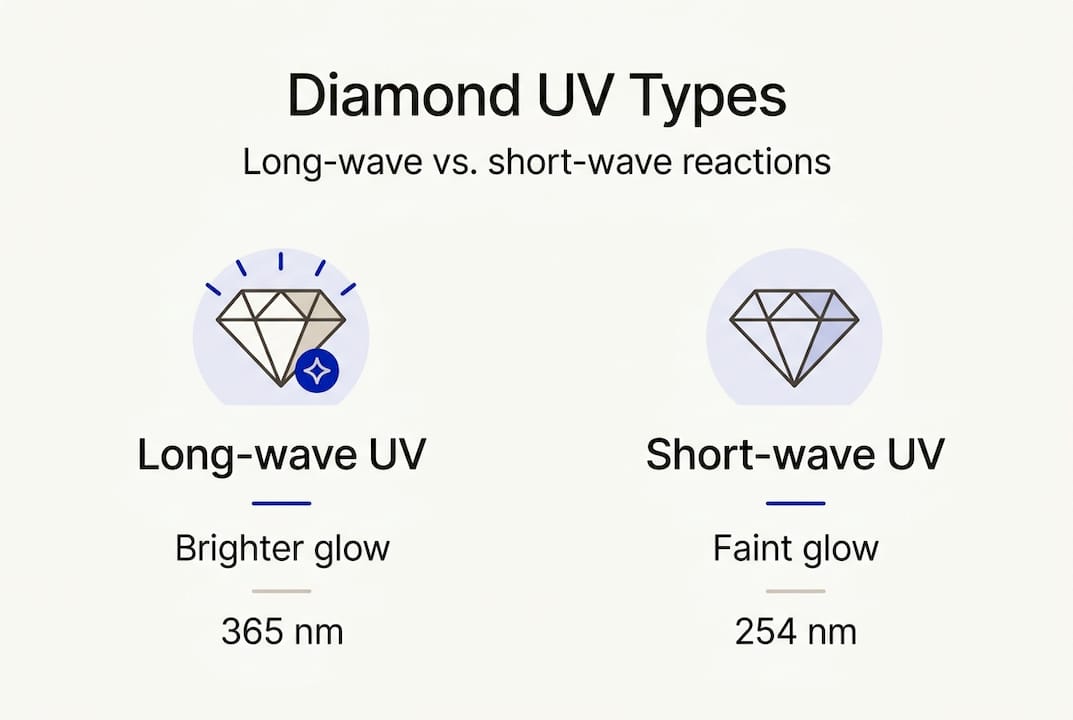
Not all UV light is the same, and the distinction matters enormously when you are trying to understand a diamond’s origins. There are two main types used in gemological testing: long-wave UV (LWUV) at around 365 nanometres, and short-wave UV (SWUV) at around 254 nanometres.
Natural diamonds tend to fluoresce more brightly under long-wave UV. Lab-grown stones, particularly those created using the HPHT (high pressure, high temperature) method, often respond more intensely under short-wave UV. There is also a phenomenon called phosphorescence, which is an afterglow that lingers once the UV source is switched off. Phosphorescence is rare in natural diamonds but is commonly seen in HPHT lab-grown stones, making it a useful secondary indicator.
| UV type | Wavelength | Natural diamonds | Lab-grown diamonds |
|---|---|---|---|
| Long-wave UV | ~365 nm | Brighter fluorescence | Weaker or absent |
| Short-wave UV | ~254 nm | Weaker fluorescence | Often brighter |
| Phosphorescence | Post-UV glow | Rare | Common in HPHT |
Using both UV types together gives a much clearer picture than relying on one alone. If you are weighing up lab-grown vs natural diamonds for a purchase, or trying to verify lab-grown diamond authenticity, UV testing is a genuinely useful first step.
Pro Tip: Always test in a completely dark environment. Even ambient light can wash out subtle fluorescence, causing you to miss important reactions that a jeweller would catch immediately.
Interpreting the GIA fluorescence scale
The Gemological Institute of America (GIA) grades diamond fluorescence on a five-step scale. Understanding this scale helps you decode grading reports and make sense of what sellers are telling you, especially in the pre-owned market where documentation varies.
The GIA fluorescence scale runs as follows: None, Faint, Medium, Strong, and Very Strong. Grading is carried out under standardised long-wave UV conditions. Fluorescence is only noted on a report if it is Medium or above, and the colour is recorded alongside the intensity.
| GIA grade | Visibility | Typical buyer impact |
|---|---|---|
| None | No reaction | Neutral, no effect |
| Faint | Barely visible | Negligible impact |
| Medium | Clearly visible | Minor effect, often positive |
| Strong | Obvious glow | Slight discount in top colours |
| Very Strong | Intense glow | Possible haze risk in D-F colours |
What this means in practice:
- A “None” or “Faint” grade has virtually no effect on appearance or price
- “Medium” fluorescence is often invisible in daylight and can actually brighten lower-colour stones
- “Strong” or “Very Strong” grades attract more scrutiny, but are rarely problematic
- Always ask for the grading report when buying pre-owned, and check the fluorescence entry specifically
For a broader understanding of how fluorescence fits into overall stone quality, our diamond cut grades explained guide and the 4 Cs complete guide are worth reading alongside this one.
Fluorescence and value: myths, realities, and UK market tips
The idea that fluorescence automatically reduces a diamond’s value is one of the most persistent myths in the gem trade. It stems from a fear of haziness, the notion that a strongly fluorescent stone will look milky or oily in daylight. In reality, haziness affects fewer than 0.2% of cases, and only in stones with very strong blue fluorescence in the top colour grades (D, E, and F).
“The market discounts fluorescent diamonds due to haze concerns that are, in most cases, significantly overstated. For buyers who understand the nuance, this creates genuine opportunity.”
For UK buyers exploring the pre-owned market, this myth creates real opportunity. Here is how to think about it:
- Stones graded I to M in colour can actually look whiter with medium to strong blue fluorescence, because the blue counteracts the yellow tint
- Fluorescent diamonds in the pre-owned market are often priced lower than non-fluorescent equivalents, despite performing identically in normal light
- Rare fluorescence colours such as yellow or green can make a stone more distinctive and collectible
- Sellers who do not understand fluorescence may undervalue a stone, creating a buying opportunity for informed collectors
Pro Tip: If you are buying a pre-owned diamond in the G to J colour range, actively look for medium blue fluorescence. You may find a stone that looks brighter in daylight for a noticeably lower price. Our complete guide to lab-grown vs natural also covers how fluorescence differs between stone types.
DIY UV testing: practical steps and pitfalls
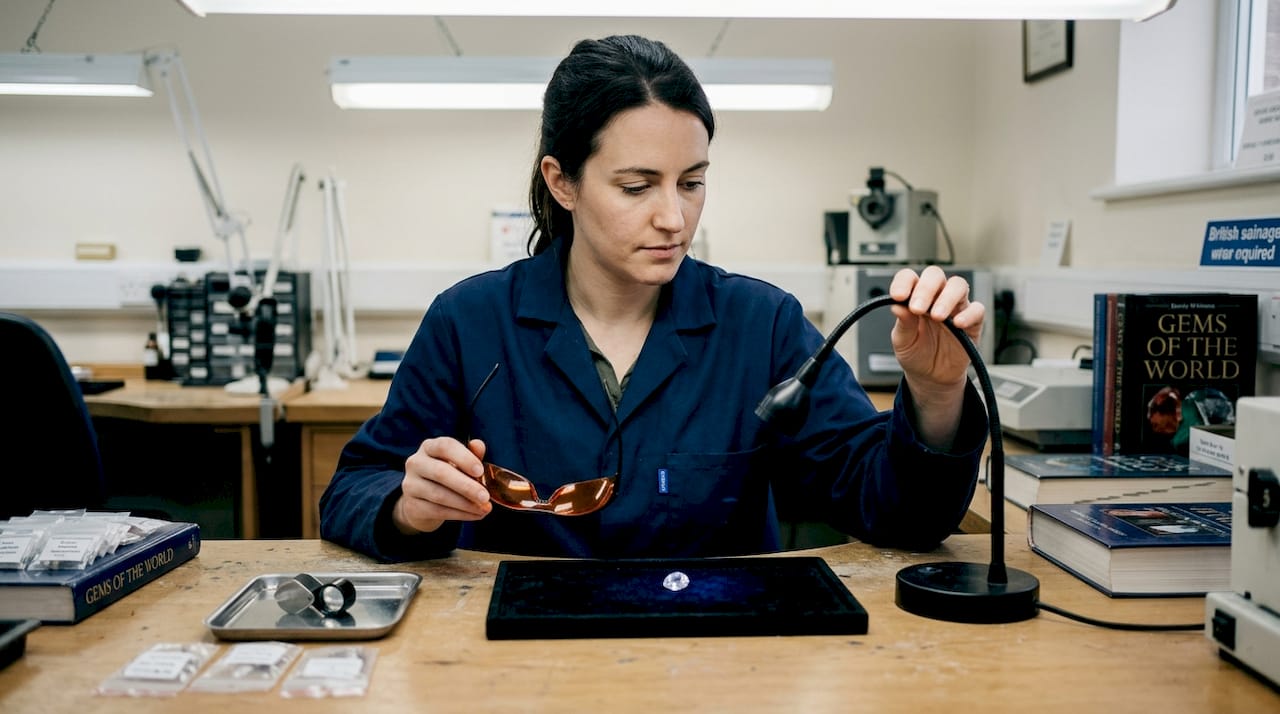
Testing a diamond’s fluorescence at home or in a shop is straightforward, but there are a few things to get right. Retailers and jewellers use DIY UV kits routinely, and you can replicate the basics with widely available equipment.
Here is a step-by-step approach:
- Source a UV torch that emits long-wave UV at around 365 nm. Short-wave UV torches are also available but require more caution
- Put on UV-protective goggles before switching on the light. Short-wave UV in particular can damage eyes quickly
- Move to a completely dark room or use a dark cabinet to eliminate ambient light interference
- Hold the diamond under the UV source and observe the colour and intensity of any glow
- Switch off the UV light and watch for phosphorescence, any lingering glow after the light is off
- Repeat with short-wave UV if available, noting whether the reaction is stronger or weaker
Common pitfalls to avoid:
- Mistaking phosphorescence for natural fluorescence and drawing the wrong conclusions
- Relying on UV testing alone without cross-referencing a grading report
- Testing in a room with residual light, which distorts results
- Assuming no fluorescence means the stone is lab-grown, as many natural diamonds show none
Deep UV below 225 nm can reveal growth patterns in diamonds, with natural stones showing complex zoning and lab-grown stones displaying more uniform patterns. This level of testing is beyond home equipment, but it illustrates why UV is such a powerful tool in professional settings. For a broader set of simple diamond tests you can try yourself, we have a dedicated guide.
Limits of UV testing and the importance of grading reports
UV testing is a genuinely useful tool, but it is not the final word on a diamond’s identity or quality. False positives and false negatives do occur. Some natural diamonds show no fluorescence at all, and some lab-grown stones can mimic natural fluorescence patterns closely enough to cause confusion.
“Fluorescence is a natural marker from geological history, not a flaw. It is a useful preliminary test for distinguishing natural from lab-grown stones, but it is not definitive on its own.”
This is why grading reports matter so much, particularly for pre-owned and vintage pieces where the provenance may be less clear. A report from a recognised laboratory such as GIA provides documented evidence of a stone’s characteristics, including its fluorescence grade, colour, clarity, and cut. No UV torch can replicate that level of certainty.
Key reasons to always combine UV testing with a grading report:
- Reports confirm characteristics with laboratory-grade equipment and trained gemologists
- They provide a permanent record that supports resale value
- They catch edge cases that DIY testing misses, such as rare natural phosphorescence mimicking lab-grown behaviour
- For high-value purchases, a report is non-negotiable
If you are still weighing up the broader question of stone origins, our guide on the truth about lab diamonds covers the full picture in plain language.
Connect with reputable jewellers for expert diamond guidance
Understanding UV reactions is genuinely empowering, but there is no substitute for holding a stone in person and having an expert walk you through what they see. At Blackwell Jewellers, our team has over 20 years of experience inspecting, authenticating, and restoring pre-owned and vintage diamond pieces across our Kent stores and online.

Every pre-owned diamond in our collection is rigorously checked, hallmarked, and verified before it reaches you. Whether you want to understand a fluorescence grade on a grading report, explore a vintage piece with unusual UV behaviour, or simply find a beautiful stone with confidence, we are here to help. Browse our pre-owned diamond collection online or visit us in Maidstone, Gravesend, or Bexleyheath for an in-person appraisal. Buying second-hand does not mean buying blind, and with the right guidance, it can be one of the smartest jewellery decisions you make.
Frequently asked questions
Does fluorescence mean a diamond is fake?
No. Fluorescence is extremely common in natural diamonds, with 25 to 35% of natural stones showing it under long-wave UV. It is a geological trait, not a sign of a fake.
Can you always tell lab-grown from natural diamonds with UV?
Not definitively. UV testing offers useful clues, such as stronger short-wave reactions and phosphorescence in lab-grown stones, but both stone types can fluoresce and expert analysis is always needed to confirm origin.
Is fluorescence bad for a diamond’s value?
Rarely. Mild to medium fluorescence has little to no effect on value, and can actually improve the appearance of lower-colour stones. Only very strong fluorescence in top colour grades carries any meaningful risk of haziness, and even then it affects fewer than 0.2% of stones.
How can I safely test a diamond’s fluorescence at home?
Use a UV torch in a completely dark room, wear protective goggles, and observe the stone under both long-wave and short-wave UV. DIY UV kits are widely used by retailers and are accessible for enthusiasts too. Always follow up with a professional grading report for any significant purchase.
Recommended
- The 4 Cs of Diamonds: The Complete 2025 Guide for UK Buyers – blackwellonline
- How to Tell if Your Diamond Is Real: 6 Simple Tests You Can Try at Hom – blackwellonline
- How to Spot Fake Silver Jewellery (UK Edition) – blackwellonline
- Colour & Clarity in Diamonds: What’s Worth Paying For? – blackwellonline