
TL;DR:
- Lab-grown diamonds are chemically and physically identical to natural diamonds, formed in laboratories.
- Verification relies on independent lab certificates and laser inscriptions, not visual appearance.
- They offer ethical, sustainable, and cost-effective alternatives to mined diamonds for UK buyers.
Walk into any jewellery shop in the UK and ask to see a lab-grown diamond alongside a mined one. Without a certificate in hand, even a trained gemologist cannot tell the difference by eye alone. For buyers who care deeply about ethical sourcing, sustainable practices, and transparent provenance, that visual ambiguity is both reassuring and slightly unsettling. This guide cuts through the confusion, explains exactly how lab-grown diamonds are created, and gives you the practical knowledge to buy with genuine confidence.
Table of Contents
- What are lab-grown diamonds?
- How lab-grown diamonds are actually made
- Lab-grown diamond grading, certification and identification
- Ethical, sustainable and practical benefits for UK jewellery buyers
- What most buyers miss about lab-grown diamond verification
- Explore sustainable diamond solutions with Blackwell Jewellers
- Frequently asked questions
Key Takeaways
| Point | Details |
|---|---|
| True diamond origins | Lab-grown diamonds are physically identical to natural ones but created in controlled environments. |
| Reliable identification | Only independent certification and report verification can distinguish lab-grown from mined diamonds. |
| Growth method basics | HPHT and CVD are the main laboratory processes for growing diamonds. |
| Ethical appeal | Lab-grown diamonds offer ethical and sustainable advantages for UK jewellery buyers. |
| Certification pitfalls | Beware of counterfeit inscriptions—always verify with reputable gem labs. |
What are lab-grown diamonds?
Lab-grown diamonds are real diamonds. That sentence deserves to stand on its own, because the single biggest misconception in the market is that they are somehow artificial substitutes, like cubic zirconia or moissanite. They are not. A lab-grown diamond shares the same chemical composition, crystal structure, and physical properties as a diamond pulled from the earth. Both are pure carbon arranged in a cubic crystal lattice. Both register a 10 on the Mohs hardness scale. Both refract light in exactly the same way.
The difference is entirely one of origin. Natural diamonds form over billions of years under extreme heat and pressure deep within the earth’s mantle. Lab-grown diamonds replicate those conditions, or use an alternative chemical process, inside a controlled laboratory environment. The result is chemically and optically identical.
For UK buyers who want to align their purchases with their values, understanding the lab-grown diamond basics is the essential starting point. Here is why they are gaining serious traction:
- No mining footprint: Lab-grown diamonds do not require open-cast mining, which can displace communities and cause significant ecological damage.
- Full traceability: Because the process is controlled from the outset, the origin story of each stone is documented.
- Identical grading: IGI diamond grading confirms that laboratory-grown origin and growth method may both be noted on the grading report, giving buyers a clear, certified record.
- No compromise on beauty: The optical fire, brilliance, and scintillation are indistinguishable from natural diamonds.
- Growing availability: UK jewellers are increasingly stocking certified lab-grown stones across all the classic cuts and carat weights.
It is worth being clear about what lab-grown diamonds are not. They are not diamond simulants. A simulant looks like a diamond but has different chemistry and different physical properties. A lab-grown diamond is a diamond in every measurable sense.
How lab-grown diamonds are actually made
This is where the science becomes genuinely fascinating, and understanding it makes you a far more informed buyer. There are two principal methods used to grow diamonds in a laboratory: HPHT (High Pressure High Temperature) and CVD (Chemical Vapour Deposition). Both produce real diamonds. Both are widely used commercially. They simply take different routes to the same destination.
The HPHT process
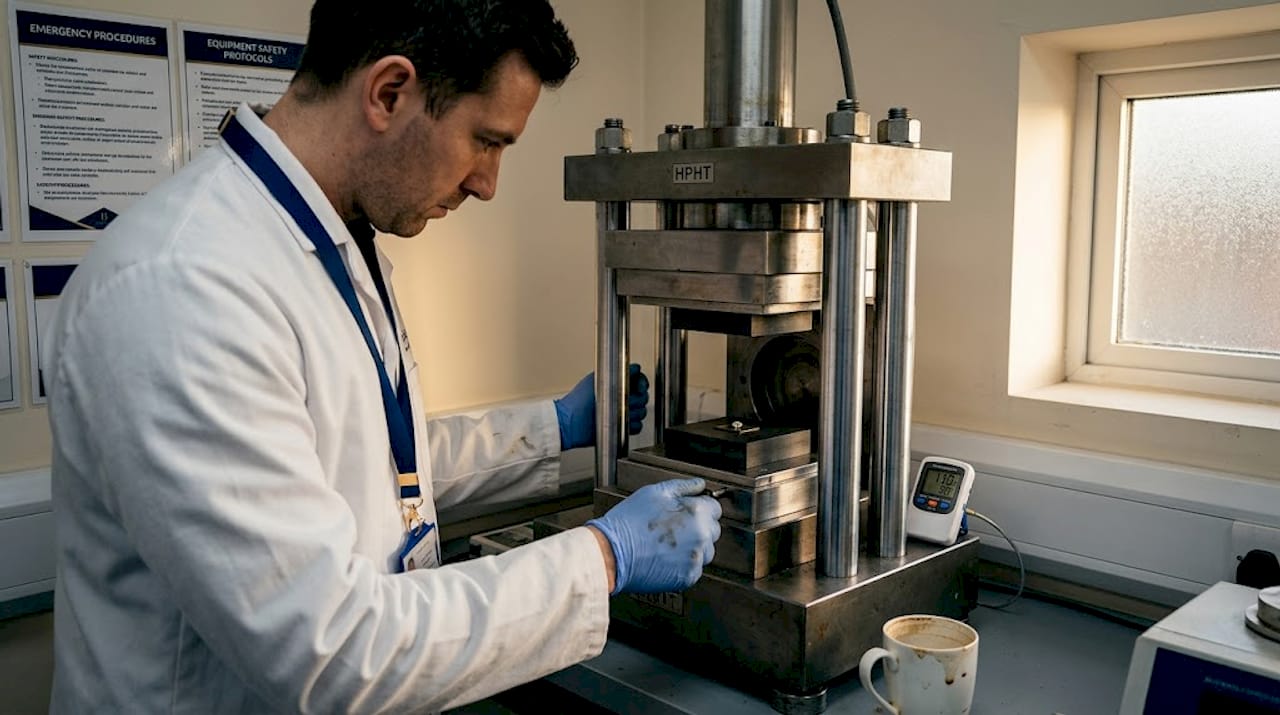
HPHT replicates the natural conditions deep within the earth. A tiny diamond crystal, called a seed, is placed inside a specialised growth chamber. The chamber subjects the seed to pressures exceeding 1.5 million pounds per square inch and temperatures above 1,400 degrees Celsius. A carbon source material, typically graphite, melts and deposits carbon atoms onto the seed. Over days or weeks, the seed grows layer by layer into a full-sized diamond crystal.
The CVD process
CVD takes a more elegant, lower-pressure approach. A diamond seed is again placed in a sealed chamber, but this time the chamber is filled with a carbon-rich gas mixture, usually methane and hydrogen. The gas is energised using microwaves or another energy source, which breaks the molecular bonds and releases pure carbon atoms. Those atoms settle onto the seed and crystallise, building the diamond layer by layer in a process that can be controlled with remarkable precision.
Here is a clear comparison of the two methods:
| Feature | HPHT | CVD |
|---|---|---|
| Pressure required | Very high (1.5 million psi+) | Low |
| Temperature | 1,400°C+ | 700°C to 1,300°C |
| Carbon source | Graphite or metal flux | Carbon-rich gas (methane) |
| Growth speed | Days to weeks | Weeks |
| Common diamond colours | Yellow, near-colourless | Colourless to near-colourless |
| Post-growth treatments | Sometimes used | Sometimes used |
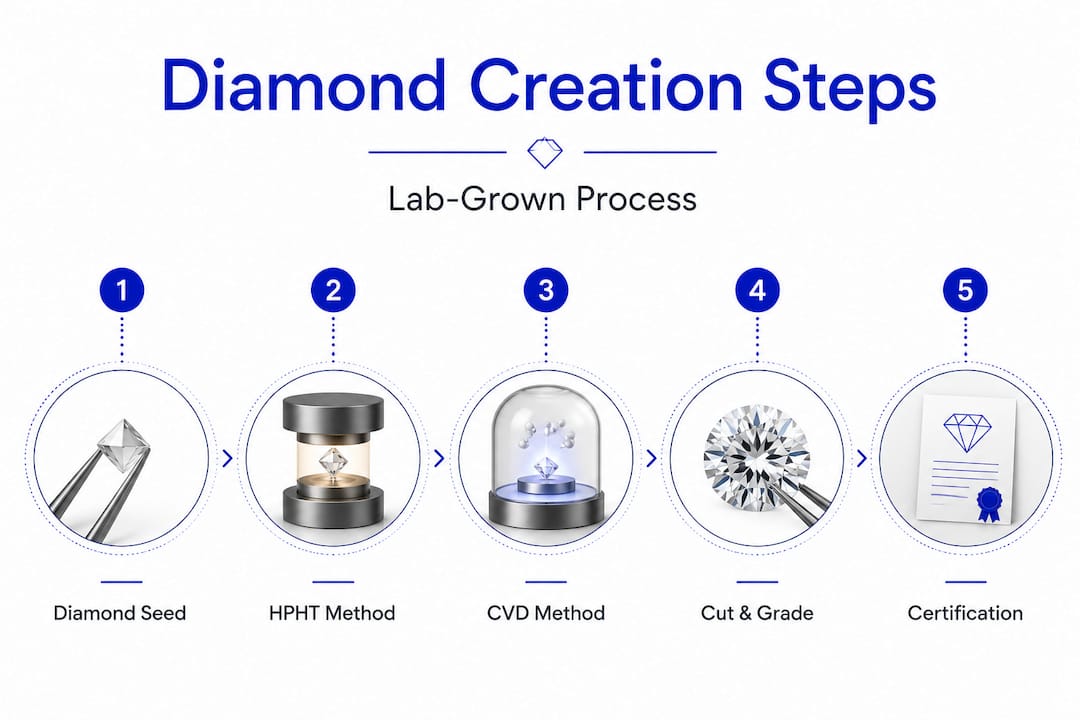
The step-by-step sequence for either method follows a broadly similar pattern:
- Seed preparation: A small, high-quality diamond seed is selected and cleaned to remove any surface contamination.
- Chamber loading: The seed is placed in the growth chamber along with the appropriate carbon source material.
- Growth phase: Heat, pressure, or energy is applied to initiate and sustain carbon deposition onto the seed.
- Controlled growth: Scientists monitor the process carefully, adjusting conditions to encourage consistent crystal formation.
- Cooling and removal: Once the diamond has reached the desired size, the chamber is slowly cooled and the rough diamond crystal is removed.
- Cutting and polishing: The rough stone is cut, shaped, and polished by skilled lapidaries, exactly as a mined rough diamond would be.
- Grading and certification: The finished stone is sent to an independent gem laboratory for grading.
For a more detailed breakdown, you can read about each step-by-step diamond creation stage, or explore the diamond types explained for differences between HPHT and CVD stones in practice.
Pro Tip: You cannot visually determine whether a lab-grown diamond was grown by HPHT or CVD. As IGI confirms, independent certification and report verification are the only reliable ways to confirm a stone’s origin and any disclosed growth or treatment details. Do not rely on appearance alone.
Lab-grown diamond grading, certification and identification
Understanding how lab-grown diamonds are made is just one part. Buyers must also know how diamonds are graded, certified, and checked for authenticity to avoid real pitfalls in the market.
Every credible lab-grown diamond should arrive with an independent gem laboratory certificate. The most respected laboratories include the IGI (International Gemological Institute) and the GIA (Gemological Institute of America). These organisations grade lab-grown diamonds across the same four key criteria used for natural stones: cut, colour, clarity, and carat weight (the famous “Four Cs”). Importantly, independent gem labs can label the stone’s laboratory-grown origin and may note the specific growth method on the grading report.
Most certified lab-grown diamonds also carry a laser inscription. This is a microscopic code etched onto the diamond’s girdle (the narrow band around its widest point) that corresponds to the certificate number. It allows buyers, jewellers, and gemologists to cross-reference the physical stone against its official documentation quickly and reliably.
Here is a practical summary of what a solid certification should include:
| Element | What to look for |
|---|---|
| Issuing laboratory | IGI, GIA, or equivalent reputable body |
| Stone origin | Explicitly stated as “laboratory-grown” |
| Growth method | HPHT or CVD (where disclosed) |
| Four Cs grading | Cut, colour, clarity, carat clearly listed |
| Laser inscription | Certificate number inscribed on the girdle |
| Report number | Verifiable on the lab’s official website |
The verification process matters enormously, and here is why. Counterfeit or fraudulent report inscriptions do exist in the market, and advanced gemological tools including spectroscopy can reveal discrepancies between a stone and its claimed documentation. This is not a theoretical risk. It is a documented one.
Practical steps every UK buyer should follow when verifying authenticity:
- Check the report number online: Both IGI and GIA provide online report verification tools. Enter the certificate number and confirm the details match the stone in front of you.
- Inspect the laser inscription: Ask the jeweller to show you the inscription under magnification. The number should match the certificate exactly.
- Question any reluctance: A reputable seller will welcome scrutiny. Reluctance to verify is a serious warning sign.
- Use an independent appraiser: For significant purchases, commissioning an independent gemological appraisal gives you an unbiased second opinion.
“The diamond’s grading and identification are typically confirmed by independent gem labs that can label laboratory-grown origin and may note the growth method on reports.” — IGI Diamond Grading Process
Pro Tip: When buying from a secondary or online marketplace, always request the original certificate rather than a photocopy. Fraudulent certificates can be convincing to the untrained eye but are detectable under proper gemological examination. Learning to identify quality diamonds before you buy protects your investment.
Ethical, sustainable and practical benefits for UK jewellery buyers
With grading and authentication covered, it is worth stepping back to consider the broader picture. Why are UK buyers increasingly drawn to lab-grown diamonds, and what tangible benefits do they actually offer?
The ethical case is compelling. Traditional diamond mining has a complicated history involving environmental destruction, significant carbon emissions, and in some regions, serious human rights concerns. Lab-grown diamonds sidestep many of these issues entirely. The production environment is controlled, the supply chain is short and documented, and there is no requirement to extract material from the earth at all.
Here are the key advantages that matter most to ethically minded buyers:
- Lower environmental impact: Lab-grown diamonds avoid the land disruption, water usage, and carbon footprint associated with open-pit mining operations.
- Clear traceability: Because production is controlled from the seed stage, provenance is documented. Lab-grown diamonds are confirmed and graded by independent labs and may be inscribed to verify origin, giving buyers a clear paper trail.
- Greater affordability: Lab-grown diamonds typically retail at significantly lower prices than comparable mined stones. For many UK buyers, this means accessing a larger, higher-quality diamond for the same budget.
- Identical beauty: There is no aesthetic trade-off. The optical performance, hardness, and durability are the same as mined diamonds.
- Ethical gifting: For milestone occasions such as engagements or anniversaries, a lab-grown diamond offers buyers the emotional weight of a genuine diamond without the ethical ambivalence.
The affordability angle deserves particular attention. A one-carat, well-cut, colourless lab-grown diamond can cost anywhere from 50 to 80 per cent less than its mined equivalent. That price difference is not a reflection of inferior quality. It reflects a shorter, more efficient production and supply chain. Before purchasing, it is worth reading an honest assessment of lab-grown diamond value to understand long-term considerations including resale market dynamics.
Pro Tip: If you are considering a lab-grown diamond for an engagement ring, prioritise the cut grade above all else. Cut determines how light moves through the stone and is responsible for the brilliance that makes a diamond captivating. A well-cut lab-grown diamond will outshine a poorly cut natural diamond every time.
The sustainable jewellery movement in the UK is growing steadily. More buyers are asking harder questions about where their jewellery comes from, and suppliers are responding. Lab-grown diamonds are not a passing trend. They represent a structural shift in how consumers think about luxury purchases.
What most buyers miss about lab-grown diamond verification
Here is a perspective that most articles on this subject do not quite land on: the confidence trap.
When buyers learn that lab-grown and natural diamonds are visually identical, many feel reassured. The logic goes, “if it looks like a diamond and tests like a diamond, I can trust it.” But that reasoning, while understandable, is where mistakes happen. Visual inspection tells you almost nothing useful about a diamond’s origin, growth method, or whether its documentation is legitimate. As IGI confirms, you genuinely cannot tell HPHT from CVD by eye, and you certainly cannot spot a fraudulent inscription without proper equipment.
The uncomfortable truth is that even experienced jewellery buyers sometimes let their guard down at the verification stage. They might accept a certificate without cross-checking it online. They might not ask to see the laser inscription under magnification. They might purchase from a source that presents documentation confidently, but that confidence is not evidence of legitimacy.
Independent certification is not a formality. It is the entire foundation of a trustworthy lab-grown diamond purchase. The report verification steps exist precisely because sophisticated counterfeiting does occur, and the only effective defence is methodical verification against the issuing laboratory’s own records.
Our view, shaped by over two decades working with UK jewellery buyers, is simple. Never let enthusiasm for a stone override the discipline of verification. The certificate is not the finish line. Checking the certificate against the lab’s online database, confirming the inscription, and asking direct questions about provenance: those are the finish line. Buyers who treat verification as a checklist item rather than a genuine safeguard are the ones who occasionally regret it.
Explore sustainable diamond solutions with Blackwell Jewellers
Now that you have practical knowledge and an expert perspective, your next step can be a confident one.
At Blackwell Jewellers, we have spent over 20 years helping UK buyers make genuinely informed jewellery choices. We understand that ethical sourcing, transparent provenance, and verified quality are not optional extras for today’s buyer. They are the baseline.

Whether you are interested in a certified lab-grown diamond for a bespoke commission, exploring our bespoke jewellery options for a truly unique piece, or considering our carefully authenticated ethical second-hand jewellery as a sustainable alternative, our team is here to guide you without pressure. We also offer a professional jewellery repairs service for pieces that deserve a second life. Visit us in Kent or browse our national online platform to explore what responsible jewellery buying looks like in practice.
Frequently asked questions
Can you tell lab-grown diamonds from natural diamonds by eye?
No, lab-grown and natural diamonds are virtually identical visually. Reliable identification requires independent certification and report verification, not visual inspection.
What are the main methods for making lab-grown diamonds?
The two main methods are HPHT (High Pressure High Temperature) and CVD (Chemical Vapour Deposition). Both produce diamonds with properties identical to natural stones, and as IGI notes, neither method can be identified reliably by eye.
How can buyers verify the authenticity of a lab-grown diamond?
Authenticity is best confirmed through independent gem lab certification and by checking that the laser inscription on the stone matches the report number, as independent gem labs label laboratory-grown origin directly on their reports.
Are lab-grown diamond certifications ever counterfeit?
Yes. Documented cases of fraudulent report inscriptions exist, but advanced gemological tools and spectroscopy can reveal such discrepancies, which is why buying from reputable, transparent sellers matters enormously.
Are lab-grown diamonds considered ethical and sustainable?
Lab-grown diamonds offer measurably reduced environmental impact and far greater supply chain transparency. They are confirmed and graded by independent laboratories and inscribed for origin verification, making them a well-supported ethical choice for UK buyers.
Recommended
- How are Lab-Grown Diamonds Made? Understanding the Diamond Creation Pr – blackwellonline
- How Lab-Grown Diamonds Are Made: A Step-by-Step Guide – blackwellonline
- Lab Grown Diamonds vs Natural: Your Complete Guide to Making an Inform – blackwellonline
- Lab-Grown Diamonds vs Mined: The Complete 2025 Guide – blackwellonline