

Upgrading jewellery demands careful navigation through authentication, hallmarking standards and trusted craftsmanship to protect both investment and integrity. Many UK jewellery owners risk losses by skipping essential verification steps or choosing unqualified jewellers. This guide walks you through a proven six-step process to upgrade your pieces confidently whilst maintaining legal compliance, authenticity and long-term value.
Table of Contents
- Prerequisites: What You Need Before Upgrading Jewellery
- Step 1: Authenticate And Inspect Your Jewellery
- Step 2: Choose Safe Materials And Upgrade Techniques
- Step 3: Select Reputable Jewellers And Verify Credentials
- Step 4: Understand The Upgrade Process Timeline And Costs
- Step 5: Troubleshooting Common Mistakes And Failures
- Step 6: Expected Results, Warranty, And Quality Benchmarks
Key takeaways
| Point | Details |
|---|---|
| Authentication prevents costly mistakes | Verify UK hallmarks and provenance before any upgrade work begins to avoid counterfeits |
| Hallmarked metals are legally required | All upgraded precious metal pieces must bear official UK hallmarks certifying purity |
| Reputable jewellers reduce risk | Choose accredited jewellers with verified credentials and transparent guarantees |
| Timelines span 4-6 weeks | Bespoke upgrades require patience through consultation, sourcing, crafting and hallmarking stages |
| Common errors cause 30% of failures | Improper cleaning, metal incompatibility and rushed workmanship damage jewellery integrity |
Prerequisites: what you need before upgrading jewellery
Before you commit to upgrading any piece, you must understand the foundational standards that govern UK jewellery work. UK hallmarking laws and metal purity requirements create legal benchmarks every upgraded piece must meet. Without this knowledge, you cannot identify compliant work or spot shortcuts that compromise value.
Authentication becomes critical when upgrading pre-owned or inherited pieces. You need documented proof of metal content, gemstone authenticity and structural condition before any jeweller begins work. This prevents expensive upgrades to worthless counterfeits or severely damaged items that cannot be salvaged.
Gather complete condition reports and ownership documentation. Professional assessments identify hidden damage, previous repairs or structural weaknesses that affect upgrade feasibility. These reports also establish baseline quality, protecting you if disputes arise about workmanship later.
Understand basic metal compatibility. Mixing certain metals during bespoke upgrades causes corrosion, discolouration or structural failure. Gold alloys, silver grades and platinum each require specific soldering techniques and complementary materials. Your jeweller should explain these technical requirements clearly.
Select jewellers with verified credentials before you share your pieces. Look for:
- Accreditation by UK assay offices or recognised trade bodies
- Transparent guarantees covering workmanship and authenticity
- Physical premises with established trading history
- Clear communication about timelines, costs and processes
- Customer testimonials and independently verified reviews
Pro Tip: Request certification copies of your jeweller’s qualifications and insurance coverage before handing over valuable pieces for upgrade work.
Step 1: authenticate and inspect your jewellery
Verifying authenticity protects you from upgrading worthless fakes or heavily damaged pieces that masquerade as salvageable. Start by examining hallmarks using a jeweller’s loupe under strong natural light. Authentic UK hallmarks appear crisp with consistent depth and spacing. Blurred, uneven or missing marks signal potential counterfeits.
Professional authentication services and hallmark verification reduce risks by using specialised equipment to test metal purity and gemstone authenticity. These services cost between £30 and £80 but prevent thousands in losses from upgrading fake pieces. Independent authentication also provides documentation for insurance and resale purposes.
Inspect structural integrity carefully. Look for:
- Cracks, splits or stress fractures in metal
- Loose settings or missing stones
- Previous repairs showing solder marks or mismatched metals
- Worn prong tips or thinned shanks
- Discolouration indicating metal degradation
Pre-owned jewellery requires extra scrutiny. Missing hallmarks, vague provenance or seller reluctance to provide documentation all raise red flags. Spotting fake silver jewellery demands specific techniques like magnetic testing and acid analysis that only qualified professionals perform safely.
Collect all available provenance documents including original receipts, certificates of authenticity, previous appraisals and ownership records. These papers validate your piece’s history and prove legal ownership, essential requirements before reputable jewellers accept upgrade commissions.
Document current condition with clear photographs from multiple angles. Capture close-ups of hallmarks, any damage and distinctive features. These images create an evidence trail if disputes about pre-existing damage arise during the upgrade process.

Step 2: choose safe materials and upgrade techniques
Selecting proper materials determines whether your upgrade enhances value or destroys it. Every precious metal component must bear UK hallmarking standards certification proving legal purity thresholds: 375, 585 or 750 for gold; 800 or 925 for silver; 950 for platinum. Uncertified metals cannot be legally sold as precious metal jewellery in the UK.
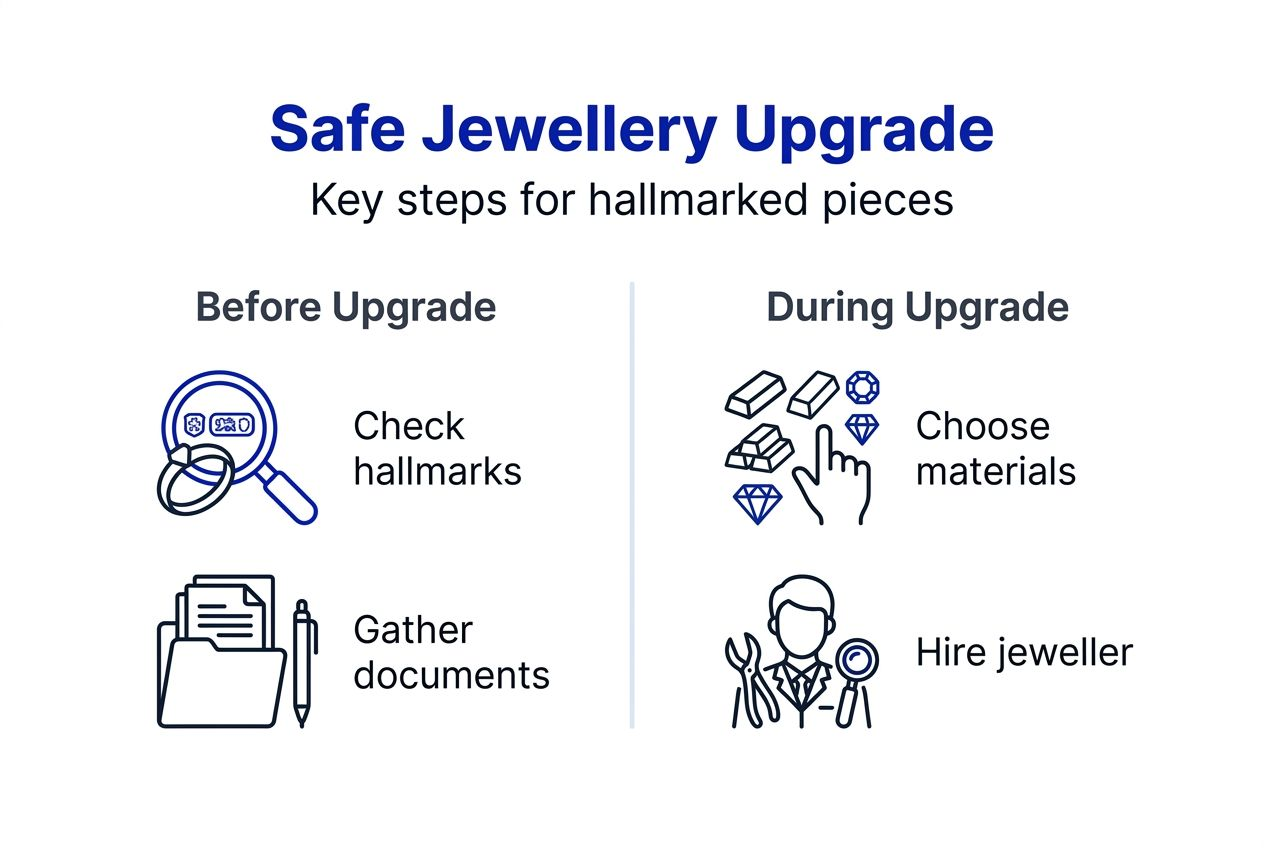
Prioritise recycled and ethically sourced precious metals. These materials meet the same purity standards whilst reducing environmental impact and supporting responsible supply chains. Reputable jewellers provide certification proving metal origin and ethical credentials.
Avoid aggressive cleaning before upgrades. Harsh chemicals, ultrasonic cleaners or abrasive polishing strips protective patinas and can weaken already fragile structures. Professional jewellers assess pieces in their current state, then apply appropriate cleaning as part of the upgrade process.
Check metal compatibility rigorously:
- Yellow gold requires yellow gold solder
- White gold needs rhodium plating after soldering
- Platinum and white gold can be paired but need specific techniques
- Silver and gold combinations require careful design to prevent galvanic corrosion
- Mixed karat golds create visible colour differences
Choose upgrade techniques that preserve structural integrity. Cold joining methods like rivets or screws work better than heat-based soldering for delicate antique pieces. Laser welding offers precision for complex repairs without damaging surrounding areas.
Pro Tip: Request material certification documents for every new component added during your upgrade, creating a complete authenticity trail for future resale or insurance claims.
Step 3: select reputable jewellers and verify credentials
Your jeweller choice determines upgrade success more than any other factor. Start by identifying businesses accredited by UK assay offices or professional bodies like the National Association of Jewellers. These credentials prove adherence to legal standards and ethical business practices.
Check customer reviews across multiple independent platforms. Look beyond star ratings to read detailed feedback about workmanship quality, timeline reliability and dispute resolution. Reviews mentioning hallmarking compliance, transparent pricing and excellent communication indicate trustworthy operators.
Understand guarantee structures thoroughly. Industry-standard warranties typically cover:
- Metal purity and hallmark authenticity for 5 years minimum
- Workmanship defects for 12-24 months
- Stone security for 6-12 months after setting work
- Structural integrity against normal wear
Negotiate clear terms before work begins. Your contract should specify exact timelines, itemised costs, materials to be used, quality benchmarks and cancellation policies. Vague agreements create disputes when expectations clash with reality.
Avoid jewellers who cannot provide transparent provenance for their materials or refuse to explain their processes. Legitimate businesses welcome questions and provide detailed answers about sourcing, techniques and quality controls.
Consider jewellery repairs in Kent specialists who combine traditional craftsmanship with modern techniques. Established local jewellers maintain reputations through consistent quality and face-to-face accountability that online-only operators cannot match.
Verify what makes good engagement ring qualities translates to all jewellery upgrades: hallmarked metals, secure settings, proportional design and guaranteed workmanship. Understanding common jewellery repair mistakes helps you ask informed questions that reveal jeweller competence.
Step 4: understand the upgrade process timeline and costs
Bespoke jewellery upgrades typically require 4 to 6 weeks from initial consultation to final delivery. Rushing this timeline compromises quality and increases error risks. Understanding each stage helps you set realistic expectations and identify potential delays early.
The process unfolds in distinct phases:
- Initial consultation and design agreement (3-5 days)
- Material sourcing and hallmark verification (7-10 days)
- Crafting and structural work (10-14 days)
- Quality inspection and adjustments (3-5 days)
- Final hallmarking and certification (5-7 days)
- Collection and documentation handover (1 day)
Costs vary significantly based on materials, complexity and jeweller expertise. Use this table to estimate budget requirements:
| Upgrade Type | Materials Cost | Labour Cost | Hallmarking Fee | Total Range |
|---|---|---|---|---|
| Simple ring resize | £20-40 | £40-80 | £15-25 | £75-145 |
| Stone setting addition | £80-200 | £120-250 | £20-30 | £220-480 |
| Complete redesign | £300-800 | £250-600 | £25-40 | £575-1440 |
| Complex restoration | £400-1200 | £350-900 | £30-50 | £780-2150 |
Budget for unexpected repairs or adjustments. Detailed inspections often reveal hidden damage requiring additional work. Reputable jewellers contact you before proceeding with extra charges, whilst poor operators simply bill for surprise costs.
Upfront cost transparency separates professional jewellers from opportunistic ones. Detailed quotes should itemise materials, labour hours, hallmarking fees and any contingency allowances. Vague estimates or reluctance to provide written breakdowns signal potential billing disputes.
Learn how bespoke jewellery design works to understand why quality upgrades take time. The custom jewellery design guide explains industry-standard processes that protect your investment.
Pro Tip: Request progress photographs at each stage to verify work quality and ensure your design vision translates accurately into the physical piece.
Step 5: troubleshooting common mistakes and failures
Improper cleaning before upgrades causes nearly 30% of jewellery upgrade failures. Aggressive chemical treatments weaken metal structures, whilst abrasive polishing removes protective layers and thins already delicate components. Always consult your jeweller before attempting any cleaning.
Metal incompatibility creates permanent damage. Mixing incompatible alloys causes:
- Galvanic corrosion between dissimilar metals
- Brittle solder joints that crack under stress
- Colour bleeding as metals react chemically
- Structural deformation during heating processes
Rushing workmanship produces poor structural fixes that fail prematurely. Inadequate annealing leaves metals brittle. Insufficient solder creates weak joints. Improper stone setting risks gem loss. Quality craftsmanship cannot be hurried without sacrificing durability.
If damage occurs during upgrades, immediately request professional assessment. Document the damage photographically and in writing. Reputable jewellers carry insurance covering work-related damage and will either repair issues at no charge or provide fair compensation.
Avoid these critical errors:
- Choosing jewellers based solely on lowest price quotes
- Proceeding without written contracts specifying all terms
- Accepting verbal promises instead of documented guarantees
- Skipping authentication on pre-owned pieces before upgrade work
- Ignoring red flags like vague timelines or unclear pricing
Understand what mistakes damage your jewellery to prevent them during upgrades. Learn why jewellery breaks and how proper upgrade techniques prevent recurrence. Review common jewellery repair mistakes that compromise structural integrity and value.
Step 6: expected results, warranty, and quality benchmarks
Successful upgrades produce jewellery bearing official UK hallmarks certifying metal purity and legal compliance. Every precious metal component over minimum weight thresholds must display sponsor’s mark, fineness mark, assay office mark and date letter. Missing or unclear hallmarks indicate substandard work or non-compliant materials.
Industry-standard warranties typically cover 5 years on authenticity and metal purity, with shorter periods for workmanship details. Your documentation should specify exactly what protections apply and under what circumstances. Lifetime guarantees on hallmark authenticity demonstrate jeweller confidence in material sourcing.
Visual and structural quality benchmarks ensure long-term durability:
| Quality Aspect | Acceptable Standard | Warning Signs |
|---|---|---|
| Solder joints | Invisible seams, colour-matched | Visible lines, discolouration |
| Stone settings | Secure prongs, even height | Loose stones, bent prongs |
| Surface finish | Uniform polish, no scratches | Uneven texture, tool marks |
| Hallmarks | Clear, correctly positioned | Blurred, missing, misaligned |
| Structural integrity | Smooth movement, no flex | Catches, wobbles, weak points |
Certification paperwork must accompany your upgraded piece including material certificates, hallmark registration, warranty terms and detailed work records. These documents prove authenticity for insurance purposes and enhance resale value by demonstrating professional provenance.
Resale value typically increases by 15 to 18 per cent following professional upgrades that improve aesthetics whilst maintaining authenticity. Higher-quality materials, superior craftsmanship and comprehensive documentation all command premium prices in secondary markets. Poorly executed upgrades or missing paperwork diminish value regardless of material quality.
Discover trusted jewellers and bespoke pieces at Blackwell Jewellers
Upgrading jewellery safely requires expertise, transparency and proven craftsmanship that Blackwell Jewellers delivers through over 20 years of established UK trading. Every piece undergoes rigorous authentication and hallmark verification before reaching you, whilst bespoke upgrade services combine traditional techniques with modern precision.

Explore unique authenticated pieces like this 9ct yellow gold cubic zirconia fish brooch or commission custom upgrades through experienced jewellery repairs in Kent specialists. Transparent guarantees, skilled craftsmanship and comprehensive documentation protect your investment throughout the upgrade journey. Visit Blackwell Jewellers to begin your safe jewellery upgrade today.
How to upgrade jewellery safely: frequently asked questions
How do I interpret UK hallmarks on upgraded jewellery?
UK hallmarks contain four compulsory marks: the sponsor’s mark identifying the maker, fineness mark showing metal purity, assay office mark proving independent testing, and date letter indicating year of hallmarking. Use a jeweller’s loupe to verify all marks appear crisp and consistent. Any blurred or missing marks indicate non-compliant work requiring immediate professional assessment.
What timeline should I expect for bespoke jewellery upgrades?
Professional bespoke upgrades typically require 4 to 6 weeks covering consultation, material sourcing, crafting, quality inspection and hallmarking stages. Complex restorations or custom designs may extend to 8 weeks. Jewellers promising completion in under 3 weeks often rush critical processes, compromising structural integrity and finish quality.
How should I care for jewellery immediately after upgrades?
Avoid wearing newly upgraded pieces for 48 hours to allow settings and solder joints to fully stabilise. Remove jewellery before swimming, bathing or exercising to prevent chemical exposure and physical stress. Store pieces separately in soft pouches to prevent scratching. Professional cleaning every 6 months maintains appearance without risking DIY damage.
What credentials verify a jeweller’s qualifications for upgrade work?
Look for accreditation by UK assay offices, membership in the National Association of Jewellers, or qualifications from the Gemmological Association. Physical premises with established trading history provide accountability that online-only operators lack. Request copies of professional indemnity insurance and business registration documents before committing valuable pieces.
Do upgrade warranties cover all potential damage?
Standard warranties cover defects in materials and workmanship but exclude damage from accidents, improper care or normal wear. Read warranty terms carefully to understand exactly what protections apply and for how long. Lifetime authenticity guarantees on hallmarks demonstrate jeweller confidence, whilst short workmanship warranties may signal quality concerns.