
TL;DR:
- Lab-grown diamonds are chemically and physically identical to natural diamonds, but cost significantly less and have lower resale value. The main difference in formation is that natural diamonds take billions of years, while lab-grown diamonds develop in weeks using HPHT or CVD methods. Ethical and environmental considerations depend on production details and certification, not the type of diamond itself.
Lab-grown diamonds are chemically and physically identical to natural diamonds. That is not marketing spin. That is the position of the Gemological Institute of America (GIA), the International Gemological Institute (IGI), and the US Federal Trade Commission (FTC). The debate around lab-grown vs natural diamonds is not really about which one is “real.” Both are real. The debate is about origin, price, resale value, and what matters to you personally. A 1-carat natural diamond costs between £3,000 and £6,000 in the UK market. A lab-grown equivalent of the same quality sits closer to £600 to £900. That gap alone is why this conversation is worth having properly.
How do lab-grown and natural diamonds differ in formation?
Natural diamonds form roughly 100 miles beneath the Earth’s surface, under extreme heat and pressure, over periods spanning one to three billion years. Volcanic activity then forces them upward through kimberlite pipes, where they are eventually mined. The whole process is, frankly, absurd in its timescale. You are wearing something older than most life on Earth.
Lab-grown diamonds take a slightly different route. Production takes roughly two weeks for a standard 1-carat stone. Two weeks versus three billion years. That difference in origin is the only fundamental distinction between the two types.
There are two main production methods used in laboratory settings:
- HPHT (High Pressure High Temperature): Mimics the conditions of the Earth’s mantle by applying intense pressure and heat to a carbon source. The result is a crystal that grows in a similar pattern to natural formation.
- CVD (Chemical Vapour Deposition): Places a diamond seed in a vacuum chamber and deposits carbon atoms layer by layer. It sounds like science fiction, but it produces gem-quality stones consistently.
One technical difference worth knowing: natural diamonds often contain nitrogen impurities absorbed during their billion-year formation. Lab-grown diamonds, particularly CVD stones, typically lack these impurities. Specialised spectroscopic equipment detects this difference, but a standard jeweller’s loupe will not. Neither will your eyes.
Pro Tip: If you want to understand the full step-by-step manufacturing process behind lab-grown stones, Blackwelljewellers has a detailed guide on how lab-grown diamonds are made that breaks it down without the jargon.
Are lab-grown diamonds visually the same as natural diamonds?
Short answer: yes, to virtually everyone who looks at them. Lab-grown and natural diamonds share identical 4Cs grading standards across cut, colour, clarity, and carat weight. A GIA-graded lab-grown diamond and a GIA-graded natural diamond of the same specifications will look identical to each other in a ring setting.
Here is how the grading process compares across both types:
- Cut: Assessed identically. Both types are cut and polished by the same craftspeople using the same techniques.
- Colour: Graded on the same D-to-Z scale. Lab-grown stones can sometimes achieve higher colour grades more consistently due to controlled growth conditions.
- Clarity: Graded on the same FL-to-I3 scale. Lab-grown diamonds can have different inclusion types (metallic flux inclusions in HPHT, for example), but these are internal and invisible to the naked eye.
- Carat: Measured identically by weight.
| Feature | Lab-grown diamond | Natural diamond |
|---|---|---|
| Chemical composition | Pure carbon (same) | Pure carbon (same) |
| Hardness (Mohs scale) | 10 | 10 |
| 4Cs grading | Yes, GIA and IGI certified | Yes, GIA and IGI certified |
| Visual difference (naked eye) | None | None |
| Expert differentiation | Possible with spectroscopy | N/A |
Some lab-grown stones receive post-growth treatments to improve colour or clarity. This is not unique to lab-grown diamonds. Natural diamonds are treated too. The key is disclosure, which is why certification matters so much.
How do lab-grown and natural diamonds compare on price and resale value?
This is where things get genuinely interesting, and where most buyers make or break their decision.

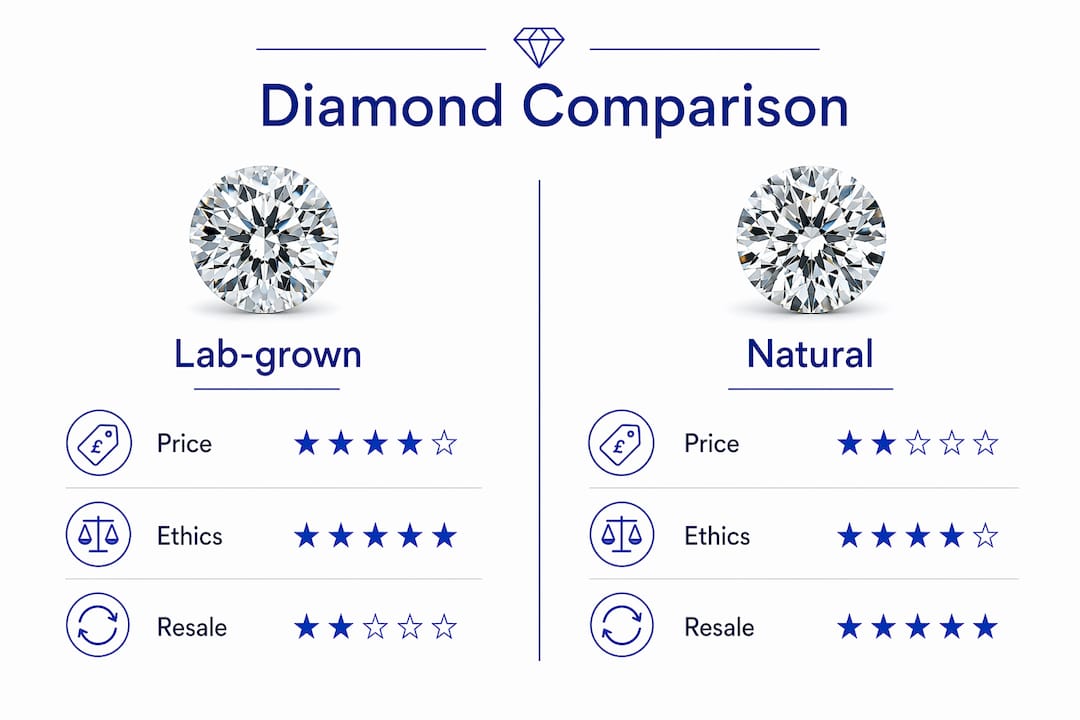
Lab-grown diamonds cost 70 to 80% less than natural diamonds of equivalent quality. A 1-carat natural diamond runs between £3,000 and £6,000 in the UK. The lab-grown equivalent sits at £600 to £900. That is not a small saving. That is the difference between a half-carat natural stone and a full 2-carat lab-grown stone for the same budget.
| Diamond type | 1-carat approximate cost (UK) | Resale value retention |
|---|---|---|
| Natural diamond | £3,000 to £6,000 | 25% to 50% |
| Lab-grown diamond | £600 to £900 | 5% to 20% |
Natural diamonds retain 25% to 50% of their resale value, while lab-grown diamonds retain between 5% and 20% as of 2026. That gap exists because natural diamonds are finite. Lab-grown supply increases with demand, which pushes prices down over time. If you bought a lab-grown diamond two years ago, it is worth less today simply because production has scaled up.
One thing buyers often overlook: setting and craftsmanship costs are nearly identical regardless of which stone you choose. A platinum solitaire setting costs the same whether the centre stone is lab-grown or mined. So the total price difference between a finished lab-grown ring and a natural diamond ring is smaller than the stone price difference suggests. Still significant, but worth factoring in accurately.
Pro Tip: If budget is your primary driver, Blackwelljewellers has a clear breakdown of lab-grown diamond costs that helps you understand exactly where the savings land.
The Jewellery Association of Australia describes lab-grown diamonds as fashion-forward choices rather than investment stones. That framing is useful. If you want size, brilliance, and quality at a lower spend, lab-grown wins. If you want a stone that holds value over decades, natural is the stronger choice.
What ethical and environmental factors should you consider?
The ethical argument for lab-grown diamonds sounds straightforward: no mining, no conflict stones, no environmental destruction. The reality is more nuanced than that.
Natural diamonds carry a complicated history. The Kimberley Process, introduced in 2003, was designed to eliminate conflict diamonds from the supply chain. It has improved things significantly, but ethical and environmental factors still vary and both types require consumer vigilance. Some mining operations support local economies in countries like Botswana and Namibia, where the diamond industry funds schools, hospitals, and infrastructure. The picture is not all negative.
Lab-grown diamonds avoid mining entirely. That is a genuine benefit. But the energy required to run HPHT or CVD facilities is substantial, and many labs in China and India still rely on fossil fuels for their power. A lab-grown diamond produced using coal-powered electricity in Surat is not necessarily the green choice it appears to be.
Here is what to actually ask before buying either type:
- For natural diamonds: request a Kimberley Process certificate and ask about the country of origin.
- For lab-grown diamonds: ask where the stone was produced and what energy source the facility uses.
- For both: request a full grading report from GIA or IGI, not just a seller’s verbal assurance.
- Consider pre-owned natural diamonds as a genuinely low-impact option. No new mining. No new energy-intensive production.
The honest answer is that neither type is automatically the ethical choice. It depends entirely on the specific stone, the specific producer, and the specific retailer you buy from.
How do you verify authenticity and certification for either type?
The FTC legally recognises lab-grown diamonds as genuine diamonds sharing the same chemical and physical properties as mined stones. The FTC removed the word “natural” from its legal definition of a diamond in 2018. So when someone tells you lab-grown diamonds are “fake,” they are contradicting US federal law. That is a fairly strong counter-argument.
Verification comes down to documentation and inscription. Many labs laser-inscribe lab-grown diamonds with a serial number on the girdle of the stone. This number links to the grading report and confirms the stone’s origin. You need a loupe or microscope to read it, but it is there.
What to look for when buying:
- A full grading report from GIA, IGI, or another recognised body (not an in-house certificate from the retailer)
- Laser inscription on the girdle, particularly for lab-grown stones
- Clear disclosure of whether the stone is natural or lab-grown, in writing
- Country of origin for natural diamonds, and production method for lab-grown stones
Blackwelljewellers has a dedicated guide on verifying lab-grown diamond authenticity if you want to go deeper on this before making a purchase.
Key takeaways
Lab-grown diamonds are chemically identical to natural diamonds but cost 70 to 80% less, retain significantly less resale value, and carry different ethical and environmental considerations that depend on production practices rather than type alone.
| Point | Details |
|---|---|
| Both types are real diamonds | GIA, IGI, and the FTC all confirm lab-grown diamonds share identical chemical and physical properties with natural stones. |
| Price gap is substantial | Lab-grown diamonds cost 70 to 80% less per carat, but setting costs remain the same for both types. |
| Resale value differs sharply | Natural diamonds retain 25 to 50% resale value; lab-grown stones retain just 5 to 20% due to increasing supply. |
| Ethics require scrutiny either way | Neither type is automatically the ethical choice. Ask for origin documentation and energy source information before buying. |
| Certification is non-negotiable | Always request a GIA or IGI grading report with laser inscription confirmation, regardless of which type you choose. |
James’s take: the question nobody actually asks
Here is the thing nobody tells you when you walk into a jewellery shop. The question is not “lab-grown or natural?” The real question is “what does this stone mean to you, and what do you want it to mean in 30 years?”
I have spoken to buyers who spent £8,000 on a natural diamond because they wanted something their grandchildren could inherit. I have spoken to others who spent £900 on a lab-grown stone and used the remaining budget for the honeymoon. Both decisions were completely right for those people.
What frustrates me is the snobbery that still exists in parts of the industry around lab-grown stones. The science is settled. They are real diamonds. The choice depends on individual values around rarity, heirloom potential, budget, and symbolism. None of those values is wrong.
What is wrong is buying either type without proper certification, without understanding the resale implications, and without asking where the stone actually came from. Informed buying is not complicated. It just requires a retailer who is willing to be straight with you, which, in my experience, narrows the field considerably.
— James
Find your perfect diamond with Blackwelljewellers
Whether you are drawn to the rarity of a natural stone or the value of a lab-grown diamond, Blackwelljewellers can help you make the right call with confidence.

The team at Blackwelljewellers has over 20 years of experience across stores in Maidstone, Gravesend, and Bexleyheath, and every diamond piece, whether new or pre-owned, comes with full authentication and grading documentation. If you want something entirely your own, the bespoke jewellery service in Maidstone lets you choose your stone type, setting, and design from scratch. Or explore the second-hand jewellery collection for certified, hallmarked diamond pieces at exceptional value. No guesswork. No pressure. Just straight answers from people who know their stones.
FAQ
Are lab-grown diamonds real diamonds?
Yes. Lab-grown diamonds are real diamonds. The FTC confirmed this legally in 2018, and the GIA and IGI both grade them using the same standards applied to natural stones.
Do lab-grown diamonds hold their value?
Lab-grown diamonds retain between 5% and 20% of their purchase price at resale, compared to 25% to 50% for natural diamonds. They are not strong investment stones, but they offer significantly more buying power upfront.
Can a jeweller tell the difference between lab-grown and natural diamonds?
Not with the naked eye or a standard loupe. Specialised spectroscopic equipment is required to detect the nitrogen impurity differences that distinguish the two types.
What certification should I look for when buying a diamond?
Look for a grading report from the GIA or IGI. For lab-grown stones, also check for a laser inscription on the girdle that links to the certificate and confirms the stone’s origin.
Is a lab-grown diamond a good choice for an engagement ring?
It depends on your priorities. Lab-grown diamonds make larger, higher-quality designs accessible without a significant increase in spend, which makes them a strong choice for buyers who prioritise size and quality over long-term resale value.
Recommended
- Are Lab-Grown Diamonds Real Diamonds? The Truth About Man-Made vs Mine – blackwellonline
- The Difference Between Lab-Grown and Natural Diamonds – blackwellonline
- Lab Grown Diamonds vs Natural: Your Complete Guide to Making an Inform – blackwellonline
- Lab-Grown vs. Natural Diamonds: Which Should You Choose for Engagement – blackwellonline