

A curb chain is a chain made from uniform links that are twisted and pressed flat, so each link locks against the next and lies smoothly against your skin instead of twisting round. That flattened, interlocking build is what separates a curb chain from almost every other chain style. You will find it holding a pendant, running solo round a neck, or sitting on a wrist as a statement piece in its own right.
TL;DR:
- The durability of a curb chain depends on its gauge and construction, with solid and soldered links outperforming hollow or unsoldered versions under heavy stress.
- Flat-pressed curb chains in wider gauges (8mm or more) catch more light, making them suitable as statement pieces, especially in gold or silver.
- For hanging heavy pendants, a solid, heavier-gauge curb chain with a secure clasp is recommended, while hollow chains suit lighter charms and daily wear.
- Proper cleaning involves gentle soap and water, avoiding abrasive cleaners and stored flat or hanging to prevent link damage or scratches.
- Before purchase, always verify hallmarks, link soldering, and clasp security to ensure the chain’s strength and authenticity.
Table of Contents
- What is a curb chain, exactly?
- Flat curb, hollow curb, gourmette: what’s the difference?
- Which metal and width should you choose?
- Is a curb chain strong enough for a pendant?
- How do you style a curb chain?
- How do you clean and care for a curb chain?
- Behind the counter: how Blackwelljewellers checks a curb chain
- Why curb chains never really go out of fashion
- Sources
- FAQ
What is a curb chain, exactly?
Right, let’s get the actual definition sorted, because half the confusion around this chain style comes from people using “curb” loosely to mean “any thick chain that looks a bit chunky.” It isn’t. A curb chain is a classic chain style made from interlocking links that are twisted and flattened so they lie smoothly against the skin, and that’s the whole trick of it. Each link gets rotated so it sits at roughly the same angle as its neighbours, and the whole thing hugs the neck or wrist rather than rolling.
Cooksongold, one of the trade’s more respected suppliers, backs this up: curb chains are made from uniform, twisted links that lie flat when worn, and depending on how they’re finished, they can be hollow or solid. Both suit anything from a delicate everyday piece to a proper statement necklace.
Here’s how it actually comes together on the bench or in a factory line:
- Round or oval links are formed and joined into a continuous chain.
- Each link is then twisted so it sits flat against the ones either side of it.
- For the classic curb look, the chain is fed through a rolling mill to flatten it further, boosting the surface area that catches light.
- The finished chain is polished, and a clasp is soldered on.
That flattening step matters more than it sounds. A flat surface reflects light in broad, controlled flashes rather than scattering it into tiny sparkles, which is why a well-made curb chain looks structured and clean rather than glittery. Fun fact for anyone who’s wondered: chains built the same way were historically used in equestrian gear before jewellers borrowed the same twist-and-flatten idea for watch chains and neckwear. Function first, sparkle second. That’s the curb chain’s whole personality in one sentence.
Flat curb, hollow curb, gourmette: what’s the difference?
You’ll see a handful of names thrown around for what is, broadly, the same family of chain. It’s worth knowing the difference before you buy, because two chains labelled slightly differently can wear very differently on your neck.
- Standard curb: links twisted and interlocked, moderate flatness, the everyday version.
- Flat-pressed curb: run through a rolling mill for a properly flat, wide profile that catches maximum light.
- Hollow curb: made from hollow tube links rather than solid metal, so it looks substantial but weighs far less.
- Gourmette: a term you’ll spot on some listings, especially French-influenced ones, used pretty much interchangeably with curb.
Then there’s the comparison everyone asks about eventually: curb versus Cuban link. They look like cousins because they are. But the Cuban link is heavier and more tightly bound, while the curb tends to sit flatter and slightly lighter, giving it a sleeker finish. If you want that dense, chunky, rapper-chain look, that’s the Cuban link’s job. If you want something flatter and more versatile that still reads as bold, the curb wins.
Which metal and width should you choose?
This is where a curb chain genuinely flexes to fit whatever job you need it for, from a subtle everyday layer to something you’d wear with a suit and no apology.
- Metals: sterling silver, 9ct and 18ct gold, and plated options are all common, with genuine listings running from 10K to 24K gold depending on the market.
- Construction: solid links weigh more and generally last longer; hollow links keep a bold look without the price tag or the neck-ache.
- Widths: curb chains span a huge range, from delicate 2mm styles right up to bold 15mm statement pieces.
A narrower gauge in sterling silver or 9ct gold reads as quiet and everyday. Push past 8 to 10mm and you’re firmly in statement territory, and that’s usually where flat-pressed styles do their best work, because the wider flattened surface adds visual heft without piling on actual weight. Solid gold in a wide gauge costs more and weighs noticeably more too, so factor that into how you plan to wear it day to day.
Is a curb chain strong enough for a pendant?
Short answer: usually, yes, and often more so than people expect. The interlocking, flattened links create multiple points of contact between neighbouring links, which spreads stress across the chain rather than concentrating it on one weak spot.
That said, “curb chain” covers a wide spread of builds, and not every version suits a heavy pendant. Choose a solid, heavier-gauge curb chain if you’re hanging something with real weight, whether that’s a large stone or a dense metal charm. A hollow curb chain is lovely for daily wear on its own, but it’s the wrong choice for anything heavier than a light pendant.
Before you buy, run through this quick checklist:
- Check the metal stamp or hallmark to confirm what you’re actually getting.
- Confirm whether the links are soldered shut, which matters far more for durability than how shiny the chain looks.
- Note the clasp type; a lobster clasp or secure trigger clasp beats a basic spring ring for anything worn daily.
- Weigh the gauge against the pendant you plan to hang on it, since a chain that’s too fine will stretch and distort under load over time.
Pro Tip: If you’re unsure whether a chain can handle a particular pendant, ask a jeweller to check the gauge and clasp in person rather than guessing from a product photo. A five-minute look under a loupe saves you a snapped chain six months later.
How do you style a curb chain?
A curb chain is one of those rare pieces that works stripped back on its own and just as well piled up with three other necklaces. It comes down to a handful of rules that are easy to apply once you know them.
- Wear a narrow curb chain, say 2 to 4mm, solo for an everyday look that doesn’t shout for attention.
- Reach for a wider, flat-pressed curb chain, 8mm or above, when you want it to be the whole outfit’s focal point, worn alone with a plain neckline.
- If you’re layering, contrast the widths rather than matching them, and stagger the lengths so each chain has its own space to sit.
- When pairing a curb chain with a pendant, match the bail size to the chain’s link width; too small and it’ll wobble, too large and it slides around.
- Test the pendant scale by holding it against your collarbone in a mirror before committing, since a pendant that looks fine on a hanger can read as too small or too heavy once it’s actually on.
How do you clean and care for a curb chain?
Curb chains are tough by design, but the finish still needs a bit of looking after, especially on hollow or plated pieces.
- Clean gold and silver curb chains with warm water, a mild soap, and a soft brush rather than anything abrasive.
- Avoid harsh chemical cleaners and ultrasonic devices on plated or hollow chains, since aggressive cleaning wears through the surface faster than normal daily wear does.
- Store the chain flat or hanging, never balled up in a drawer, to stop links kinking or scratching each other. Our jewellery care hacks cover a few simple habits worth adopting.
- Take a chain to a jeweller for soldering, clasp replacement, or rhodium re-plating the moment you notice a loose link or dulling finish rather than waiting for it to snap.
Behind the counter: how Blackwelljewellers checks a curb chain
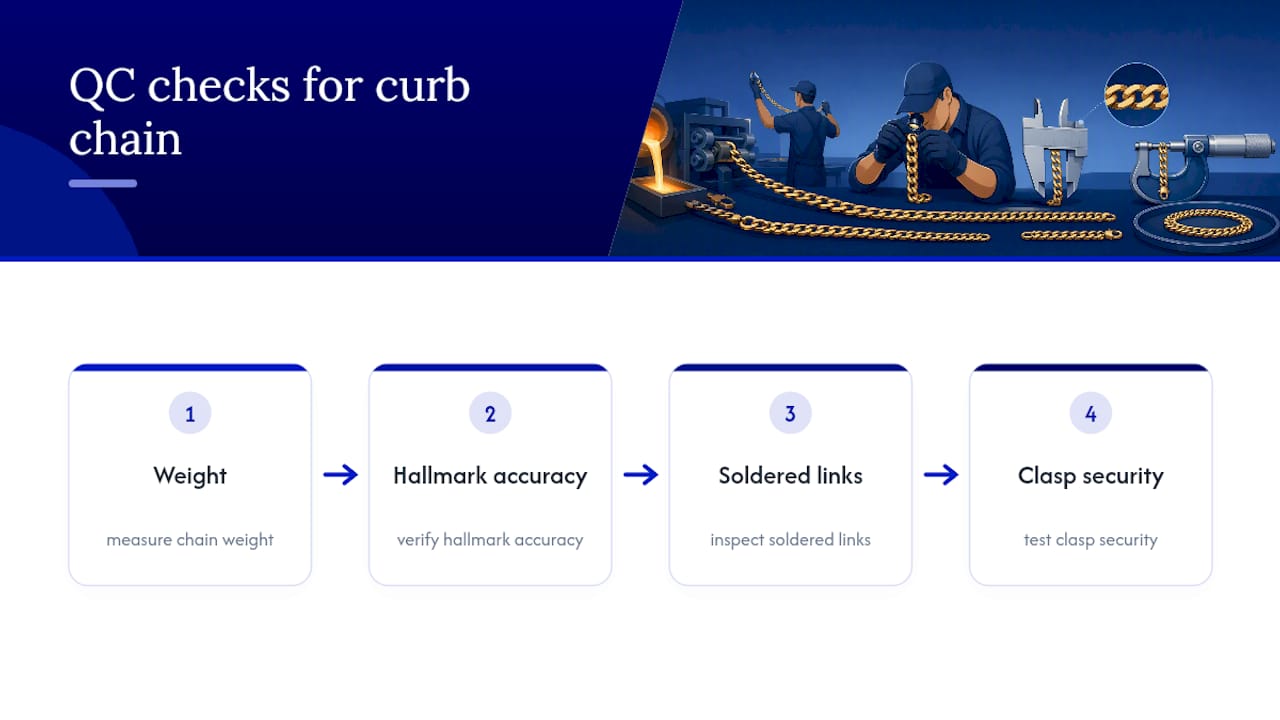
Every curb chain is checked for weight, hallmark accuracy, soldered links and clasp security before it goes anywhere near a display cabinet. That’s standard practice for anything in the second-hand jewellery collection, not an extra step reserved for expensive pieces. If a chain needs resizing, re-plating, or a bespoke length to carry a specific pendant, that work is done rather than being sent elsewhere.
Why curb chains never really go out of fashion

Customers come back to curb chains because they do two jobs at once: they look deliberate on their own, and they carry a pendant without a fuss. That’s rare in a chain style. Most trend pieces ask you to choose between subtle and sturdy, but a curb chain doesn’t force the choice.
If you’re buying one, whether new or pre-owned, get someone qualified to check the gauge, the clasp, and the hallmark before you commit. It’s a five minute check that saves you a lot of grief later.
— James
Sources
Definitions and construction details drawn from BlueStone, Cooksongold, Antique Jewelry University, and GOLDZENN.
Before you buy or bring in a piece for repair, our Jewellery Repairs service can assess an existing curb chain, and our Bespoke Jewellery team can build one to a length and gauge that actually suits what you plan to hang on it.
- Curb Chains: Styles, fit guide and how to choose the right one - BlueStone Blog
- Understanding the different types of chain - Cooksongold
- Curb chain: styles, sizes & buying guide | GOLDZENN
- Curb Chain - Antique Jewelry University
FAQ
What’s the point of a curb chain?
A curb chain’s flattened, interlocking links let it lie smoothly against the skin, giving it a clean, structured look while still being tough enough for daily wear or holding a pendant.
Is a curb chain strong?
Yes, generally. The interlocking flat links spread stress across multiple contact points rather than one weak spot, though a soldered, solid-gauge curb chain will always outlast a hollow, unsoldered one under heavy use.
What is another name for a curb chain?
“Gourmette” is a common alternative name you’ll see used on some listings, particularly those with French styling influence, and it refers to essentially the same twisted, flat-lying link structure.
Are curb chains trendy?
Curb chains have stayed popular for decades rather than cycling in and out with trends, and the current run of wider, flat-pressed statement styles has kept them firmly in fashion for both everyday and bold looks.