

TL;DR:
- A signet ring is characterized by its flat engraved bezel used historically for sealing documents and asserting identity. Originally dating back to Mesopotamia around 3500 BC, these rings evolved from objects of security to personal symbols of heritage, fashion, and status. Today, signet rings are worn worldwide in diverse styles, made from various metals, and engraved by both hand and machine, blending tradition with modern personalization.
A signet ring is defined as a ring featuring a flat or slightly domed bezel engraved with a personal device, such as a family crest, monogram, or symbol, historically used as a wearable seal to authenticate documents and mark ownership. The term “signet” derives from the Latin signum, meaning sign or seal, and that etymology tells you everything about the ring’s original purpose. These are not decorative rings that happen to have engravings. They are identity objects that happen to be rings. Today, signet rings span gold, silver, and platinum, worn by everyone from aristocrats to fashion editors, and their appeal shows absolutely no sign of fading.
What is a signet ring, exactly?
The bezel is the defining element of a signet ring. Everything else, the shank, the weight, the metal choice, exists to support that flat top and whatever is engraved upon it. This is what separates a signet from every other ring type. A plain band is decorative. A signet ring is functional, or at least it was, and that functional origin is precisely why it carries so much cultural weight.
The engraving itself is typically executed using intaglio technique, where the design is cut into the surface rather than raised above it. Historically, this was deliberate. When pressed into warm wax, an intaglio design produces a raised positive impression, like a stamp. The craftsman had to engrave the design in reverse, which required serious skill and is still considered a mark of quality today.
Materials vary widely. Gold (9ct and 18ct), silver, platinum, and titanium are all used, but 18ct gold and platinum are preferred for prestige pieces because they hold fine engraving detail over decades of daily wear. The choice of metal is not just aesthetic. It directly affects how well the engraving survives long-term use.
How did signet rings originate and evolve?
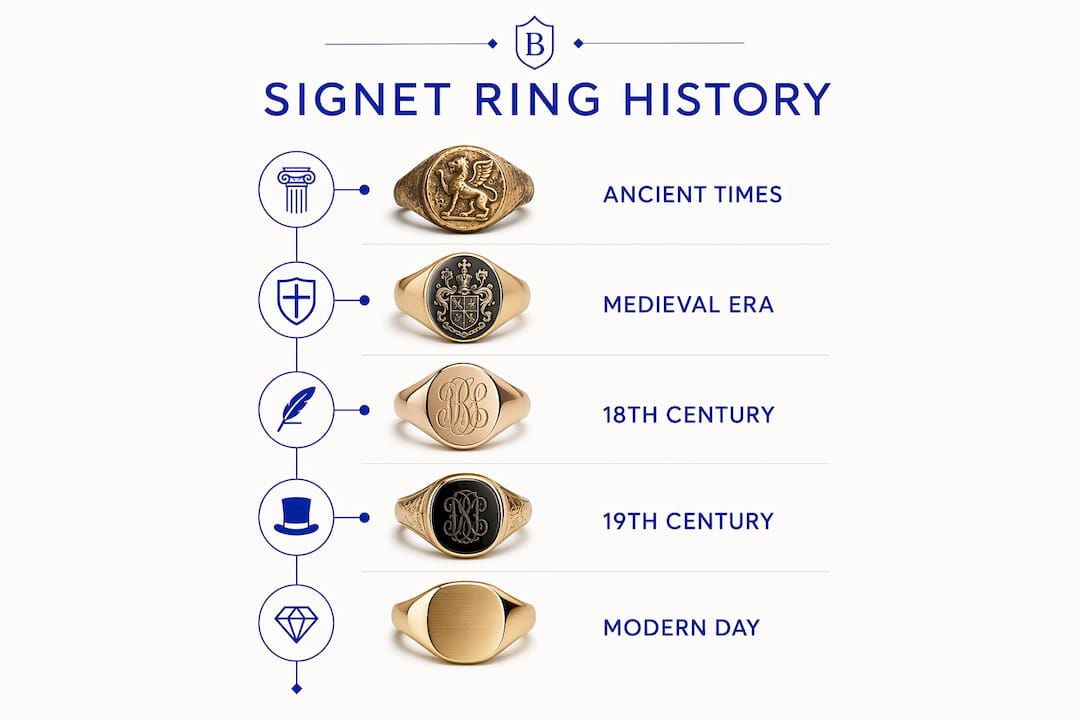
The history of signet rings is, frankly, extraordinary. Signet rings date back to Mesopotamia around 3500 BC, when cylindrical clay seals evolved into portable stamp seals worn on the finger. That is over five thousand years of continuous use. No other piece of jewellery comes close to that track record.
Ancient Egyptians used scarab signet rings bearing royal cartouches. In medieval Europe, nobility sealed correspondence and legal documents with their family crests pressed into wax. Losing your signet ring was not just inconvenient. It was a security crisis, because whoever held the ring held your legal authority.
“The signet ring compresses identity into a durable, personal object that outlasts the wearer.” — Alexandria
This is why one of the most striking traditions in signet ring history involves destruction rather than preservation. The Ring of the Fisherman is ceremonially struck and destroyed after a pope dies, specifically to prevent forgery or misuse of the papal seal. That single tradition tells you how seriously these objects were taken as instruments of power and identity.
Key moments in signet ring history include:
- 3500 BC: Cylindrical seals in Mesopotamia used to authenticate clay tablets
- Ancient Egypt: Pharaohs and officials wore scarab rings as personal seals
- Medieval Europe: Nobility sealed legal documents with heraldic crests
- 17th to 19th century: Signet rings became markers of social class and family lineage
- 20th century: Elvis Presley wore a signet ring as a personal statement, helping shift the ring from aristocratic tool to cultural icon
- 21st century: Meghan Markle and runway appearances fuel the resurgence of signet rings as mainstream fashion accessories
The transition from legal instrument to status symbol happened gradually across the 18th and 19th centuries, as literacy spread and wax seals became less necessary. But the ring did not disappear. It adapted, which is the mark of an object with genuine cultural staying power.
What is the significance of a signet ring today?
Signet rings no longer serve as legal instruments for sealing documents, but their symbolic power has, if anything, grown. The significance has simply shifted from external authority to internal identity. You are no longer saying “this document is mine.” You are saying “this is who I am.”
The modern signet ring meaning covers a surprisingly broad range of personal statements:
- Family heritage: Inherited crests or motifs passed down through generations
- Personal identity: Initials, birth dates, or symbols meaningful only to the wearer
- Fraternity or membership: University colleges, military regiments, and professional bodies still commission signet rings as membership markers
- Relationship symbols: Couples use matching signet rings as wedding band alternatives
- Pure fashion: No deeper meaning required. Sometimes a beautiful ring is just a beautiful ring.
One of the more interesting shifts in recent years is the move away from signet rings as an exclusively male, aristocratic accessory. Modern styles are versatile and genderless, and the idea that a signet ring belongs only on the hand of a landed gentleman is thoroughly outdated. Designers like Monica Vinader have built entire collections around delicate, contemporary signet styles aimed at a broad audience.
Pro Tip: If you are commissioning a signet ring as a personal heirloom, think beyond initials. A meaningful symbol, a birth flower, a coordinate, or even a phrase in a specific script can carry far more emotional weight and tell a more specific story.
The persistent cultural need to compress identity into a durable object is what keeps signet rings relevant. Trends come and go. The desire to carry something meaningful on your body does not.
Signet ring styles, materials, and how to choose one
Choosing a signet ring is more interesting than choosing most jewellery because the variables actually matter. Shape, metal, engraving type, and finger placement all interact to produce a very different result.
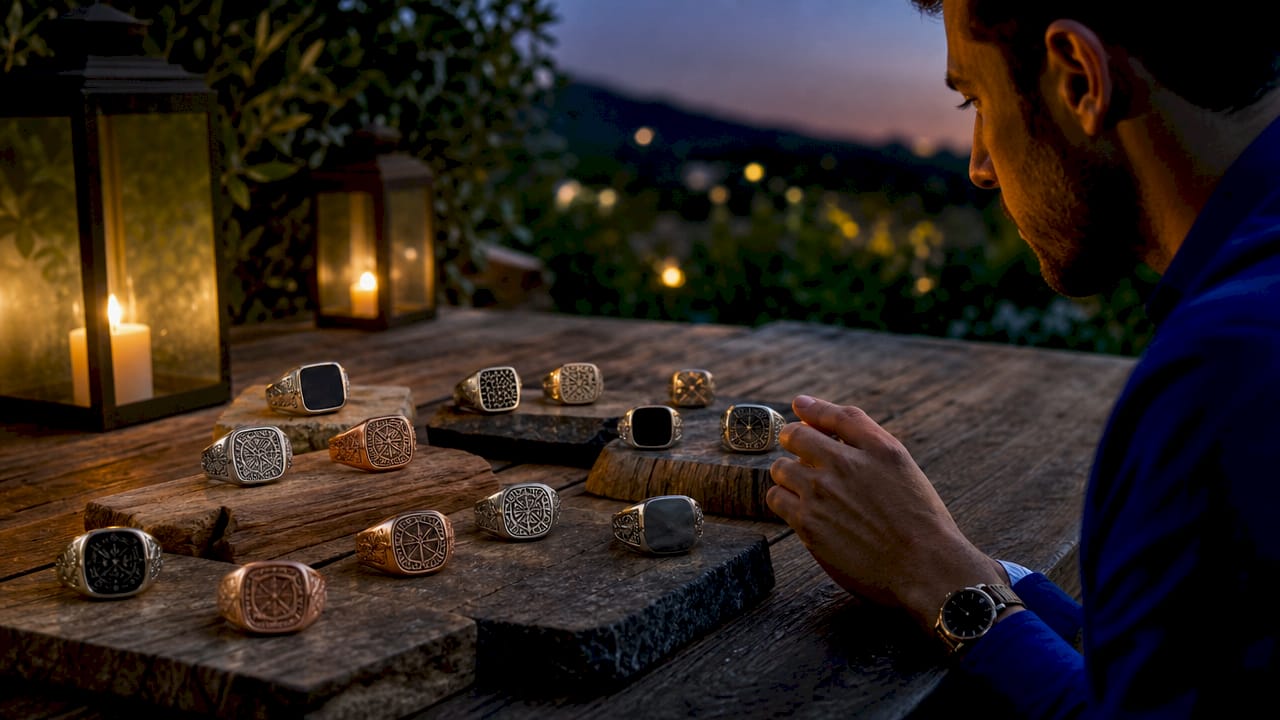
| Style | Material | Best for | Engraving type |
|---|---|---|---|
| Classic oval or cushion | 9ct or 18ct yellow gold | Traditional family crests, heirlooms | Intaglio hand engraving |
| Round or square bezel | Sterling silver | Casual wear, initials, modern motifs | Machine or hand engraving |
| Flat rectangular | Platinum | Formal wear, fine detail work | Intaglio, high precision |
| Oval with hardstone | Gold with onyx or carnelian | Decorative, collector pieces | Raised or intaglio on stone |
| Slim or tapered shank | Titanium or white gold | Everyday wear, minimalist styling | Laser or light hand engraving |
The intaglio engraving technique remains the gold standard for authenticity. Laser engraving is faster and cheaper, but hand engraving produces finer lines and a depth that catches light differently. If you are buying a signet ring as a long-term piece, hand engraving is a mark of quality worth paying for.
On sizing: signet rings are typically worn on the pinky finger of the non-dominant hand, a tradition rooted in practicality. The pinky does not interfere with writing or gripping tools. That said, modern wearers place them on the index or middle finger without any issue, and stacking multiple rings on one hand is entirely acceptable now.
Pro Tip: If you are unsure about sizing, get professionally measured before commissioning an engraved piece. Resizing an engraved signet ring is possible, but it requires careful work to preserve the integrity of the shank. Blackwelljewellers has a useful ring resizing guide worth reading before you commit to a size.
For everyday wearability, 9ct gold strikes the best balance between durability and cost. For a prestige piece you intend to pass on, 18ct gold or platinum is worth the investment.
Are signet rings in fashion, and how are people wearing them now?
Yes, signet rings are absolutely in fashion, and have been climbing steadily for the past decade. The reasons are not mysterious. They are personal, they are durable, and they photograph well. That last point matters more than jewellers like to admit.
Here is how modern wearers are using signet rings in 2026:
-
As wedding band alternatives. Couples are increasingly choosing customised signet rings as wedding bands, engraved with shared symbols, dates, or coordinates. The result is a ring that looks nothing like a traditional wedding band but carries the same weight of commitment.
-
As personalised heirlooms. Parents commission signet rings for children at milestone birthdays, engraved with the child’s initials or birth year. The ring is meant to be worn, passed down, and eventually re-engraved.
-
As fashion statements. Runway appearances from houses including Gucci and Alexander McQueen have pushed oversized, bold signet rings into mainstream fashion. Celebrities wearing them on red carpets have done the rest.
-
As part of a stacked look. Wearing two or three rings on the same hand, mixing a signet with plain bands or gemstone rings, is one of the most popular styling approaches right now. Check out top ring styles for 2026 for more on how to pull this off without it looking chaotic.
-
As bespoke commissions. More buyers are skipping off-the-shelf options entirely and working directly with jewellers to create pieces from scratch. Bespoke engraving services allow for genuinely unique designs that no catalogue can replicate.
Care for a signet ring is straightforward. Clean with warm soapy water and a soft brush. Avoid ultrasonic cleaners if the ring has a hardstone setting. Have the engraving checked every few years, particularly if you wear the ring daily, as fine lines can soften over time with wear.
Key takeaways
A signet ring is defined by its engraved bezel, and that single feature connects five thousand years of human history, identity, and craftsmanship in one wearable object.
| Point | Details |
|---|---|
| Defining feature | The flat engraved bezel is what makes a signet ring a signet ring, not the metal or the shape. |
| Historical origins | Signet rings date to Mesopotamia around 3500 BC, originally used to authenticate documents pressed in clay or wax. |
| Modern significance | Today they represent personal identity, family heritage, and fashion rather than legal authority. |
| Engraving quality | Hand intaglio engraving is the mark of a quality signet ring and holds detail far longer than machine alternatives. |
| Wearing conventions | Traditionally worn on the pinky finger, but modern styling places them on any finger, often stacked with other rings. |
Why I think signet rings are the most honest piece of jewellery you can own
I have handled a lot of jewellery over the years, and signet rings are the ones that consistently tell the most interesting stories. Every other ring type is essentially decorative. A signet ring has a job. Or it did, and that sense of purpose never quite left it.
What strikes me most is the craftsmanship question. There is a real difference between a hand-engraved signet ring and a laser-engraved one, and you can feel it when you hold them side by side. The hand-engraved version has a quality of line that looks almost alive. The laser version looks like a printout. Both are technically “engraved,” but only one of them will still look extraordinary in fifty years.
My honest advice: if you are going to buy a signet ring, buy one worth keeping. That means getting the metal right (18ct gold or platinum for anything you intend to pass on), getting the engraving done properly by hand, and not skimping on sizing. A signet ring that fits badly is a signet ring you will not wear, and a signet ring you do not wear is just an expensive paperweight.
The other thing I would say is this: do not overthink the design. The most meaningful signet rings I have seen are the simple ones. A single initial. A small crest. A date. The ring does not need to explain itself. That is rather the point.
— James
Explore signet rings at Blackwelljewellers
If you are ready to find or commission your own signet ring, Blackwelljewellers is a good place to start. The team at Blackwelljewellers has over 20 years of experience working with gold, silver, and platinum pieces, and the bespoke design service in Maidstone covers everything from initial concept through to hand engraving and final finishing.

If you prefer to browse pre-owned pieces, the second-hand jewellery collection includes authenticated, hallmarked signet rings inspected and restored by expert jewellers before sale. For rings that need resizing or engraving restoration, the jewellery repair service handles structural work in-house. You can also browse specific examples like this 9ct yellow gold oval engraved signet ring to get a sense of the craftsmanship on offer.
FAQ
What is a signet ring used for?
A signet ring was historically used to authenticate documents by pressing the engraved bezel into wax to create a personal seal. Today, signet rings are worn as symbols of identity, family heritage, or personal style rather than for any legal function.
Which finger should a signet ring be worn on?
Traditionally, signet rings are worn on the pinky finger of the non-dominant hand, a convention rooted in practicality so the ring did not obstruct writing. Modern wearers place them on any finger, including the index or middle finger, depending on personal preference and ring size.
What is the difference between intaglio and raised engraving?
Intaglio engraving cuts the design into the surface of the bezel, which historically produced a raised positive impression in wax. Raised engraving, by contrast, leaves the design proud of the surface. Intaglio is the traditional and more prized technique for authentic signet rings.
Can signet rings be used as wedding rings?
Yes. Signet rings are increasingly chosen as wedding band alternatives, engraved with shared dates, initials, or symbols meaningful to the couple. They offer a personalised, non-traditional option that carries the same symbolic weight as a conventional wedding band.
What metals are signet rings made from?
Signet rings are made from gold (9ct and 18ct), silver, platinum, and titanium. For prestige or heirloom pieces, 18ct gold and platinum are preferred because they hold fine engraving detail over long periods of daily wear.