
Yes. Lab-grown diamonds are real diamonds. They’re crystalline carbon arranged in the same cubic lattice as a stone pulled from the ground, they score a full Mohs 10 on the hardness scale, and GIA grades them with laser-inscribed reports rather than treating them as fakes. The only thing “lab” changes is where the diamond grew, not what it’s made of.
TL;DR:
- Lab-grown diamonds are chemically and physically identical to mined diamonds but lack the geological scarcity that drives natural diamond prices.
- Most lab-grown diamonds are now produced using CVD methods, often followed by HPHT treatment to improve color or clarity.
- Industry-standard tests and GIA reports, including laser inscriptions and spectroscopy, are essential for verifying a diamond’s origin, as visual identification isn’t possible.
- Resale value for lab-grown diamonds remains significantly lower than natural stones due to supply controllability and market perceptions.
- Buyers should always verify report numbers through the issuing lab’s official database to confirm authenticity before purchase.
Table of Contents
- What actually is a lab-grown diamond?
- How are lab-grown diamonds made: HPHT and CVD explained
- Is a lab-grown diamond chemically the same as a natural one?
- How do gem labs prove where a diamond came from?
- Do lab-grown diamonds hold their value the same way?
- Are lab-grown diamonds actually the ethical choice?
- How do you check a lab-grown diamond is genuine before buying?
- What I’ve learned watching this debate play out
- Buying with confidence at Blackwell Jewellers
- Sources
- FAQ
What actually is a lab-grown diamond?
Strip away the marketing language and you’re left with one straightforward idea: a lab-grown diamond is carbon that crystallised inside a machine instead of inside the earth. You’ll see it called laboratory-created, synthetic, engineered, or man-made. All four terms point at the same object. None of them mean fake, and none of them mean simulant, which is a different category entirely.
That distinction matters because a lot of buyers muddle it up.
- Lab-grown diamond: pure carbon, cubic crystal structure, grown in a controlled industrial process rather than formed over a billion years underground.
- Moissanite: silicon carbide, not carbon at all, sold as a diamond alternative rather than a diamond.
- Cubic zirconia: a synthetic zirconium oxide, cheap, soft, and never marketed as anything other than a stand in for the real thing.
The GIA’s Laboratory-Grown Diamond Report exists precisely because a lab-grown stone earns diamond status. Nobody issues a diamond report for cubic zirconia. That gatekeeping alone tells you where the line actually sits.
How are lab-grown diamonds made: HPHT and CVD explained
Two production methods dominate the industry, and they get there by completely different routes.
- HPHT (High Pressure High Temperature) recreates the conditions diamonds form under naturally, roughly 1,300 to 1,600 degrees Celsius under crushing pressure, applied to a small diamond seed sitting in molten metal. Growth typically takes days to a few weeks. The metal flux used in the process sometimes gets trapped inside the crystal as it forms, leaving telltale metallic inclusions.
- CVD (Chemical Vapour Deposition) works at far lower pressure. A diamond seed sits inside a vacuum chamber filled with carbon-rich gas, which is ionised into plasma so carbon atoms deposit onto the seed layer by layer. It’s slower and gentler, running over several weeks, and it leaves its own signature: fine growth layering and occasional graphitic inclusions.
GIA’s own research from 2024 confirms CVD now dominates the diamonds submitted for grading, a shift from the HPHT-heavy supply of a decade ago. Many colourless CVD stones then go through a second HPHT treatment after growth, not to fake anything, but to improve colour and dissolve internal defects that would otherwise dull the stone. It’s a finishing step, similar in spirit to how a natural diamond might be polished to maximise its brilliance.
Is a lab-grown diamond chemically the same as a natural one?
Chemically and structurally, yes, essentially identical. Both are pure crystalline carbon locked into a cubic lattice, and both land at Mohs 10, the hardest natural material known. GIA states plainly that laboratory-grown diamonds share essentially the same chemical composition, crystal structure and physical properties as mined ones.
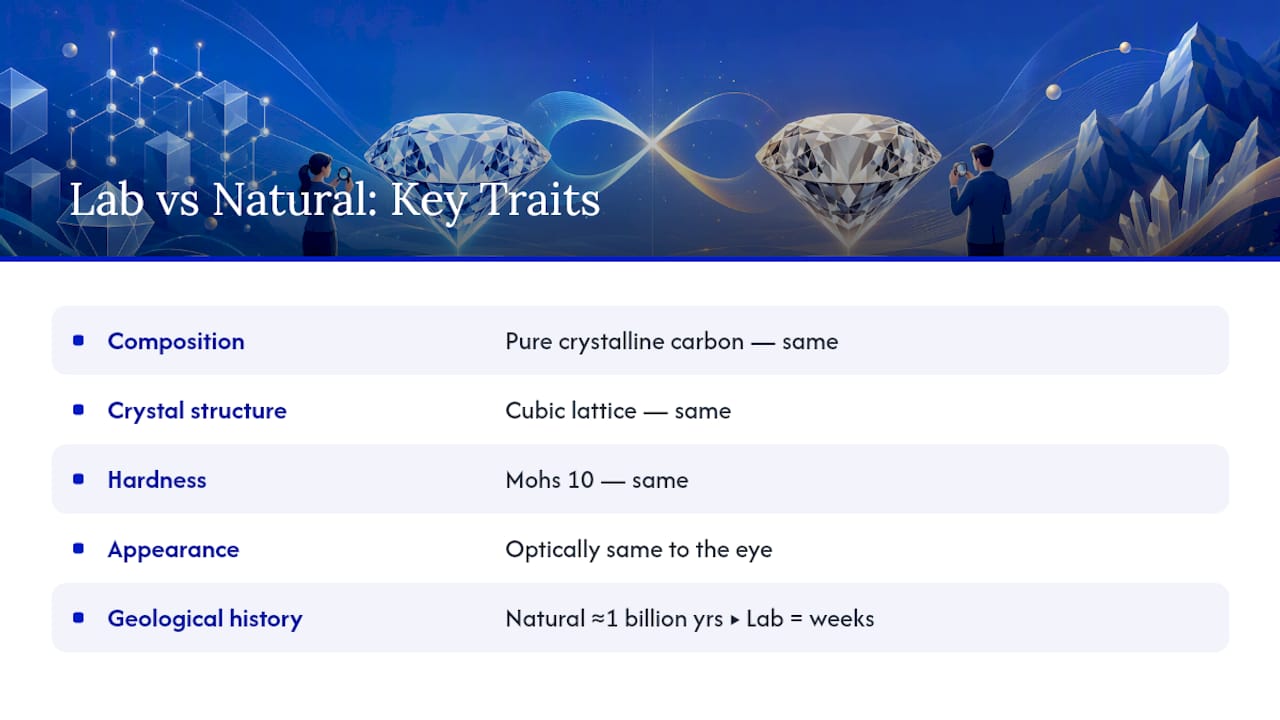
The number that settles most arguments: both types hit Mohs 10 on the hardness scale, and gem-quality lab-grown stones are optically indistinguishable from natural diamonds to the naked eye.
What separates them isn’t chemistry, it’s geological history. A natural diamond carries roughly a billion years of formation deep in the earth’s mantle. A lab-grown stone carries a few weeks in a chamber. That age and scarcity, not the carbon itself, is what the market prices differently. It’s the reason two visually identical rings can carry very different price tags, and why understanding the real difference between lab-grown and natural diamonds matters before you commit to either.
How do gem labs prove where a diamond came from?
You can’t tell a lab-grown diamond from a mined one by eye, and neither can most jewellers without instruments. Origin determination is a laboratory job, and it typically needs more than one test.
- Laser inscription and lab reports: GIA laser-inscribes the words “Laboratory-Grown” plus the report number directly onto the girdle of graded stones, giving buyers a permanent, checkable marker.
- Spectroscopy: photoluminescence testing and absorption analysis pick up defect patterns that differ between HPHT and CVD growth, and between either method and natural formation.
- Inclusion analysis: HPHT stones commonly show metallic flux inclusions and specific phosphorescence, while CVD stones can show layered growth structures and silicon-related defects. Labs read these signals in combination, never in isolation.
Handheld consumer testers have a real place in the trade, but they’re a first filter, not a verdict. GIA’s own findings note that most screening devices return only a pass or refer result and can’t conclusively identify every stone. A “refer” result means the diamond needs proper lab analysis, not a shrug and a sale.
Pro Tip: Before buying anything with a report attached, look up the report number on the issuing lab’s own online database, not through a link the seller sends you. It takes thirty seconds and it’s the single best fraud check available to an ordinary buyer.
Do lab-grown diamonds hold their value the same way?
They don’t, and pretending otherwise sets buyers up for disappointment. The gap isn’t about authenticity, it’s about supply.
- Lab-grown diamonds can be manufactured to demand, which keeps prices considerably lower than natural stones of comparable size and quality.
- Natural diamonds carry the weight of geological scarcity, which has historically supported a resale premium that lab-grown stones haven’t matched.
- Both types generally lose value on resale. The Natural Diamond Council advises buying diamonds for enjoyment rather than as an investment, and that guidance holds regardless of which type you choose.
- Reporting has shifted too. GIA now issues a Premium or Standard Quality Assessment for many colourless to near-colourless lab-grown diamonds rather than a full 4Cs grade, reflecting how manufactured supply behaves differently from mined supply.
If you’re weighing which route fits your budget and your expectations, Blackwell’s guide to making an informed choice walks through the trade-offs without the sales pitch either side usually leans on.
Are lab-grown diamonds actually the ethical choice?
The pitch is familiar: no large-scale mining, a shorter and more traceable supply chain, less land disturbance. There’s genuine substance to that argument, and it’s one reason demand for lab-grown stones has grown steadily.
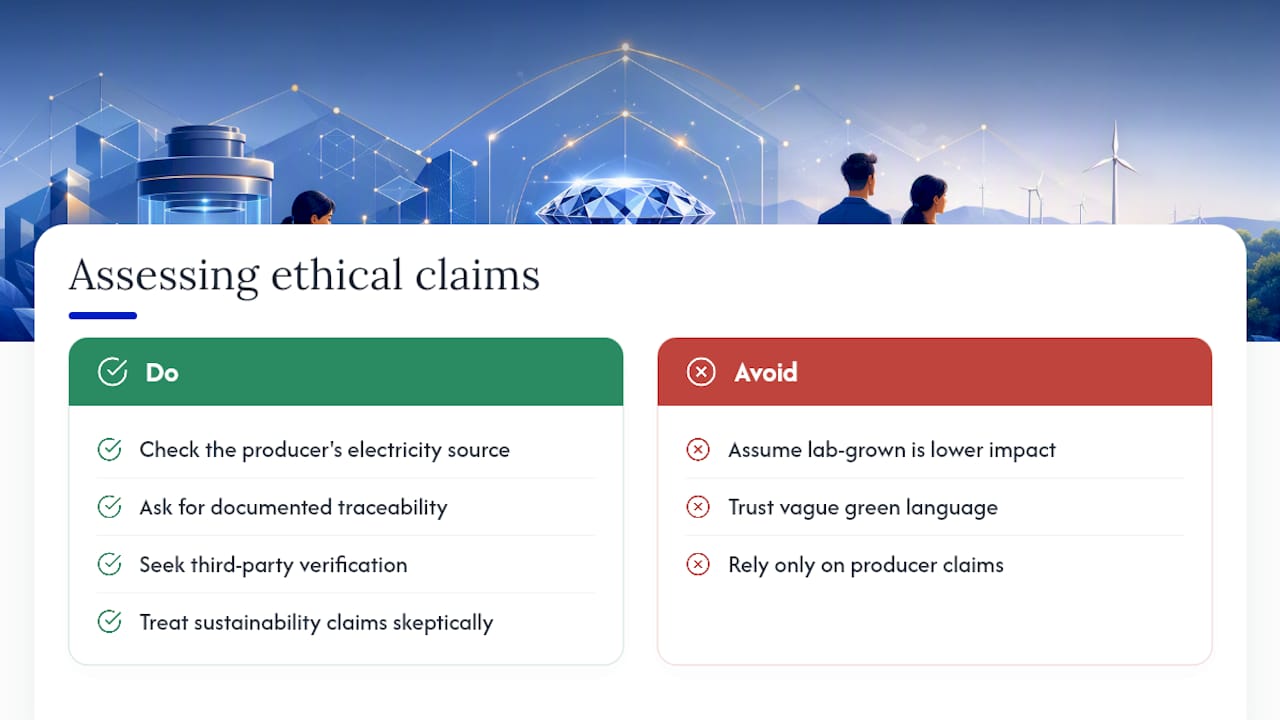
The environmental picture is messier than the marketing suggests, though. Growing a diamond takes real energy, and the footprint varies enormously depending on the producer’s electricity source, whether that’s a coal-heavy grid or renewable power. A lab-grown diamond made with fossil-fuel electricity isn’t automatically the lower-impact choice.
Sustainability claims deserve scrutiny rather than automatic trust. Look for producers offering genuine traceability and third-party verification rather than vague green language on a product page. GIA’s own guidance points the same way: assume nothing about a producer’s environmental credentials without independent confirmation.
How do you check a lab-grown diamond is genuine before buying?
Verification isn’t complicated, but it does take a few deliberate steps most buyers skip.
- Ask for the laboratory report and confirm it comes from a recognised issuer, GIA or IGI, rather than an in-house certificate with no independent standing.
- Check the report number against the issuing lab’s public database before you pay, not after.
- Look for the girdle inscription. It should match the report number exactly, and its absence on a supposedly graded stone is a red flag worth walking away from.
- Get an independent appraisal for second-hand pieces, since older stones may predate current inscription standards or lack accompanying paperwork entirely.
Pro Tip: If a seller can’t produce a report or won’t let you verify the number independently, treat that as your answer. Reputable dealers expect the question and welcome it.
For a closer look at what separates a well-made stone from a mediocre one, Blackwell’s expert guide to identifying high-quality lab-grown diamonds covers the practical checks worth doing before you commit.
What I’ve learned watching this debate play out
The argument over whether lab-grown diamonds are “real” is mostly a language problem dressed up as a science problem. Nobody disputes the carbon, the lattice, or the hardness. What people actually mean when they ask the question is “will this hold value the way a mined diamond does,” and that’s a fair concern dressed in the wrong words.
Over many years of inspecting stones in jewellery stores, I’ve watched the conversation shift from suspicion to genuine curiosity. Customers used to ask if lab-grown meant fake. Now they ask about resale and inscriptions, which tells me the science argument is settled and the market argument is the one still being worked out. Bring a stone into a trusted jeweller, lab-grown or natural, and they will check the report against the girdle inscription rather than take a seller’s word for it.
— James
Buying with confidence at Blackwell Jewellers
Choosing between lab-grown and natural comes down to what you value, but verifying what you’re actually buying shouldn’t be left to guesswork on either side of that decision. Reputable jewellers check every stone as described throughout this piece: report numbers verified against the issuing lab, girdle inscriptions checked against paperwork, and second-hand pieces authenticated and hallmarked before they reach a shop floor.

Our ethical diamonds collection gives you a straightforward way to buy a lab-grown or responsibly sourced stone with the paperwork already sorted. If you’re weighing a second-hand piece instead, our authenticated second-hand jewellery has been through the same inspection and hallmarking process before it’s listed. And if you want a stone, lab-grown or natural, set into something built specifically for you, our bespoke jewellery service starts with a conversation about the piece you actually want, not a catalogue you have to compromise around. Pop into one of our Kent stores or browse the collection online to see verified stones for yourself.
Sources
- Laboratory-Grown Diamond Report (LGDR) by GIA
- Laboratory-Grown Diamonds: An update on identification and products evaluated at GIA (Gems & Gemology, Summer 2024)
- Laboratory-Grown Diamond Report (LGDR) by GIA
- Diamond value guidance — Natural Diamond Council
FAQ
Is a lab-grown diamond worth buying?
Yes, for most buyers it’s a sound choice: you get identical hardness and appearance to a natural stone at a considerably lower price, provided you buy one with a proper laboratory report and verified girdle inscription.
What are the disadvantages of lab-grown diamonds?
The main drawback is resale value, since lab-grown stones generally don’t hold a premium the way scarce natural diamonds can, and their environmental footprint depends heavily on the producer’s energy source rather than being uniformly low.
Do rich people buy lab diamonds?
Some do, particularly for larger stones where a mined equivalent would be prohibitively expensive, but high-net-worth buyers more often choose natural diamonds specifically for their rarity and long-term prestige value.
What do jewellers think of lab diamonds?
Most reputable jewellers treat lab-grown diamonds as genuine diamonds worth stocking and recommending, provided they come with verifiable lab reports rather than vague seller assurances.
Are lab-grown diamonds valuable?
They hold real value as gemstones with genuine hardness and brilliance, but their financial value trends lower than natural diamonds of comparable size, since manufacturing removes the scarcity that historically drives price premiums.
How can I verify a lab-grown diamond’s report is genuine?
Look up the report number directly on the issuing laboratory’s website, such as GIA’s own database, rather than relying on a copy or link supplied by the seller.