

If you want to avoid a low offer when selling gold near Maidstone, do one thing before anything else: get a written, in-person valuation from a trusted local jeweller and compare it with at least one other documented quote before you accept anything. That single step filters out the vast majority of lowball tactics before they can cost you money.
Blackwelljewellers in Maidstone offers exactly that kind of in-person appraisal, with transparent written calculations and in-house testing. For UK hallmarking questions, the Birmingham Assay Office is the independent authority. If anything feels off at any point, Trading Standards via Citizens Advice is your first call.
Here is your immediate checklist before you walk into any buyer:
- Photograph every item clearly, including any hallmarks or maker’s marks
- Weigh items at home if you have accurate scales (or ask the buyer to weigh them in front of you)
- Locate and photograph hallmarks; use Blackwelljewellers’ guide to understanding gold hallmarks if you are unsure what you’re looking at
- Write down the current gold spot price before you go (check the London Bullion Market Association or a live gold price site)
- Get every offer in writing before you say yes
- Never accept a verbal offer on the spot without comparing it elsewhere
That is the short version. Everything below explains the why, the how, and what to do when things go sideways.
Key takeaways
Selling gold near Maidstone without getting a low offer comes down to one discipline: get at least two written, documented valuations before you accept anything, and check your hallmarks first.
| Point | Details |
|---|---|
| Get a written valuation first | A documented, in-person quote showing weight, purity, and spot price is your baseline before accepting any offer. |
| Check hallmarks before you go | Hallmarking applies to gold items of 1 gram or over; a clear hallmark is a legal purity indicator buyers cannot reasonably dispute. For gold items under 1 gram, the law still requires an accurate description—check for maker’s marks, certificates, and written assessments of purity to avoid disputes. |
| Compare at least two offers | Never accept the first quote; a second written offer takes minutes and often reveals a significant difference in payout. |
| Use insured tracked postage | If selling by post, use Royal Mail Special Delivery and keep all correspondence and proof of postage. |
| Report suspicious behaviour | Contact Citizens Advice to report to Trading Standards, or Action Fraud for suspected criminal fraud. |
| Blackwelljewellers, Maidstone | Offers in-person written valuations, in-house testing, pawnbroking, and transparent spot-price calculations at its Maidstone store. |
Table of Contents
- How to spot lowball tactics and scams when selling gold near Maidstone
- How do buyers calculate your gold offer?
- What do UK hallmarking rules mean for your gold offer?
- Where can you get a reliable gold valuation in Maidstone?
- How to sell gold safely by post
- What questions should you ask every gold buyer?
- What timelines and fees should you expect when selling gold?
- What should you do if you suspect a scam or a low offer?
- Why a local Maidstone jeweller is often the smartest first call
- Blackwelljewellers in Maidstone: get a fair, written gold valuation today
- Sources
How to spot lowball tactics and scams when selling gold near Maidstone
Some buyers are brilliant. Others are, frankly, hoping you have no idea what your gold is worth. Here is what the dodgy ones actually do.
Common lowball tactics to watch for:
- Pressure to sell immediately. “I can only hold this price for the next ten minutes.” That is not how legitimate buyers operate.
- Vague pricing. Quoting per item rather than per gram is a classic way to obscure a terrible rate.
- Hidden fees. Testing fees, handling charges, and “admin costs” quietly shaved off after the initial quote.
- Rigged or uncalibrated scales. A scale that reads slightly heavy means you get paid for less gold than you actually have.
- Bait-and-switch purity testing. Quoting based on a higher purity, then downgrading after “closer inspection.”
- Unsolicited doorstep buying. Someone knocks on your door offering cash for jewellery. Walk away. Citizens Advice warns that cold calls and unsolicited offers are used to push precious-metal scams.
- Rushed postal offers with urgent deadlines. A countdown timer on a postal offer is a red flag, not a feature.
Red flags that mean you should leave immediately:
- Refusal to show you the testing method or the scales
- No business address, no traceable reviews, no clear terms
- Offers that are dramatically below the current spot price with no explanation
- Cash-only insistence (more on legality in the timelines section)
- No written quote available
How to confirm a buyer is legitimate:
- They have a verifiable physical address and registered business name
- They publish or will state their spot-price basis and payout percentage
- They have verified reviews on Trustpilot or Google
- Their terms are written down and available before you commit
Consumer guidance from Quids in! magazine recommends checking buyer reviews and comparing multiple offers before using any postal or online buyer. That advice applies equally to in-person buyers in Maidstone.
Pro Tip: Industry guidance flags offers well below a certain band of spot price for scrap jewellery as likely unfair. Use that as a quick screen — if a buyer’s offer sits noticeably below that band without a clear explanation, treat it as a red flag and get a second opinion before proceeding.
How do buyers calculate your gold offer?
Understanding the maths here is genuinely useful. Once you know the formula, you can check any offer in about two minutes.
The basic calculation works like this:
- Weigh the item in grams
- Determine purity (9ct gold is 37.5% pure gold; 18ct is 75%; 22ct is 91.6%; 24ct is 99.9%)
- Calculate pure gold content: weight (g) × purity percentage
- Multiply by the spot price per gram (live gold price in £ per gram)
- Apply the dealer’s payout percentage (their margin comes out here)
Key terms you need:
- Spot price: the live market price for gold per troy ounce or gram, set by the London Bullion Market
- Karat/purity: how much of the item is actually gold (9ct, 18ct, 22ct, 24ct)
- Scrap value vs retail value: scrap is the melt value of the gold content only; retail value includes craftsmanship, brand, and condition
- Alloy vs gem value: the non-gold metals and any stones are usually excluded from a gold offer
Two quick examples to make this tangible:
Say you have a 9ct gold ring weighing 5 grams. At a spot price of £65 per gram, the pure gold content is 5 × 0.375 = 1.875 grams of pure gold. At spot, that is £121.88. A buyer paying 80% of that value would offer around £97.50.
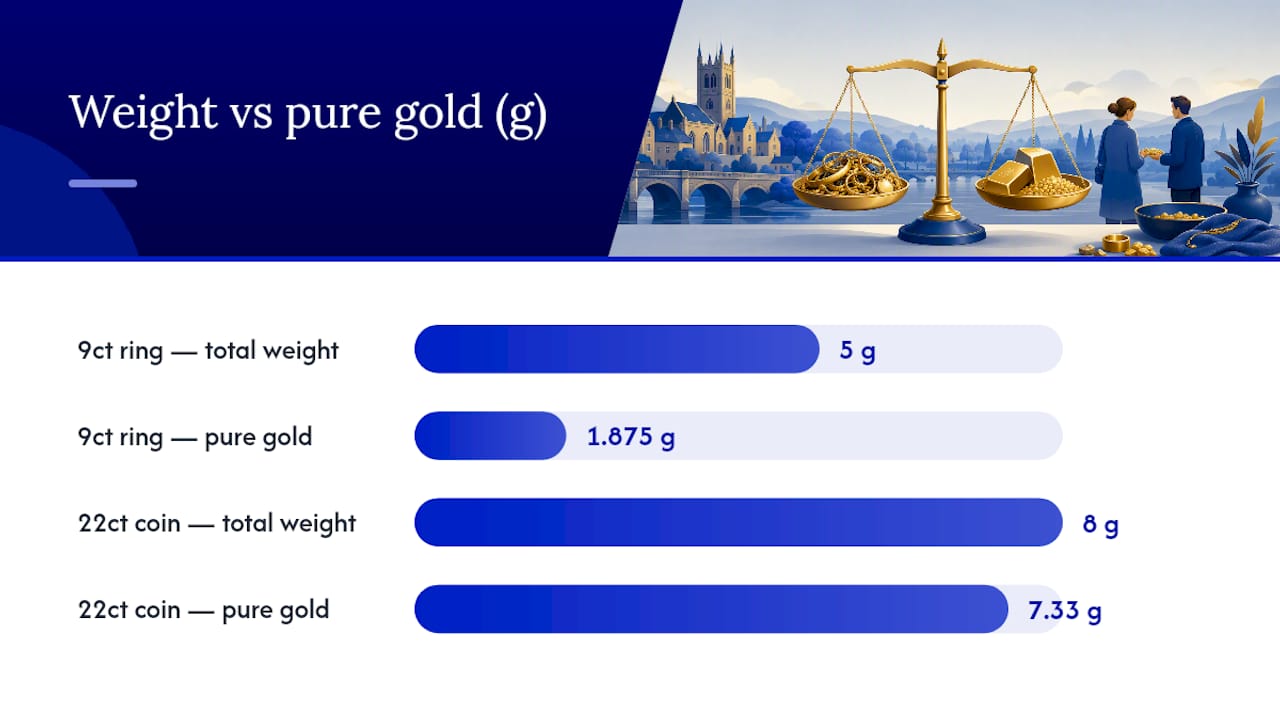
Now take a 22ct gold coin weighing 8 grams. Pure gold content is 8 × 0.916 = 7.33 grams. At £65 per gram spot, that is £476.45 at spot. Investment bullion typically attracts higher payout percentages than scrap jewellery, so a reputable buyer might offer 90–95% of spot on a coin versus 70–85% on scrap jewellery. Those are illustrative ranges, not guarantees. Industry guidance confirms that transparent dealers publish their base spot price and payout percentage so you can verify the maths yourself.
Pro Tip: Before you accept any offer, ask the buyer to write down the item weight, the purity they tested, the spot price they are using, and the payout percentage. If they will not do that, walk away. A legitimate buyer has nothing to hide.
You can also value your gold at home using Blackwelljewellers’ step-by-step guide before you visit any buyer.
What do UK hallmarking rules mean for your gold offer?
Hallmarks are not just decorative stamps. They are a legal trust signal, and knowing how to read them protects you from being underpaid or misled.
Under UK law, hallmarking applies to gold items of 1 gram or over. A hallmark confirms the metal’s purity independently of what any buyer tells you. The Hallmarking Act 1973 makes it an offence in trade to describe un-hallmarked articles as gold, silver, platinum or palladium. So if a buyer tries to downgrade your clearly hallmarked 18ct piece to “probably 9ct,” that is not just cheeky — it may be unlawful.
Step-by-step: how to check your hallmarks before selling
- Use a jeweller’s loupe or a macro phone camera to locate the marks (usually inside a ring shank, on a clasp, or on the back of a pendant)
- Photograph them clearly before any appointment
- Compare the purity mark against standard UK assay symbols: a crown (gold), a lion passant (sterling silver), and the millesimal fineness number (375 for 9ct, 750 for 18ct, 916 for 22ct)
- If the mark is worn or unclear, ask the buyer to confirm via XRF testing or acid testing before they price the item
- If you want an independent check, the Birmingham Assay Office offers UKAS-accredited testing and express hallmarking services
A hallmarked item gives you a clear, legally recognised purity indicator. Buyers who ignore or dispute a clear hallmark without testing evidence are not acting in good faith.
Pro Tip: Small items under the 1-gram hallmarking threshold still need an accurate description by law. Look for maker’s marks, any original paperwork or certificates, and ask the buyer to confirm their purity assessment in writing. That documentation protects you if a dispute arises later.
Blackwelljewellers’ blog on understanding gold hallmarks and purity walks through every UK assay symbol in plain English if you want to go deeper.
Where can you get a reliable gold valuation in Maidstone?
The safest first step for most people in Maidstone is a local, in-person valuation from a reputable jeweller. Here is why that beats starting with a postal buyer or an online quote tool.
An in-person valuation means the buyer tests your item in front of you, weighs it on calibrated scales you can see, and explains the calculation before you commit to anything. If you disagree, you pick up your jewellery and leave. No waiting, no postal risk, no “we’ve already processed your item” pressure.
What a trustworthy Maidstone buyer should provide:
- A visible, permanent shop address (not a pop-up or a hotel lobby)
- Clear written calculation showing weight, purity, spot price, and payout percentage
- Proof of testing method (XRF testing or acid testing, with the result shown to you)
- Transparent payment options (bank transfer is standard; more on cash restrictions below)
- Willingness to give you a written quote to take away and compare
What to bring to your valuation appointment:
- The items themselves, cleaned if safe to do so
- Any original paperwork, certificates, or receipts
- Photographs of hallmarks you have already taken
- Photo ID (required for pawnbroking transactions and some higher-value purchases)
Trust signals to look for locally:
- Verified Trustpilot or Google reviews with consistent, recent feedback
- Pricing visibly tied to the current spot price
- UKAS-accredited or clearly described testing equipment
- A willingness to print or email you a quote
Consumer guidance consistently recommends visiting local jewellers for valuations and comparing at least two offers before deciding. Blackwelljewellers’ local guide to selling scrap gold safely in Maidstone covers what to expect from the process in more detail.
Pro Tip: If your item is in poor condition, ask whether a repair or restoration would increase its value before selling it as scrap. A piece worth £80 as scrap gold might be worth considerably more as a repaired, wearable piece. A jeweller with in-house repair capability can tell you that on the spot.

How to sell gold safely by post
Postal selling is a legitimate option, but it has more moving parts than an in-person sale. Get the sequence right and it is fine. Rush it and you can end up with a low offer, a slow return, or worse.
Step-by-step postal process:
- Research the buyer thoroughly: check their registered address, Trustpilot rating, and terms before you send anything
- Request their full terms in writing, including their cooling-off period and return policy
- Photograph every item from multiple angles, including hallmarks and any damage
- Weigh items at home and record the weight
- Pack securely and use Royal Mail Special Delivery — it is tracked, signed for, and insured up to £2,500 as standard (higher cover available)
- Keep your proof of postage and tracking number
- Wait for their written valuation before funds are released; do not accept a payment that arrives without a prior written offer
Security checklist for postal sales:
- Insured packaging (Royal Mail Special Delivery or equivalent)
- Tracked shipment with signature on receipt
- Documented testing result sent to you before payment
- Clear return policy if you reject the offer
The Competition and Markets Authority has taken action against unfair contract terms in postal gold buying. Reputable buyers must give you a reasonable timeframe to accept or reject an offer and return your items if you decline. A legitimate postal buyer will never attach a short countdown to an offer or send payment without your explicit agreement.
Practical valuation advice recommends keeping all correspondence and documentation throughout a postal transaction. Screenshot the offer email, keep the tracking receipt, and save every message.
Pro Tip: Only use postal buyers that publish their cooling-off terms clearly on their website before you send anything. If you cannot find those terms, ask for them in writing. A buyer who cannot or will not provide them is not worth the risk.
What questions should you ask every gold buyer?
Asking the right questions takes about three minutes and can add real money to your payout. Here is exactly what to say.
Questions to ask before you accept any offer:
- “How do you test purity — XRF, acid test, or something else?”
- “Can you show me the item weight on the scales right now?”
- “Which spot price are you using, and what time was it taken?”
- “What is your payout percentage for this type of gold?”
- “What fees, if any, will you deduct from that figure?”
- “Can I have all of that in writing before I decide?”
- “If I want to think about it, how long will you hold this offer?”
Negotiation tips that actually work:
- Ask for the full calculation on paper before responding. Buyers who know you understand the maths tend to offer more.
- Mention any hallmark or certificate evidence you have. A clearly hallmarked 18ct piece is harder to downgrade than an unmarked one.
- Request a short hold to get a second quote. A reputable buyer will not refuse.
- Ask whether bank transfer is available for immediate payment. It is safer than cash and creates a paper trail.
Red flags during negotiation:
- Refusal to explain the calculation or show the scales
- Pressure to decide immediately
- No record of weight or purity offered in writing
- Insistence on cash only (see the legality note in the next section)
- Refusal to let you observe the testing process
What timelines and fees should you expect when selling gold?
Typical timelines by route:
- In-person valuation and payment: usually same day, often within the hour
- Pawnbroking advance: same day once ID and paperwork are completed
- Postal valuation turnaround: typically 24–72 hours from receipt, though this varies by buyer
- Assay office testing (if used independently): express services at the Birmingham Assay Office can turn around results quickly; standard services take longer
Payment methods and legality:
Bank transfer is the standard and safest payment method for in-person gold sales. Cheque is also normal. Cash payments for scrap gold from licensed scrap metal dealers are restricted under UK legislation, limiting such transactions. That law does not cover all jewellery buyers, but cash-only insistence from any buyer is worth querying. An immediate bank transfer is the cleanest option: it is traceable, instant, and leaves a clear record.
Common fees and deductions to watch for:
- Assay or handling charges (rare for straightforward purchases, but ask upfront)
- Postage and insurance costs for returning items if you reject a postal offer
- Auction or marketplace fees if you choose to sell through a platform rather than directly
No legitimate buyer should surprise you with fees after quoting a price. If deductions appear after the initial quote, that is a red flag.
What should you do if you suspect a scam or a low offer?
Stay calm, stop, and document everything. Here is the sequence.
Step-by-step reporting process:
- Preserve all evidence immediately: photographs, receipts, text messages, emails, and any written quotes
- Stop further communication with the buyer until you have taken advice
- Contact the buyer in writing (email is best) to request a remedy — return of items, correction of the offer, or a clear explanation
- Report to Trading Standards via Citizens Advice, which passes reports to the relevant local Trading Standards team. Trading Standards investigates unfair trading practices, though it does not recover money directly.
- Report to Action Fraud (actionfraud.police.uk, 0300 123 2040) if you believe criminal fraud has occurred — for example, if items were taken without payment or a buyer misrepresented themselves deliberately.
What each body does:
- Trading Standards: investigates businesses acting unfairly or illegally; can prosecute and impose penalties
- Citizens Advice: provides consumer advice, helps you understand your rights, and passes reports to Trading Standards
- Action Fraud: the UK’s national reporting centre for fraud and cybercrime; reports feed into police intelligence
For postal cases specifically:
- Check the buyer’s cooling-off policy and request your items back in writing immediately
- If the parcel was lost or damaged, contact Royal Mail’s claims team with your Special Delivery tracking number and proof of value
- Keep every piece of correspondence — it is your evidence if the case escalates
Why a local Maidstone jeweller is often the smartest first call
Here is an opinion that might ruffle a few feathers: the postal gold market is not bad, but it is almost never the best starting point for someone in Maidstone who has never sold gold before.
The reason is simple. When you sell in person, you see the scales, you see the test, and you can ask questions in real time. If the offer is low, you pick up your items and leave. There is no waiting period, no “we’ve already processed your parcel” excuse, and no dispute about whether the item arrived in the condition you sent it.
A local jeweller with genuine in-house expertise — the kind that understands UK hallmarking, can spot a 22ct piece from a 9ct one without guessing, and has a repair workshop on the premises — can also tell you something a postal buyer never will: whether your item is worth more as a restored piece than as scrap gold. That conversation alone can be worth more than any marginal difference in payout percentages.

The recourse argument matters too. If something goes wrong with a local buyer, you know where they are. You can walk back in. That accountability changes how buyers behave, and it changes your confidence as a seller.
Blackwelljewellers in Maidstone: get a fair, written gold valuation today
Over 20 years of trading in Kent, in-house testing, and a permanent Maidstone shopfront — that is what Blackwelljewellers brings to a gold valuation that a pop-up buyer or a postal service simply cannot match.

Walk in with your gold and you get a written calculation showing weight, purity, spot price, and payout percentage before you decide anything. No pressure, no countdown, no surprises. Blackwelljewellers also offers pawnbroking in Maidstone if you need fast cash without selling outright, and the team can advise whether a piece is worth more repaired than sold as scrap. For higher-value items, the second-hand jewellery service may return a better price than a straight scrap offer.
Visit the Cash 4 Gold Maidstone page to see the full service and book a valuation appointment. Bring your items, any paperwork, and photo ID for pawnbroking transactions. That is all you need.
Sources
Before you sell, these are the sources worth bookmarking:
- Hallmarking guidance notes — GOV.UK (PDF)
- Gov
- How to sell gold jewellery safely and avoid scams - Quids in! magazine
- Avoid Gold Scams UK | Red Flags When Selling Gold 2026 — London Gold Exchange
- Report a business to Trading Standards — Citizens Advice
- What Is My Gold Jewellery Worth? A Beginner’s Guide — Gold Bank