
For most buyers, diamond fluorescence is neutral. It’s neither a flaw to fear nor a feature to chase, and in the vast majority of stones you’ll never notice it once the ring is on your finger. That’s not a guess; GIA’s own research found that ordinary observers cannot consistently spot an appearance effect under everyday lighting, even when they’re told to look for one.
The quick version, so you can act on it:
- Ask the seller what the fluorescence field says on the lab report before you worry about anything else.
- View the stone in daylight and under warm indoor light, not just a jeweller’s spotlight.
- Treat medium to strong blue fluorescence as a potential bonus on lower colour grades, and a reason for a closer look on colourless stones.
Quick fact: Roughly 25 to 35% of gem-grade diamonds show some fluorescence, but only around 10% of those glow strongly enough to plausibly affect how the stone looks.
Key Takeaways
Diamond fluorescence rarely changes how a stone looks to the naked eye, but it can meaningfully improve perceived colour in lower grades and occasionally signal a pricing opportunity worth negotiating.
| Point | Details |
|---|---|
| Fluorescence is common, strong effects are rare | Around 25 to 35% of diamonds fluoresce, but only 10% of those reach an intensity likely to affect appearance. |
| Most buyers can’t see it anyway | GIA visual studies show typical observers can’t reliably detect fluorescence under everyday lighting conditions. |
| Colour masking helps lower grades | Medium to strong blue fluorescence can make I to N stones appear whiter in daylight. |
| Haziness is rare and usually structural | Fewer than 0.2% of fluorescent diamonds show the milky “overblue” effect, typically from pre-existing defects. |
| Verify before you buy | Blackwell Jewellers checks lab reports, runs UV tests and offers in-store demonstrations on every fluorescent stone sold. |
Table of Contents
- What is diamond fluorescence, and why does it happen?
- How fluorescence shows up on a diamond grading report
- Does fluorescence change how a diamond actually looks?
- How much does fluorescence affect diamond value?
- How to evaluate a fluorescent diamond before you buy
- How Blackwell Jewellers checks fluorescence in every stone
- Does fluorescence weaken a diamond or affect its durability?
- Can fluorescence throw off a diamond’s grading accuracy?
- The biggest myths about diamond fluorescence
- Does the type of UV light matter when checking fluorescence?
- Fluorescence in natural diamonds versus lab-grown and treated stones
- Frequently asked questions
- Sources
What is diamond fluorescence, and why does it happen?
Diamond fluorescence is the glow a diamond gives off when exposed to long-wave ultraviolet light. Most of the time, that glow is blue, though it can only be seen under UV lamps, not in ordinary room light. Over 95% of fluorescent diamonds glow blue; yellow and green fluorescence exist but are uncommon, and generally less desirable in fancy-coloured stones where colour purity matters more.
The cause is structural, not cosmetic. Trace boron or nitrogen related defects within the crystal lattice absorb UV energy and re-emit it as visible light. This has nothing to do with cut, clarity or how the stone was polished; it’s simply a quirk of the diamond’s atomic makeup.
Here’s what the numbers tell you about how likely you are to encounter it:
- Around 25 to 35% of gem-grade diamonds show measurable fluorescence.
- Only about 10% of those fluorescent stones reach medium, strong or very strong intensity, the levels where appearance might genuinely shift.
- The rest sit at faint intensity, which is essentially invisible outside a lab.
How fluorescence shows up on a diamond grading report
Every reputable lab grades fluorescence on a five-step scale: None, Faint, Medium, Strong and Very Strong. If a stone rates Medium or higher, the report will usually also state the colour of the fluorescence, almost always blue.
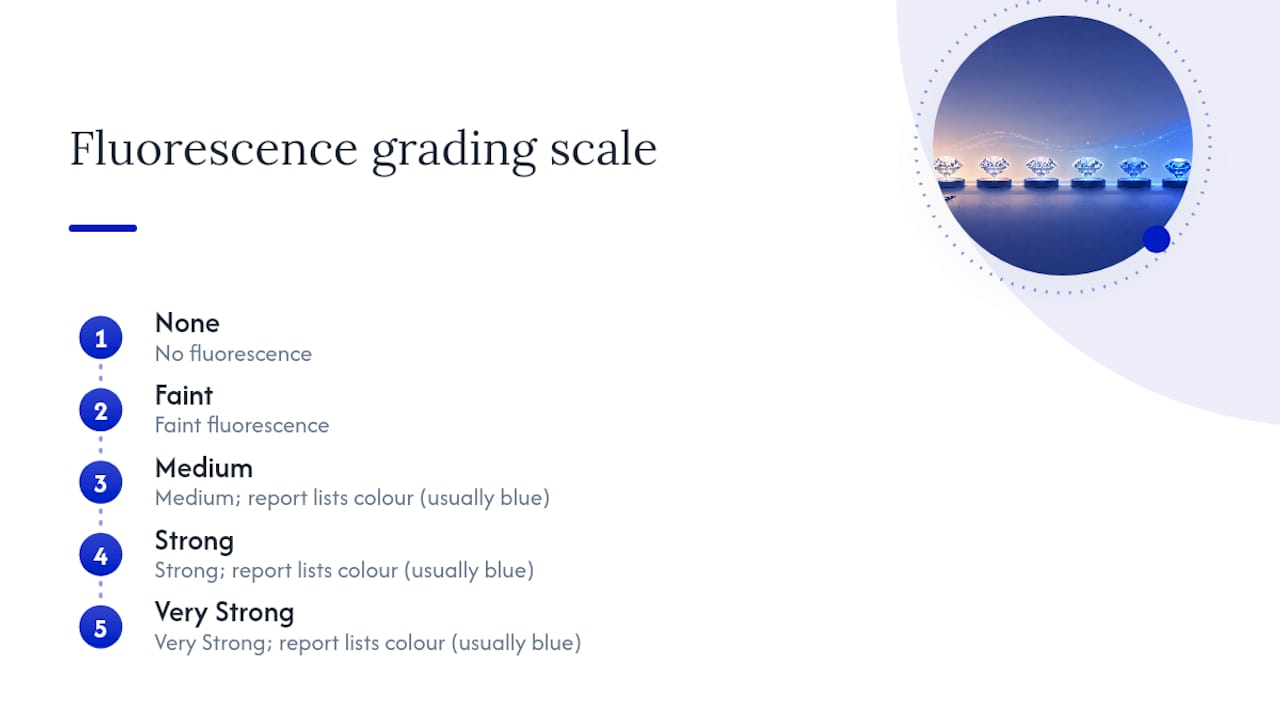
Fluorescence sits alongside the 4Cs as an identifying characteristic rather than a grading factor in its own right. GIA records it to help identify and track a specific stone, not to penalise or reward it within the colour or clarity grade itself. That distinction trips up a lot of buyers who assume “Strong” fluorescence automatically knocks points off a diamond’s quality. It doesn’t. The colour grade and the fluorescence grade are recorded independently.
Pro Tip: Look for the fluorescence field on a GIA report directly beneath the clarity grade. If a seller only shows you a photo of the stone and not the certificate, ask for the full report before you go any further.
Does fluorescence change how a diamond actually looks?
Mostly, no. GIA’s visual studies found that typical consumers cannot reliably tell fluorescent diamonds apart from non-fluorescent ones under normal viewing conditions, which is the single most useful fact in this entire topic. If you’re buying a colourless stone expecting it to look “off” because it fluoresces, the evidence doesn’t back that worry up.
Where fluorescence earns its keep is on lower colour grades. In stones graded I through N, medium to strong blue fluorescence can make a faint yellow tint appear whiter when viewed in light containing UV, such as daylight. Essentially, the blue glow counteracts the yellow, nudging the stone’s apparent colour a notch or two brighter than its paper grade suggests.
The flip side is the effect everyone’s heard rumours about: the hazy, oily “overblue” look. It’s real, but rare. Fewer than 0.2% of fluorescent diamonds submitted to GIA show this milky appearance, and even then, it’s typically caused by structural defects or nano-inclusions the stone already had, not by fluorescence acting alone.
- Colour masking is most likely to show in daylight or near a window, where UV content is higher.
- Warm indoor LED lighting carries far less UV, so the same stone can look completely unremarkable indoors.
- Haziness, when it appears, tends to show face-up in bright, diffuse light rather than under a jeweller’s spotlight.
Pro Tip: If you’re viewing a strongly fluorescent stone, ask to see it near a window in natural daylight as well as under the shop’s standard lighting. That single comparison tells you more than any spec sheet.
How much does fluorescence affect diamond value?
The pricing picture is messier than most buyers expect, and there’s no fixed formula. Trade behaviour has been inconsistent for decades:
- Strongly fluorescent D to H stones have historically traded at a discount, since some buyers assume any fluorescence signals a lower-quality stone, fair or not.
- I to N stones with medium to strong blue fluorescence sometimes carry a modest premium, because that colour-masking effect genuinely helps them look better for the money.
- Perception drives price more than physics does; two visually identical stones can sell at different prices purely because one carries a “Strong” fluorescence note that spooks a nervous buyer.
Historically, trade discounts on high-colour fluorescent stones have run as high as 15 to 30% in specific reported cases, though this varies enormously by market, stone and buyer sentiment rather than following any consistent rule.
Pro Tip: Before accepting a “fluorescence discount” story from a seller, ask to compare pricing against a genuinely equivalent non-fluorescent stone of the same colour and clarity. If the gap is bigger than you’d expect from a cosmetic quirk, that’s your negotiating leverage.
How to evaluate a fluorescent diamond before you buy
Treat this like a five-minute due diligence routine, not a chore:
- Request the lab report first. Confirm the fluorescence grade and colour before you even look at the stone in person.
- View it table-up and table-down in daylight. This is where colour masking or, rarely, haziness will actually appear.
- Ask for a controlled UV test. A proper UV lamp demonstration shows you exactly what the certificate is describing.
- Request photos and video under multiple lights. Daylight, indoor LED and direct sunlight if possible.
- Book an in-person demo if you’re still unsure. A reputable jeweller should have no problem showing you the stone under different conditions before you commit.
Worth asking the seller directly: has this stone ever shown signs of haziness under any lighting? What’s the return window if the stone doesn’t look the way it did in photos? Is there an in-house inspection note on file?
Pro Tip: Film the stone yourself under at least two light sources before paying a deposit, and confirm the return or inspection policy in writing. A seller who hesitates on either request is telling you something.
How Blackwell Jewellers checks fluorescence in every stone
Every fluorescent diamond that passes through our Kent stores goes through the same authentication routine, whether it’s heading to Maidstone, Gravesend or Bexleyheath:
- Verify the lab report against the physical stone, checking carat, measurements and fluorescence grade match.
- Examine the stone under loupe and microscope for graining, feathers or nano-inclusions that could compound any haziness.
- Run a UV lamp test to confirm the reported fluorescence intensity and colour.
- Check face-up contrast and brightness under daylight-equivalent lighting.
- Photograph the stone for our own authentication record, alongside any restoration work carried out.
Pro Tip: Ask for an in-store UV demonstration before you buy. Seeing a stone glow (or not) in front of you, side by side with a non-fluorescent equivalent, settles more doubts than any amount of reading.
Fluorescence has no bearing on a diamond’s structural integrity. A Very Strong fluorescent stone is exactly as durable as an identical stone graded None; every diamond we authenticate gets hallmarked and inspected to the same standard, fluorescence or not.
Does fluorescence weaken a diamond or affect its durability?
No. Fluorescence is an optical response to UV light, produced by trace boron and nitrogen-related defects reacting with radiation. It has nothing to do with the diamond’s crystal strength, hardness or resistance to chipping.
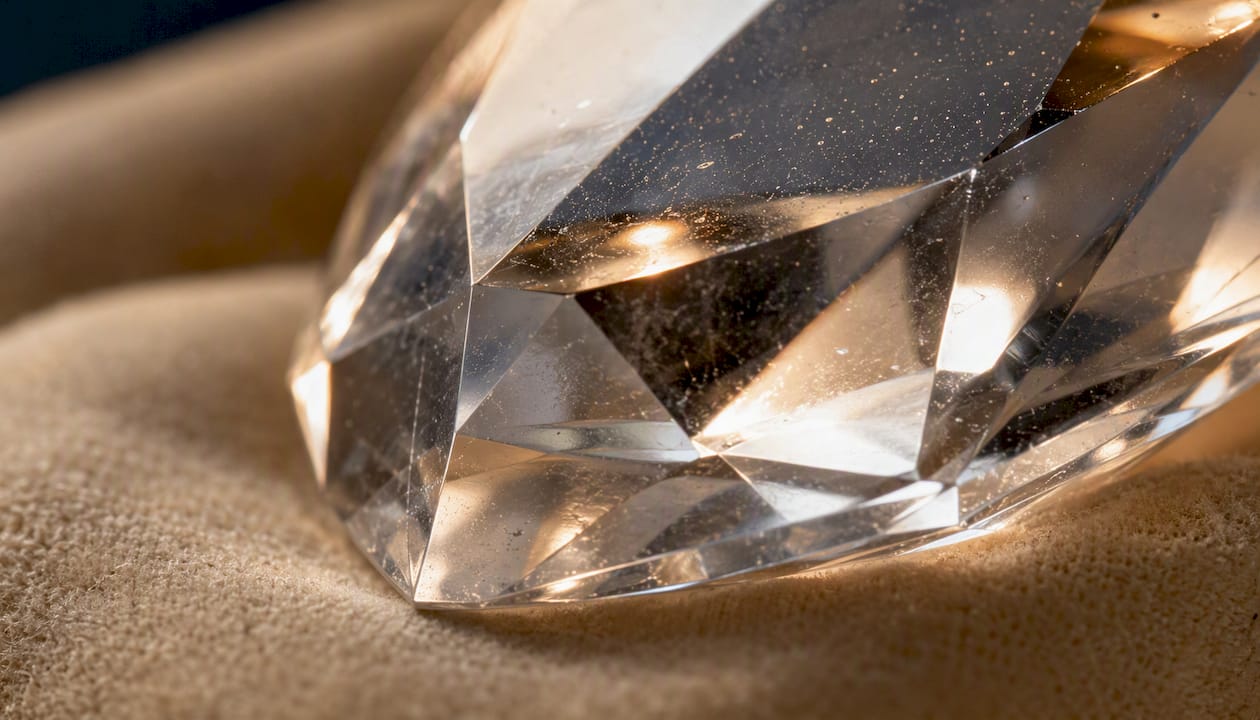
Durability comes down to different factors entirely: clarity characteristics like feathers near the girdle, the cut’s proportions, and how the stone is set. A diamond rated 10 on the Mohs scale doesn’t become softer or more brittle because it glows blue under a UV lamp. If anything, worrying about fluorescence and durability in the same breath is a category error, they’re unrelated properties measured by unrelated tests.
Where confusion creeps in is the “overblue” haziness some buyers encounter. That milky look isn’t fluorescence damaging the stone; it’s usually pre-existing nano-inclusions or structural graining that fluorescence happens to make more visible under specific lighting. The underlying defect was always there. Fluorescence doesn’t create weakness, it occasionally reveals an optical quirk that a defect-free stone wouldn’t show at all.
For everyday wear, from an engagement ring worn daily to an heirloom passed down for decades, fluorescence grade simply isn’t a variable worth factoring into your durability assessment. Cut quality and clarity plot, covered in detail in our cut grade guide, matter far more to long-term wearability than whether a stone glows under a blacklight.
Can fluorescence throw off a diamond’s grading accuracy?
Fluorescence itself doesn’t distort a diamond’s colour or clarity grade, since labs grade colour under controlled, UV-filtered lighting specifically to remove that variable. But the interaction between fluorescence and lighting conditions is exactly why some buyers end up confused when a stone looks different in the shop than it did in the lab photo.
Grading happens under standardised daylight-equivalent bulbs with calibrated UV output. That consistency is what makes GIA reports comparable stone to stone. The catch is that real-world lighting varies wildly, and some lab studies note measurable contrast loss under strong UV excitation in certain fluorescent stones, though this alone doesn’t create the milky appearance unless structural defects are also present.
This is where measurement nuance matters more than most buyers realise. A “Strong” fluorescence grade tells you the intensity under a specific UV wavelength in laboratory conditions. It doesn’t tell you exactly how that stone will behave under your bathroom mirror lighting, your office desk lamp, or bright July sunshine. Two stones both graded Strong can present slightly differently depending on the exact defects present alongside the fluorescence.
The practical takeaway: the grade is accurate as a laboratory measurement, but it’s a starting point for judging real-world appearance, not a guarantee of it. That’s precisely why in-person or video verification under multiple lights matters more for fluorescent stones than for non-fluorescent ones, where lighting variation barely registers.
The biggest myths about diamond fluorescence
Myth one: fluorescence always makes a diamond hazy or milky. It doesn’t. Fewer than 0.2% of fluorescent diamonds show this effect, and even then, structural defects are usually the real cause, fluorescence just makes them more visible.
Myth two: strong fluorescence means a lower quality stone. Fluorescence and quality are graded independently. A Strong fluorescent, VVS1, Excellent cut diamond is still a Strong fluorescent, VVS1, Excellent cut diamond; nothing about the glow demotes the other grades.
Myth three: you’ll notice fluorescence every time you wear the ring. GIA’s research found ordinary observers can’t consistently detect a fluorescence-driven appearance effect under everyday viewing conditions. The dramatic blue glow you see under a jeweller’s UV torch simply isn’t visible in normal light.
Myth four: fluorescence is always a discount trigger. It sometimes is, particularly on colourless stones, but it’s occasionally a selling point on lower colour grades where blue fluorescence helps mask yellow tint. Treating it as a flat negative ignores half the picture.
Myth five: any glow under UV is a red flag for treatment or synthetic origin. Fluorescence occurs naturally in a substantial minority of natural diamonds and isn’t, by itself, evidence of treatment. It’s simply a trace-element response, present in plenty of untreated, natural stones bought and sold every day.
Does the type of UV light matter when checking fluorescence?
Yes, and this trips up more buyers than any other practical detail. Diamonds fluoresce specifically under long-wave UV, roughly 365 nanometres. Short-wave UV lamps, the kind used in some mineral identification kits, produce a different and often much weaker response.
A cheap keychain UV torch, the sort sold for checking banknotes, often emits a mix of wavelengths and considerably less power than a proper gemmological long-wave lamp. Testing a diamond under one of these and concluding “it doesn’t fluoresce” can be misleading; the lamp may simply be too weak or the wrong wavelength to trigger a visible response that a lab-grade UV source would catch instantly.
Daylight itself contains a measurable UV component, which is precisely why colour masking from blue fluorescence is more likely outdoors or near a window than under typical indoor LED lighting, which carries far less UV output. That’s not a coincidence, it’s the same underlying mechanism at play in both the lab and your living room.
If you’re testing a stone yourself, don’t rely on a single light source and assume you’ve got the full picture. A proper long-wave UV lamp, daylight near a window, and standard indoor lighting each tell you something different about how that specific stone will behave across the situations you’ll actually wear it in.
Fluorescence in natural diamonds versus lab-grown and treated stones
Fluorescence appears in both natural and lab-grown diamonds, but the underlying cause and typical pattern differ. In natural stones, fluorescence usually stems from trace boron or nitrogen-related structural defects that formed over the diamond’s geological history.
Lab-grown diamonds, created via CVD or HPHT processes, can also fluoresce, and the intensity or colour pattern sometimes differs from what’s typical in natural stones. Some CVD-grown diamonds show fluorescence patterns, including uneven or patchy zones, that experienced gemmologists use as one clue among several when distinguishing lab-grown from natural origin.
Treated diamonds, ones that have undergone HPHT processing to improve colour, or irradiation to alter it, can also show altered fluorescence characteristics compared with how the same stone fluoresced before treatment. This is one reason labs treat fluorescence pattern and intensity as part of a broader identification toolkit rather than a single deciding factor.
For the average buyer, the takeaway is straightforward: fluorescence alone doesn’t tell you whether a stone is natural, lab-grown or treated. That determination needs proper laboratory testing, spectroscopy and trained examination, not a UV torch in a shop. If origin matters to you, always work from a lab report that states it explicitly, rather than drawing conclusions from fluorescence colour or intensity on your own.
A publisher’s honest preference on fluorescence
I lean towards embracing fluorescence on lower colour grades, where it genuinely earns its place, and treating it with mild caution only on colourless stones. Value seekers can use it well; perfectionists should inspect in daylight first; nervous first-time buyers should simply ask more questions before deciding.
How Blackwell Jewellers helps you buy with confidence
Every fluorescent diamond in our pre-owned collection has already been through lab report verification, UV testing and a face-up contrast check by our in-house jewellers, so you’re not relying on guesswork or a seller’s word alone.

Unlike buying blind from an online marketplace where you can’t test lighting conditions yourself, our Kent stores let you book an in-store UV demonstration and compare a fluorescent stone against a non-fluorescent equivalent side by side. If you’re closer to Maidstone, our second-hand showroom there carries authenticated diamond pieces ready for exactly this kind of comparison, and our repair and restoration service means any structural concern gets addressed under one roof rather than passed between different specialists. Visit a Blackwell Jewellers store or browse our online collection to arrange an inspection before you commit to a fluorescent stone.
Frequently asked questions
Is diamond fluorescence good or bad? Neither, for most buyers. It’s a neutral trait that occasionally helps lower-colour stones look whiter and, in extremely rare cases, contributes to haziness alongside existing structural defects.
Can I see fluorescence without a UV lamp? No. Fluorescence only appears under long-wave ultraviolet light. In normal daylight or indoor lighting, a fluorescent diamond looks like any other diamond of the same colour and clarity.
Does blue fluorescence lower a diamond’s value? Sometimes, particularly on colourless (D to H) stones, where strong fluorescence has historically triggered trade discounts. On lower colour grades, it can occasionally support a modest premium instead.
How do I know if my diamond fluoresces? Check the fluorescence field on your lab report. It will state None, Faint, Medium, Strong or Very Strong, and note the colour if it’s Medium or above.
Does fluorescence affect how long rhodium plating lasts on a white gold setting? No, fluorescence is a property of the diamond, not the metal. Rhodium plating wear depends on daily wear, skin chemistry and how often the ring is worn, and typically needs reapplying every 12 to 18 months regardless of the stone’s fluorescence grade.
Sources
- Measurement and characterization of the effects of blue fluorescence on diamond appearance
- More info about fluorescence | Gemological Institute of America - 4Cs
- Diamond fluorescence: evidence-based questions and answers – Diamond Screener