
TL;DR:
- Couples often feel overwhelmed by wedding band options due to the diverse styles, materials, and personalization choices available. Choosing a ring that suits their lifestyle, comfort, and personal meaning ensures satisfaction that endures for decades, rather than succumbing to fleeting trends. Engaging with experts and considering practical aspects like metal durability, fit, and sentimental details helps couples find their perfect, lasting symbol of love.
Most engaged couples walk into a jeweller expecting to pick a plain metal circle and walk out ten minutes later. Then they see the options. Suddenly there are court bands, flat bands, hammered finishes, pavé diamonds, bi-metal combinations, and about six different types of gold. Explaining wedding band designs properly is not something most people bother doing, which is why so many couples end up overwhelmed or, worse, underwhelmed by their final choice. This guide covers the styles, materials, and personalisation options you actually need to know, so you can make a decision you will still love decades from now.
Table of Contents
- Key takeaways
- Popular wedding band styles explained
- Wedding band materials explained
- Personalisation and finishing touches
- How to choose complementing bands
- My honest take on all of this
- Find your perfect band at Blackwelljewellers
- FAQ
Key takeaways
| Point | Details |
|---|---|
| Style affects comfort as much as looks | Court and comfort-fit bands reduce daily pressure on the finger, making them better for all-day wear. |
| Metal choice has real consequences | Durability, tarnish resistance, skin sensitivity, and cost all vary significantly between gold, platinum, and alternative metals. |
| Personalisation goes beyond engraving | Gemstone settings, mixed metals, and surface finishes all offer ways to make a band genuinely unique. |
| Pairing with your engagement ring matters | Width, metal, and profile all influence whether your rings sit well together on the hand. |
| Pre-owned bands are a smart option | Authenticated second-hand wedding bands offer verified quality at better value without compromising on craftsmanship. |
Popular wedding band styles explained
Right, let us start with shapes. Because yes, the shape of a wedding band is an actual thing, and it makes a surprisingly big difference to how a ring feels after eight hours on your finger.
Court bands are the most popular style in the UK. Court bands offer comfort fitting thanks to their curved inner surface, which moulds to your finger rather than sitting flat against it. They look traditional from the outside and feel effortless to wear. If you have no strong preference and just want something you will forget you are wearing, court is almost always the right call.
Flat bands are exactly what they sound like. The inside is flat, the outside is flat, and the profile has a more contemporary, architectural feel. They suit people who want something minimal and modern. The trade-off is that flat bands can feel slightly rigid on the finger compared to court profiles.
Domed bands sit somewhere in between, with a slightly rounded exterior and a flatter interior. They catch light nicely and tend to look fuller on the hand than flat bands of the same width.
Hammered bands are a different story altogether. The surface is textured, with irregular facets created by a hammer or a mechanical tool. The result is a ring that looks hand-crafted and uniquely tactile. A hammered finish masks scratches remarkably well over time, because the texture already breaks up the surface.
Milgrain edging is not a band shape in itself but a decorative detail. It refers to tiny beaded borders running along the edges of a band, giving it a vintage, ornate feel. It is particularly popular on bands designed to complement antique-style engagement rings.
Here is a quick breakdown to help you visualise the differences:
- Court: Curved inside and outside, most comfortable, traditional appearance
- Flat: Straight edges, modern look, slightly firmer feel on the finger
- Domed: Curved exterior, flatter interior, sits fuller on the hand
- Hammered: Textured surface, rustic and artisanal, excellent at hiding wear
- Milgrain: Beaded edge detail, vintage aesthetic, pairs beautifully with intricate engagement rings
Pro Tip: If your job involves working with your hands, going to the gym regularly, or anything where your fingers take a bit of a battering, go for a court or comfort-fit profile. The rounded interior reduces pressure on the finger and holds up far better during active daily wear.
Wedding band materials explained
This is where people get genuinely confused. And honestly? It is understandable. There are more metal options than there used to be, and the differences between them are not always obvious just by looking.
Here is a comparison of the most common wedding band materials to help you make sense of it all:
| Metal | Durability | Tarnish resistance | Hypoallergenic | Resizable | Price range |
|---|---|---|---|---|---|
| 9ct yellow gold | Good | Good | Rarely | Yes | Budget-friendly |
| 18ct yellow gold | Moderate | Very good | Rarely | Yes | Mid to high |
| 18ct white gold | Moderate | Good (rhodium needed) | Sometimes | Yes | Mid to high |
| Rose gold | Moderate | Good | Rarely | Yes | Mid to high |
| Platinum | Excellent | Excellent | Yes | Yes | Premium |
| Titanium | Excellent | Excellent | Yes | Limited | Mid |
| Tungsten | Very high | Excellent | Yes | No | Budget to mid |
Gold remains the most popular choice for wedding bands in the UK. 18ct gold contains 75% gold, giving it a richer colour, while 9ct is harder and more affordable because of the higher alloy content. White gold gets its colour from alloys and is usually rhodium-plated to maintain its bright, silver-like appearance. That plating does wear off over time, so occasional re-plating is part of the maintenance.
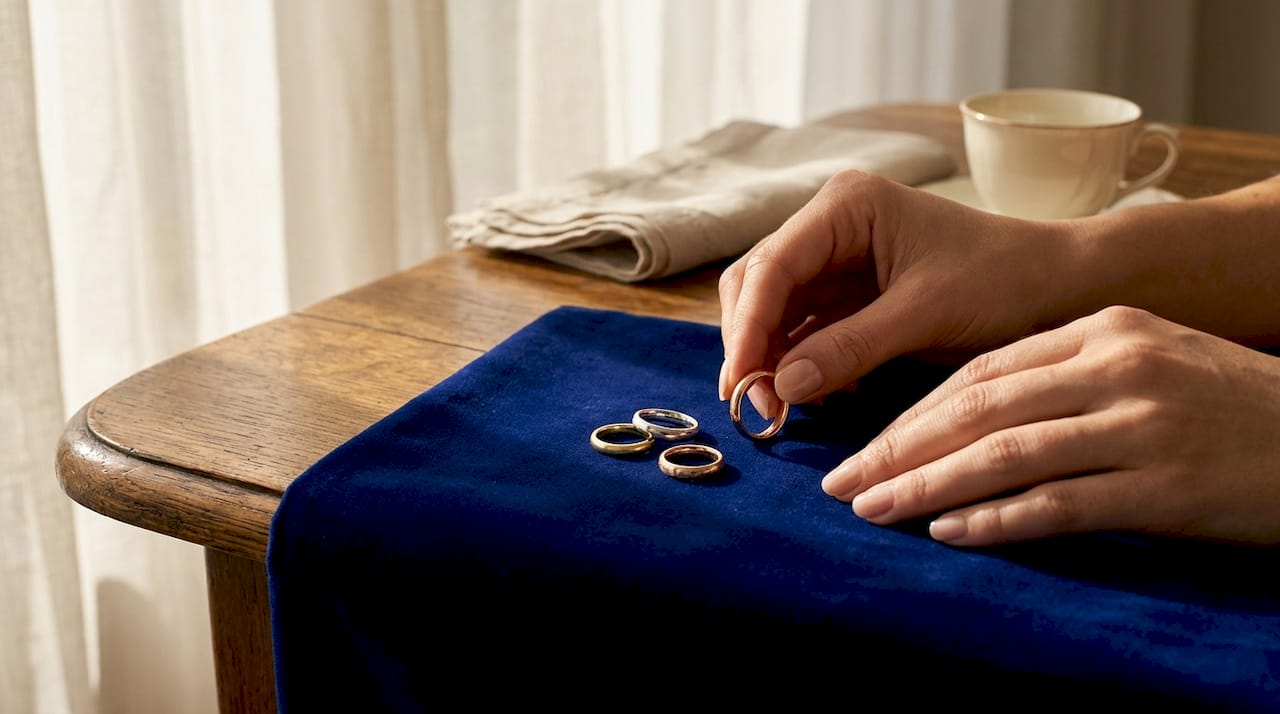
Rose gold has grown enormously in popularity. Its warm, pinkish tone works beautifully as a contrast metal when paired with white gold or platinum engagement rings.
Platinum is the premium choice. Platinum does not tarnish and is naturally hypoallergenic, making it the go-to for anyone with sensitive skin. It is also denser than gold, so a platinum ring of the same size will feel noticeably heavier. That weight feels luxurious to some people. Others find it a bit much after a full day.
Titanium and tungsten are the modern alternatives. These metals are stronger and more scratch-resistant than gold, which appeals to people who want low-maintenance bands. The catch is that tungsten cannot be resized and is extremely difficult to cut off in an emergency, which matters more than you might think if your ring size changes or you have an accident. For a broader look at how different metals compare for everyday jewellery, this material guide is worth a read.
Pro Tip: If you are torn between platinum and white gold, think about your lifestyle rather than the price tag. Platinum develops a natural patina over time. Some people love it. Others prefer the bright shine of rhodium-plated white gold. Neither is wrong, they are just different.
Personalisation and finishing touches
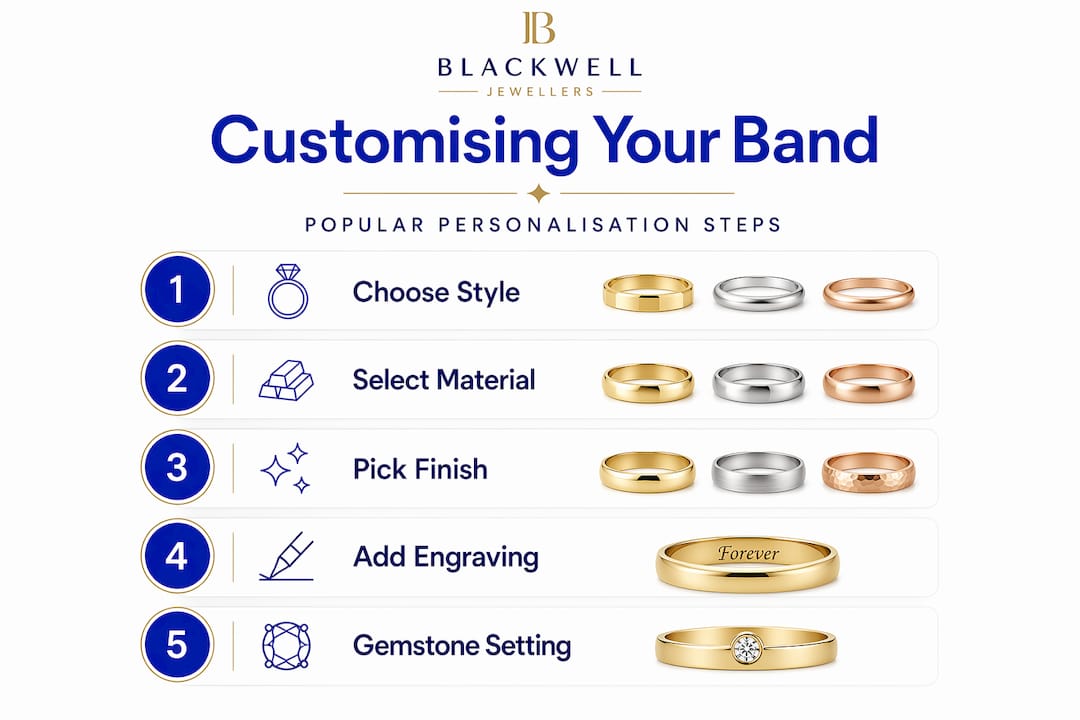
Here is where understanding wedding band styles gets genuinely fun. Once you know your shape and metal, you can start thinking about all the ways to make the band actually yours.
The most common personalisation options are:
- Gemstone settings: Diamonds, sapphires, rubies, or emeralds can be set into bands using different techniques. Pavé settings feature tiny stones set close together across the surface. Channel settings place stones in a groove cut into the metal, protecting them on the sides. Bezel settings encase the stone fully in metal, offering maximum protection for daily wear while giving a sleek, contemporary look.
- Engravings: Hidden engravings inside the band are one of the most timeless ways to personalise a wedding ring. A date, a name, a private joke, a line from a song. Nobody sees it but the two of you. You can also have engravings on the outer surface for a more visible personal statement.
- Surface finishes: High polish gives a bright, mirror-like shine. Matte or brushed finishes are softer and more understated. Hammered finishes (mentioned above) add texture and character. Some bands combine finishes, with a polished centre and brushed edges, which creates a striking contrast.
- Mixed metal and bi-metal bands: These combine two different metals in one ring, such as yellow gold rails with a platinum centre, or rose gold inlaid into titanium. They can look extraordinary and are a brilliant way to honour both partners’ preferences in a shared design.
The cost of personalisation varies significantly. A simple engraving is usually modest. Pavé diamond settings across a full band, on the other hand, will add considerably to the price. Think about which details you will actually notice and appreciate every day.
How to choose complementing bands
This is the practical bit that a surprising number of couples overlook until it is almost too late.
- Consider the width first. A very slim engagement ring can look lost next to a wide wedding band. And a chunky band next to a delicate solitaire tends to crowd it. As a rough guide, try to keep widths within a similar range unless you are going deliberately for contrast.
- Think about metal compatibility. Matching metals creates a harmonious set, but mixed metals are completely acceptable if the contrast is intentional and consistent. Mismatched metals that happen by accident rather than design tend to look unfinished.
- Test the profile together. If your engagement ring has a raised setting, your wedding band will need a curved or contoured profile to sit flush against it. A flat band will leave a gap, which is not ideal either aesthetically or practically (things get caught in gaps).
- Factor in your job and hobbies. A stone-set band is a bad idea if you work with your hands regularly. Stones can loosen, and delicate settings are vulnerable to impact. A simple, smooth metal band is far more practical for active lifestyles.
- Try both rings on together before you commit. This sounds obvious. You would be amazed how many couples do not do it until the day.
Common mistake to avoid: Do not buy your wedding band months before your engagement ring is finished, especially if the engagement ring is bespoke. The profile and dimensions of the finished engagement ring will determine what wedding band options work best.
My honest take on all of this
I have spent years watching couples agonise over wedding band decisions, and I will tell you what I have genuinely noticed. The people who are happiest with their bands years later are almost never the ones who chased the trendiest design. They are the ones who picked something that felt right on their hand, matched their actual daily life, and meant something personal to them.
There is a tendency to over-complicate this. You see a stunning pavé diamond band on social media and think you need it. Then six months into wearing it, you are worried about losing stones every time you wash your hands. Trends shift quickly. A beautifully simple court band in a metal you love, with a meaningful engraving inside, will outlast any Instagram trend by decades.
What I find genuinely moving is when couples bring their own stories into the design. The couple who used their pet’s pawprint as an engraving motif. The person who chose the exact metal their grandmother’s ring was made from. That is what makes a wedding band last, not the price or the finish. The meaning behind it.
My advice? Wear the ring in your imagination before you buy it. Think about 10 years from now, not just the wedding day. Choose comfort. Choose meaning. Choose something that feels like you, not something that felt like you on Pinterest.
— James
Find your perfect band at Blackwelljewellers
If this guide has helped you realise there are a lot more wedding band design options than you thought, the next step is talking to someone who actually knows what they are looking at. At Blackwelljewellers, the team offers bespoke wedding band consultations at their Maidstone studio, where you can work through style, metal, and personalisation options with expert guidance. Whether you want something made entirely from scratch or need help pairing a new band with an existing engagement ring, they have the in-house craftsmanship to make it happen. If budget is a consideration, the authenticated second-hand collection includes hallmarked, inspected wedding bands that offer genuine quality without the new price tag. Pop into one of the Kent stores or browse online at Blackwell Jewellers.
FAQ
What is the most comfortable wedding band shape?
Court bands are widely considered the most comfortable option because of their curved inner surface. Comfort-fit bands reduce pressure on the finger, which makes a noticeable difference during all-day wear.
Is platinum better than gold for a wedding band?
Platinum is more durable and hypoallergenic, but gold is easier to maintain and available in warmer tones. The better choice depends on your skin sensitivity, lifestyle, and budget rather than any objective ranking.
Can you mix metals between your engagement ring and wedding band?
Yes, absolutely. Mixed metals are popular today for couples who want a distinctive look. The key is making the contrast feel intentional rather than accidental, which usually means keeping finishes consistent.
What does a bezel setting mean on a wedding band?
A bezel setting encases a gemstone in a rim of metal rather than using prongs. It offers more protection for the stone during daily wear and gives the ring a modern, low-profile look.
Can titanium or tungsten wedding bands be resized?
Not easily. Titanium is difficult to resize and tungsten cannot be resized at all. If there is any chance your ring size might change, gold or platinum are much safer choices for long-term wearability.