
TL;DR:
- Choosing engagement and wedding rings requires considering how the setting, shape, and metal work together for daily comfort and aesthetic harmony. Opting for different styles or metals is acceptable if the overall look feels balanced and intentional, prioritizing personal taste over traditional matching. Trying combinations in person and focusing on comfort ensure the rings will stay beautiful and functional for a lifetime.
You’ve got the ring. Now comes the bit nobody warns you about. Figuring out how to match engagement and wedding rings is genuinely one of the trickiest decisions in the whole wedding planning process, and yet it gets about a tenth of the attention it deserves. You’ll wear both of these rings every single day, probably for the rest of your life. Getting them to look and feel right together actually matters. This guide covers everything: settings, band shapes, metals, common blunders, and how to build a ring combination that feels completely, unmistakably you.
Table of Contents
- Key takeaways
- How to match engagement and wedding rings: understanding what you’re working with
- Choosing the right wedding band: a practical step-by-step
- Common mistakes couples make when pairing rings
- Trends and personalisation: beyond the traditional matched set
- My honest take on matching rings
- Find your perfect ring pairing with Blackwelljewellers
- FAQ
Key takeaways
| Point | Details |
|---|---|
| Start with the engagement ring | Your engagement ring is the anchor. Every band choice should respond to its setting, height, and width. |
| Fit matters as much as looks | Rings that rub, gap, or shift uncomfortably will drive you mad within a week, regardless of how pretty they look. |
| Mixing metals can absolutely work | Keep roughly 60 to 70% of your stack in one metal tone and the contrast reads as intentional, not accidental. |
| You don’t have to match perfectly | A cohesive, balanced look beats exact matching every time. Shared design language does the heavy lifting. |
| Try combinations in person | Photos lie. The only way to know if a pairing works is to physically put it on your hand and wear it for five minutes. |
How to match engagement and wedding rings: understanding what you’re working with
Before you start browsing wedding bands, you need to get properly acquainted with your engagement ring. Not just “oh it’s a solitaire with a round diamond.” We’re talking about the specifics that actually control what will and won’t work alongside it.
Setting type is the big one. Here’s a quick breakdown of how common settings behave in a stack:
- Solitaire settings are the most forgiving. A simple four or six prong solitaire works with almost any band shape, which is why they’re so popular.
- Halo settings are trickier. The outer ring of stones creates a wider footprint, so curved bands fit the halo shape far better than straight ones to avoid an ugly gap at the sides.
- Cathedral settings sit high off the finger on arched shoulders, which means a flat or thin band often looks lost beside them.
- Bezel settings have a clean, low profile and pair beautifully with flat, minimalist bands.
- Three-stone settings often have a more complex silhouette and benefit from a contoured or shadow band that echoes their shape.
Band profile matters more than most people realise. A court profile (rounded inside and outside) feels very different to a flat court or a D-shape, and those differences become obvious when you’re stacking. Width and height also dictate whether your engagement ring sits level or tilts.
Here’s a handy reference:
| Engagement ring type | Best band pairing | What to avoid |
|---|---|---|
| Round solitaire | Straight, curved, or pavé band | Overly wide bands that dwarf the setting |
| Halo setting | Contoured or shadow band | Straight bands (creates side gaps) |
| Cathedral setting | Low-profile, thin band | Very thick bands that compete with the arched shoulders |
| Bezel setting | Flat, minimalist, or flush-set band | Ornate bands that clash with the clean aesthetic |
| Three-stone | Shadow or contoured band | Stiff straight bands that leave visible gaps |
Pro Tip: Take your engagement ring into the shop with you. Don’t rely on your finger size alone. The height of your setting will affect how any new band sits, and you won’t know until you see them side by side.
Finally, think about metal colour. Rose gold, yellow gold, white gold, platinum: they each have a different warmth, tone, and finish. Intentional design language like shared metal tone or a balanced profile creates cohesion even when the rings differ in texture or shape.
Choosing the right wedding band: a practical step-by-step
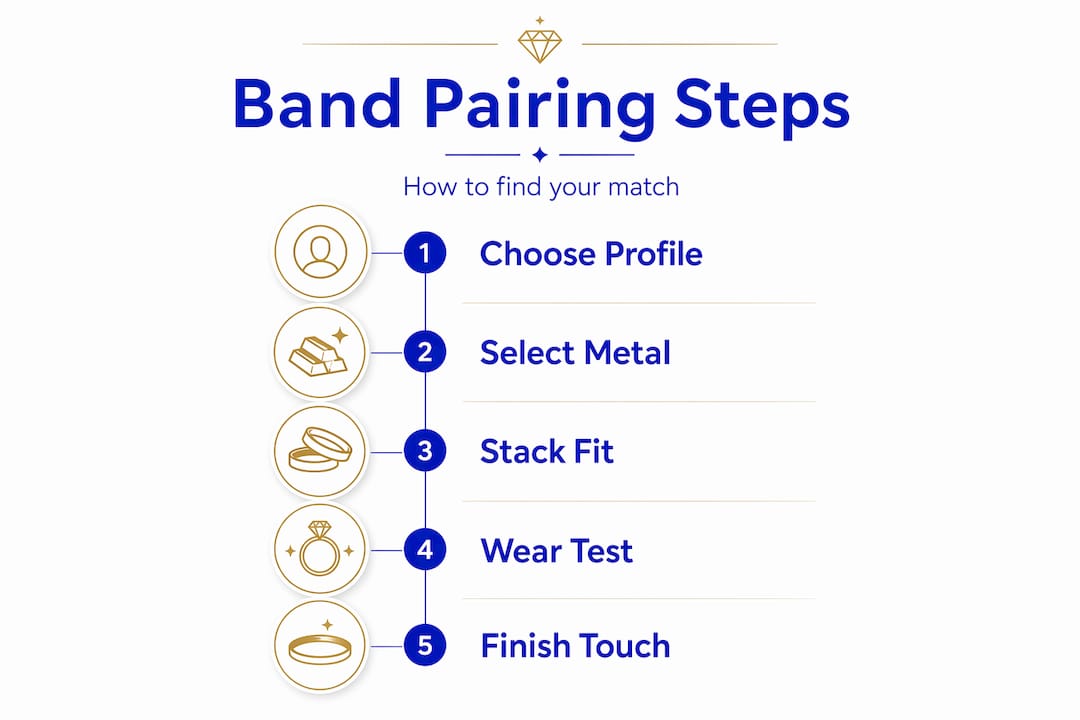
Right. You know your engagement ring inside out. Now here’s how to actually go about choosing a wedding band that works with it. Think of this as a decision process, not a shopping list.
- Treat your engagement ring as the anchor. Every choice flows from it. Its metal, height, width, and setting style set the boundaries of what will look balanced.
- Match metal type and, where possible, purity. Metal purity affects durability and wear rate. Mixing 18ct and 14ct gold in the same stack can cause uneven scratching and ageing over time.
- Decide on texture and finish. Do you want your band to mirror the engagement ring (matching pavé with pavé, for example) or provide contrast (a matte band against a brilliant polished ring)? Both approaches work. You just need to pick one intentionally.
- Choose a band shape that complements the setting geometry. This is where the geometry of your engagement ring setting largely determines the ideal band shape for a seamless look. Halo needs a curve. Solitaire can take a straight band. Cathedral often needs something slim.
- Think about comfort in daily wear. You’re not just wearing this to look at in photos. You’re washing up in it, typing in it, and sleeping next to someone who will definitely notice if you fidget with it at 2am.
- Try combinations in person. Seriously. Seeing and feeling a combination on your actual hand reveals fit and visual compatibility in a way that no online image can replicate.
- Consider future stacking. Do you want to add an anniversary band eventually? Think about how a third ring would sit in the stack now, even if you’re not buying it yet. Many couples now view wedding bands as a design system that evolves over time rather than a fixed matching set.
- Revisit sizing. Stacking multiple rings takes up more surface area on the finger. You may need to size up slightly on the wedding band to keep things comfortable.
Pro Tip: If your engagement ring has a high setting that tends to spin or rub against a wedding band, a thin spacer band (around 1mm wide) placed between the two rings acts as a buffer. It prevents the setting from catching on the band and protects any side stones from contact damage.
You can find a thorough breakdown of band shapes and profiles in the Blackwelljewellers wedding band guide if you want to dig even deeper before your visit.
Common mistakes couples make when pairing rings
Let’s talk about what goes wrong. Because plenty of people get this bit wrong, and they only find out after the wedding day.
- Choosing a band that’s too wide for the setting. A chunky 5mm band next to a delicate solitaire makes the engagement ring look like it’s being bullied. The proportions matter enormously.
- Ignoring the height of the engagement ring setting. High-profile settings like cathedral mounts create a significant gap above a flat wedding band. That gap looks odd and often allows the rings to move independently on the finger.
- Mixing metal purities without thinking it through. As mentioned above, softer 18ct gold scratches faster than 14ct and will show wear unevenly in a stack. If you want to mix metals for aesthetic reasons, at least match the karatage to keep wear rates consistent.
- Assuming “matching” means identical. This is probably the most widespread misconception. Creating a balanced, cohesive look matters far more than buying rings from the same set. Plenty of beautiful ring pairings involve two pieces from completely different collections.
- Forgetting about the wearing order. Traditionally, the wedding band sits closest to the heart on the left ring finger, with the engagement ring stacked above it. But some people find this order uncomfortable, especially with a high-set engagement ring. There’s no law here.
“There is no single correct way to wear or match engagement and wedding rings. Personal style, comfort, and meaning should guide choices over strict tradition.” — GIA 4Cs
One thing that surprises people: rings that rub or have awkward spacing cause real problems in everyday wear. The diamonds in a halo can snag on a neighbouring band’s prongs. A cathedral shoulder can grind against a thick wedding ring. These things are annoying at best and damaging at worst.
The fix is often a contoured band, a spacer, or simply going up a width. None of these are drastic solutions. They just require you to notice the problem before the wedding rather than after it.
Trends and personalisation: beyond the traditional matched set
Here’s the genuinely exciting part. The whole idea of the “matching set” is quietly falling out of fashion, and honestly? Good. Couples are getting far more creative, and the results are often far more personal.
- Mixing metals intentionally. Rose gold with white gold, or yellow gold with platinum. It sounds bold, but it works brilliantly when you keep roughly 60 to 70% of your stack in one dominant tone. The contrast reads as a deliberate design choice rather than a mismatch.
- Bespoke contoured bands. These are bands designed specifically to fit around the exact profile of your engagement ring, like a puzzle piece. They’re particularly popular with halo and shaped solitaire settings. Blackwelljewellers offers a full bespoke design service if you want something made precisely for your ring.
- Stacking multiple thinner bands. Instead of one wedding band, some couples opt for two or three slim bands worn together. This lets you build and evolve the stack over time, adding an anniversary band at five years, say, or marking another milestone.
- Coloured gemstone accents. Birthstones, sapphires, or emeralds in a wedding band add personal meaning without competing with the engagement ring’s centre stone. A band with a single ruby flush-set into it, for example, is subtle but deeply personal.
- Wearing rings on different hands. Some couples choose to wear the engagement ring on the right hand and the wedding band on the left, especially if the two rings don’t sit comfortably together. Personal preference or comfort may lead to reversing the order or wearing rings separately, and there is genuinely nothing wrong with that.
Pro Tip: Start with your engagement ring and let it lead every other decision. The most coherent stacks are built from one strong anchor piece outward, not from two rings picked simultaneously and forced to coexist.
If you want to see what’s driving current choices in metal and finish, the metal trends for 2026 piece over on the Blackwelljewellers blog covers it well.
My honest take on matching rings
I’ve seen a lot of couples agonise over this, and I want to say something that might save you a significant amount of stress.
The pursuit of the “perfectly matched set” is a bit of a trap. You end up chasing a visual ideal that looks great in a catalogue and feels sterile on an actual finger. The ring combinations I’ve seen that genuinely work are the ones where someone thought carefully about comfort and personal meaning first, and aesthetics second.
What I’ve learned is this: the engagement ring you chose reflects something real about who you are. The wedding band should respond to that, not compete with it. Sometimes that means a near-invisible plain platinum band that lets the diamond breathe. Sometimes it means three stacked gold rings of slightly different textures that tell a story about different chapters of life.
The physical comfort thing is something I feel strongly about. I’ve watched people fall in love with a ring combination in a shop and come back six months later frustrated because the two rings rock, or rub, or never quite sit right. Treating both rings as a daily-wear system means thinking about how they interact on your finger in motion, not just how they look in a photo sitting still.
So my advice: spend less time matching and more time wearing. Try things on. Sit with them. Walk around the shop for ten minutes. If a combination feels right on your hand, it probably is.
— James
Find your perfect ring pairing with Blackwelljewellers
Whether you’re starting from scratch or trying to find the ideal wedding band to complement an existing engagement ring, Blackwelljewellers can help you get there.

If you want something truly unique, the bespoke design service in Maidstone lets you create a contoured or custom wedding band built precisely around your engagement ring. No compromises, no gaps, no awkward rubbing. Just a ring made specifically for yours. And if budget is a consideration, the pre-owned ring collection includes authenticated, hallmarked pieces that are every bit as beautiful as new, at a fraction of the price. For rings that already need a little attention before the big day, the jewellery repair service covers resizing, refinishing, and structural work. Pop into any of the Kent stores or browse online at Blackwelljewellers for a proper look.
FAQ
Do engagement and wedding rings have to match?
No. A balanced, cohesive look matters far more than exact matching. Shared metal tone or a complementary profile is usually enough to make two different rings look intentional together.
Which ring should you wear closest to your hand?
Traditionally, the wedding band sits closest to the heart, with the engagement ring stacked above it. That said, personal comfort and cultural customs vary, and there is no strict rule.
Can you mix metals in an engagement and wedding ring stack?
Yes, and it can look brilliant. Keep the majority of your stack in one metal tone and introduce the second as an accent. Aim for roughly a 60 to 70% dominant metal for the contrast to read as deliberate rather than accidental.
What band shape works best with a halo engagement ring?
A curved or contoured band is the best match for a halo setting. Curved bands fit the halo shape specifically to prevent the visible side gaps that a straight band would create.
Should you size up when adding a wedding band?
Often, yes. Stacking multiple rings increases the surface area on the finger, which can make the fit feel tighter. Try both rings together on your finger when sizing to get an accurate measurement.