

TL;DR:
- HPHT and CVD are two distinct methods for growing laboratory diamonds, with differences in growth environments, physical characteristics, and market applications. While both produce identical chemical compositions, HPHT diamonds form under high pressure and temperature with metallic inclusions, whereas CVD diamonds grow layer by layer with collimated striations and often require post-growth treatment. Verification requires specialized spectroscopic and microscopic analysis, highlighting the importance of independent certification and expert assessment for authentication.
High Pressure High Temperature (HPHT) and Chemical Vapour Deposition (CVD) are the two principal methods used to grow laboratory diamonds, and understanding the difference between them is non-negotiable for anyone buying, selling, or authenticating stones. Both processes produce diamonds with the same chemical composition as their mined counterparts — pure carbon in a cubic crystal lattice — but the growth environments, resulting characteristics, and market implications diverge significantly. For investors and gemologists, knowing your HPHT from your CVD is not a nice-to-have. It is the foundation of accurate valuation and reliable authentication. This guide covers the technical differences, physical traits, production economics, and verification methods you actually need.
How HPHT vs CVD processes differ at a fundamental level
The two methods could not be more different in terms of engineering approach, even though the end product looks identical to the naked eye.
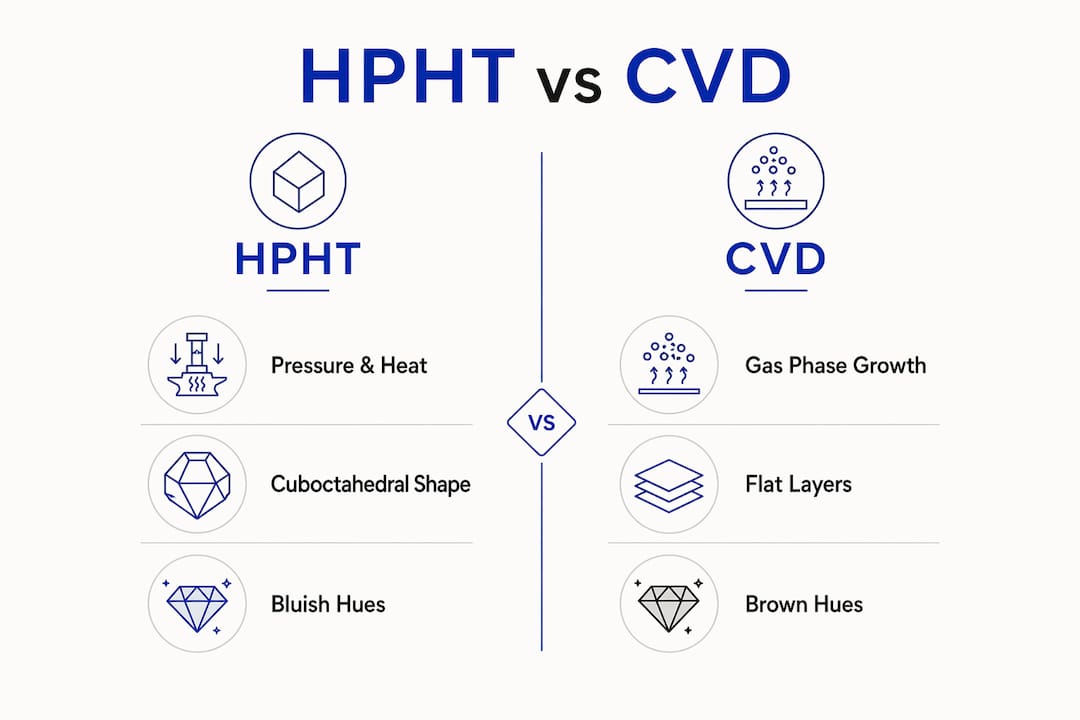
HPHT simulates earth’s mantle conditions by subjecting a carbon source and a diamond seed to pressures exceeding 1.5 million pounds per square inch and temperatures above 1,400°C. The carbon dissolves into a molten metal flux (typically iron, nickel, or cobalt) and then crystallises around the seed as conditions stabilise. The result is a cuboctahedral crystal with 14 distinct growth directions. It is, essentially, a very expensive pressure cooker doing what the earth takes billions of years to do.
CVD takes the opposite approach entirely. CVD grows diamonds by introducing a methane-hydrogen gas mixture into a low-pressure plasma chamber, where microwave energy breaks the gas into reactive carbon species that deposit atom by atom onto a diamond seed. No extreme pressure required. The diamond builds up in flat cubic layers, growing in a single direction. Think of it less like forging and more like painting, one impossibly thin carbon layer at a time.
The specific reactor type matters enormously in CVD production. Microwave Plasma CVD (MPCVD) reactors are the industry standard for gem-quality stones, and plasma uniformity critically influences diamond quality and growth rate. A 2026 IOPscience study confirmed that small geometric adjustments, such as substrate height and edge chamfering, can reduce electric field non-uniformity to less than 4%, which translates directly into better crystal quality and fewer inclusions.
Pro Tip: When evaluating a CVD diamond from a supplier, ask specifically which reactor configuration was used. MPCVD-grown stones from optimised reactors consistently outperform those from older or poorly calibrated systems, regardless of the CVD label on the certificate.
Key process parameters that separate a mediocre CVD diamond from an exceptional one include:
- Methane concentration (higher ratios accelerate growth but risk defects)
- Microwave power stability (fluctuations create strain and discolouration)
- Substrate temperature uniformity (hot spots cause uneven crystal growth)
- Chamber pressure (must remain tightly controlled throughout the growth cycle)
HPHT, by contrast, has fewer variables to manage but is far less forgiving when things go wrong. A pressure failure mid-growth typically destroys the entire batch.
How do HPHT and CVD diamonds differ in appearance and quality?
Here is where it gets genuinely interesting for gemologists, because the two methods leave fingerprints you can actually detect.
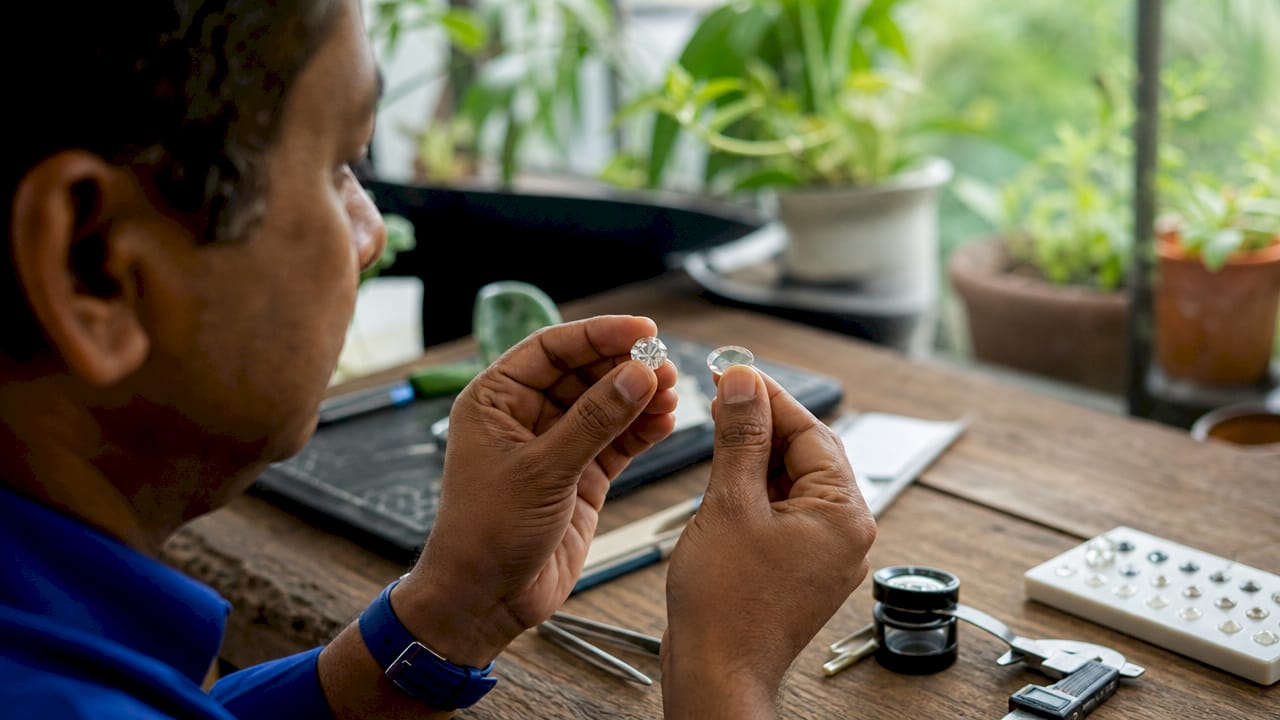
HPHT diamonds form as cuboctahedra with 14 growth directions, and this multi-directional growth often produces faint blue or grey undertones caused by boron incorporation or strain patterns. Under magnification, you may observe metallic flux inclusions (iron, nickel, or cobalt) that are essentially impossible to fake and serve as a reliable HPHT indicator. The colour is generally more consistent straight out of the press, which is why HPHT is the preferred method for producing fancy coloured diamonds, particularly yellows and blues.
CVD diamonds typically show brown hues before post-growth treatment, caused by structural defects and vacancy clusters introduced during the layered growth process. The vast majority of CVD stones on the market have undergone HPHT annealing after growth to eliminate that brownish tint and push the colour into the near-colourless or colourless range. This is not a flaw or a deception. It is standard practice, and treatment disclosure is required on grading certificates from GIA and IGI.
| Characteristic | HPHT diamond | CVD diamond |
|---|---|---|
| Crystal shape | Cuboctahedron (14 growth directions) | Cubic layers (single growth direction) |
| Typical colour pre-treatment | Near-colourless to faint blue/grey | Brown to near-colourless |
| Post-growth treatment | Rarely required | HPHT annealing common |
| Inclusions | Metallic flux particles possible | Pinpoint inclusions, graining |
| Fancy colour production | Well-suited (yellows, blues) | Less common |
| Grading lab disclosure | Growth method stated on certificate | Growth method stated on certificate |
Pro Tip: GIA and IGI both disclose growth method on their lab-grown diamond reports. If a stone lacks a certificate or the certificate omits growth method, treat that as a red flag, not a minor oversight.
One thing worth noting: the post-growth HPHT annealing applied to CVD stones is permanent and stable. Treated CVD diamonds remain stable and are widely accepted across the trade. The colour improvement is not a coating or a temporary fix. It is a structural change at the atomic level.
Production scale, cost, and market availability compared
If you are an investor tracking supply chain dynamics, this section is where the rubber meets the road.
CVD dominates online market inventory due to its scalability and flexibility. A single MPCVD reactor can run multiple growth cycles per month, producing stones across a wide range of sizes and shapes with relatively predictable yields. The process is also far more amenable to automation and process control, which is why AI integration has become a genuine competitive advantage in CVD production.
AI-driven CVD reactor control reduces energy consumption by 25 to 40% and shortens cycle times by 10 to 15% without sacrificing quality. That is not a marginal improvement. For a facility running dozens of reactors continuously, that kind of efficiency gain translates into meaningful per-carat cost reductions that eventually flow through to retail pricing. Machine learning frameworks dynamically adjust microwave power and gas ratios in real time, removing the human error factor from the most sensitive stages of growth.
HPHT, by contrast, produces larger fancy coloured diamonds but with more limited throughput. The equipment is expensive, the energy demands are substantial, and the process is less forgiving of variation. That said, HPHT retains a clear advantage for investors specifically interested in large fancy yellows or blues, where CVD struggles to match colour saturation and consistency.
Here is a practical breakdown of where each method currently stands in the market:
- CVD advantages: Higher scalability, lower per-carat energy cost with AI optimisation, broader size availability, dominant in online retail
- HPHT advantages: Better for fancy colour production, stronger origin narrative for certain investor segments, no post-growth treatment typically required
- Price dynamics: Price differences between HPHT and CVD stones of equivalent grade are increasingly market-driven rather than a reflection of intrinsic quality differences
One thing that catches investors off guard: two stones with identical GIA grades, one HPHT and one CVD, can carry different price tags purely because of market perception rather than measurable quality differences. Knowing this prevents you from overpaying for a label.
How to verify diamond synthesis type for authentication
Verification is where gemological expertise genuinely earns its keep. You cannot tell HPHT from CVD with the naked eye, and neither can most standard gemological equipment.
Here is the practical verification process used by professional gemologists:
-
Check the grading certificate first. GIA and IGI both disclose growth method on lab-grown diamond reports. This is your starting point, not your finishing line. Certificates can be mismatched to stones, so always verify the stone’s characteristics match the report.
-
Examine growth patterns under magnification. HPHT stones may show metallic flux inclusions visible under 10x to 40x magnification. CVD stones often display columnar growth striations or pinpoint inclusions arranged in flat planes, reflecting the layer-by-layer growth direction.
-
Use spectroscopic analysis. Photoluminescence spectroscopy and infrared spectroscopy can identify nitrogen aggregation patterns and structural defects specific to each growth method. HPHT stones typically show Type IIa or Type Ib nitrogen characteristics; CVD stones are almost always Type IIa with specific vacancy-related features.
-
Look for strain patterns under cross-polarised light. HPHT diamonds often show anomalous birefringence in patterns consistent with multi-directional growth stress. CVD stones show different strain distributions reflecting their single-direction growth.
-
Consult a dedicated screening device. Instruments such as the De Beers DiamondView or the GIA iD100 use ultraviolet fluorescence imaging to reveal growth patterns invisible under standard lighting. These are the gold standard for synthesis identification in a professional setting.
For a thorough walkthrough of authenticating lab-grown diamonds, Blackwelljewellers has published a practical guide covering provenance verification and method identification in detail. Understanding how to identify quality in lab-grown stones is equally worth your time before making any significant purchase or investment decision.
Key takeaways
HPHT and CVD diamonds are chemically identical but process-distinct, and the growth method determines crystal structure, typical colour characteristics, treatment requirements, and production economics in ways that matter directly to investors and gemologists.
| Point | Details |
|---|---|
| Process fundamentals differ | HPHT uses extreme pressure and heat; CVD uses low-pressure plasma deposition at the atomic level. |
| Physical traits are identifiable | HPHT shows metallic inclusions and multi-directional growth; CVD shows columnar striations and brown pre-treatment colour. |
| CVD dominates market supply | AI-optimised CVD reactors cut energy use by 25 to 40%, making CVD the scalable choice for volume production. |
| HPHT suits fancy colour production | HPHT remains the preferred method for large fancy yellow and blue diamonds with consistent colour saturation. |
| Certification is non-negotiable | GIA and IGI disclose growth method on all lab-grown diamond reports; always verify the certificate matches the stone. |
Why the HPHT vs CVD debate misses the point
Here is my honest take after years of handling lab-grown diamonds at Blackwelljewellers: the question “is HPHT better than CVD” is the wrong question entirely. It is a bit like asking whether a diesel engine is better than a petrol one without specifying what you are trying to do with the car.
Neither method produces an inherently superior diamond. What matters is the specific stone in front of you: its cut quality, its clarity grade, its colour, and whether the certificate is legitimate and matches the stone. I have seen exceptional CVD diamonds and mediocre HPHT ones, and vice versa. The growth method is context, not verdict.
What I find genuinely exciting is the pace of engineering progress in CVD production. The AI-driven optimisation happening in 2026 is not marketing fluff. Real-time machine learning control of plasma power and gas ratios is producing more consistent stones at lower cost, and that consistency matters enormously for gemologists trying to set quality benchmarks. The variability in CVD quality across manufacturers is a reactor configuration problem, not a fundamental flaw of the method.
For investors, my practical advice is this: prioritise cut, certification, and clarity over growth method. Understand the synthesis process well enough to verify authenticity, but do not let the HPHT versus CVD debate distract you from the fundamentals of stone quality. The market increasingly prices both methods similarly for equivalent grades, which tells you something important about where the trade’s collective opinion has landed.
— James
Explore lab-grown diamonds at Blackwelljewellers
Whether you are building a collection, commissioning a bespoke piece, or simply want expert eyes on a stone before you commit, Blackwelljewellers is set up to help.

The team at Blackwelljewellers has over 20 years of experience authenticating and sourcing diamonds across all synthesis methods, with physical stores in Maidstone, Gravesend, and Bexleyheath. If you want a stone selected and set to your specification, the bespoke jewellery service in Maidstone covers everything from stone selection to finished piece. For buyers prioritising responsible sourcing, the ethical diamonds collection includes lab-grown options across both HPHT and CVD origins, with full certification and provenance transparency. No guesswork. No vague assurances. Just verified stones and honest advice.
FAQ
What is the main difference between HPHT and CVD diamonds?
HPHT diamonds grow under extreme pressure and heat that mimics earth’s mantle, producing cuboctahedral crystals with 14 growth directions. CVD diamonds grow layer by layer in a low-pressure plasma chamber, forming cubic crystals in a single direction.
Is HPHT or CVD better for investment purposes?
Neither method is inherently superior for investment. Cut quality, clarity, colour, and certification from GIA or IGI matter far more than growth method when assessing value and resale potential.
Do CVD diamonds require post-growth treatment?
Most CVD diamonds undergo HPHT annealing after growth to remove brown hues caused by structural defects. This treatment is permanent, stable, and must be disclosed on grading certificates from GIA and IGI.
Can you tell HPHT from CVD without specialist equipment?
No. Distinguishing the two methods reliably requires spectroscopic analysis, cross-polarised light examination, or dedicated screening devices such as the De Beers DiamondView. Visual inspection alone is insufficient.
How does AI affect CVD diamond production in 2026?
AI-driven control systems dynamically adjust plasma power and gas ratios in real time, reducing energy consumption by 25 to 40% and shortening cycle times by 10 to 15% without compromising diamond quality.