
TL;DR:
- Verify diamonds with GIA or IGI certification and matching inscription for authenticity.
- Prioritize cut quality over carat size for better sparkle and value.
- Consider ethical sourcing options like Kimberley Process certification and lab-grown diamonds.
Buying a diamond should feel exciting, not overwhelming. Yet most buyers walk into a jeweller or browse online and immediately hit a wall of jargon: carat weights, clarity grades, cut proportions, and certification acronyms that mean very little without context. The result is either paralysis or, worse, an expensive mistake. Whether you are choosing a diamond engagement ring, adding to a collection, or considering pre-owned jewellery as a smart investment, a clear and repeatable selection process makes all the difference. This guide walks you through every step, from setting your criteria to verifying authenticity, so you can buy with genuine confidence.
Table of Contents
- Getting started: What you need to know before buying
- Step 1: Setting your criteria – The 4Cs and certification
- Step 2: Comparing shapes and examining features
- Step 3: Inspecting, verifying, and avoiding common pitfalls
- Step 4: Ethical, environmental and value considerations
- What most guides miss about smart diamond selection
- How Blackwell Jewellers can help on your diamond journey
- Frequently asked questions
Key Takeaways
| Point | Details |
|---|---|
| Cut trumps carat | A diamond’s brilliance depends more on cut quality than size or weight. |
| Always demand certification | Only buy stones with verifiable GIA or IGI grading reports. |
| Pre-owned requires extra checks | Inspect hallmarks, condition, and resale potential when buying second-hand. |
| Ethics matter | Look for Kimberley Process certification or opt for lab-grown for reduced environmental impact. |
Getting started: What you need to know before buying
Before you look at a single stone, you need a framework. Without one, you are comparing apples to oranges and relying entirely on a salesperson’s guidance, which may not always align with your interests.
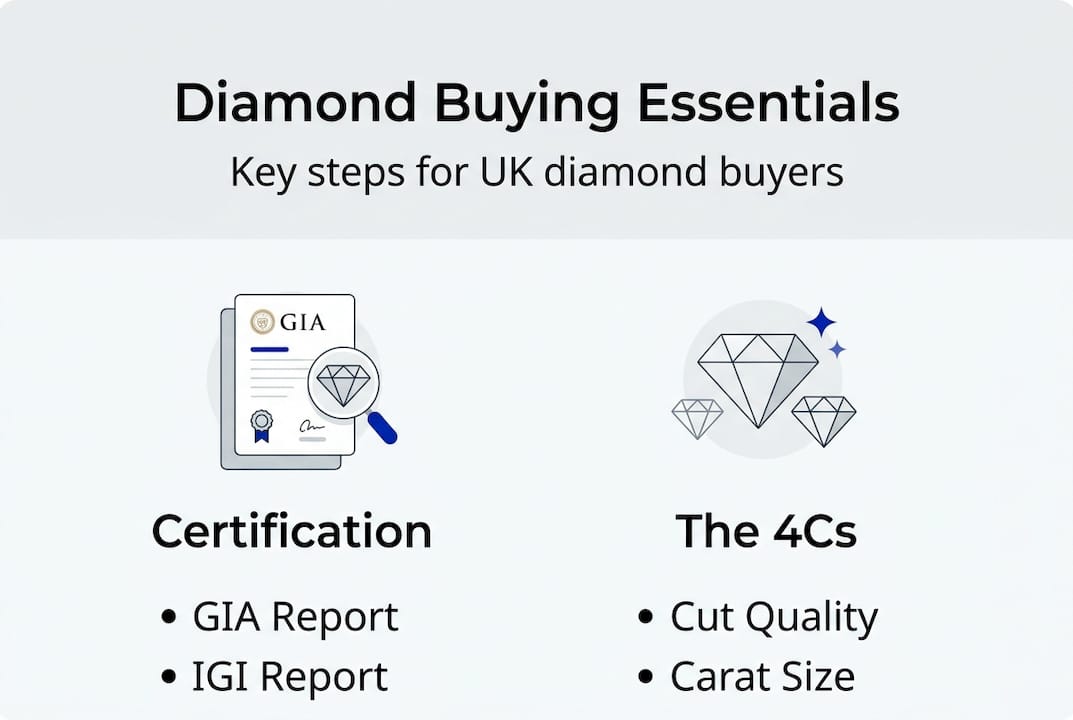
The single most important document in any diamond purchase is the grading report. GIA or IGI certification is the gold standard: always verify the report number matches the girdle inscription on the stone itself. These two bodies use consistent, internationally recognised grading criteria. Any other certification should prompt caution.
For pre-owned diamonds, the process adds another layer. Resale value sits at roughly 25 to 50% of retail, which means pre-owned can offer exceptional value if you know what to check. Always look for UK hallmarks from one of the four Assay Offices (London, Birmingham, Edinburgh, Sheffield), examine prong condition, and check for metal thinning around the setting. Our pre-owned jewellery inspection guide explains exactly what to look for.
The foundation of any diamond assessment is the 4Cs: cut, colour, clarity, and carat. Understanding these before you shop means you are in control of the conversation. You can read a thorough breakdown in our diamond 4Cs explained guide.
Finally, consider the ethical dimension from the outset. Responsible sourcing, including Kimberley Process certification and lab-grown alternatives, is covered in detail in this ethical sourcing guide.
| Requirement | Why it matters | What to check |
|---|---|---|
| Grading report | Objective quality benchmark | GIA or IGI only |
| UK hallmark | Legal proof of metal purity | Assay Office mark |
| Cut grade | Drives visual beauty | Excellent or Very Good |
| Ethical sourcing | Conflict-free provenance | Kimberley Process or lab-grown |
| Condition (pre-owned) | Wearability and safety | Prongs, shank, setting |
- Always request the original grading report, not a copy
- Check the report number against the stone’s girdle inscription
- For pre-owned, ask for independent valuation alongside the seller’s price
Pro Tip: If a seller cannot produce a GIA or IGI report, treat that as a significant red flag, regardless of how appealing the price looks.
Step 1: Setting your criteria – The 4Cs and certification
With your baseline requirements in mind, it is time to get specific. Setting personal criteria before you browse prevents emotional decisions and keeps your budget working efficiently.
The most counterintuitive lesson in diamond buying is this: cut is the most important factor for beauty, not carat. A 0.9ct stone with an Excellent cut will outshine a 1.2ct stone with a Poor cut every single time. Prioritise cut first, then colour (G to H for near-colourless), then clarity (VS2 to SI1 for eye-clean stones), and consider carat last.
The GIA cut grade system rewards diamonds that balance proportions for maximum light return. A “Triple X” grade (Excellent cut, polish, and symmetry) represents the top tier of light performance. This is the grade to target if sparkle is your priority.
| Priority | Recommended grade | Budget impact |
|---|---|---|
| Cut | Excellent or Very Good | High priority, worth the cost |
| Colour | G to H | Near-colourless, good value |
| Clarity | VS2 to SI1 | Eye-clean without overpaying |
| Carat | 0.9ct vs 1.0ct | Significant saving, same look |
Follow these steps when setting your specifications:
- Decide your maximum budget before anything else
- Set cut grade as non-negotiable (Excellent or Very Good only)
- Choose a colour range (G to H suits most settings)
- Select clarity range (VS2 to SI1 is the sweet spot for value)
- Let carat weight be the variable that fits within your remaining budget
- Confirm GIA or IGI certification as a hard requirement
You can explore all of this in greater depth through our guide on exploring the 4Cs.
Pro Tip: Choosing a 0.9ct stone instead of a 1.0ct can save 15 to 20% with no visible difference to the naked eye. The price jumps at whole carat weights are a quirk of market psychology, not optical reality.
Step 2: Comparing shapes and examining features
Once you have set your grades and requirements, the next vital step is narrowing down shape and unique features. This is where personal taste and lifestyle genuinely come into the decision.
Round brilliant diamonds deliver the most sparkle of any shape, thanks to their 58-facet geometry optimised for light return. However, oval and pear shapes offer more visible size per carat than round stones, making them excellent value choices. For oval diamonds, a length-to-width ratio of 1.4 to 1.5 is considered ideal for a balanced, elegant appearance.
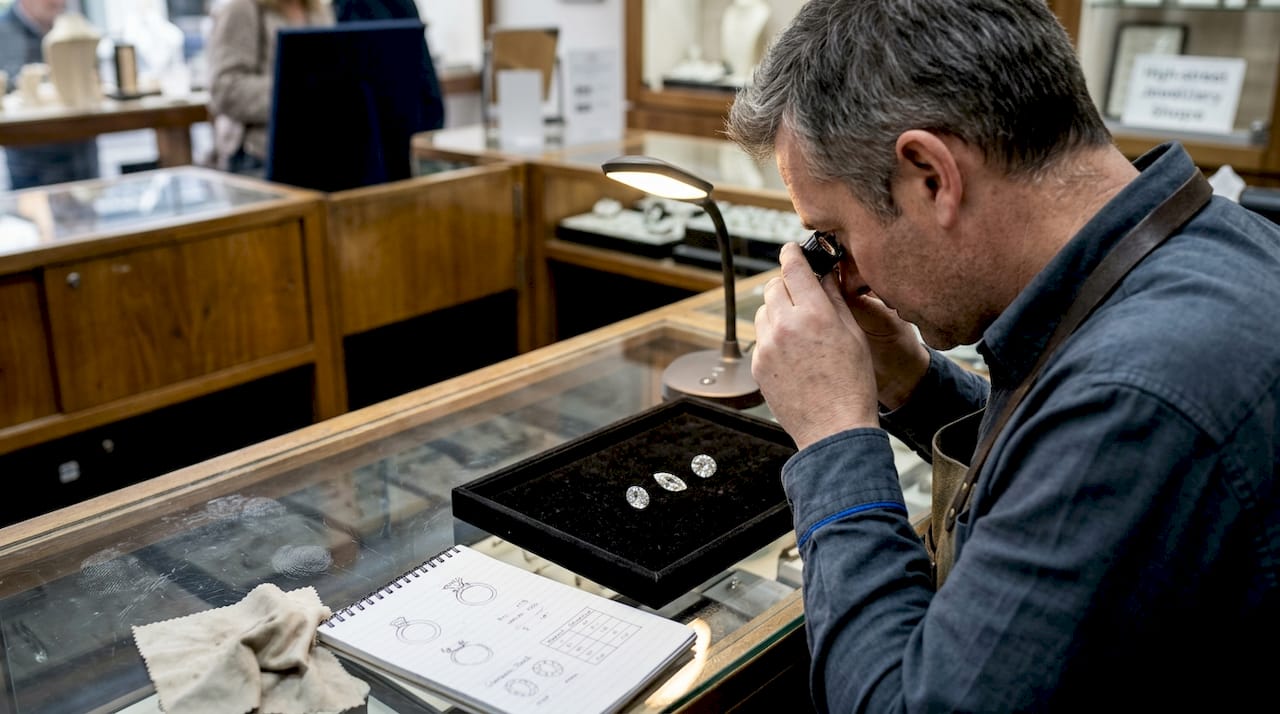
Durability is a practical consideration that buyers often overlook. Pointed shapes such as marquise and pear are vulnerable at their tips. Avoid knife-edge girdles on any shape, as these are prone to chipping with daily wear.
When viewing diamonds, always inspect them in at least three different lighting conditions: bright overhead light, natural daylight, and dim ambient light. A stone that looks spectacular only under spotlights may appear dull in everyday settings.
For fancy shapes, watch for the “bow-tie” effect, a dark shadow across the centre of the stone. Minimising bow-tie in fancy shapes requires careful selection and is not captured in a grading report, so viewing in person matters enormously.
Shape trade-offs at a glance:
- Round: Maximum sparkle, most studied cut, premium price per carat
- Oval: Larger appearance per carat, elongates the finger, watch for bow-tie
- Pear: Unique look, versatile, vulnerable tip requires protective prong
- Princess: Modern, geometric, corner chips possible without bezel setting
- Cushion: Soft, romantic look, good for vintage styles, variable cut quality
For more on matching shape to setting and lifestyle, see our guide on choosing diamond shapes. You can also explore current diamond trends to see what shapes are gaining popularity.
Pro Tip: Ask to see the diamond loose before it is set. Once a stone is mounted, it is much harder to spot inclusions, assess symmetry, or check the girdle condition.
Step 3: Inspecting, verifying, and avoiding common pitfalls
Having chosen your preferred shape and set your grade requirements, the inspection phase ensures you are getting genuine value, not unpleasant surprises.
The most common mistake buyers make is purchasing an uncertified diamond. Avoid poor cut, unnecessary flawless grades, and uncertified stones entirely. Always view the stone in multiple lighting conditions before committing.
“The single biggest risk in diamond buying is not overpaying for carat weight. It is buying a stone with no independent certification and no way to verify what you actually own.”
For pre-owned pieces, check UK hallmarks and seek independent valuation before purchasing. Also confirm whether the ring can be resized if needed, as some settings and metal types limit this option significantly.
Verification checklist:
- Locate the grading report number on the girdle using a loupe (10x magnification)
- Match that number exactly to the printed or digital GIA/IGI report
- Check the metal for UK hallmarks (date letter, Assay Office mark, fineness mark)
- Inspect prongs under magnification for wear, bending, or gaps
- Ask for the stone to be cleaned before your viewing appointment
Step-by-step authenticity verification:
- Request the original grading report and check the issuing body (GIA or IGI only)
- Ask the jeweller to show you the girdle inscription under magnification
- Confirm the inscription number matches the report exactly
- Check all hallmarks on the metal setting
- Request an independent valuation if purchasing pre-owned
- View the stone in natural light, not just showroom spotlights
Our detailed pre-owned jewellery checks guide covers each of these steps in full. For inspiration on how pre-owned pieces can be styled beautifully, see this guide on styling pre-owned jewellery.
Step 4: Ethical, environmental and value considerations
With verification complete, thinking ethically and long-term helps you make a decision that reflects both your values and your investment sense.
The Kimberley Process is an international certification scheme that aims to prevent conflict diamonds (sometimes called “blood diamonds”) from entering the legitimate trade. While it is not a perfect system, Kimberley Process certification remains the baseline standard for conflict-free sourcing. Always ask your seller whether their diamonds carry this certification.
Lab-grown diamonds have changed the market considerably. They are chemically and physically identical to mined stones but carry a significantly lower environmental footprint. Lab-grown diamonds offer exceptional value with reduced impact, making them an increasingly popular choice for ethically minded buyers. For a direct comparison of long-term value, see our guide on lab vs mined diamond value.
On the resale side, pre-owned diamonds typically hold around 25 to 50% of retail value, which means buying pre-owned is one of the most cost-effective ways to access a higher-quality stone. You can also review further guidance in this ethical diamond sourcing resource.
Practical questions to ask your seller:
- Is this diamond Kimberley Process certified?
- Can you provide documentation of the supply chain?
- Is this stone lab-grown or mined, and is that reflected in the price?
- What is the independent resale valuation for this piece?
- Does the price reflect current market rates for this grade and weight?
Pro Tip: Lab-grown diamonds are not “fake” diamonds. They are real diamonds in every measurable sense. The distinction is origin, not quality. For buyers prioritising ethics and budget, they represent outstanding value.
What most guides miss about smart diamond selection
Most diamond buying guides tell you to learn the 4Cs. That is sensible advice. But they rarely tell you which rules you can safely bend, and which ones are genuinely non-negotiable.
Here is the honest truth after years of working with diamond buyers: very few people can see the difference between a VS1 and an SI1 clarity grade with the naked eye. Paying a premium for a near-flawless stone is largely invisible to everyone, including you. What is visible is cut quality. A dull stone with a perfect clarity grade is still a dull stone.
Similarly, chasing a round number on carat weight costs money for no optical gain. The market prices 1.0ct stones at a significant premium over 0.95ct stones that look identical in a setting.
The other thing guides miss is the power of a verified report. A GIA or IGI report does not just tell you what you have. It protects your investment, supports insurance valuation, and makes the stone far easier to sell or exchange in future. Our in-depth 4Cs advice explains how to use these grades strategically, not just academically.
Buy the cut. Verify the report. Let everything else flex within your budget.
How Blackwell Jewellers can help on your diamond journey
Putting these steps into practice is straightforward when you have the right support behind you.
At Blackwell Jewellers, every diamond and pre-owned piece goes through a rigorous inspection and authentication process before it reaches you. Our expert jewellers check hallmarks, verify grading reports, assess structural integrity, and restore pieces to wearable condition. With over 20 years of trading and stores across Kent in Maidstone, Gravesend, and Bexleyheath, we combine hands-on craftsmanship with transparent provenance. Whether you are browsing online or visiting in person, you can explore our full range with confidence. Read more about how we work in our pre-owned jewellery workflow guide.
Frequently asked questions
Why is diamond cut more important than carat weight?
A well-cut diamond reflects light with far greater brilliance and visual impact than a larger stone with a poor cut. Cut grade drives sparkle more than any other factor in the 4Cs.
What is the safest way to verify a diamond’s authenticity?
Match the grading report number to the laser inscription on the diamond’s girdle, and confirm UK hallmarks on the metal setting. GIA or IGI certification is the only reliable independent benchmark.
Are lab-grown diamonds recommended for ethical buyers?
Yes. Lab-grown diamonds are physically identical to mined stones and carry a lower environmental footprint. Conflict-free and responsibly sourced, they offer excellent value for ethically minded buyers.
What is the resale value of a pre-owned diamond?
Pre-owned diamonds typically sell for around 25 to 50% of retail, making them a cost-effective route to a higher-quality stone than you might afford new.