

Mourning jewellery is a wearable keepsake, ring, locket, brooch or pendant made or worn to remember someone who has died. It turns grief into something you can hold, carry hair, a painted portrait, or a symbolic motif close to the skin, and it once did serious social work too, signalling to the world that you were bereaved and honouring who you’d lost. The core materials and symbols repeat across centuries:
- Whitby jet, mined on England’s north-east coast, for the deep matte black
- Hairwork, woven or plaited from the deceased’s own hair
- Seed pearls, standing in for tears
- The weeping willow and the urn, borrowed from classical mourning art
Private grief, public etiquette. That’s the whole story in miniature.
Key Takeaways
Mourning jewellery encodes grief through specific materials and motifs, and correctly identifying a genuine Victorian piece depends on testing the material, examining the hairwork mounting, and checking inscriptions against known dating conventions.
| Point | Details |
|---|---|
| Definition | Mourning jewellery is a wearable keepsake, ring, locket or brooch, made to remember the dead and signal bereavement. |
| Key materials | Whitby jet, hairwork, seed pearls and enamel dominate, with vulcanite and black glass as period substitutes. |
| Symbol literacy | Willow means grief, urns mean burial, broken columns mean a life cut short, and snakes mean eternal love. |
| Identification test | Genuine jet feels warm and light; vulcanite and glass feel colder and heavier, though lab testing settles high-value cases. |
| Professional next step | Get hallmarks, construction and hairwork checked by a jeweller before cleaning, wearing or reworking an inherited piece. |
Table of Contents
- What does mourning jewellery mean, and where did it start?
- What materials and techniques were used in mourning jewellery?
- What do the symbols on mourning jewellery mean?
- What forms did mourning jewellery take?
- How can you tell if a piece is genuinely Victorian mourning jewellery?
- Why did mourning etiquette matter so much socially?
- How does Blackwelljewellers help with inherited mourning jewellery?
- What the conventional advice on mourning jewellery gets wrong
- Sources
What does mourning jewellery mean, and where did it start?
The habit didn’t begin with Queen Victoria, though she gets most of the credit. Its roots go back to memento mori jewellery of the 16th and 17th centuries, rings and pendants carved with skulls and skeletons designed to nag the wearer with a blunt moral: you will die too, so behave accordingly. These pieces were less about a specific person and more a general reminder of mortality, worn the way some people now wear a stoic quote on a bracelet.
The shape of the tradition changed across four rough phases.
- Memento mori (1500s to 1600s): skulls, coffins, hourglasses. Moral instruction, not personal remembrance.
- Georgian sentimentality (1700s): rings inscribed with a name, initials, or the date of death; miniature portraits and neoclassical urns start replacing skulls. A Newcastle University thesis tracing English funerary jewellery from around 1500 to 1800 shows this shift toward named, personal commemoration rather than generic warning.
- Victorian intensification (1837 to 1901): after Prince Albert’s death in 1861, Queen Victoria wore mourning attire for the remaining forty years of her life, and the nation followed her lead. Hairwork and Whitby jet became mainstream, not niche.
- Twentieth century onward: strict mourning etiquette collapsed after the First World War (too much collective loss to sustain elaborate ritual for each one), and the pieces that survive today are mostly inherited, collected, or reimagined rather than newly commissioned in the old style.
What’s striking is how personal the later phases became. Museum research on the period notes that mourning jewellery served both remembrance and social duty at once, and testators frequently named exactly who should inherit a specific mourning ring in their wills. The object wasn’t incidental. It was written into the estate.
What materials and techniques were used in mourning jewellery?
Whitby jet earned its reputation the hard way, and then Queen Victoria made it fashionable. It’s technically fossilised monkey puzzle tree wood, mined along the Yorkshire coast, and it takes a deep, warm polish unlike anything glass or resin can quite fake. Once the Queen adopted it for her own mourning wear, demand outstripped what Whitby’s mines could supply, and manufacturers turned to cheaper stand ins. According to the GIA’s reading list on Whitby jet, vulcanite, gutta-percha and black glass, nicknamed “French jet”, all flooded the market to imitate the real thing.
- Whitby jet: warm to the touch, genuinely light, with a distinctive velvety lustre
- Vulcanite: a hardened rubber compound, tends to feel colder and can develop a greenish tinge with age
- Gutta-percha: a moulded natural latex, used for cheaper mass-produced pieces
- Black glass (“French jet”): noticeably heavier and colder than real jet, with a glassier shine
Hairwork was arguably the more intimate craft. Hair was plaited, woven into intricate patterns, or ground and mixed with pigment for sepia painting, then sealed under a glass locket panel to protect it from handling and light. The V&A’s research on hairwork describes this as a specialist Victorian craft that peaked precisely because it offered something a photograph couldn’t: an actual physical trace of the person. Enamelling and seed pearls filled in the decorative edges, black enamel bezels for widowhood, white enamel for a child or unmarried person, seed pearls scattered like tears around a locket rim.
Pro Tip: If you’re handling an old piece with a hairwork panel, resist the urge to clean it with household products. Hair degrades under humidity and handling far faster than metal or stone, and a well-meaning polish can do permanent damage.
What do the symbols on mourning jewellery mean?
Every motif on a mourning piece was doing a specific job, and once you know the vocabulary, the pieces stop looking morbid and start looking almost like handwritten letters.
- Weeping willow: grief itself, the tree that bends but doesn’t break
- Urn: burial and the passage to the afterlife
- Broken column: a life cut short, usually a young or sudden death
- Skull or skeleton: the older memento mori reminder of mortality, largely phased out by the Victorian era in favour of gentler imagery
- Snake, often eating its own tail: eternal, unbroken love
- Heart or key: affection, or stewardship of someone’s memory
- Seed pearls: tears, scattered around a bezel or set into a border
- Painted eye portraits: an intensely intimate memento, a single eye rendered in miniature so the piece could be worn without revealing whose eye it was, kept as a discreet, almost secret connection
The London Museum’s research into these motifs frames the whole shift neatly: symbolism moved from public, generic moral warning toward private, specific remembrance as the decades passed. A Georgian ring might carry a skull to remind any onlooker of death in general. A Victorian locket, by contrast, more often carried a single strand of one particular person’s hair, meaningless to a stranger and everything to the person wearing it.
What forms did mourning jewellery take?
Mourning rings were the most common bequeathed item, frequently specified by name in a will, often inscribed with the deceased’s initials, date of death, or a short Latin phrase, and handed out at the funeral itself as a keepsake for close family and friends.
Lockets and pendants usually held a hair compartment behind a glass panel, or a small painted miniature, sometimes both, worn close enough to the body to feel like an actual connection rather than a decoration.
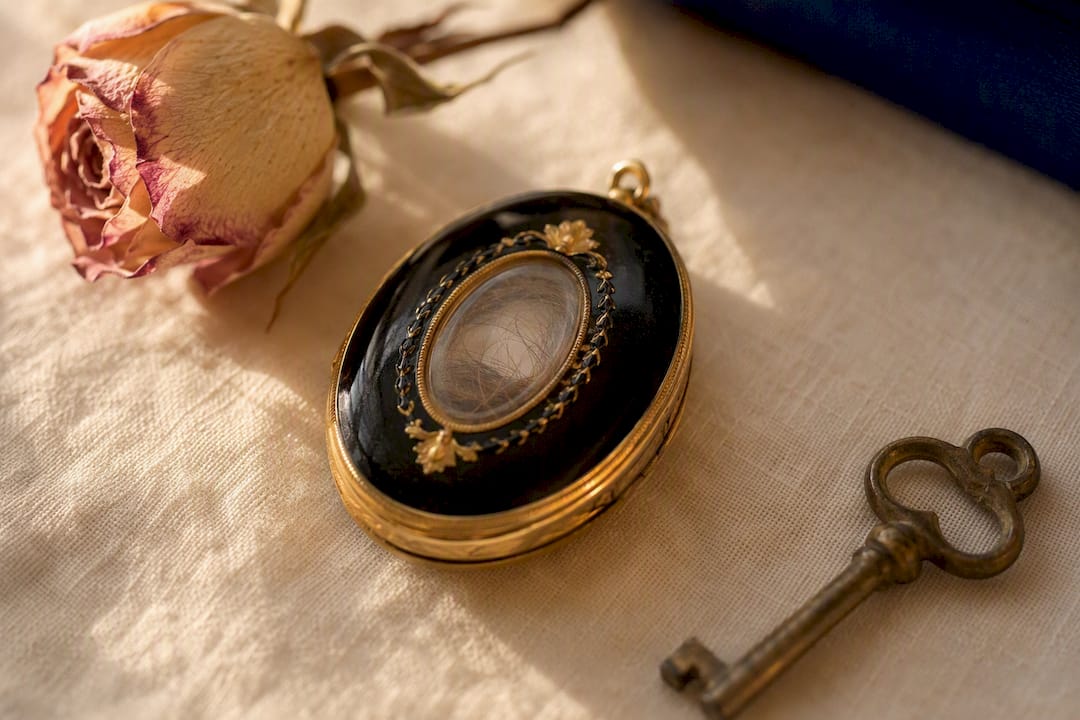
Brooches and bracelets carried enamelled bezels in black or white, hairwork panels set into the centre, or woven hair bracelets where the hair itself formed the entire band rather than just an accent.
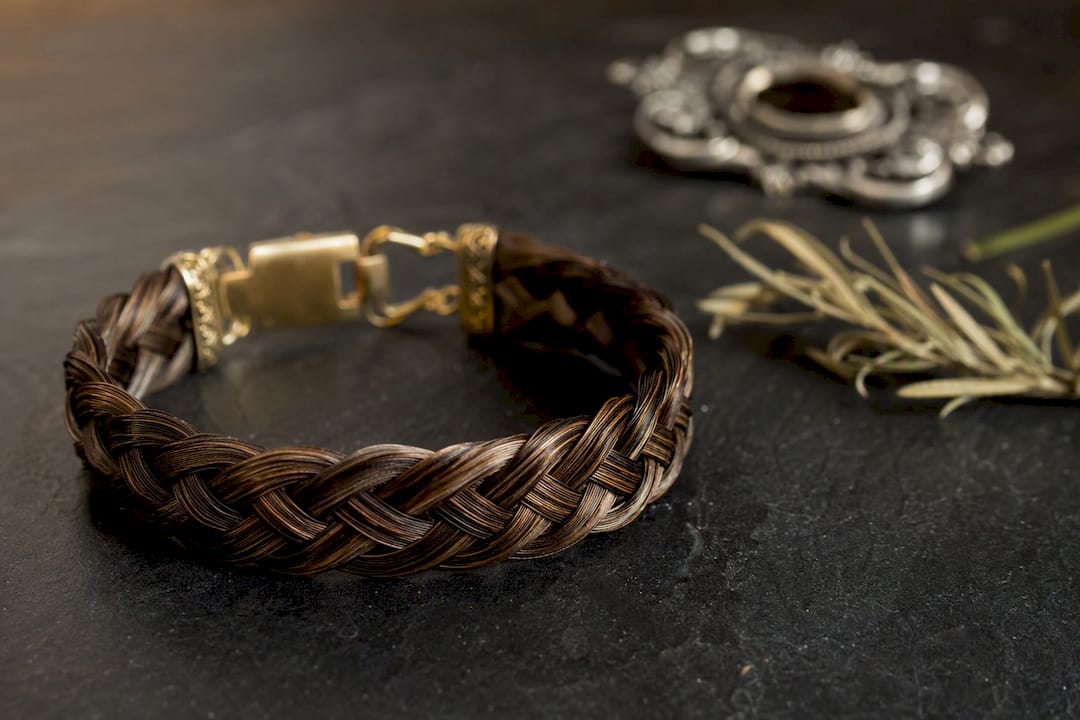
Men’s memorial pieces existed too, watch fobs, cufflinks, and signet-style rings, understated compared to women’s mourning jewellery but carrying the same inscriptions and symbolism in a smaller, more restrained register.
How can you tell if a piece is genuinely Victorian mourning jewellery?
- Check for hallmarks and inscriptions. Genuine period pieces often carry engraved details like “ob.” (obiit, meaning “died”) or “æt.” (aetatis, meaning “aged”), followed by a date. A hallmark consistent with 19th-century assay standards is a strong dating clue.
- Look closely at the hairwork mounting. Real Victorian hairwork sits under a sealed glass panel, plaited or woven with visible craftsmanship, not glued flat or loose. Painted miniatures should show period-appropriate brushwork rather than crisp modern printing.
- Test the material, gently. Whitby jet feels warm and surprisingly light for its size, with a soft, deep lustre. Vulcanite feels colder and can smell faintly of sulphur when rubbed; black glass feels noticeably heavier and colder still. V&A project notes on mourning jewellery authenticity confirm these tactile differences, though they also caution that laboratory analysis is the only reliable route for high-value pieces.
- Compare against museum examples. An Ashmolean museum record for a mourning ring gives a real reference point for inscription style, ring construction and typical dating.
- Get a specialist appraisal before you clean, sell, or rework anything. Provenance and condition both affect value, and both are easy to damage permanently through good intentions.
Pro Tip: A magnet is a quick first test. Jet and vulcanite are both non-magnetic, but if a “jet” piece has a metal core showing wear at the edges, that’s a hint you’re looking at a later reproduction rather than an original.
Why did mourning etiquette matter so much socially?
Victorian mourning ran on strict, phased rules, and jewellery was the visible marker of which phase you were in.
- Full mourning (roughly the first year of widowhood): dull black clothing, jet jewellery only, no shine or colour permitted
- Half mourning (the following months): muted colours like grey, mauve and lavender allowed, alongside jet or hairwork pieces
- Return to ordinary dress: jewellery could gradually incorporate colour and precious stones again
Wills routinely funded mourning rings for named beneficiaries, turning the object into both sentiment and social obligation. Queen Victoria’s own forty-year mourning for Prince Albert set the national tone so firmly that jet and hairwork became default choices across the social scale, not just among the aristocracy. The First World War then broke the pattern entirely. Loss on that scale made individual, prolonged mourning rituals impractical, and etiquette loosened for good.
How does Blackwelljewellers help with inherited mourning jewellery?
If you’ve inherited a mourning ring, a hairwork locket, or a Whitby jet brooch, the honest first step isn’t cleaning it or wearing it. It’s getting it properly looked at.
- Authentication first: Blackwelljewellers checks hallmarks, construction, and material against known period standards before recommending anything.
- Conservation over restoration where possible: hairwork and painted miniatures need controlled humidity and minimal handling, not a polish. Jet should never be scrubbed with household cleaners.
- Repair when the structure needs it: loose bezels, worn clasps and cracked glass panels can usually be fixed without touching the sentimental core of the piece. Blackwelljewellers’ repair service covers exactly this kind of structural work.
- Remodelling when a piece can’t be worn as it is: turning inherited pieces into something wearable today, while keeping the hair panel, the inscription, or the stone, is a genuine option. The guide on reworking inherited jewellery into a modern bespoke piece walks through how that balance works in practice.
Family keepsakes carry weight precisely because they’re specific to one relationship, one person, one memory, which is part of why research into keepsakes and family bonding finds they do genuine emotional work that a photograph alone often doesn’t replicate.
Pro Tip: Bring the piece in before you decide whether to repair or remodel. What looks like irreparable damage is often a loose setting or a tarnished surface, both fixable without losing anything sentimental.
If you’d rather buy an authenticated antique piece outright than restore one, Blackwelljewellers’ second-hand jewellery collection is inspected, hallmarked and restored before sale, and the Maidstone store carries pre-owned stock you can view in person.
What the conventional advice on mourning jewellery gets wrong
Most guides treat mourning jewellery as a curiosity, morbid Victoriana to admire behind museum glass. That undersells it. The evidence, from the wills that named specific mourning rings to the hairwork panels sealed against light and handling, points to something closer to a private language of grief that happened to have public rules attached.
The overrated part is the skull. People fixate on memento mori imagery because it’s the most visually striking, but skulls were largely a Georgian and earlier habit, phased out as sentimentality took over. If you inherit a piece with a willow, an urn, or a hairwork panel rather than a skull, you’re looking at the more emotionally specific end of the tradition, not a lesser one.
What actually matters, and what most casual advice skips, is provenance and condition before sentiment. A piece’s meaning doesn’t survive careless cleaning or a botched repair. Get it looked at by someone who can tell jet from vulcanite and hairwork from a later reproduction, before you decide whether to preserve it as it is or rework it into something you’ll actually wear.
Sources
- GIA — Whitby jet reading list
- London Museum blog — objects of love & loss: mourning jewellery
- V&A blog — hairwork and mourning jewellery
- Newcastle University thesis — mourning jewellery in England, c.1500–1800