

TL;DR:
- A solitaire ring features a single, prominent gemstone, typically on a simple band, symbolizing purity and focus. It is distinct from other styles like halo, trilogy, or cluster rings, which involve multiple stones and more elaborate designs. Choosing the right setting is essential for daily wear, with options like prong, bezel, cathedral, or tension based on lifestyle and aesthetic preferences.
You’d be surprised how many people assume that any diamond engagement ring is a solitaire. Spoiler: it’s not. A solitaire is a very specific style, and once you understand what makes it distinct, you’ll never mix it up again. Whether you’re ring shopping for yourself, planning a proposal, or just trying to sound knowledgeable next time the topic comes up at a dinner party (no judgement), this guide covers everything you need to know. The meaning, the settings, the comparisons, and how to figure out if a solitaire is genuinely right for you.
Table of Contents
- What defines a solitaire ring?
- Common solitaire ring settings explained
- Solitaire rings versus other popular engagement styles
- Who should choose a solitaire ring?
- Why the simplest style is often the most brilliant
- Explore solitaires and more with Blackwell Jewellers
- Frequently asked questions
Key Takeaways
| Point | Details |
|---|---|
| Solitaire means single gem | A solitaire ring highlights one main gemstone without any surrounding stones. |
| Settings affect style | Different settings like prong or bezel impact security and appearance. |
| Versatile and timeless | Solitaires suit classic tastes and remain stylish for generations. |
| Ideal for everyday | Choose secure settings to make your solitaire practical for daily wear. |
| Easily paired | The simplicity of solitaire rings makes them easy to match with wedding bands. |
What defines a solitaire ring?
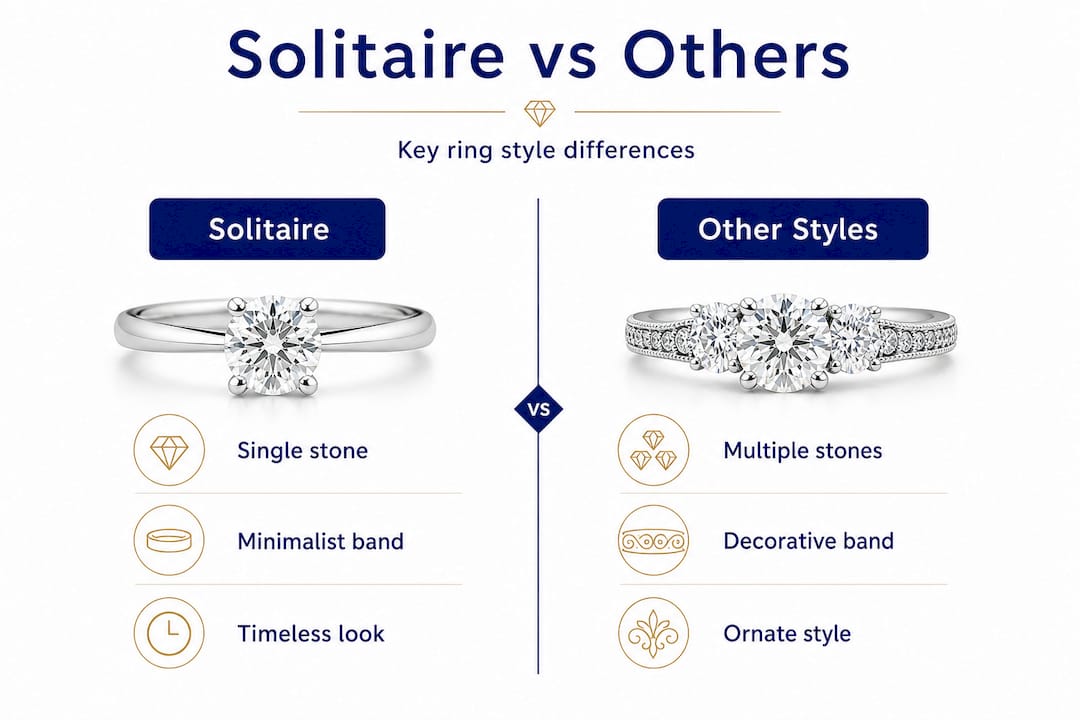
Let’s start at the beginning. The word “solitaire” comes from the French word meaning alone or single. And that’s pretty much the whole vibe. A solitaire ring is jewellery (most commonly an engagement ring) with a single centre gemstone mounted on a plain or minimally adorned band. That’s it. One stone. No side stones. No halo of tiny diamonds crowding around it. Just the gem, the band, and a whole lot of quiet confidence.
Most people picture a diamond when they think of a solitaire, and honestly, that’s fair. Diamonds dominate the solitaire market. But a solitaire can technically feature any centre stone. Sapphires, emeralds, rubies, moissanite… if it’s a single stone on a simple band, it qualifies. The stone is the star, full stop.
What makes solitaires symbolically powerful is exactly that simplicity. There’s something to be said for a ring that says, “this one thing is everything.” No distractions. The stone represents your relationship in its purest form, and that resonates deeply with a lot of couples.
Here’s a quick breakdown of what sets solitaires apart from other styles you’ll encounter when browsing popular ring styles:
- Solitaire: One centre gemstone, plain or simple band
- Halo ring: Centre stone surrounded by a ring of smaller stones
- Three-stone (trilogy) ring: Three main stones, usually representing past, present, and future
- Cluster ring: Multiple stones grouped together to create the illusion of one larger gem
- Side-stone ring: Centre stone flanked by smaller accent gems along the band
“The solitaire endures because it does one thing and does it brilliantly. It lets the stone speak for itself.”
None of those other styles are wrong, by the way. They’re all gorgeous in their own right. But they are fundamentally different from a solitaire, and knowing that difference matters when you’re spending serious money on something you’ll wear every day.
Common solitaire ring settings explained
Right, so you know what a solitaire is. Now let’s talk about how the stone actually sits in the ring, because this is where things get genuinely interesting (and where a lot of people get tripped up).
The “setting” refers to how the stone is held in place on the band. Common solitaire settings include prong, bezel, cathedral, and tension variations, each of which changes the security, the light performance, and how the ring feels to wear day to day. Choosing the wrong setting for your lifestyle is one of the most common mistakes first-time ring buyers make.
Here’s a clear comparison to help you weigh things up:
| Setting type | Security | Light performance | Best for |
|---|---|---|---|
| Prong (4 or 6 claws) | Moderate | Excellent | Classic look, maximum sparkle |
| Bezel | High | Good | Active lifestyles, modern style |
| Cathedral | Moderate | Very good | Dramatic, elevated appearance |
| Tension | Moderate | Excellent | Minimalist, contemporary look |
Now let’s go through each one properly:
-
Prong setting. This is the classic. Four or six small metal claws grip the stone, lifting it high off the band so light can enter from every angle. The result? Brilliant, eye-catching sparkle. The downside is that those prongs can catch on fabric or bend over time, so they need checking every year or two.
-
Bezel setting. A thin rim of metal wraps completely around the stone’s edge, holding it flush to the band. It’s the most secure setting by a long stretch, and it’s brilliant for people who work with their hands or lead active lives. The trade-off is that less light enters the stone from the sides, so the sparkle is slightly softer.
-
Cathedral setting. The band arches upward on either side of the stone, creating an elevated, dramatic silhouette. It’s undeniably striking and adds height to the centre gem. It can feel slightly bulkier under gloves or tight sleeves, but for everyday office wear, it’s absolutely fine.
-
Tension setting. This is the showstopper for minimalists. The stone appears to float between two ends of the band, held in place by the pressure (or “tension”) of the metal. Visually, it’s stunning. It requires extremely precise engineering, so buy from a jeweller you trust.
Pro Tip: If you’re buying a solitaire for someone who does a lot of hands-on work, gardening, sport, or gym sessions, steer toward a bezel or low-profile prong. A sky-high cathedral setting is stunning on a shelf but genuinely awkward during a spin class.
When choosing engagement ring settings, think about the recipient’s actual daily life, not just what looks incredible in photographs. Both matter. But one of them matters more at 7am on a Tuesday.
You can browse solitaire rings in a range of settings to see how each one looks in practice before you commit.
Solitaire rings versus other popular engagement styles
With settings clear in your mind, let’s see how solitaires actually compare to the competition. Because there’s a lot of it.
Solitaire rings exclude accent stones and halos, which makes them fundamentally different in both appearance and price structure. Here’s the honest breakdown:
| Style | Number of stones | Relative sparkle | Symbolic meaning | Complexity |
|---|---|---|---|---|
| Solitaire | 1 | High (centre stone) | Singular love, simplicity | Low |
| Halo | Many | Very high | Amplified centre stone | High |
| Trilogy (three-stone) | 3 | High | Past, present, future | Moderate |
| Cluster | Many | High | Bold, maximalist | High |
| Vintage solitaire | 1 (decorative band) | High | Classic romance | Moderate |
Each style has its merits. Let’s be real about each:
- Halos make the centre stone look bigger than it actually is. That’s not a criticism, it’s a genuine benefit for those on a budget who still want maximum visual impact. The downside is that all those tiny stones require more maintenance.
- Trilogy rings carry lovely symbolism and are visually balanced. They tend to be a favourite for anniversaries as well as engagements.
- Cluster rings are bold and statement-making. They’re a brilliant choice for someone who finds the idea of a single stone a bit understated.
- Vintage-style solitaires offer a middle ground: one centre stone, but with ornate detailing on the band. They’re romantic without being over the top.
So when does a solitaire win? When the person wearing it prefers clean lines, wants the focus on one excellent stone, and doesn’t want a ring that will feel “of its time” in fifteen years. Solitaires simply don’t go out of fashion. That’s not an opinion; it’s just the track record.
You can compare with vintage and halo styles in more detail if you’re still weighing up the options.
Who should choose a solitaire ring?
After weighing up all the options, it’s useful to know exactly who benefits most from the classic solitaire design. Because honestly, it’s not for everyone, and that’s perfectly fine.
Solitaires are most popular for engagements due to their timeless style and versatile elegance, but they particularly suit certain personalities, lifestyles, and priorities.
Here’s a numbered list of the people who tend to absolutely love a solitaire:
-
The classic minimalist. If your wardrobe is mostly clean lines and you find busy jewellery overwhelming, a solitaire is basically made for you. It complements everything without competing with anything.
-
The quality-over-quantity buyer. A solitaire lets the centre stone be the hero. If you’re investing in a genuinely exceptional diamond or a meaningful coloured gemstone, you want it front and centre without visual clutter.
-
The practical wearer. With the right setting (bezel, sturdy prong), a solitaire is one of the most low-maintenance ring styles you can own. Fewer stones mean fewer settings to check, fewer prongs to bend, and easier cleaning.
-
The future-planner. Solitaires pair beautifully with wedding bands. You can stack them, upgrade the centre stone later, or add a fitted band that sits flush. The ring grows with you.
-
The heirloom buyer. If you’re choosing a ring that might one day be passed down through your family, timeless beats trendy every single time. A well-made solitaire from today will still be elegant and wearable in fifty years.
Signs a solitaire might not be right for you: you love maximalist jewellery, you find single stones a bit underwhelming visually, or you specifically want the symbolism of a three-stone ring. All completely valid reasons to go a different direction.
Pro Tip: Not sure between a solitaire and a halo? Look at the other jewellery the person wears day to day. If they gravitate toward simple gold hoops and delicate necklaces, a solitaire is probably their speed. If they regularly layer statement pieces, a halo might be the better fit.
A thorough guide to choosing engagement rings can help you think through every angle before you buy.
Why the simplest style is often the most brilliant
Here’s an opinion you might not expect from a jeweller: we actually think most people overthink engagement rings. And the solitaire is the antidote to that overthinking.
Trends come and go. The halo ring, for example, peaked massively in the 2010s. Cluster rings had their moment. Three-stone rings surge in popularity every time a celebrity wears one. But through every single one of those trends, the solitaire just… sits there. Quietly brilliant. Completely unbothered.
There’s a psychological reason for this. When you buy something ornate and trend-driven, part of you knows it might feel dated in a decade. That’s a low-level anxiety you carry with the ring. With a solitaire, that anxiety simply doesn’t exist. You know it looked good fifty years ago. You know it looks good now. You know it’ll look good in 2046. That certainty is genuinely underrated as a purchasing benefit.
We’ve also seen, over more than two decades in the jewellery trade, that people who buy elaborate styles sometimes end up wanting to simplify later. The opposite rarely happens. People with solitaires don’t usually come to us wishing their ring had more going on. They come to us wanting to upgrade the stone. Which, incidentally, is much easier to do with a solitaire than with a complex multi-stone design.
The other thing why minimalist rings matter comes down to wearability. A clean, simple ring works with everything. Formal outfits, casual days, beach holidays, the office. A chunky, elaborate ring can sometimes feel like it needs a matching outfit. That matters when you’re wearing something every single day for the rest of your life.
Simplicity, done well, is never boring. It’s confident. And a solitaire is the jewellery world’s most confident statement.
Explore solitaires and more with Blackwell Jewellers
If this guide has helped you get clear on what you want, brilliant. That’s exactly why we wrote it.

At Blackwell Jewellers, we’ve been helping people find their perfect ring for over 20 years, and we genuinely enjoy this bit. Whether you’re after something pre-owned and full of character (every piece is inspected, authenticated, and restored before it reaches you), or you want to design something entirely from scratch, we’ve got you covered. Our pre-owned solitaire rings collection is a brilliant place to find exceptional quality at a sensible price. Or if you want something made just for you, our custom solitaire rings service lets you choose the stone, the setting, and every detail. Come and find us in Kent or shop online nationally.
Frequently asked questions
Are all engagement rings solitaire rings?
No. Solitaire rings feature one main gemstone only, while other engagement ring styles include halos, side stones, clusters, and multi-stone designs.
What are the most secure solitaire settings?
Bezel settings encircle the stone for maximum security, making them ideal for active lifestyles, while a well-made prong setting is also very reliable with regular maintenance.
Can I get a solitaire ring with gemstones other than diamonds?
Absolutely. Solitaires can feature sapphires, emeralds, rubies, moissanite, or any other gemstone as the centre stone. The defining feature is the single-stone design, not the gem type.
How do solitaire rings compare in price to other styles?
Solitaires are often more affordable than halo or multi-stone designs because there are fewer stones and less setting complexity involved. The biggest cost driver is the quality of the centre gem itself.
Are solitaire rings suitable for everyday wear?
Yes, particularly with secure settings. A bezel setting is ideal for active lifestyles, and a sturdy prong setting with regular checks will hold up perfectly well to daily wear over many years.