

Understanding how much your gold is worth per gram can feel overwhelming when you’re faced with fluctuating daily prices, complex purity standards, and varying buyer offers across the UK. Many gold owners struggle to determine whether they’re receiving a fair price or being undervalued. With spot prices hovering around £121-122 per gram for pure 24ct gold in early 2026, knowing how to accurately value your jewellery has never been more important. This guide will walk you through the essential factors that determine gold value, from hallmarking and purity testing to calculating melt values and navigating buyer payouts, so you can confidently assess your gold’s true worth and maximise returns when selling.
Table of Contents
- Understanding Gold Prices And Purity In The UK
- How To Calculate Your Gold’s Worth Per Gram
- Testing Gold Purity And Spotting Fake Gold
- Navigating Buyer Payouts And Getting The Best Price
- Get Reliable Gold Valuation And Selling Services
- Frequently Asked Questions
Key takeaways
| Point | Details |
|---|---|
| Current gold prices | Spot price for 24ct gold is approximately £121-122 per gram in early 2026 |
| Purity determines value | UK hallmarks certify purity from 9ct (37.5%) to 24ct (99.9%), directly affecting per-gram worth |
| Buyer rates vary widely | Payout rates range from 60-80% at high street buyers to up to 97% from specialist bullion dealers |
| Testing verifies authenticity | XRF testing provides non-destructive purity verification for unhallmarked or antique gold pieces |
| Multiple quotes maximise returns | Getting three or more quotes and timing sales when spot prices peak can increase your payout significantly |
Understanding gold prices and purity in the UK
The foundation of accurate gold valuation starts with understanding two critical concepts: spot price and purity. Spot price represents the global benchmark for pure 24ct gold and fluctuates daily based on market conditions, currently sitting at approximately £121-122 per gram in March 2026. This benchmark applies only to pure gold, so your jewellery’s actual value will differ based on its carat rating.
Gold jewellery’s value depends entirely on its purity, measured in carats and expressed as fractions of pure gold content. A 9ct ring contains 37.5% pure gold, whilst an 18ct necklace contains 75%. The remaining percentage consists of alloy metals like copper, silver, or zinc added for durability and colour variation. Understanding these percentages is essential because they directly determine how much of the spot price applies to your item.
UK law requires hallmarking for gold items weighing over 1 gram, certifying purity through numeric stamps applied by assay offices. These hallmarks provide immediate verification of gold content and form the basis for valuation. Without a hallmark, professional testing becomes essential to avoid undervaluation or fraud.
Common UK hallmarks include:
- 375 marking indicates 9ct gold (37.5% pure gold content)
- 585 marking indicates 14ct gold (58.5% pure gold content)
- 750 marking indicates 18ct gold (75% pure gold content)
- 916 marking indicates 22ct gold (91.6% pure gold content)
- 999 marking indicates 24ct gold (99.9% pure gold content)
Knowing your hallmark meanings allows you to calculate the theoretical melt value before buyer adjustments. A 10-gram 18ct bracelet contains 7.5 grams of pure gold (10g × 0.75), which you can multiply by the current spot price to determine base value. Buyer payout rates then reduce this figure to your actual selling price, typically ranging from 60% to 97% depending on the dealer and quantity sold.
How to calculate your gold’s worth per gram
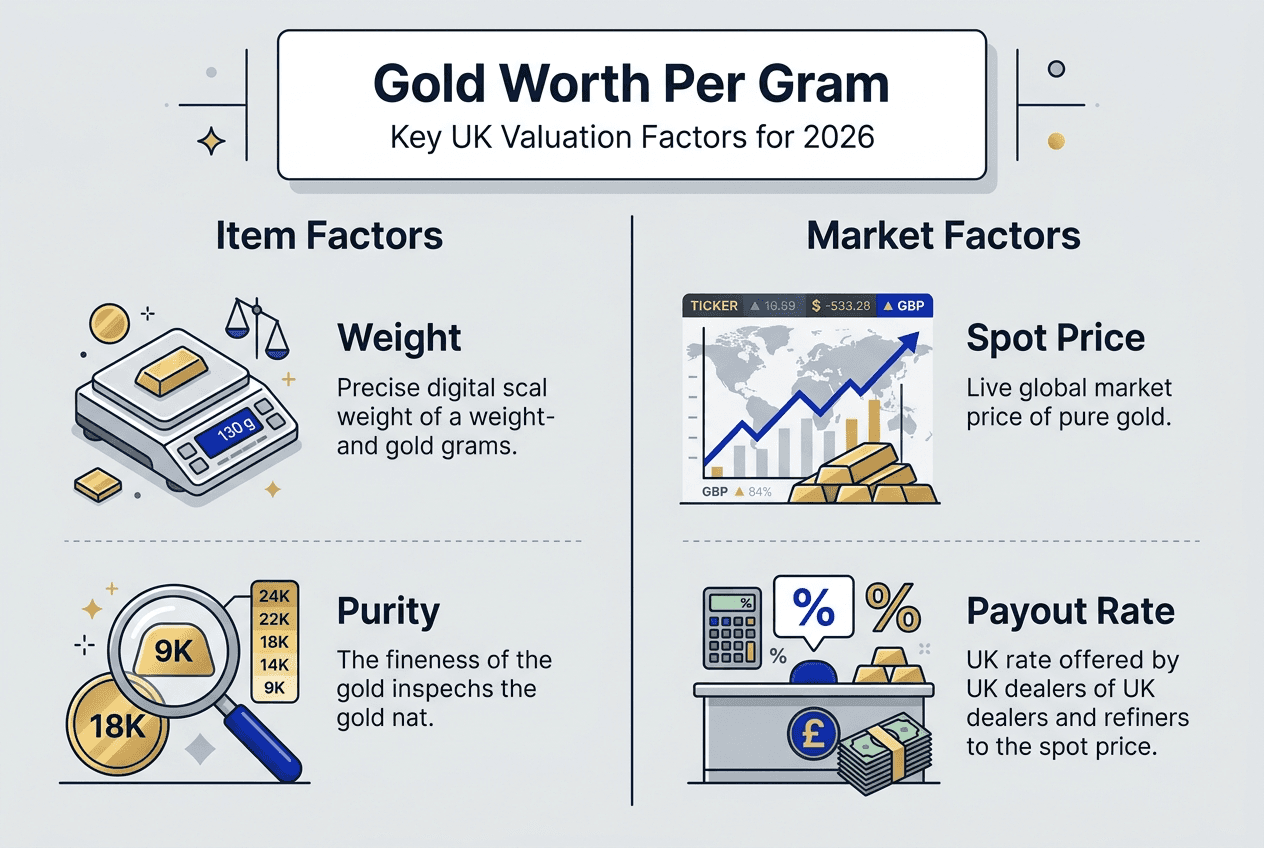
Calculating your gold’s worth requires a straightforward formula that accounts for weight, purity, current market rates, and buyer margins. The basic calculation is: weight in grams × purity as decimal × spot price per gram × buyer payout rate. Each variable plays a crucial role in determining your final payout.
Weight represents the total mass of your gold item in grams, measured on a precise digital scale. Purity appears as a decimal fraction derived from your hallmark: 9ct becomes 0.375, 14ct becomes 0.585, 18ct becomes 0.75, and so forth. Spot price per gram reflects the current market rate for pure 24ct gold, which you can check on reputable market websites. Buyer payout rate typically ranges from 80% to 95% of the calculated melt value, though some dealers offer as low as 60% whilst specialist bullion dealers may reach 97%.
Here’s how melt values compare across different purities based on current spot prices:
| Carat | Purity % | Melt value per gram | Typical buyer payout (85%) |
|---|---|---|---|
| 9ct | 37.5% | £46 | £39 |
| 14ct | 58.5% | £71 | £60 |
| 18ct | 75% | £91 | £77 |
| 22ct | 91.6% | £111 | £94 |
| 24ct | 99.9% | £121 | £103 |
To apply this calculation in practice, follow these steps:
- Weigh your gold item accurately using a digital scale calibrated to 0.01 gram precision
- Identify the hallmark stamp and convert it to decimal purity (750 hallmark = 0.75 purity)
- Check the current spot price for 24ct gold on a reliable market website
- Multiply weight × purity × spot price to get theoretical melt value
- Apply the buyer’s payout percentage to calculate your actual offer
- Compare offers from multiple buyers to ensure you’re receiving fair market value
Pro Tip: Always confirm the buyer’s exact payout percentage before agreeing to sell, as rates can vary significantly between dealers and may change based on the quantity you’re selling or current market conditions.
For example, a 15-gram 18ct gold chain would calculate as: 15g × 0.75 × £121 × 0.85 = £1,156. This represents an 85% payout rate, which sits in the middle range for reputable buyers. Understanding these calculations empowers you to verify offers instantly and identify dealers attempting to undervalue your items.

Testing gold purity and spotting fake gold
Verifying gold authenticity before valuation protects you from accepting payment for plated or fake items that carry minimal scrap value. Professional testing methods vary in accuracy, invasiveness, and cost, with XRF spectroscopy emerging as the preferred option for valuable or antique pieces.
XRF testing uses X-ray fluorescence to analyse metal composition without damaging jewellery, providing precise purity readings within seconds. Assay offices and reputable dealers use this technology to verify hallmarks or test unhallmarked items. The non-destructive nature makes it ideal for antique pieces where preserving original condition matters for potential collector value beyond melt weight.
Acid testing offers a lower-cost alternative but involves applying corrosive chemicals to a small scratch on the item’s surface. This method can damage jewellery and provides less precise results than XRF, particularly for items with surface plating or complex alloy compositions. Electronic testers fall between these options, using electrical conductivity to estimate purity, though they can be fooled by tungsten-core fakes or heavy plating.
Testing methods and their characteristics:
- XRF spectroscopy provides non-destructive, laboratory-grade accuracy ideal for valuable or antique items
- Acid testing offers budget-friendly verification but damages items and gives approximate results
- Electronic testers deliver quick estimates but can be deceived by sophisticated fakes
- Visual hallmark inspection works for clearly marked modern pieces but fails with worn or forged stamps
- Magnet testing eliminates some fakes (gold is non-magnetic) but cannot confirm purity or detect gold-plated items
Pro Tip: For unhallmarked or antique items, always insist on XRF testing rather than accepting visual estimates or acid tests that could damage potentially valuable pieces and provide unreliable purity readings.
Hallmarks remain the primary purity indicator, but they can wear off through decades of use, be absent on imported or pre-1973 items, or occasionally be forged on counterfeit pieces. Worn or missing hallmarks require professional testing to establish true gold content before valuation. Some antique pieces predate compulsory hallmarking or originate from countries with different marking systems.
Expert jewellers recommend never accepting a valuation based solely on visual inspection for unhallmarked items. Insist on transparent purity testing, preferably XRF, and obtain written documentation of the test results before agreeing to any sale price.
Fake or gold-plated items represent the biggest risk when selling without testing. A gold-plated brass item might weigh the same as solid gold but contains virtually no scrap value. Spotting fake gold requires professional equipment, particularly for sophisticated counterfeits using gold-filled or heavily plated construction. Reputable buyers will always test items before making offers, but unscrupulous dealers might skip this step hoping sellers don’t realise their items are fake or lower purity than assumed.
Navigating buyer payouts and getting the best price
Buyer payout rates vary dramatically across different dealer types in the UK, directly impacting how much cash you receive for identical gold items. Understanding these variations helps you target the right buyers and negotiate effectively.
Scrap gold buyers typically pay 80% to 95% of calculated melt value, positioning themselves in the middle range for convenience and speed. Specialist bullion dealers offer the highest rates, reaching up to 97% of spot price, because they focus on volume and operate with lower margins. High street jewellers and pawnbrokers generally pay the lowest rates, often 60% to 80%, due to higher overheads and business models that prioritise profit margins over competitive pricing.
Larger quantities command better payout percentages because dealers save on processing costs and can justify tighter margins when handling significant weights. Selling 100 grams might fetch 95% payout whilst 10 grams from the same dealer might only achieve 85%. This quantity premium rewards sellers who consolidate items rather than making multiple small transactions.
Comparison of buyer types and typical payouts:
| Buyer type | Typical payout % | 9ct per gram | 18ct per gram | Best for |
|---|---|---|---|---|
| Specialist bullion dealers | 92-97% | £42-45 | £84-88 | Large quantities, pure gold |
| Reputable scrap buyers | 85-92% | £39-42 | £77-84 | Mixed jewellery, convenience |
| Online gold buyers | 80-90% | £37-41 | £73-82 | Postal transactions |
| High street jewellers | 70-85% | £32-39 | £64-77 | Immediate local payment |
| Pawnbrokers | 60-75% | £28-35 | £55-68 | Emergency cash needs |
Maximising your returns requires strategic planning beyond simply choosing high-payout dealers:
- Obtain at least three written quotes from different buyer types to establish market range
- Separate gold items by purity before weighing to ensure accurate per-carat pricing
- Time your sale when spot prices peak rather than during market dips
- Verify buyer credentials through reviews, particularly Trustpilot ratings above 4.5
- Negotiate payout percentages, especially for larger quantities or higher-purity items
- Avoid buyers who refuse to disclose their payout percentage or testing methods
Pro Tip: Never accept the first offer without comparison shopping, even from reputable dealers, as payout rates can vary by 15-20% between buyers for identical items, potentially costing you hundreds of pounds on larger quantities.
Timing your sale strategically can significantly impact returns. Gold prices fluctuate based on economic uncertainty, currency movements, and global demand. Monitoring spot prices over several weeks helps you identify upward trends and sell during peaks rather than troughs. A difference of £5 per gram in spot price translates to substantial amounts on heavier items.
Reputable buyers in established locations like Hatton Garden or well-reviewed online platforms typically offer better rates than opportunistic high street operations. Check business longevity, physical premises, and customer testimonials before committing. Dealers with 20+ years of trading history and transparent testing processes generally provide fairer valuations than newer operations with limited track records.
Get reliable gold valuation and selling services
Now that you understand how gold valuation works and what determines fair pricing, putting this knowledge into practice requires a trusted partner who combines transparent testing with competitive payouts. Blackwell Jewellers offers expert gold valuation services across Kent and nationally, using XRF technology to provide accurate purity verification without damaging your items.

With over 20 years of established trading, Blackwell Jewellers delivers fair and competitive payouts based on current spot prices and verified purity levels. Whether you’re selling a single piece or consolidating multiple items, you’ll benefit from transparent processes and in-house expertise that ensures you receive accurate valuations backed by professional testing.
Key benefits of choosing Blackwell Jewellers:
- Certified purity checks using XRF technology for non-destructive accuracy
- Competitive offers reflecting current market rates and transparent payout percentages
- Multiple locations across Kent including Maidstone, Gravesend and Bexleyheath
- Expert jewellers with decades of experience in gold valuation and authentication
- Comprehensive service covering gold, silver and diamond pieces
Visit Blackwell Jewellers to receive a professional appraisal and discover how transparent valuation practices can maximise your returns when selling gold.
Frequently asked questions
How do I find out the current spot price of gold?
Spot prices update continuously throughout trading hours on reputable gold market websites. Check sites like gold.co.uk for current UK spot prices displayed in pounds per gram, which currently show 24ct gold at approximately £121-122 per gram in early 2026. These prices fluctuate based on global market conditions, so verify the rate immediately before selling.
What should I do if my gold has no hallmark?
Unhallmarked gold requires professional XRF testing to verify purity before accepting any valuation or sale offer. Never sell without testing due to the risk of significant undervaluation or accepting payment for plated items. Reputable dealers will test items free of charge as part of their valuation process, and you should insist on seeing written test results before proceeding. Items predating 1973 or imported pieces may legitimately lack UK hallmarks whilst still containing substantial gold content.
How can I ensure I get the best price when selling gold?
Obtain at least three written quotes from different buyer types, including specialist bullion dealers, established scrap buyers, and reputable online platforms. Separate items by purity and weigh each carat group separately to ensure accurate per-gram pricing. Time your sale when spot prices show upward trends rather than during market dips, and never accept offers without verifying the buyer’s payout percentage and testing methods.
Can I sell damaged or broken gold jewellery?
Damaged, broken or unwearable gold jewellery retains full scrap value based on weight and purity, making condition irrelevant for melt-value sales. Buyers assess only the gold content, not aesthetic appeal or functionality. This makes selling broken chains, single earrings, or damaged rings a practical way to recover value from items no longer suitable for wear. Separate any gemstones if possible, as these may carry additional value beyond the gold content.
Do I need to clean my gold before selling it?
Cleaning gold before selling provides no value advantage for scrap sales, as buyers assess only weight and purity through testing. Avoid aggressive cleaning methods that might remove small amounts of gold or damage hallmarks. Simple removal of obvious dirt helps buyers inspect hallmarks more easily, but professional dealers will test items regardless of cosmetic condition. Focus instead on accurately weighing items and obtaining multiple quotes rather than spending time on unnecessary cleaning.