
An assay office mark is the pictorial symbol showing which UK assay office tested and hallmarked the article, London (leopard’s head), Birmingham (anchor), Sheffield (rose), or Edinburgh (castle). It’s stamped alongside three other marks to form a legal UK hallmark, and it tells you exactly who checked your gold, silver, platinum or palladium before it ever reached a jewellery box.
TL;DR:
- The assay office mark identifies which of the four UK assay offices tested and hallmarked the jewelry, with each office having a distinct symbol.
- Dating a piece involves examining the date letter and shield shape, which cycle differently across London, Birmingham, Sheffield, and Edinburgh.
- Small gold, silver, platinum, or palladium items may legally skip hallmarking below certain weight thresholds, so absence of marks does not always indicate illegitimacy.
- Batch submissions for hallmarking are more cost-effective, as minimum parcel charges are spread over multiple items, especially for multiple pieces or larger lots.
- Verifying ambiguous or worn marks requires consulting official hallmark charts, photography, or direct contact with the assay office, not guesswork.
Table of Contents
- What an assay office mark is (and why you should care)
- The four UK assay offices and how to spot each one
- The five marks that make up a full UK hallmark
- Working out how old your piece actually is
- What hallmarking actually costs, and how long it takes
- Where to verify a mark you’re not sure about
- How Blackwell Jewellers documents marks on second-hand pieces
- Why hallmark literacy matters when you’re buying pre-owned
- Get your jewellery properly checked, not just admired
- Sources
What an assay office mark is (and why you should care)
Right, let’s get one thing straight before anything else: the assay office mark isn’t decoration. It’s a legal identifier. It tells you precisely which of the UK’s authorised offices tested the metal and applied the hallmark, and that matters because nobody, not even the poshest workshop in Hatton Garden, is allowed to grade their own homework.
That’s the whole point of the Hallmarking is the law guidance. A maker’s mark or sponsor’s punch, the little stamp a jeweller applies at the bench, tells you who made or sponsored the piece. It has zero legal weight on its own. Only an assay office, after independently testing the metal, can strike the mark that actually guarantees the fineness. Think of it like the difference between a chef signing their own menu and a food inspector certifying the kitchen.
The British Hallmarking Council oversees this whole system, and calls hallmarking one of the oldest consumer protection mechanisms in the country. In practice, that means:
- The assay office mark identifies which office tested the article, not who made it.
- The maker’s mark identifies the sponsor or manufacturer, and carries no legal guarantee of fineness alone.
- Only genuine assay testing, not a jeweller’s own claim, can confirm precious metal content under law.
The four UK assay offices and how to spot each one
Britain has just four authorised assay offices left, each with a symbol you’ll recognise once you know what you’re looking for.
- London, the Leopard’s head. The oldest of the lot, run out of Goldsmiths’ Hall since roughly 1300, according to background history on Wikipedia. You’ll see it as either a full leopard’s head with whiskers on older or bespoke pieces, or a simplified, more angular version on most modern jewellery. Goldsmiths’ Hall confirms the leopard’s head remains London’s official assay mark to this day.
- Birmingham, the Anchor. Ironic, given Birmingham isn’t anywhere near the sea, but the anchor has marked more British jewellery by volume than any other symbol, thanks to the city’s enormous historic trade in small gold and silver goods.
- Sheffield, the Rose. Sheffield used a crown mark for well over a century before switching to the Yorkshire rose in 1975, to avoid confusion with Edinburgh’s older use of a similar emblem. If you’re dating a piece and see a crown rather than a rose next to Sheffield-style marks, you’re almost certainly looking at something made before that change.
- Edinburgh, the Castle. Scotland’s assay office has used a three-towered castle mark for centuries, usually appearing crisp and compact even on small silver items, a Scottish signature that’s hard to mistake once you’ve seen it once.
The five marks that make up a full UK hallmark
A complete traditional UK hallmark isn’t one stamp, it’s five, working together like a fingerprint. According to Goldsmiths’ Hall, the assay office mark is actually the fourth of five components:
- Sponsor’s mark, identifying the maker or company that submitted the item.
- Traditional fineness symbol, such as the Lion Passant for sterling silver or Britannia for higher-grade silver.
- Millesimal fineness mark, a three-digit number like 925 (sterling silver) or 750 (18 carat gold) showing parts per thousand of pure metal.
- Assay office mark, the leopard’s head, anchor, rose or castle covered above.
- Date letter, a single letter denoting the year of testing.
Not everything needs a hallmark, though. The Hallmarking Act 1973 sets legal weight thresholds below which hallmarking isn’t compulsory:
Pro Tip: Gold needs hallmarking above a small weight threshold; silver, platinum, and palladium also have legal minimum weights for hallmarking, below which hallmarking is not compulsory. Below those weights, a piece can legally skip the full hallmark, so don’t panic if your tiny stud earrings look mark-free under a loupe.
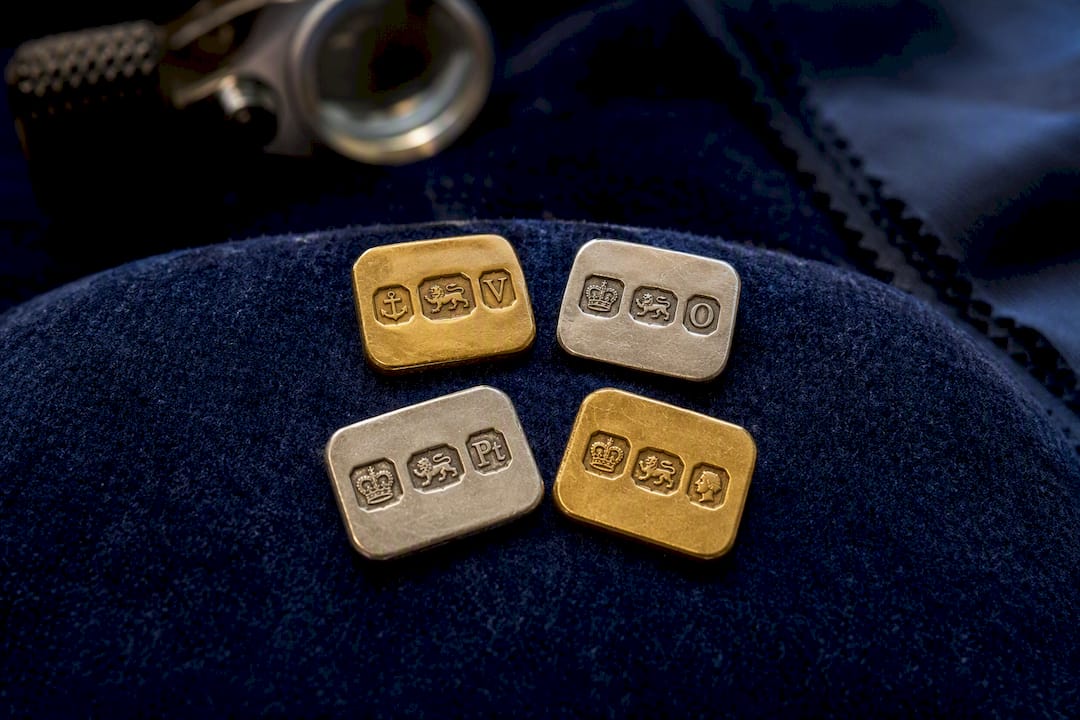
For a deeper breakdown of how these five marks fit together on different metals, our complete guide to jewellery hallmarks walks through real examples.
Working out how old your piece actually is
Date letters are where hallmark reading turns into a proper little detective exercise. Each assay office cycles through the alphabet using a different font and, crucially, a different shield shape around the letter, then starts again once it runs out of letters. That shield shape matters as much as the letter itself, because the same letter in a different font or outline can mean a completely different decade.
Here’s how to actually date something sitting in your jewellery box:
- Photograph the mark close up, ideally in raking light, so the shield outline and letter form show clearly rather than blurring into the metal.
- Compare both the letter and the shield shape against an official date chart, not just the letter alone.
- Use the assay office’s own published date tables online, since third-party charts occasionally simplify or misdate transition years.
- Note which office struck the mark first. Date letter cycles aren’t synchronised across London, Birmingham, Sheffield and Edinburgh.
If you’re working with silver specifically, our guide to reading and verifying sterling silver marks covers common date letter mix-ups in more depth.
What hallmarking actually costs, and how long it takes
Assay offices charge per article, but almost every price list also sets a minimum parcel charge, and that detail catches a lot of first-time submitters off guard.
The London Assay Office price list, effective 6 April 2026, lists packet charges alongside per-article fees, second-hand item charges and surcharges for bespoke marks. Submit one ring on its own and you’ll likely pay closer to the minimum parcel charge than a genuine per-item rate. Submit ten rings in one packet, and that same minimum charge gets spread across the whole batch.
Batching genuinely saves money. Industry price lists, including Birmingham’s 2026 hallmarking price list, consistently show that small, one-off submissions cost proportionally more than grouped ones.
A few practical points worth flagging:
- Priority or express services exist at most offices, but availability varies by season and item type, so check ahead rather than assuming a same-day turnaround.
- Minimum parcel charges apply regardless of how small your item is, which is exactly why trade jewellers batch submissions.
- Prices and thresholds change periodically. Always check the current published list before budgeting for a submission.
Where to verify a mark you’re not sure about
If you’re squinting at a stamp under a loupe wondering whether that’s a rose or a crown, don’t guess, check.
- Start with the assay office’s own published hallmark charts online. All four offices maintain these, and they’re the definitive reference.
- The British Hallmarking Council is your first port of call for general legal questions about what a mark means or whether an item should carry one at all.
- Retailers displaying or selling hallmarked items must comply with Dealers Notice A and B requirements, covering physical counter displays and online listings respectively, so a reputable seller should be able to point to compliant documentation.
- If a mark is worn, damaged or genuinely ambiguous, contact the relevant assay office directly with clear photographs and the item’s measurements. They deal with this constantly.
Our piece on authenticating gold jewellery covers photography angles that make faint marks far easier to read, and if you’re worried about counterfeit stamps specifically, spotting fake silver jewellery is worth a read too. Watch owners have their own quirks here too. Cases and movements are often hallmarked separately, something Horology Kings explains well for anyone checking a gold timepiece.
How Blackwell Jewellers documents marks on second-hand pieces
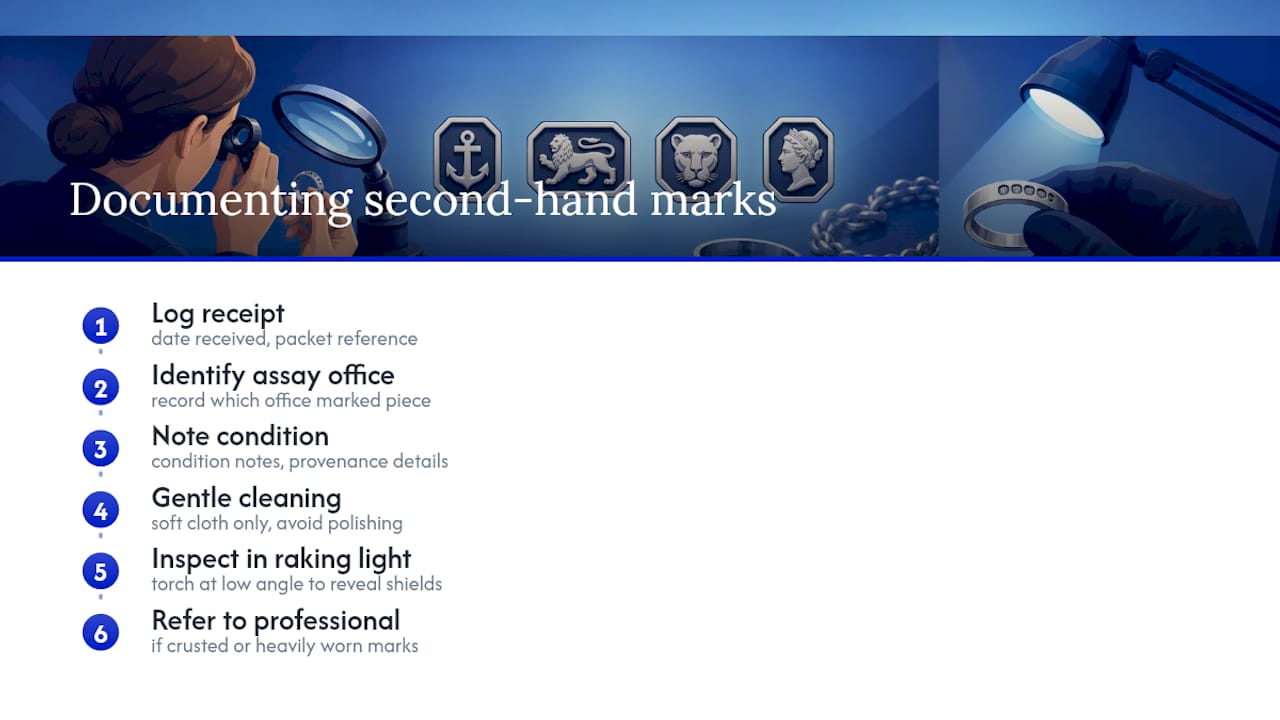
Every piece that comes through our doors gets logged before it goes anywhere near a display cabinet: date received, assay office identified, packet reference, condition notes. It’s tedious, sure, but it means provenance never gets fuzzy six months down the line.
Pro Tip: Marks hide in raking light. Angle a small torch across the metal at a low slant rather than shining it straight on, and a worn hallmark that looked blank suddenly shows its shield outline. Gentle cleaning with a soft cloth before inspection helps too, though anything crusted or worn should go to a professional rather than risk damaging the mark with over-eager polishing.
Why hallmark literacy matters when you’re buying pre-owned
Here’s the thing nobody tells new buyers: a hallmark isn’t just trivia for collectors, it’s often the single most decisive clue when you’re deciding whether a second-hand piece is what it claims to be. Learn to read the assay mark, the fineness number and the date letter together, and you stop taking a seller’s word for it. You start checking for yourself.
— James
Get your jewellery properly checked, not just admired
Reading a hallmark yourself is a brilliant start, but nothing beats having an expert eye look over a piece before you buy, sell or wear it daily. Blackwell Jewellers inspects, authenticates and hallmarks every item in our second-hand collection in-house, so you’re never relying on a stamp alone.

Every piece we sell has been checked by our own jewellers, not just glanced at, giving you documented provenance most casual sellers simply can’t offer. If you’re curious what’s currently available, browse our second-hand jewellery collection or visit us in Maidstone to see hallmarked pieces up close. Got something that needs a professional clean, resize or repair before its marks are fully readable? Our jewellery repairs team can help with that too. Pop in, bring the piece, and we’ll talk you through exactly what its marks tell us.
Sources
For legal detail and current fees, consult the British Hallmarking Council, Goldsmiths’ Hall and each assay office’s published price list.
- Hallmarking is the law: guidance summary
- London Assay Office price list (6 April 2026)
- Hallmarking — The Goldsmiths’ Company