
A British silver hallmark is an independent, legally recognised stamp confirming precious-metal content and the assay office that tested it — and when you spot one, do three things immediately: read the millesimal fineness number first, locate the assay office town mark, then photograph the full set clearly before you do anything else.
Those three steps sound simple, but they unlock a surprising amount of information. A complete set of marks can tell you what the silver is (925 sterling, 958 Britannia, or something else entirely), where it was tested, roughly when it was made, and who submitted it for assay. Hallmarking is the UK’s oldest form of consumer protection, and it has been doing that job since the 14th century. The Hallmarking Act 1973 made it a criminal offence in trade to describe an unhallmarked article as silver unless it falls under a specific exemption — so these marks carry real legal weight, not just collector interest.
- Read the fineness mark first — it answers the most urgent question: is this actually silver?
- Find the assay office mark — it tells you which of the four current UK offices tested the piece and points you to the right date-letter tables.
- Photograph the full set — good macro shots under raking light are worth more than any note you scribble down.
Key takeaways
British silver hallmarks are a legally enforced authentication system: read the fineness mark first, match the assay office town mark to one of the four UK offices, use office-specific date tables to date the piece, and consult Silvermakersmarks or 925-1000 for maker identification.
| Point | Details |
|---|---|
| Read fineness first | The millesimal number (925, 958, 800, 999) confirms silver grade before anything else. |
| Match the assay office mark | London, Birmingham, Sheffield, and Edinburgh each have a distinct town mark that unlocks the right date-letter tables. |
| Use maker databases | Silvermakersmarks.co.uk and 925-1000.com are the primary free resources for sponsor’s mark identification. |
| Know the legal threshold | Silver items over 7.78 g sold in trade must be hallmarked; describing an unhallmarked piece as silver is a criminal offence under the Hallmarking Act 1973. |
| Consult professionals for high-value pieces | Visual inspection and databases narrow the field; formal XRF or assay office testing closes it. |
Essential official and reference links for further verification
Use these sources for specific purposes rather than treating them as interchangeable:
- Silvermakersmarks.co.uk: Primary free database for British makers’ marks; search by initials and symbol shape.
- Hallmarking Act 1973 — Schedule 2 (fineness standards): The statutory list of recognised silver fineness values.
This article provides general information about UK silver hallmarking and is not a substitute for professional advice. For legal compliance questions or formal authentication of high-value items, consult the relevant assay office or a qualified professional.
Table of Contents
- What do UK silver hallmarks actually mean?
- Step-by-step: how to read a set of British or Irish hallmarks
- The four UK assay offices and how to verify with them
- Date letters and dating: how the cycles work
- Makers’ marks: where to look and how to identify a maker
- Legal essentials: the Hallmarking Act and dealer obligations
- Practical checks: spotting fakes and plated items
- Databases, apps, and online tools — what actually helps
- How professional jewellers authenticate hallmarked silver
- Buying second-hand hallmarked silver: an experienced buyer’s perspective
- Sources
What do UK silver hallmarks actually mean?
Assay offices confirm that a modern British hallmark must include three compulsory symbols: the sponsor’s (maker’s) mark, the millesimal fineness mark, and the assay office mark. On older pieces you will often find a date letter and, on items made between 1784 and 1890, a duty mark (a sovereign’s head) showing that excise duty was paid. The LAPADA guide to reading British silver hallmarks recommends reading them in this order: maker, fineness, assay office, date letter.
Here is what each mark tells you at a glance:
- Sponsor’s/maker’s mark — initials or a symbol in a shaped cartouche, identifying the person or company that submitted the piece for assay. Compulsory on all modern hallmarked silver.
- Millesimal fineness mark — a number showing parts per thousand of pure silver: 925 (sterling), 958 (Britannia), 800, or 999 (fine silver). Schedule 2 of the Hallmarking Act 1973 lists all recognised standards.
- Assay office/town mark — a symbol identifying which office tested the piece: leopard’s head (London), anchor (Birmingham), rose (Sheffield), castle (Edinburgh). Irish pieces from Dublin carry a crowned harp.
- Date letter — a letter of the alphabet in a shaped shield, cycling roughly every 20–26 years; the font and shield shape change with each cycle, and the cycle is office-specific.
- Duty mark (historical) — a sovereign’s head, struck 1784–1890 to confirm excise duty was paid. Not present on modern pieces.
- Scottish/Irish variants — Edinburgh used a thistle mark alongside the castle; some older Scottish pieces carry a lion rampant. Dublin’s crowned harp is distinct from mainland British marks.
On modern pieces, expect all three compulsory marks to be present and legible. Partial or worn marks on antiques are normal, but missing compulsory marks on anything made after 1999 should raise questions immediately.
Step-by-step: how to read a set of British or Irish hallmarks
Reading a set of hallmarks is less like decoding a cipher and more like reading a short address — each mark is a field, and they build a complete picture when read in sequence.
-
Find the fineness mark. Look for a three-digit number: 925, 958, 800, or 999. This is your first confirmation that the piece is silver and tells you its purity grade. On very old pieces (pre-1975 imports or pre-Act items) you may see a lion passant (a walking lion) instead of a number — that symbol traditionally indicated sterling standard on English silver.
-
Identify the assay office mark. Match the symbol to one of the four current UK offices (see the next section for details). This step matters because date-letter cycles are office-specific — a letter ‘K’ in one cycle at Birmingham falls in a completely different year from a ‘K’ at London.
-
Read the date letter. Note the letter, its font style (Roman, italic, Gothic, script), and the shape of the shield surrounding it. Cross-reference with the date tables published by the relevant assay office. A worn or ambiguous letter is one of the most common causes of mis-dating antiques, so if you are unsure, consult the office directly rather than guessing.
-
Note the sponsor’s/maker’s mark. Write down the initials, any surrounding symbols, and the cartouche shape. You will need all three details when searching makers’ databases — initials alone rarely narrow it down enough.
-
Record and photograph the full set. Do this before cleaning, polishing, or handling the piece further.
This side-lighting throws worn or shallow marks into sharp relief. For photography, a macro lens or a phone’s portrait mode with a clip-on macro attachment works well — shoot in RAW if your phone allows it, so you can boost contrast in editing without losing detail.*
Worn marks on spoons and flatware are particularly common because those pieces see the most handling. If a mark is genuinely illegible, a professional jeweller can sometimes read it under a bench microscope, or you can send a rubbing (using thin paper and a soft pencil) to the relevant assay office for an opinion.
The four UK assay offices and how to verify with them
The four active UK assay offices are London (Goldsmiths’ Hall), Birmingham, Sheffield, and Edinburgh. Each is an independent, not-for-profit regulator with a statutory duty to hallmark. AssayAssured is the industry scheme run on their behalf, providing an additional layer of quality assurance for participating retailers.
- London — Goldsmiths’ Hall: Town mark is a leopard’s head (uncrowned since 1821). The oldest assay office in the UK, operating since 1300. Contact via the Goldsmiths’ Company website for verification queries.
- Birmingham: Town mark is an anchor, oriented upright. Established 1773 after lobbying by Matthew Boulton. The Birmingham Assay Office handles the largest volume of hallmarking in the UK and publishes date-letter tables on its website.
- Sheffield: Town mark is a rose (since 1975; previously a crown). Also established 1773. Sheffield’s office is particularly useful for cutlery and flatware dating, given the city’s silversmithing history.
- Edinburgh: Town mark is a castle (three towers). Scotland’s only assay office, and one of the oldest in the UK. Edinburgh also used a thistle mark as a standard mark on Scottish silver, distinct from the fineness number system introduced later.
- Dublin (Irish hallmarking): Dublin’s assay office uses a crowned harp as its town mark. Irish hallmarking follows broadly similar conventions but has its own date-letter cycles and fineness standards. Pieces marked in Dublin are not British hallmarks, though they carry equivalent legal standing in Ireland.
To verify a mark or report a suspected fake, contact the relevant assay office directly. All four publish contact details and some offer formal verification services for a fee. The AssayAssured scheme also lists participating retailers who meet the offices’ standards — worth checking when buying from an unfamiliar online seller.
Date letters and dating: how the cycles work
Date letters are the most misunderstood part of a hallmark set, and honestly, they trip up even experienced collectors. Each assay office runs its own independent cycle, typically covering 20–26 letters of the alphabet (usually omitting a few to keep cycles tidy), and when one cycle ends, a new one begins with a different letter font and a different shield shape. That combination of letter, font, and shield is what pins a piece to a specific year.
A practical example: a lowercase italic ‘k’ in a plain rectangular shield at Birmingham points to a very different decade than an uppercase Roman ‘K’ in an ornate shaped shield at the same office. Date-letter tables from LAPADA and the individual assay offices are the only reliable way to resolve this — there is no shortcut.
| Fineness mark | Standard | Typical use |
|---|---|---|
| 999 | Fine silver | Bullion, investment bars |
| 958 | Britannia silver | High-quality hollowware, some coins |
| 925 | Sterling silver | Most jewellery and flatware |
| 800 | Lower-grade silver | Continental European imports |
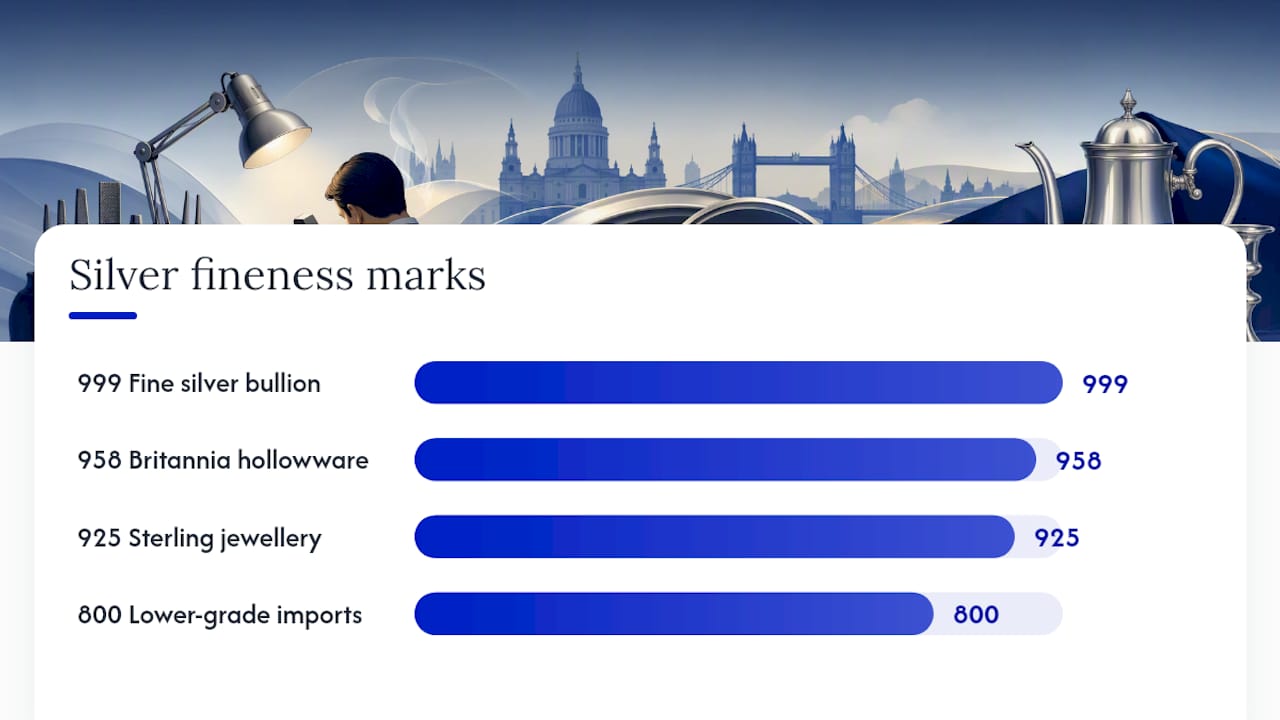
The 800 standard appears frequently on Continental imports and pre-1975 pieces. Sterling (925) is the benchmark for most British jewellery and flatware. Britannia (958) was briefly compulsory in England from 1697 to 1720 to protect coinage, and pieces from that period carry a Britannia figure and a lion’s head erased instead of the usual lion passant and leopard’s head.
A few practical cautions: letters repeat across centuries, so a lone date letter without the shield shape and font is almost useless for dating. Worn letterforms are the single most common cause of mis-dating. And if you are valuing or insuring a piece, a rough date range from visual inspection is not enough — consult the relevant office’s published tables or ask a professional.
Makers’ marks: where to look and how to identify a maker
A sponsor’s mark (the trade term for what most people call a maker’s mark) is compulsory on every modern hallmarked piece. It identifies the person or business that submitted the item for assay — which is not always the person who made it, particularly with larger retailers who submit on behalf of their suppliers.
The two most widely used free databases for British silver makers are Silvermakersmarks.co.uk and 925-1000.com. Both are long-established reference resources used by dealers and collectors alike. The LAPADA guide also provides context on reading and interpreting marks within a trade setting.
When searching, use all three elements: the initials, any surrounding symbols or devices, and the cartouche shape (oval, rectangular, shaped). Searching by initials alone returns too many results to be useful. Narrowing by locality (if you know the assay office) and approximate date range cuts the list dramatically. Some marks were struck by the assay office rather than the maker, which can affect orientation — if a mark appears upside-down relative to the others, that is usually why, not a sign of a fake.
For genuinely obscure marks, the Goldsmiths’ Company library holds historical records not available online, and the Birmingham Assay Office maintains its own archive. Both accept research enquiries, though response times vary.
Legal essentials: the Hallmarking Act and dealer obligations
The Hallmarking Act 1973 is the backbone of UK precious-metal consumer protection. Selling or describing an unhallmarked article as silver in the course of trade is a criminal offence unless the item qualifies for an exemption.
The main exemptions and thresholds, per Gov:
- Minimum weight threshold: Silver items weighing below a specific minimum weight are exempt from compulsory hallmarking.
- Pre-1950 antiques: Items made before 1950 that have not been substantially altered are exempt from the requirement to be hallmarked before sale, though they may carry original marks.
- Imported items: Items imported after 1975 must carry a UK or Convention hallmark if described as silver.
Dealer obligations go beyond simply having the marks present. Retailers — including online sellers — must display the official Dealers Notice, which explains hallmarking to buyers. Edinburgh Assay Office confirms that online dealers carry the same legal obligations as high-street shops and must provide hallmark information clearly in listings.
Government guidance also specifies how plated items must be described: a gold-plated silver piece must be described as silver immediately followed by “gold plated” — for example, “925 & 18ct gold plated.” Describing it simply as “gold” would be a misleading trade description.
If you suspect a seller is misrepresenting an item, contact the relevant assay office first (they have enforcement powers), then Trading Standards or Citizens Advice for broader consumer protection support.
Practical checks: spotting fakes and plated items
Not every piece stamped “925” is what it claims to be. Here is a quick triage checklist before you commit to a purchase or send something for professional testing:
- Weight check: Silver is dense. A piece that feels light for its size relative to similar items is worth scrutinising. Hollow or plated items often feel noticeably lighter than solid silver equivalents.
- Magnet test: Silver is not magnetic. A strong rare-earth magnet (neodymium) will not attract genuine silver. A clear pull suggests ferrous metal underneath plating. Note: this test rules out some fakes but not all — non-magnetic base metals like copper or brass are also used under silver plating.
- Edge and seam inspection: Plating wears first at edges, hinges, and high-contact points. Look for a colour change or a yellowish or reddish tinge at wear points — that is the base metal showing through.
- Fineness mark clarity: Genuine hallmarks are struck cleanly and sit within a defined cartouche. Laser-engraved or acid-etched fakes often look slightly fuzzy or shallow under magnification.
- Completeness of the mark set: On modern pieces, all three compulsory marks must be present. A piece with only a “925” stamp and no assay office mark or sponsor’s mark has not been through a UK assay office — it may be a foreign import or an unmarked piece. That alone does not prove fraud (it may be under the 7.78 g threshold), but it warrants further investigation.
For identifying fake silver in more detail, avoid acid tests at home unless you are experienced — they are destructive and the results are easy to misread. A professional jeweller can perform a non-destructive XRF (X-ray fluorescence) test that gives an accurate elemental reading without touching the surface.
Databases, apps, and online tools — what actually helps
The honest answer on hallmark-reading apps: treat them as a starting point, not a verdict. Automated image recognition for hallmarks has improved, but false positives are common, particularly with worn or partial marks. No app currently replaces a trained eye and a good reference table.
What does work reliably:
- Silvermakersmarks.co.uk — the go-to free database for British makers’ marks, searchable by initials and symbol. Regularly updated and widely trusted by dealers.
- 925-1000.com — broader international coverage, useful for Continental imports and comparing fineness standards across markets.
- LAPADA guide — a concise, trade-standard reference for reading mark sets and understanding the legal context.
- Individual assay office websites — London, Birmingham, Sheffield, and Edinburgh all publish date-letter tables and contact details for verification queries. These are the primary sources; everything else is secondary.
Pro Tip: For any piece worth more than a few hundred pounds, combine at least two database sources with the relevant assay office’s date tables, then get a professional opinion before buying or selling. Database searches narrow the field; they do not close it.
A word on the British Hallmarking Council: it oversees the UK hallmarking system and publishes policy guidance. It is not a verification service for individual pieces, but its published guidance is authoritative for legal and compliance questions.
How professional jewellers authenticate hallmarked silver
The workflow a professional jeweller follows when taking in a piece of second-hand silver is more systematic than most buyers realise — and it is worth understanding because it sets the standard you should expect from any reputable seller.
- Visual inspection under magnification: Every mark is examined under a loupe or bench microscope. The jeweller checks completeness, clarity, and consistency of the mark set before anything else.
- Macro photography: High-resolution images of each mark are taken and retained as part of the item’s record. These images go into the listing or condition report.
- Database and date-table cross-reference: The assay office mark narrows the date-letter search to one office’s tables. The maker’s mark is searched across Silvermakersmarks and 925-1000 to confirm or identify the sponsor.
- Weight and measurement: The piece is weighed and measured. Weight inconsistencies relative to known examples of the same type flag potential plating or substitution.
- Formal assay for ambiguous or high-value pieces: When visual inspection and database checks leave doubt, the piece goes to an assay office or an accredited laboratory for XRF or fire assay testing. AssayAssured provides a framework for this kind of formal verification.
At Blackwelljewellers, every piece of second-hand silver goes through this process before it reaches a listing. Condition reports, hallmark photographs, and provenance notes are standard — not optional extras. If restoration work has been carried out (polishing, re-plating, structural repair), that is disclosed, because restoration can affect hallmark visibility and occasionally obscures a mark that was previously legible. Jewellery repairs that involve significant metalwork near a hallmark area may require re-assay.
Buying second-hand hallmarked silver: an experienced buyer’s perspective
Second-hand silver is one of the best-value categories in the jewellery market — but only if you buy from sellers who can show their working. Here is what actually separates a trustworthy purchase from a gamble.
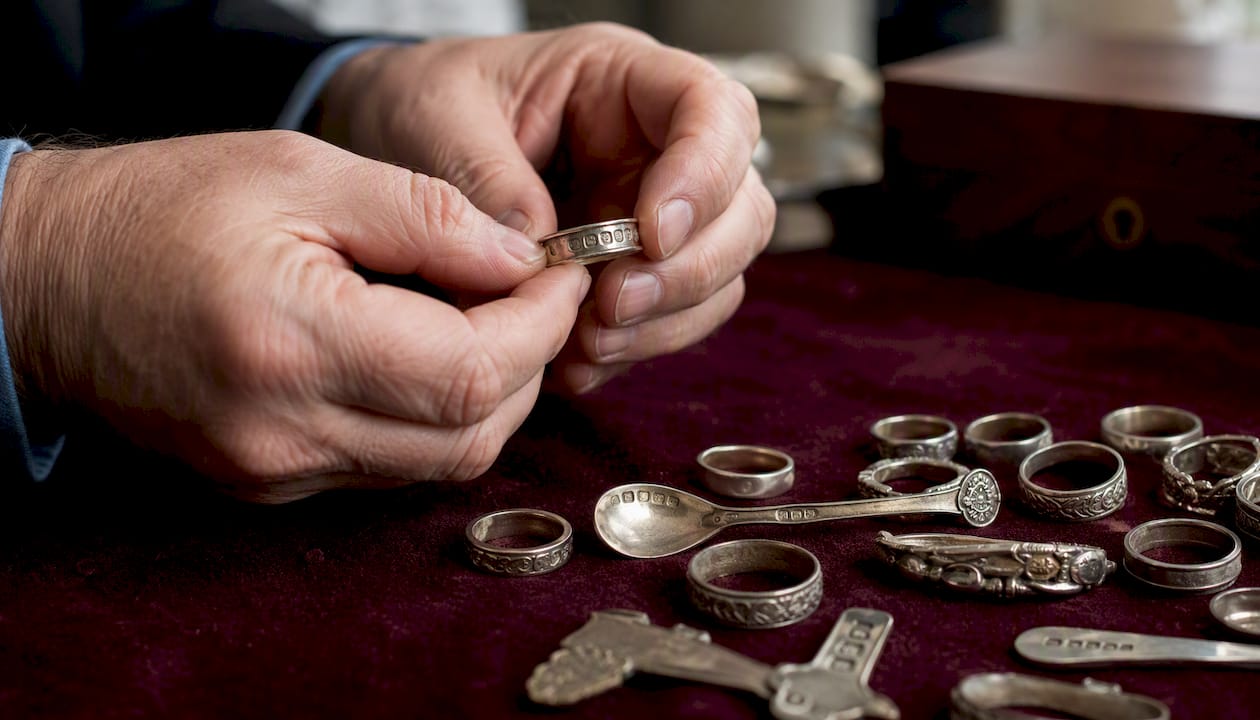
Documented provenance matters more than price. A seller who provides clear hallmark photographs, a condition report, and a transparent description of any restoration work is giving you something genuinely useful. A seller who cannot or will not provide those things is asking you to take their word for it — and that is not a trade you should make on anything significant.
Ask these questions before buying:
- Can you provide close-up photographs of all hallmarks, including the assay office mark and date letter?
- Has the piece been polished, re-plated, or repaired in a way that might affect the marks?
- Do you display a Dealers Notice, and are you registered under the Hallmarking Act?
- What is your returns policy if the piece turns out not to be as described?
Online marketplaces are convenient but carry real risk for silver purchases. Prefer sellers who display the Dealers Notice, offer condition reports, and have a clear returns policy. Buying authenticated second-hand jewellery from a specialist retailer who inspects and documents every piece removes most of that risk at source.