
Check for a UK Assay Office hallmark first. That single step is the most reliable way to authenticate gold jewellery, and it costs you nothing but a magnifying glass and thirty seconds. If the hallmark is clear and readable, run a quick magnet test to confirm there is no ferrous core hiding underneath. Those two checks together will catch the vast majority of fake or misdescribed pieces before you spend a penny.
Here is what to do right now:
- Look for the hallmark. Find a small stamped mark, usually on the inside of a ring band, the clasp of a bracelet, or the back of a pendant. You are looking for three compulsory components: a sponsor’s mark, a millesimal fineness number such as 375, 585, 750, 916, or 999, and an assay office symbol.
- Run the magnet test. Hold a strong magnet (a neodymium fridge magnet works well) close to the piece. Real gold is not magnetic. A strong pull means something ferrous is in there.
- Stop and get professional help if: the hallmarks are worn smooth, the piece is high value, it is a sentimental heirloom, or you are about to spend serious money on it. Home checks are a starting point, not a verdict.
Key takeaways
The single most reliable way to authenticate gold jewellery in the UK is to check for a complete Assay Office hallmark containing a sponsor’s mark, a millesimal fineness number, and an assay office symbol.
| Point | Details |
|---|---|
| Hallmark first, always | A UK Assay Office hallmark is the only independent legal guarantee of gold fineness. |
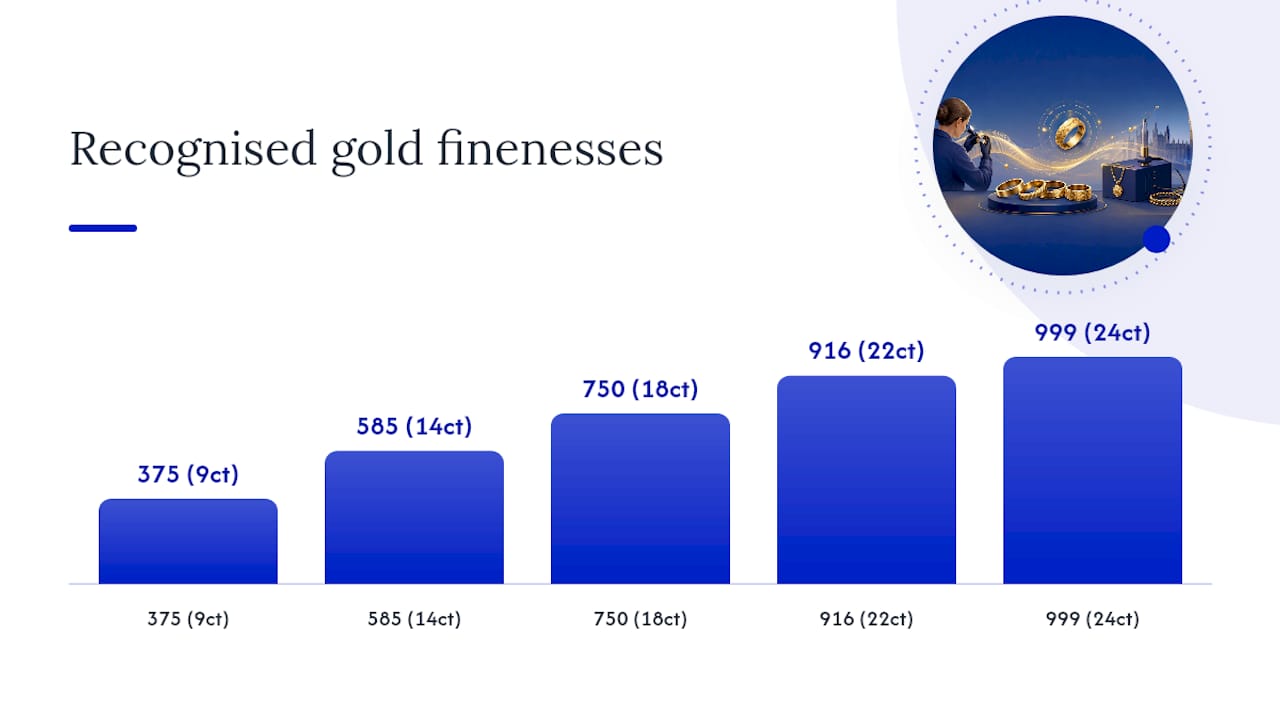
| Know your fineness numbers | 375 = 9ct, 585 = 14ct, 750 = 18ct, 916 = 22ct, 999 = 24ct gold. |
| Safe home checks have limits | Magnet and visual checks rule things out; they cannot confirm solid gold on their own. |
| Avoid destructive DIY on valuables | Acid kits and heat tests damage items and are unreliable on plated pieces. |
| Blackwelljewellers pre-authenticates | Every pre-owned piece is XRF scanned, inspected, and hallmarked before sale. |
Table of Contents
- How does UK hallmarking work, and why does it matter?
- What safe checks can you do at home before buying?
- DIY tests: which ones are worth it, and which ones will ruin your jewellery?
- When should you get a professional test, and what are your options in the UK?
- Your pre-purchase checklist: questions to ask and red flags to watch for
- How Blackwelljewellers authenticates every piece it sells
- Why a hallmark beats every home test, every time
- Blackwelljewellers: verified gold, no guesswork required
- Sources
How does UK hallmarking work, and why does it matter?
The UK hallmarking system is, genuinely, one of the best consumer protections in the world for jewellery buyers. It is not marketing fluff. Under the Hallmarking Act 1973, selling an item described as gold in trade without a hallmark (where one is required) is a criminal offence. That is a real legal backstop most countries simply do not have.
A complete UK hallmark contains three compulsory marks:
- Sponsor’s mark: The maker’s or importer’s registered initials, usually in a shaped cartouche. This tells you who submitted the piece for testing and creates a chain of accountability.
- Millesimal fineness mark: A number showing the gold content in parts per thousand. The recognised values for gold are 375 (9ct), 585 (14ct), 750 (18ct), 916 (22ct), and 999 (24ct).
- Assay office mark: The symbol of whichever of the four UK Assay Offices tested the piece. London uses a leopard’s head, Birmingham an anchor, Sheffield a rose, and Edinburgh a castle.
A date letter is optional but useful for antique and vintage pieces, as it tells you the year of hallmarking.
The minimum weight threshold for compulsory gold hallmarking is 1 gram. Items below that weight are exempt, so a tiny gold charm with no hallmark is not automatically fake. But it also carries no independent guarantee of its gold content.
Here is the thing people get wrong constantly: a stamp that just says “18K” or “750” is NOT a UK hallmark. It is a maker’s declaration, nothing more. Gov is clear that only a mark applied by an independent, government-appointed Assay Office provides the legal guarantee. A workshop can stamp whatever number it likes on a piece of brass. An Assay Office cannot.
For a deeper look at reading fineness marks, the Blackwelljewellers guide to gold hallmarks and purity is worth bookmarking.
What safe checks can you do at home before buying?
Good news: you do not need a chemistry lab. Several non-destructive checks give you useful information without risking damage to the piece.
Inspecting the hallmark properly
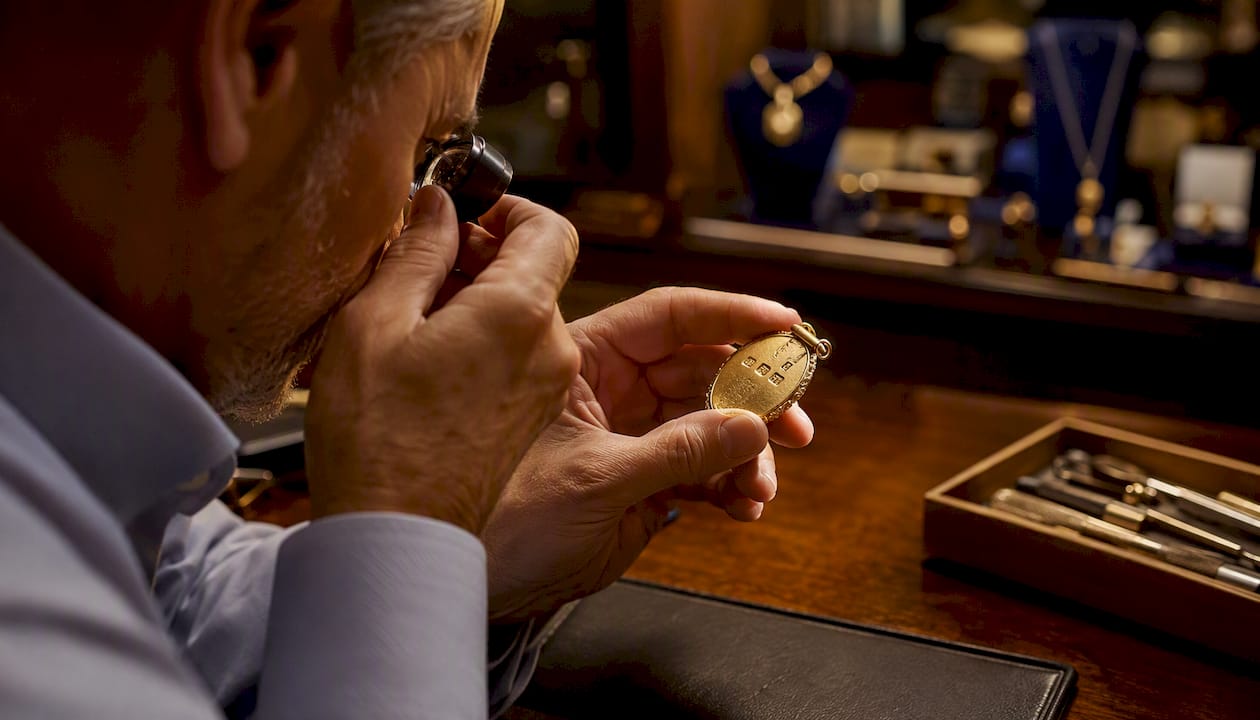
Look for the three marks described above in good, raking light. Photograph them. A genuine hallmark is struck cleanly into the metal; a fake one is often shallow, smudged, or inconsistently shaped. Compare what you see against the Assay Office London’s hallmark reference online.
The magnet test
Hold a strong magnet near the piece. Gold, silver, and most gold alloys are non-magnetic. If the piece pulls toward the magnet, something ferrous is present. Important caveat: some base metals used in plated jewellery (copper, brass, zinc) are also non-magnetic, so passing the magnet test does not confirm solid gold. It only rules out a ferrous core.
Weight and heft
Gold is dense. A 9ct gold ring feels noticeably heavier than a similarly sized brass or pot-metal ring. If a piece feels suspiciously light for its size, that is worth noting. You cannot calculate density without scales and water displacement, but the heft check is a useful first impression.
Colour and wear patterns
Look at the edges of rings, the inside of settings, and any high-wear points. Plated items reveal a different colour underneath where the plating has worn through, often showing yellow brass or silver-toned base metal. Official guidance confirms that sight and touch alone cannot reliably determine precious metal content, but visible wear-through is a strong red flag.
Pro Tip: Photograph every mark before you buy. A clear image of the hallmark, sponsor’s mark, and any wear patterns gives you a permanent record and makes any later dispute with a seller much easier to resolve.
DIY tests: which ones are worth it, and which ones will ruin your jewellery?
Let’s be honest here. Most DIY gold tests you find online range from “mildly useful” to “actively destructive.” Here is the real picture:
Vinegar test: Dropping a piece in white vinegar and watching for a colour change. Real gold does not react with acetic acid. The problem? Many base metals also do not react visibly, and surface plating can protect the base metal underneath from reacting at all. It is not reliable enough to stake money on.
Ceramic scratch test: Dragging the piece across unglazed ceramic tile. A gold streak suggests gold content; a black streak suggests a base metal. Surface plating will leave a gold streak even on a plated piece, so this test is largely useless for anything that might be gold-plated. GIA technical guidance confirms that modern alloys and surface treatments can easily mislead simple surface tests.
Magnet test (revisited): As covered above, useful for ruling out ferrous cores, not for confirming gold.
Lighter or heat test: Do not do this. It can damage gemstones, discolour metal, destroy hallmarks, and the results are unreliable. Skip it entirely.
Acid test kits: These use nitric acid to test a small scratch of metal. They are the most informative DIY option, but they are also destructive (they remove a tiny amount of metal), require PPE (gloves, eye protection, good ventilation), and can damage gemstones and surface finishes. Steps, if you choose to use one:
- Scratch the piece on a touchstone or the back of the item in an inconspicuous spot.
- Apply the appropriate acid for the carat you are testing.
- Watch the reaction: no reaction suggests the metal matches the acid’s rating; a green or brown reaction suggests a lower-carat or base metal.
- Neutralise and rinse immediately.
Use acid kits only on low-value items you own outright. Never use them on heirlooms, pieces with gemstones, or anything with sentimental value. The scratch is permanent.
When should you get a professional test, and what are your options in the UK?
If the piece is worth more than you are comfortable losing, stop guessing and get a professional opinion. Here are the main routes:
XRF analysis
X-ray fluorescence (XRF) is the go-to non-destructive test for most jewellers and pawnbrokers. A handheld XRF gun fires X-rays at the surface and reads the elemental composition back in seconds. No scratching, no chemicals, no damage. Many jewellers offer this as a quick in-store check, sometimes free, sometimes for a small fee.
The catch: XRF reads surface composition. A thick gold plating can fool it. Assay office guidance notes that XRF is a widely used non-destructive test but can be affected by plating or surface treatments. For a definitive answer on a suspicious piece, you need something more.
Fire assay (cupellation)
This is the laboratory gold standard, literally. Fire assay dissolves a small sample of the metal and measures the pure gold content with high precision. It is destructive (a small amount of metal is consumed), takes longer, and costs more, but the result is as accurate as it gets. Assay offices use this method when absolute fineness is required.
Assay Office hallmarking submission
You can submit an unhallmarked piece directly to one of the four UK Assay Offices: the London Assay Office, Birmingham Assay Office, Sheffield Assay Office, or Edinburgh Assay Office. They test the piece independently and, if it meets the declared fineness, apply a full legal hallmark. Turnaround times and fees vary by office and service level; standard submissions typically take a few days to a couple of weeks, with express options available. Check each office’s current fee schedule directly, as pricing changes.
A hallmark from an Assay Office is the only mark that gives you a legal remedy if the fineness turns out to be wrong. A jeweller’s verbal assurance or a private XRF reading does not carry the same weight in law.
For context on how valuation and testing intersect, the Blackwelljewellers guide to gold jewellery valuation explains what factors affect a piece’s assessed worth.
Your pre-purchase checklist: questions to ask and red flags to watch for
Whether you are buying from a retailer, a market stall, or a private seller online, run through this before handing over any money:
- Visible hallmark? Can you see all three components clearly (sponsor’s mark, fineness number, assay office mark)?
- Readable fineness? Does the number match what the seller claims (e.g., 750 for 18ct)?
- Documentation? Ask for a receipt, certificate, or original purchase paperwork. For pre-owned pieces, ask about provenance.
- Return policy? A reputable seller will give you time to verify the piece independently.
- Will they let you inspect it? A seller who refuses to let you examine the hallmark under a loupe is a red flag.
Specific questions worth asking out loud:
- “Has this been hallmarked by a UK Assay Office?”
- “Can I see the paperwork?”
- “Would you be willing to have it XRF tested before I commit?”
Red flags that should make you walk away:
- Seller refuses any form of inspection or independent testing.
- Price is dramatically below market value for the stated carat weight.
- Marks are vague, worn, or the seller cannot identify the assay office symbol.
- Provenance is vague (“I inherited it” with no further detail) on a high-value piece.
- The piece feels light for its size.
For second-hand or inherited pieces with worn or missing hallmarks: the absence of a hallmark does not automatically mean the piece is fake (especially for very old or very small items), but it does mean you have no independent guarantee. Get an XRF check or submit it for hallmarking before you treat it as confirmed gold. The Blackwelljewellers guide to buying authenticated second-hand jewellery covers this in more detail.
On international hallmarks: pieces from continental Europe often carry a convention hallmark (a common control mark used across signatory countries) or national marks such as French eagle heads or Italian star marks. These are legitimate but differ from UK Assay Office marks. If you are unsure, treat any non-UK mark as unverified until a UK Assay Office or qualified jeweller confirms it.
How Blackwelljewellers authenticates every piece it sells
Blackwelljewellers has been doing this for over 20 years across its Kent stores in Maidstone, Gravesend, and Bexleyheath. Every pre-owned piece in the collection goes through a structured authentication process before it reaches the shop floor or the website:
- Visual inspection and loupe examination: Every mark is checked under magnification. Sponsor’s marks, fineness numbers, and assay office symbols are all verified and recorded.
- XRF scan: A handheld XRF reading confirms surface composition and flags anything that does not match the declared fineness.
- Full assay submission for high-value pieces: Where XRF raises questions or the piece is high value, it goes to an Assay Office for independent testing and hallmarking.
- Conservation and repair: Items are cleaned, structurally assessed, and restored where needed before sale. Rhodium plating, stone resetting, and structural repairs are all handled in-house.
- Hallmarking where appropriate: Pieces that require a UK hallmark are submitted and marked before sale.
The result is a second-hand collection where every item carries verified provenance and, where required by law, a current UK hallmark.
Pro Tip: When bringing a piece to Blackwelljewellers for authentication, bring any documentation you have: original receipts, certificates, or photographs of the piece being worn. Clear provenance speeds up the process and strengthens any valuation.
Services available include authentication checks, XRF scans, jewellery repairs and restoration, assay office submissions, and pawnbroking for those who need a valuation or loan against a piece.
Why a hallmark beats every home test, every time
Here is my honest take on this: the home tests covered in this article are useful for ruling things out, not for ruling things in. A magnet test that passes tells you there is no iron hiding inside. A vinegar test that shows no reaction tells you… not very much, actually. None of them give you a legal guarantee.
An Assay Office hallmark is different in kind, not just degree. It means a government-appointed body with no commercial interest in the result tested that piece and staked its reputation on the fineness number stamped into the metal. If the hallmark turns out to be wrong, you have a legal remedy under the Hallmarking Act 1973. Try getting that from a YouTube scratch test.
The practical upshot: use home checks as a quick filter before you spend time and money on a piece. Use XRF when you need a fast, non-destructive read. Use an Assay Office when the value or the stakes are high enough to warrant certainty. And buy from sellers who have already done that work for you.
Blackwelljewellers: verified gold, no guesswork required
Buying pre-owned gold jewellery is a genuinely smart move when the provenance is solid. The problem is that “solid provenance” is rare in the second-hand market. Most private sellers cannot tell you which Assay Office hallmarked a piece, let alone produce the original receipt.

Blackwelljewellers’s authenticated second-hand collection solves that problem directly. Every piece has been through the full inspection, XRF, and hallmarking process described above, carried out by in-house expert jewellers with over two decades of experience. You get verified fineness, clear provenance, and the peace of mind that comes from buying from a business with physical stores you can walk into and people you can talk to. If you need a repair, restoration, or a jewellery repair service before or after purchase, that is handled in-house too. Visit any of the Kent stores or browse the full collection online at blackwelljewellers.co.uk to find a piece you can buy with confidence.
Sources
Official and authoritative references used in this article:
- Assayofficelondon
- Gov
- Assets
- What is a hallmark? - Edinburgh Assay Office
- What is a hallmark? - Assay Office London
- GIA (Gemological Institute of America)