
TL;DR:
- Most snapped gold chains are repairable by a professional jeweller, using soldering or laser welding techniques.
- The repairability depends on chain style, thickness, and condition, with common chains like cable or Figaro being easier to fix.
A snapped gold chain can almost always be repaired by a professional jeweller, provided the damage is not too extensive and the chain type is suitable for repair. The two main techniques used are soldering and laser welding, and both can restore a broken chain to full wearable strength. What determines whether your chain is a good candidate comes down to its style, thickness, karat, and the extent of the damage. This guide walks you through everything you need to know, from repair methods and realistic costs to when replacement makes more sense than fixing.
Can a snapped gold chain be repaired? The honest answer
Yes. The vast majority of snapped gold chains are fixable. Gold is a soft metal, especially at higher karats like 18K and 24K, which makes chains vulnerable to breaks from everyday wear, yanks, chemical exposure, and microscopic metal fatigue. That softness is also what makes gold so workable for a skilled jeweller.
Professional gold chain repair follows a standardised six-step process: inspection, cleaning, repair method selection, strengthening, finishing, and quality control. That process takes anywhere from a few days to two weeks depending on complexity and the jeweller’s workload. So no, you are not looking at months of waiting for a simple solder job.
The important thing to understand is that “repairable” does not always mean “repair is the right call.” Chain style, metal condition, and the number of previous repairs all matter. Read on before you hand anything over.
Which gold chains are easy to repair (and which are a nightmare)
Not all chains are created equal when it comes to repair. Some are straightforward. Others will test the patience of even the most experienced jeweller.
Chains that repair well:
- Standard cable chains (the most common type, with uniform oval or round links)
- Curb chains above 0.5mm thickness
- Figaro chains with alternating link sizes
- Box chains with square links
These styles have accessible link structures and enough metal mass to hold solder or a laser weld cleanly.
Chains that are genuinely tricky:
- Herringbone chains (flat, interlocking V-shaped links that distort easily)
- Snake chains (smooth, flexible tubes with no individual links to work with)
- Rope chains (twisted structure that can look uneven after repair)
- Very thin or hollow chains (the metal walls are simply too thin to hold a repair)
- Gold-plated chains (the base metal underneath behaves differently under heat)
Herringbone, snake, and rope chains have structural complexities that make repairs difficult and sometimes visible after fixing. A repaired herringbone chain may lose flexibility at the join point, which is noticeable when worn. That is not a failure of skill. It is just the nature of the design.
Karat matters too. Higher-karat gold (18K and above) is softer and more prone to stretching around the break point. A good jeweller will check the links neighbouring the snap for thinning and wear, not just the break itself.
Pro Tip: Before you take your chain in, hold it up to a light and look for any links that appear thinner, stretched, or discoloured near the break. If you spot more than one weak area, mention it. A thorough inspection at the start saves you from a second break six weeks later.
What repair methods do jewellers actually use?
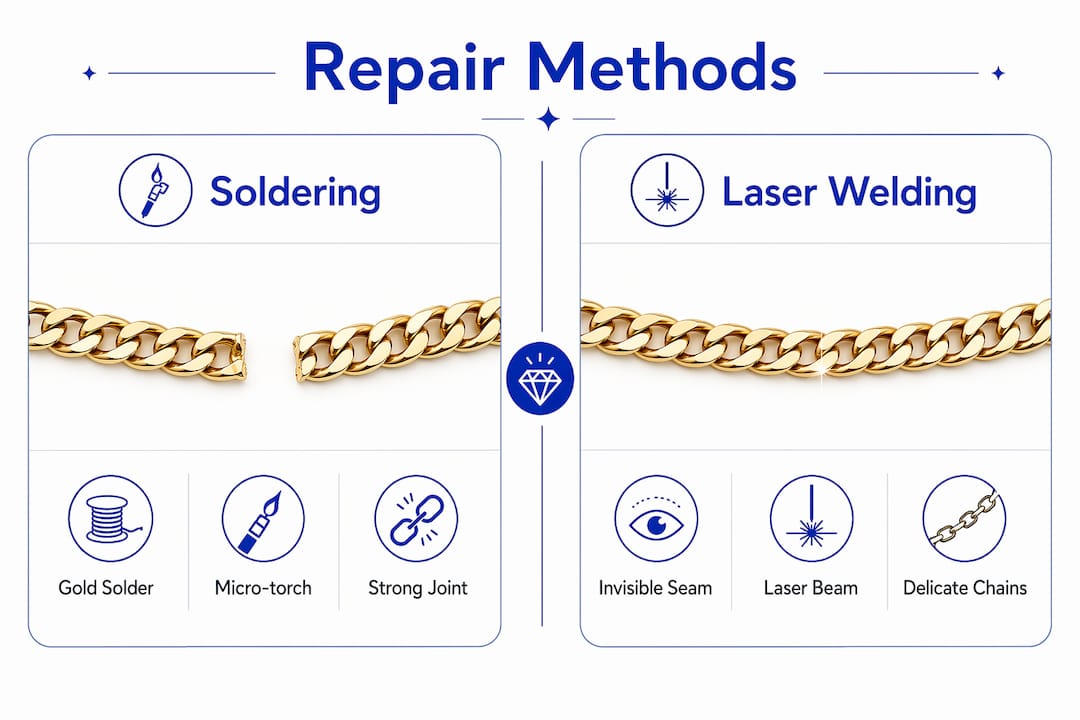
There are two main professional techniques for repairing a snapped gold chain: soldering and laser welding. Each has its place, and the right choice depends on your chain.
Soldering
Soldering uses gold solder (a lower-melting-point gold alloy), flux, and a micro-torch to fuse the broken ends together. The jeweller applies flux to prevent oxidation, heats the join, flows the solder in, then cools and cleans the piece. After that comes acid bath pickling to remove fire scale, followed by polishing to restore the finish. Done properly, the result is strong and barely visible.
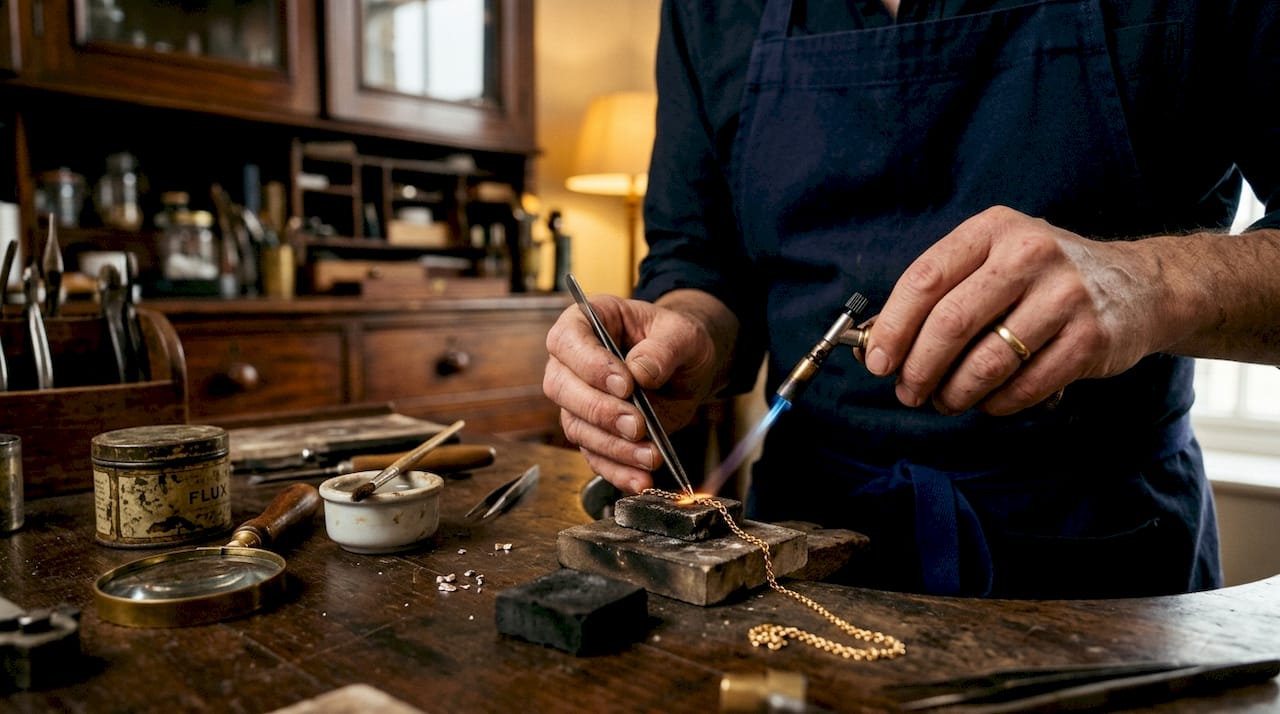
A properly soldered joint is often stronger than the original metal at that point. The catch is that neighbouring links may have been weakened by the same stress that caused the break, so a professional will inspect those too.
Laser welding
Laser welding creates virtually invisible seams and is the preferred method for delicate or intricate chains. It uses a focused laser pulse to fuse metal without the heat spread of a torch, which means less risk of distortion or discolouration. It is more costly than soldering, but for a fine herringbone or a thin box chain, it is often the only sensible option.
Different gold karats require adjustments in solder composition and heating temperature to avoid metal damage and preserve colour match. A 9K chain and an 18K chain are not treated the same way.
Here is a quick comparison of your main options:
| Method | Durability | Visibility of repair | Typical cost | Best for |
|---|---|---|---|---|
| Professional soldering | High | Low to moderate | Lower | Cable, curb, Figaro chains |
| Laser welding | Very high | Very low | Higher | Delicate, thin, or intricate chains |
| DIY kits or superglue | Very low | High | Minimal | Not recommended |
Pro Tip: Superglue does not bond well to precious metals and leaves a residue that complicates any future professional repair. Skip it entirely. A DIY soldering kit from a hardware shop is not calibrated for gold alloys and can cause irreversible damage to the metal.
What does it cost to repair a gold chain, and how long does it take?
Cost is the question everyone wants answered, and the honest answer is: it depends. But here is a realistic picture.
Basic solder repair for a standard gold chain starts at around £25–£45 for a simple break on a cable or curb chain. Complex patterns, thicker chains, or multiple repair points push the price up considerably. Clasp replacements sit in a similar range depending on the gold weight involved.
Turnaround time follows the same logic. A single clean break on a standard chain can often be done within a few days. A rope chain with multiple weak points, or a laser weld job on a delicate piece, may take closer to two weeks.
| Repair type | Approximate cost (UK) | Typical turnaround |
|---|---|---|
| Single break, cable or curb chain | £25–£45 | 2–5 days |
| Complex pattern (rope, Cuban link) | £50–£100+ | 5–14 days |
| Clasp replacement | £30–£60 | 2–5 days |
| Laser weld, delicate chain | £50–£120+ | 5–14 days |
One legal point worth knowing: UK jewellers comply with the Hallmarking Act 1973 for chains over one gram. This means any repair that adds metal must use the correct karat solder and maintain the item’s legal integrity. A reputable jeweller handles this automatically. An unqualified one might not.
When does replacement beat repair? If the repair cost approaches or exceeds the chain’s replacement value, and the piece has no sentimental weight, a new chain is the smarter spend. You can find well-priced pre-owned gold chains that have already been inspected and hallmarked, which takes the guesswork out of condition.
For a fuller picture of how long repairs take and what drives the timeline, it is worth reading up before you book in.
Should you repair or replace your snapped gold chain?
This is where honest advice matters more than a sales pitch. Here is how to think it through.
Repair is the right call when:
- The break is a single, clean snap with no other visible damage
- The chain is solid (not hollow) and above 0.5mm thickness
- The piece has sentimental value that outweighs the repair cost
- A professional inspection confirms no other weak points
Replacement makes more sense when:
- The chain has multiple weak areas, previous failed repairs, or hollow damage
- The metal has thinned significantly along its length from years of wear
- The repair cost is close to what a replacement chain would cost
- The chain style (herringbone, snake) makes a clean, invisible repair unlikely
The key step before deciding is a professional inspection. Compromised links adjacent to a break point often carry microscopic stress and wear that is invisible to the naked eye. A jeweller who only fixes the visible snap without checking the surrounding links is not doing the full job. Ask specifically whether neighbouring links have been checked.
Sentimental value is real and valid. A chain worn by someone you loved is not replaceable by a new one from a shop. In those cases, repair is almost always worth it, even if the result is not cosmetically perfect.
Key takeaways
A snapped gold chain is repairable in most cases, but the chain’s style, thickness, and overall condition determine whether soldering, laser welding, or replacement is the right path.
| Point | Details |
|---|---|
| Most chains are fixable | Solid cable, curb, and Figaro chains repair well; hollow and herringbone styles are more challenging. |
| Two main repair methods | Soldering suits standard chains; laser welding is better for delicate or intricate styles. |
| Inspect beyond the break | Neighbouring links often carry hidden stress and should be checked before any repair is approved. |
| Cost reflects complexity | Simple repairs start around £25–£45; complex or laser weld jobs can reach £120 or more. |
| Know when to replace | Multiple weak points or previous failed repairs often make replacement the safer, more cost-effective choice. |
What most people miss when their chain snaps
Here is something I see regularly at Blackwelljewellers: a customer brings in a snapped chain and points to the break. That is the obvious bit. What they have not noticed is that the two links either side of the snap are stretched, thinned, and barely holding. Fix only the break, and the chain snaps again within a month. Then the customer is frustrated, and honestly, who can blame them?
The repair itself is rarely the hard part. The hard part is the inspection. A good jeweller treats the visible break as a symptom and looks for the underlying cause. Was the clasp putting uneven tension on one section? Has the chain been worn in a swimming pool (chlorine attacks gold alloys)? Are there three or four other links that are one bad tug away from failing?
I am also going to say something that might sound counterintuitive: not every piece of jewellery should be repaired. Honest jewellers prioritise safety and longevity over repeatedly charging for repairs that are likely to fail. If a chain has been repaired twice already and the metal is genuinely compromised, the right advice is to replace it. Any jeweller who keeps taking your money for the same failing chain is not doing you a favour.
The UK jewellery trade has professional standards for a reason. Look for jewellers who are transparent about what they find during inspection, explain your options clearly, and do not push unnecessary work. That is the standard Blackwelljewellers holds itself to, and it is the standard you should expect anywhere you take your jewellery.
— James
Gold chain repair at Blackwelljewellers
Blackwelljewellers offers professional jewellery repair services across its Kent stores in Maidstone, Gravesend, and Bexleyheath, covering everything from single-break soldering to laser welding on delicate chains. Every repair includes a thorough inspection of the full chain, not just the break point, and all work complies with the Hallmarking Act 1973 for pieces over one gram.

If your chain is not worth repairing, Blackwelljewellers can also help you find a quality pre-owned replacement that has been inspected, authenticated, and hallmarked before sale. Get in touch with the team for a no-obligation assessment and repair quote at any of the Kent stores or through the online platform.
FAQ
Can all types of gold chain be repaired?
Most solid gold chains can be repaired professionally. Herringbone, snake, and hollow chains are the most difficult, and repairs on these styles may leave a visible mark or affect flexibility.
How much does it cost to repair a gold chain in the UK?
A basic solder repair on a standard chain typically starts at around £25–£45. Complex patterns, laser welding, or multiple repair points push costs higher, sometimes to £120 or more.
Is laser welding better than soldering for gold chains?
Laser welding produces a virtually invisible seam and is better suited to delicate or intricate chains. Soldering is more cost-effective for standard cable or curb chains and delivers excellent results when done correctly.
How long does a gold chain repair take?
A simple break on a standard chain can be completed within two to five days. More complex repairs or laser welding jobs typically take up to two weeks depending on the jeweller’s workload.
When should I replace rather than repair my gold chain?
Replacement is the better option when a chain has multiple weak points, has been repaired more than once already, or is hollow and structurally compromised. A professional inspection will confirm which route makes sense for your specific piece.
Recommended
- Repair a broken gold chain: step-by-step guide – Blackwell Jewellers
- Where to get a broken gold chain repaired near you in Kent – Blackwell Jewellers
- Find quality gold chain repair near you in Kent – Blackwell Jewellers
- Can Broken Jewellery Be Fixed? In-Store Repair Services at Blackwell J – blackwellonline