

TL;DR:
- Local jewellers in Kent typically repair gold chains within 1 to 2 days.
- Preparation and clear communication improve repair quality and satisfaction.
- Reputable shops offer transparent quotes, guarantees, and expert craftsmanship.
A broken gold chain can feel surprisingly upsetting. Whether it snapped during everyday wear or simply gave way at the clasp after years of use, that small piece of jewellery often carries real emotional weight. The good news for Kent residents is that skilled, local repair services are far more accessible than most people realise. This guide walks you through everything you need to know, from understanding what local jewellers can deliver, to preparing for your visit, following the repair process step by step, and knowing how to verify the finished work before you leave the shop.
Table of Contents
- What to expect from gold chain repair services near you
- Tools, materials, and preparation before visiting a jeweller
- The gold chain repair process: step-by-step overview
- Troubleshooting and avoiding common gold chain repair issues
- What most guides miss about gold chain repairs in Kent
- Where to find trusted gold chain repair in Kent
- Frequently asked questions
Key Takeaways
| Point | Details |
|---|---|
| Fast local turnaround | Most Kent jewellers finish gold chain repairs within 2 days, much quicker than mail-in services. |
| Bring key details | Knowing the chain’s metal, gauge, and purchase history can help ensure smoother repairs. |
| Understand repair steps | Familiarising yourself with the repair process lets you ask better questions and spot quality work. |
| Quality varies by jeweller | Customer reviews and guarantees are vital for choosing a reliable gold chain repair service. |
What to expect from gold chain repair services near you
When your gold chain needs attention, the first question most people ask is: how quickly can this be fixed? Local jewellers in Kent typically complete straightforward repairs within 1 to 2 days, whilst mail-in services can stretch to 7 to 10 working days. That difference matters enormously if the chain is a piece you wear daily or need for an upcoming occasion.
Understanding repair turnaround times before you commit helps you plan properly. Complexity plays a big role. A simple solder on a clean break is usually quicker than sourcing a replacement clasp or repairing a multi-strand chain where several links have failed.
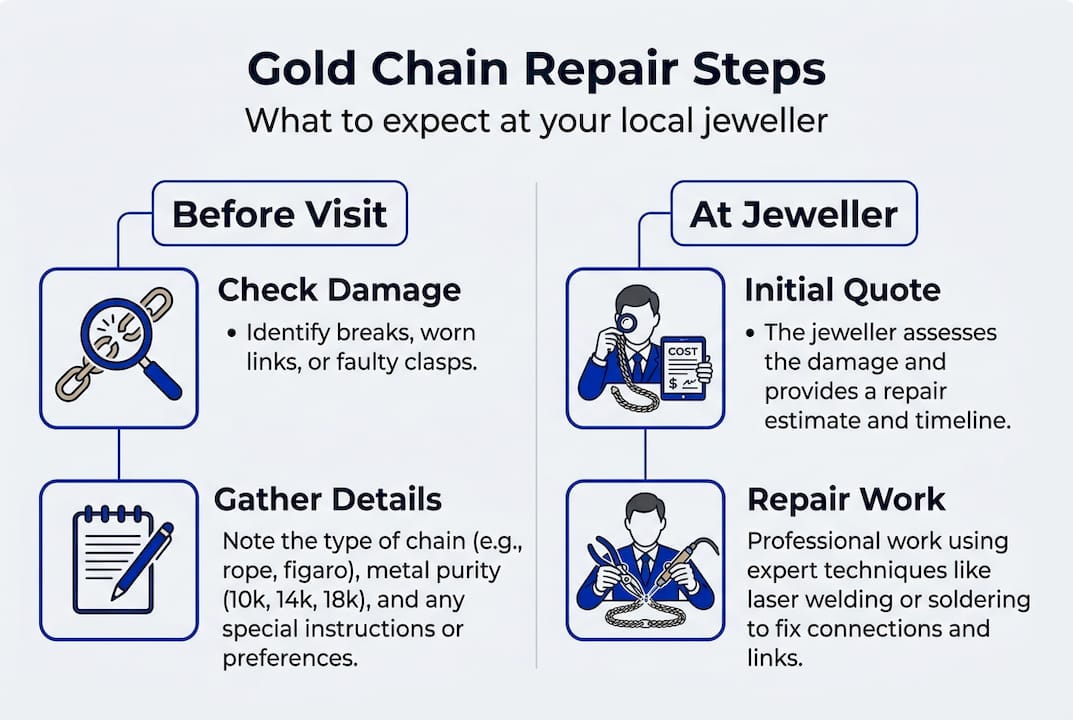
Typical repair cost ranges
| Repair type | Estimated cost | Typical turnaround |
|---|---|---|
| Simple solder (yellow gold) | £20 to £40 | 1 to 2 days |
| Clasp replacement | £25 to £50 | 1 to 3 days |
| White gold or platinum repair | £40 to £80 | 2 to 4 days |
| Complex multi-link rebuild | £60 to £100 | 3 to 5 days |
Of course, UK repair costs shift depending on current metal prices and the individual jeweller’s pricing structure. Always ask for a written quote before work begins.
When choosing a local jeweller, look for these quality indicators:
- Customer reviews: Platforms like Google and Trustpilot offer genuine insight. Jewellers with consistent high scores, such as those maintaining 4.8 out of 5 across many reviews, signal reliable craftsmanship.
- Accreditations: Look for membership of the National Association of Jewellers or similar industry bodies.
- In-house workshop: Jewellers who carry out repairs on-site rather than sending work away offer faster turnaround and greater accountability.
- Transparent pricing: A reputable jeweller will always provide a firm quote before starting, never a vague estimate.
Mail-in services can seem appealing on price alone, but they carry real risks: lost parcels, longer waits, and no face-to-face communication if something goes wrong. For a piece you value, local is almost always the smarter choice.
Tools, materials, and preparation before visiting a jeweller
Now that you understand local standards and what to expect, let’s get ready for your chain repair visit. Arriving well prepared makes a genuine difference, both to the quality of the outcome and to how smoothly the conversation with your jeweller goes.
Before you visit, gather the following:
- The chain itself, ideally in a small sealed bag to keep all broken pieces together
- Any original receipt or certificate of authenticity if you have it
- Notes or photos showing where and how the break occurred
- A rough idea of how old the piece is and whether it has been repaired before
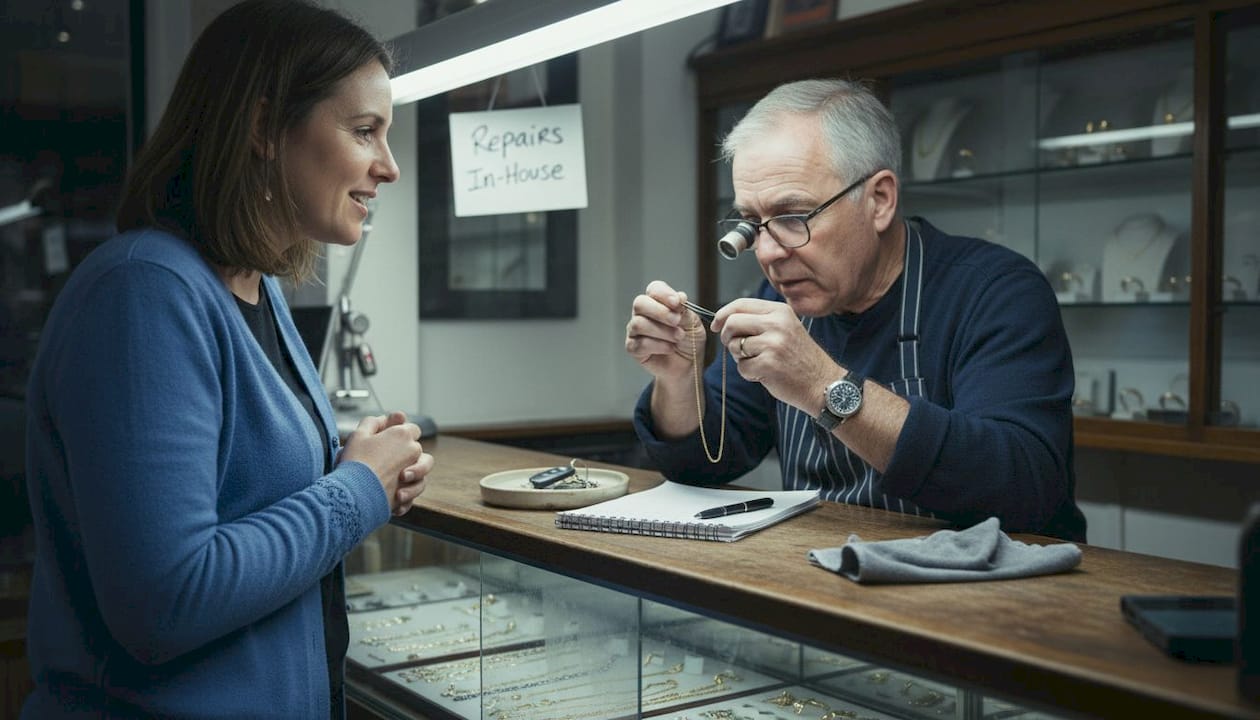
Your jeweller will carry out an initial inspection covering several key areas. They will assess the metal type and purity (most gold chains are 9ct, 18ct, or 22ct in the UK), the chain gauge (thickness of the links), the style of break (clean snap, gradual wear, or clasp failure), and the overall condition of the rest of the chain. As industry benchmarks confirm, repair costs vary significantly depending on metal type, gauge, and break complexity, so this inspection directly shapes your quote.
Our broken chain guide goes into more detail about identifying break types, which can help you describe the problem clearly when you arrive.
Comparison: being prepared vs. unprepared
| Factor | Prepared visit | Unprepared visit |
|---|---|---|
| Quote accuracy | Higher, based on full information | May require a follow-up |
| Time spent in shop | Shorter, efficient | Longer, with back-and-forth |
| Communication quality | Clear, focused | Vague, potentially costly |
| Repair satisfaction | Generally higher | Risk of misunderstanding |
Pro Tip: Before you agree to any repair, ask these three questions: Is the quote fixed or subject to change? Will I be contacted if additional work is needed? Is there a guarantee on the repair?
These questions are especially relevant if you are visiting for the first time. Our overview of common jewellery repairs can help you understand what category your chain repair falls into, so you feel confident going into that conversation.
The gold chain repair process: step-by-step overview
Having completed your preparation, here is what typically happens once your chain is in expert hands.
The standard repair workflow
- Intake and assessment: The jeweller logs your chain, records its condition, and gives you a written quote and an expected collection date.
- Cleaning: The chain is ultrasonically cleaned or polished to remove any grease or debris that might interfere with the repair.
- Break assessment under magnification: A loupe or microscope is used to examine the exact break point and surrounding links for hidden weaknesses.
- Soldering or link reassembly: For most breaks, a jeweller applies solder (a metal alloy compatible with the chain’s gold content) using a fine torch. Some repairs instead require a replacement link or clasp to be sourced and fitted.
- Polishing and finishing: Once the repair has cooled and set, the join is polished so it blends seamlessly with the rest of the chain.
- Quality check: The join is tested for strength, the clasp is checked for function, and the chain is inspected under magnification for colour consistency.
- Collection and handback: You are shown the repair and invited to inspect it before leaving.
Most local repairs are completed in 1 to 2 days, making local service the obvious choice when time matters.
Repair methods at a glance
| Method | Used for | Skill level required |
|---|---|---|
| Soldering | Clean breaks, thin links | High |
| Clasp replacement | Worn or broken clasps | Moderate |
| Link reassembly | Opened or stretched links | Moderate to high |
| Full section replacement | Severe damage or missing links | High |
For a broader understanding of what falls under repair work, our guide to types of jewellery repair is worth reading before your visit.
Pro Tip: Ask your jeweller to show you the repaired join under a loupe before you leave. A good solder should be nearly invisible. If the join looks bulky or discoloured, it is entirely reasonable to raise this before accepting the piece back.
Troubleshooting and avoiding common gold chain repair issues
With a clear understanding of the repair steps, it is vital to know how to identify and respond to problems, both before and after collecting your jewellery.
Even skilled jewellers occasionally encounter complications. The most common issues customers report after collection include:
- Weak joins: The repaired link reopens within weeks, usually because insufficient solder was applied or the metal was not properly cleaned before repair.
- Colour mismatches: The soldered area appears slightly different in tone, which can happen when the wrong solder grade is used for the gold carat.
- Loose or stiff clasps: A replacement clasp that was not properly sized or fitted can cause the chain to feel unbalanced.
- Surface scratches: Heavy-handed polishing can leave fine scratches near the repair site.
As customer research consistently shows, repair quality depends on both craftsmanship and communication. The best results come when both jeweller and customer are clear about expectations from the start.
Before you leave the shop, take time to do the following checks. Hold the chain up to the light and look for colour consistency along its full length. Gently tug the repaired join to feel whether it holds firm. Test the clasp by opening and closing it several times. Ask about aftercare, specifically whether you should avoid water, chemicals, or heavy wear for a period after repair.
If the repair does not meet your expectations, raise it immediately and calmly. Reputable jewellers stand behind their work. Our jewellery repair guarantees page explains what you should expect as standard. You can also read about what customers in Kent most frequently ask, including questions about recourse if work falls short, in our customer questions on repairs article.
What most guides miss about gold chain repairs in Kent
Most repair guides focus entirely on the technical side, the solder, the clasp, the carat. What they rarely address is how much the relationship between customer and jeweller shapes the final result.
In our experience across more than 20 years in Kent, the repairs that go smoothly are almost always the ones where the customer asked questions and the jeweller gave straight answers. Communication is not a nice extra. It is part of the craft. A jeweller who cannot explain what they are going to do, or why, is one worth being cautious about.
Accreditations and reviews matter, but so does the conversation in the shop. Does the jeweller listen? Do they examine the chain carefully before quoting? Do they explain their method? These signals tell you more than a certificate on the wall.
Small independent jewellers in Kent often deliver genuinely personal service, but always verify whether a guarantee is offered in writing. Our guide to jewellery refurbishment quality explains the standards a professional repair should meet, which gives you a useful benchmark when asking questions.
Where to find trusted gold chain repair in Kent
If your gold chain needs expert attention, Blackwell Jewellers offers skilled in-house repair across our Kent stores in Maidstone, Gravesend, and Bexleyheath.

Our craftsmen handle everything from straightforward soldering to complex link rebuilds, with transparent quotes and a clear guarantee on all work. You can explore our full range of local jewellery repairs online, or visit in person for a no-obligation assessment. If you are interested in something more involved, our bespoke repair services cover custom reworking and redesign. And if you are thinking about replacing your chain entirely, our second-hand jewellery selection offers inspected, hallmarked gold chains at genuine value.
Frequently asked questions
How long does a local gold chain repair usually take in Kent?
Most in-store repairs are completed within 1 to 2 days, depending on complexity and whether specialist parts need to be sourced. Mail-in services typically take 7 to 10 working days by comparison.
What does it typically cost to repair a gold chain?
Repairs usually range from £20 to £80, with cost varying according to the metal type, chain thickness, and the nature of the break. Always request a written quote before work begins.
Can all types of gold chains be repaired locally?
Most gold chains can be repaired by a skilled local jeweller, though chain gauge and complexity may mean some very fine or intricate styles require specialist attention or a longer turnaround.
What should I check when collecting my repaired gold chain?
Inspect the join for colour consistency and strength, test the clasp, and ask about aftercare or guarantees. As research shows, repair quality depends on both craftsmanship and clear communication throughout the process.