
TL;DR:
- Diamond clarity affects appearance, price, and ethical considerations, with most inclusions invisible to the naked eye.
- The GIA grading scale ranges from Flawless to Included, guiding buyers on value and visibility.
- Most UK buyers prefer VS2 or SI1 clarity grades for balancing beauty, cost, and ethical sourcing.
Choosing a diamond feels daunting when you’re standing in a Kent jeweller’s and the assistant starts throwing around terms like “VVS2” or “eye-clean.” For UK buyers weighing up pre-owned or ethical options, clarity becomes even more confusing because those stones rarely come with the same pristine paperwork as a brand-new solitaire. This guide cuts through that fog. We’ll explain what clarity really means, walk you through every grade on the scale, show you how clarity interacts with ethical and second-hand stones, and give you a practical comparison so you can walk into any jeweller, in Maidstone or online, and feel genuinely confident.
Table of Contents
- What is diamond clarity and why does it matter?
- Diamond clarity grades explained
- How clarity affects ethical, pre-owned and lab-grown diamonds
- Diamond clarity comparison: What to choose in the UK
- A jeweller’s perspective: Clarity is only one part of the story
- Find your ideal ethical diamond in Kent
- Frequently asked questions
Key Takeaways
| Point | Details |
|---|---|
| Clarity affects value | A diamond’s clarity directly impacts both its price and visual appeal for UK buyers. |
| VS2 and SI1 give best value | Most shoppers find these eye-clean grades offer the ideal balance of beauty and budget. |
| Ethical gems are unique | Pre-owned or recycled diamonds with minor flaws can be more sustainable and meaningful choices. |
| See before you buy | Always view diamonds in varied lighting to ensure clarity and quality meet your standards. |
What is diamond clarity and why does it matter?
Clarity sounds like a simple idea, but it carries significant weight when it comes to how a diamond looks, what it costs, and whether it aligns with your values. At its core, diamond clarity relates to the presence of internal inclusions and surface blemishes affecting a stone’s brilliance.
Inclusions are natural flaws found inside the diamond itself. Think of tiny crystals, clouds, or feathers trapped when the stone formed billions of years ago deep inside the earth. Blemishes are surface-level imperfections, such as scratches, chips, or extra facets that sit on the outside of the stone. Both types affect how light travels through the diamond, which in turn affects how much it sparkles.
Why does this matter to you? A few reasons:
- Appearance: Large or centrally placed inclusions can interrupt the path of light and reduce brilliance.
- Price: Clarity is one of the 4 Cs of diamonds and has a direct, measurable effect on cost. Flawless stones command a serious premium.
- Resale value: Higher clarity grades tend to hold their value better on the second-hand market, though character stones tell a better story.
- Ethical sourcing: Lower clarity diamonds, particularly recycled or vintage ones, can actually be the smarter ethical choice. They already exist; no new mining required.
According to the Gemological Institute of America (GIA), diamond quality is measured across several criteria, and clarity is amongst the most technically nuanced. Yet here is the thing most people don’t realise: the vast majority of inclusions are invisible without 10x magnification. A trained gemologist may spot a tiny pinpoint inclusion under a loupe that you would never notice in everyday wear.
Pro Tip: Before ruling out a stone because of its clarity grade, always ask to see it with your naked eye in natural light. A grade on paper doesn’t tell the whole story of how a diamond actually looks on your hand.
For buyers in Kent looking at pre-owned rings or ethically sourced stones, understanding clarity is about far more than chasing a perfect number. It’s about making a choice that suits your lifestyle, your budget, and your conscience.
Diamond clarity grades explained
The GIA clarity scale is the global standard you’ll encounter when shopping for diamonds in the UK. The GIA clarity scale ranges from Flawless (FL) to Included (I3), impacting a diamond’s desirability and cost at every step.
Here’s a plain-English breakdown of what each grade actually means:
- FL (Flawless): No inclusions or blemishes under 10x magnification. Exceptionally rare. Commands the highest price.
- IF (Internally Flawless): No internal inclusions, but minor surface blemishes may be present. Still extremely rare.
- VVS1 and VVS2 (Very Very Slightly Included): Tiny inclusions that even a skilled grader struggles to locate under magnification. Invisible to the naked eye.
- VS1 and VS2 (Very Slightly Included): Minor inclusions that are difficult to see under magnification and invisible without it. Excellent value zone.
- SI1 and SI2 (Slightly Included): Inclusions are noticeable under magnification and may be visible to the naked eye in SI2. Often still eye-clean in SI1.
- I1, I2, I3 (Included): Inclusions visible to the naked eye. Significant impact on brilliance. Best suited to buyers prioritising size or budget over clarity.
| Grade | Visibility to naked eye | Typical price impact | Best for |
|---|---|---|---|
| FL / IF | None | Very high premium | Collectors, investment buyers |
| VVS1 / VVS2 | None | High premium | Those wanting near-perfection |
| VS1 / VS2 | None | Moderate premium | Most UK engagement ring buyers |
| SI1 | Usually none | Good value | Budget-conscious shoppers |
| SI2 | Sometimes visible | Lower cost | Pre-owned and ethical gems |
| I1 to I3 | Clearly visible | Lowest cost | Maximising carat for budget |
For diamond cut grades, note that an outstanding cut can actually disguise minor inclusions by maximising brilliance, which makes cut and clarity a powerful combination to consider together.
Most UK shoppers find the sweet spot in VS2 and SI1. You get a stone that looks beautiful to the naked eye without the steep premium attached to FL or VVS grades. According to GIA grading standards, each grade step represents a genuine, measurable difference in a stone’s characteristics, even if those differences aren’t always visible in real-world conditions.
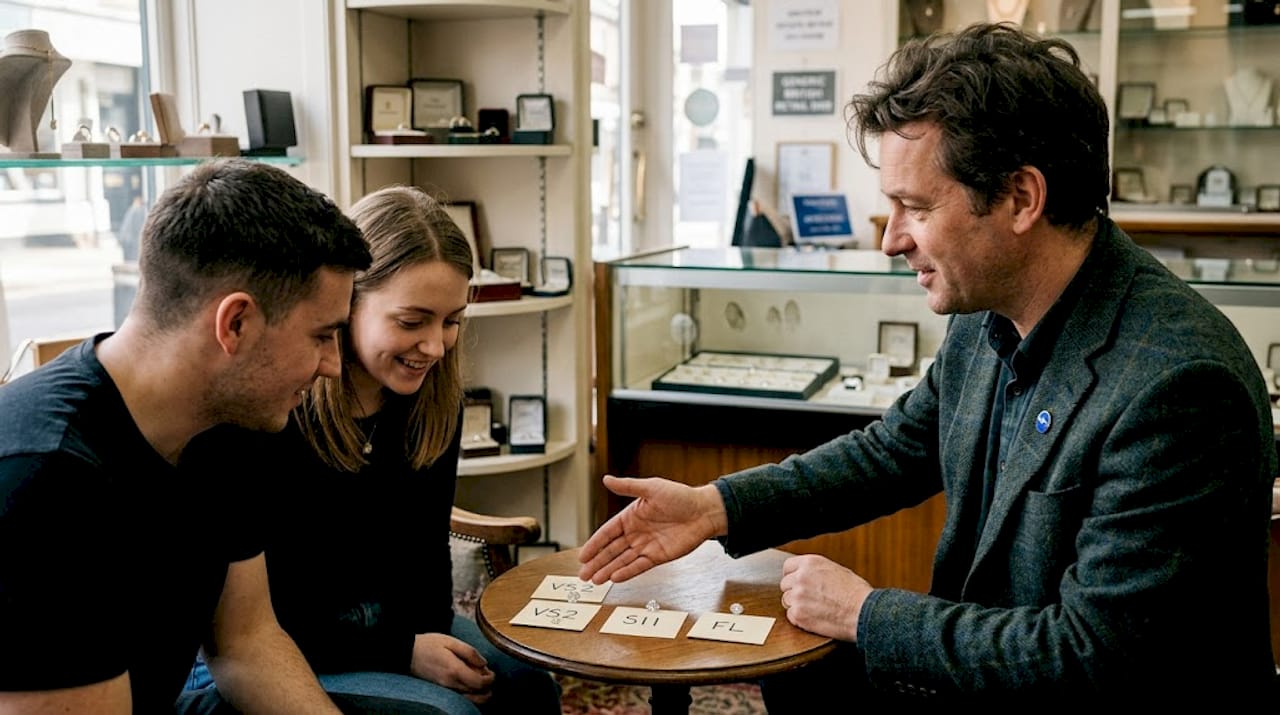
Pro Tip: VS2 often looks absolutely identical to a flawless stone when worn as jewellery, yet it can cost 20 to 40 per cent less. That difference could mean a better setting, a larger carat, or simply savings in your pocket.
How clarity affects ethical, pre-owned and lab-grown diamonds
This is where things get genuinely interesting for Kent and UK buyers who care about more than just a sparkle. The ethical diamond landscape is shifting fast, and clarity grades tell a very different story depending on where your stone comes from.
Pre-owned and vintage diamonds often sit in the SI or even I range. They’ve lived a life. They may carry a tiny feather from a Victorian setting or a minor chip from decades of wear. But here’s the reframe: ethical and pre-owned diamonds may show more inclusions, but offer superior ethical value because they demand no new mining, no new land disruption, and no questionable supply chains.
Lab-grown diamonds flip the script entirely on clarity expectations. Lab-grown diamonds can equal or surpass natural diamond clarity at a lower price, because the controlled growing environment eliminates many of the geological pressures that cause inclusions in the first place. VVS and VS grades are far more common in lab-grown stones than in natural ones of similar price.
Here’s a summary of how each category stacks up on clarity:
- Pre-owned diamonds: Often SI1 to I1. Character-rich with provenance. Lower price. Highest ethical appeal for recycled-gem buyers.
- Ethical natural diamonds: Varies widely. Can be FL to I range. Certified conflict-free but still newly mined.
- Lab-grown diamonds: Frequently VVS to VS. High clarity at accessible prices. Carbon footprint varies by production method.
“When clients ask us about clarity in pre-owned stones, we remind them that a tiny inclusion is part of that diamond’s story. The most memorable pieces we sell aren’t perfect. They’re full of character.”
For lab-grown vs natural clarity, the practical answer is that lab-grown wins on clarity per pound spent. But pre-owned wins on circular economy principles. Neither choice is wrong. It depends entirely on what matters most to you.
Diamond clarity comparison: What to choose in the UK
Now for the practical part. Based on everything above, here’s a direct comparison of the three grades most UK shoppers consider, factored against price, appearance, and ethical alignment.
| Clarity grade | Approximate price vs FL | Eye-clean? | Best for |
|---|---|---|---|
| VVS1 | 40 to 50% less than FL | Yes | Near-perfection seekers |
| VS2 | 50 to 65% less than FL | Yes | Best all-round value |
| SI1 | 65 to 75% less than FL | Usually yes | Budget-smart buyers, pre-owned |
Most British buyers select VS2 or SI1 diamonds as the sweet spot for value and appearance. That aligns with what we see in our Kent stores day in, day out.
Here’s a step-by-step approach to choosing your clarity grade:
- Set your budget first. Clarity is one of the biggest price drivers, so knowing your ceiling early prevents falling in love with a grade you can’t afford.
- Decide how much ethics matter. If recycled or pre-owned is a priority, embrace SI1 or below as part of that choice, not a compromise.
- Ask for a step-by-step diamond selection consultation from a reputable jeweller who can show you stones side by side.
- View shortlisted stones in person. Showroom lighting is often flattering. Ask to step outside or near a window.
- Check engagement ring value tips to balance clarity against cut, colour, and carat for the full picture.
Pro Tip: Checking diamonds in bright natural light exposes more inclusions than standard showroom lighting ever will. Jewellers use carefully controlled lighting to present stones beautifully. Natural daylight is your honest test.
A jeweller’s perspective: Clarity is only one part of the story
After more than 20 years working with diamonds in Kent, we’ve watched countless customers chase flawless grades only to feel underwhelmed by the stone they took home. Technically perfect on paper, but cold and characterless in the hand.
The truth is that what’s worth paying for in clarity is not always the highest grade you can afford. It’s the grade that makes the whole stone sing. A lively VS2 with an excellent cut will outshine a dull IF every single day. We’ve seen it happen repeatedly.
What really delivers long-term satisfaction is choosing a stone that moves you when you see it. A vintage diamond with an SI1 grade may carry a tiny feather inclusion that catches the light in a unique way, making it yours in a way no flawless stone ever could. Ethics, provenance, and personal connection matter enormously, and no clarity certificate can capture those qualities. Buy the stone you love. Let your values and instincts lead, not just the grading report.
Find your ideal ethical diamond in Kent
You now understand clarity better than most people walking into a jewellery shop. Use that knowledge with confidence.

At Blackwell Jewellers, our expert team across Maidstone, Gravesend, and Bexleyheath is ready to help you apply everything you’ve learnt here to a real diamond you can see and touch. Browse our ethical diamond jewellery range for responsibly sourced options, explore our carefully authenticated second hand jewellery collection for unique pre-owned gems with verified provenance, or book a consultation about our bespoke engagement rings to create something truly personal. Whatever grade you settle on, we’ll make sure you choose with clarity, in every sense.
Frequently asked questions
What clarity grade is best for diamond engagement rings?
Most UK buyers choose VS2 or SI1 for the best balance of beauty and value, as both grades are eye-clean at a significantly lower cost than flawless options.
Do vintage and second-hand diamonds have lower clarity?
Vintage and pre-owned diamonds often carry more inclusions reflecting their history, but as noted with ethical pre-owned diamonds, that character and ethical appeal frequently outweighs the technical grade for many buyers.
Can lab-grown diamonds be as clear as natural diamonds?
Yes. Lab-grown diamonds can equal or surpass the clarity of natural stones, often achieving VVS grades at prices well below comparable natural diamonds.
Is clarity more important than colour or cut when buying in the UK?
Not necessarily. Balancing clarity with cut and colour delivers the most overall sparkle and satisfaction, and most UK buyers are better served by a well-cut VS2 than a flawless stone with a mediocre cut.
Recommended
- What is an ethical diamond? A 2026 guide for UK buyers – blackwellonline
- Step-by-step diamond selection: A practical guide for UK buyers – blackwellonline
- Ethical Diamond Jewellery – blackwellonline
- The 4 Cs of Diamonds: The Complete 2025 Guide for UK Buyers – blackwellonline
- How Craftsmanship Shapes Luxury Watch Value and Artistry – OP