
TL;DR:
- Ethical diamonds cause no harm to people or the planet across their entire supply chain.
- Lab-grown diamonds are genuine, cheaper, and have a lower environmental impact than mined stones.
- Alternatives like moissanite and vintage diamonds offer sustainable, cost-effective options with their own unique qualities.
The idea that only a mined diamond counts as ‘real’ is one of the jewellery world’s most persistent myths. Today, UK buyers have access to genuinely stunning, rigorously verified alternatives that carry no ethical baggage. Lab-grown diamonds cost 30–95% less than their mined counterparts and are chemically, physically, and optically identical. Beyond lab-grown stones, there are moissanite, recycled diamonds, and vintage pieces worth serious consideration. This guide walks you through every option, what certification actually means, how to avoid greenwashing, and how to make a choice you’ll feel good about for years to come.
Table of Contents
- What makes a diamond ethical?
- Lab-grown diamonds: Facts, value, and ethical credentials
- Beyond lab-grown: Exploring moissanite and other alternative gems
- How to choose an ethical diamond alternative in the UK
- The overlooked truth: Why ethical still isn’t simple
- Find your ethical sparkle with Blackwell Jewellers
- Frequently asked questions
Key Takeaways
| Point | Details |
|---|---|
| Lab-grown are real | Lab-grown diamonds have all the same properties as mined stones and are recognised as real by UK authorities. |
| Moissanite alternatives | Moissanite and recycled gems offer affordable, ethical sparkle for the style-conscious buyer. |
| Certifications matter | Always verify GIA or IGI certification and check UK Green Code compliance before you buy. |
| No option is perfect | Each ethical alternative involves trade-offs, so weigh your priorities on sustainability, style, and budget. |
What makes a diamond ethical?
The word ‘ethical’ gets used liberally in jewellery marketing, but it has a specific meaning that matters enormously when you’re making a significant purchase. At its core, an ethical diamond is one that causes no harm to people or planet across its entire supply chain. That covers three broad areas: freedom from conflict, fair treatment of workers, and meaningful environmental protection.
Traditional diamond mining has a troubled history. Conflict diamonds, sometimes called blood diamonds, have historically funded armed militias in war zones. Even outside conflict regions, open-pit mining strips vast tracts of land, disrupts ecosystems, and can leave communities with little long-term benefit. Transparency in the conventional supply chain remains patchy despite the Kimberley Process certification, which many experts argue has serious limitations.
So what should UK buyers look for? Here are the key markers of a genuinely ethical diamond or alternative:
- Verified supply chain: The stone’s origin can be traced and documented, not simply claimed.
- Independent certification: Look for GIA/IGI, SCS, or RJC accreditation. UK brands such as Queensmith, Lily Arkwright, Kimaï, and Monica Vinader set a useful benchmark.
- Energy and environmental disclosures: Reputable sellers will tell you how stones are grown or sourced, not deflect the question.
- UK Green Code compliance: The Competition and Markets Authority (CMA) Green Code requires brands to back up any environmental claims with evidence.
“An ethical diamond isn’t just about where it came from. It’s about whether everyone involved in bringing it to you was treated fairly and whether the land was respected in the process.”
Understanding your own ethical diamond expectations before you shop is the single most important step. It sharpens your questions and protects you from vague marketing language.
The good news is that the UK market has genuinely improved. More jewellers now offer detailed sourcing documentation, and regulatory pressure is increasing. Knowing what to ask puts you firmly in control.
Lab-grown diamonds: Facts, value, and ethical credentials
Lab-grown diamonds are the most discussed ethical alternative, and for good reason. They are created in controlled laboratory environments using one of two methods: Chemical Vapour Deposition (CVD) or High Pressure High Temperature (HPHT). CVD grows diamonds by introducing carbon-rich gas into a chamber where it crystallises onto a seed crystal. HPHT mimics the conditions deep within the earth, applying extreme pressure and heat to carbon. Both methods produce real diamonds.
The distinction between the two matters for buyers. CVD stones tend to be cleaner and more uniform, with fewer inclusions. HPHT may produce metallic inclusions or slight colour tints, though it excels for fancy-coloured diamonds. Neither method makes a stone ‘fake’. Both UK and international trade authorities recognise lab-grown diamonds as genuine diamonds.
| Feature | Lab-grown diamond | Mined diamond |
|---|---|---|
| Chemical composition | Identical to mined | Carbon crystal |
| Graded by GIA/IGI | Yes | Yes |
| Average price | 30–95% less | Higher |
| Resale value | Lower | Higher |
| Environmental impact | Energy-intensive but less land damage | Significant ecological disruption |
| Conflict risk | None | Possible without full traceability |
For UK buyers comparing lab-grown vs mined value, the price difference is striking. A one-carat lab-grown diamond might cost £800–£1,500 compared to £4,000–£6,000 for a comparable mined stone. The trade-off is resale value: lab-grown diamonds have depreciated faster as supply has grown.
Pro Tip: Always ask the retailer to confirm in writing which growing method was used, what energy source powers the facility, and which grading laboratory certified the stone. Responsible vendors will answer without hesitation.
Certification is non-negotiable. A reputable UK lab-grown brand will always supply a GIA or IGI grading report. If a seller cannot produce one, walk away. Greenwashing is real: vague claims like ‘sustainably made’ without documented evidence should raise your suspicions immediately.
For those still wondering whether these stones are truly genuine, exploring are lab-grown diamonds real is worth doing before making any purchase decision.
Beyond lab-grown: Exploring moissanite and other alternative gems
Lab-grown diamonds dominate conversations about ethical alternatives, but they are far from the only option. Moissanite, recycled diamonds, and vintage stones each offer something distinct, and for many buyers, these alternatives are actually the better fit.
Moissanite is a naturally occurring silicon carbide mineral, though virtually all jewellery-grade moissanite is lab-created. It scores 9.25 on the Mohs hardness scale (diamond is 10), making it exceptionally durable for everyday wear. Its brilliance is actually higher than a diamond’s, producing a distinctive rainbow-like sparkle that some buyers love and others find too bold. For bold sparkle on a budget, moissanite is hard to beat. It is also significantly cheaper than lab-grown diamonds, typically costing £200–£600 per carat.

Recycled diamonds are mined diamonds that have been resold, reclaimed, or repurposed. They introduce no new mining activity into the supply chain, which is a meaningful environmental advantage. Their provenance can be harder to verify, but a reputable jeweller should be able to document the stone’s history. Vintage and antique pieces sit in a similar category: every pre-owned stone is, in a sense, already the most sustainable choice available.
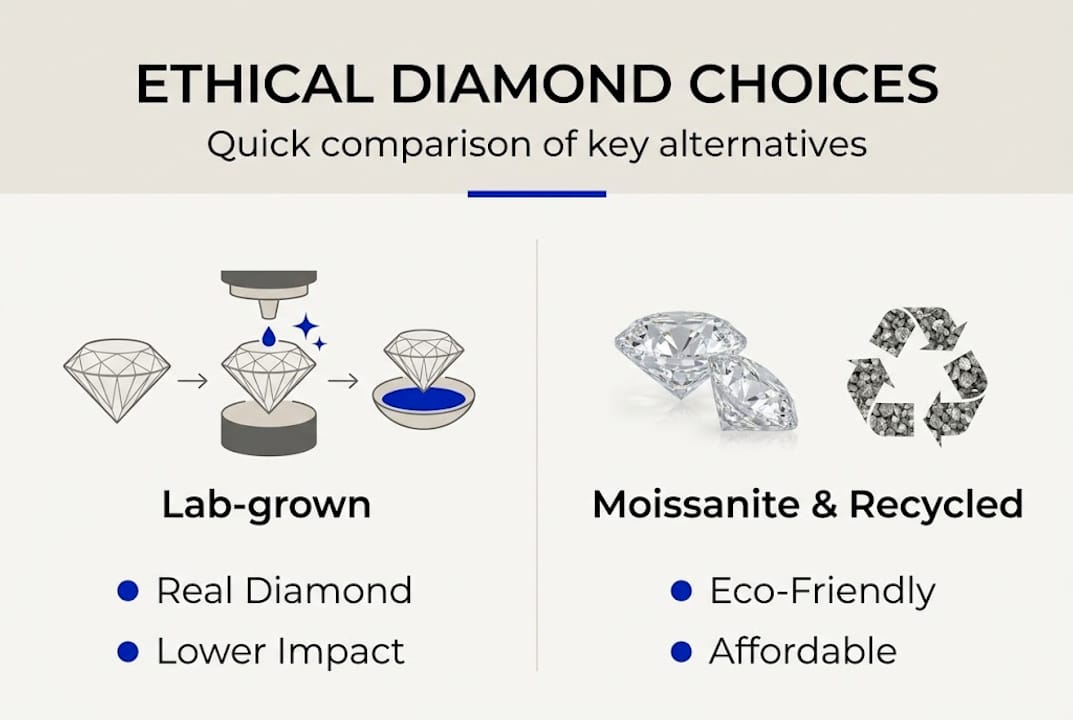
| Gem | Hardness (Mohs) | Relative price | Sparkle character | Ethical edge |
|---|---|---|---|---|
| Mined diamond | 10 | Highest | White brilliance | Requires verification |
| Lab-grown diamond | 10 | 30–95% less | White brilliance | Low conflict risk |
| Moissanite | 9.25 | Very affordable | Rainbow brilliance | No mining impact |
| Recycled/vintage diamond | 10 | Variable | White brilliance | No new mining |
How do you decide which option suits you? Here is a straightforward numbered guide:
- Define your priorities. Is environmental impact, conflict avoidance, or budget your main concern?
- Consider wearability. All four options above offer excellent everyday durability.
- Think about style. Moissanite’s sparkle reads differently to a diamond. View both in person before deciding.
- Set a resale expectation. If long-term resale matters, mined or recycled diamonds hold value better.
- Check the difference between lab-grown and natural options once you have shortlisted your preferred type.
Reading about wearing statement jewellery can also help you decide how bold you want your choice to be, particularly if you’re drawn to moissanite’s distinctive fire. Brands like Queensmith, Lily Arkwright, and Kimaï offer lab-grown and recycled metal options across a range of budgets.
How to choose an ethical diamond alternative in the UK
Knowing your options is one thing. Making a confident, informed purchase is another. The UK market is improving, but greenwashing remains a genuine risk, and not all jewellers are equally transparent.
Here is what to check before you buy:
- Certification documents: Insist on a physical or digital GIA or IGI grading report for any diamond or lab-grown stone. Moissanite should come with its own authenticity certificate.
- Origin proof: Can the seller trace the stone’s journey? For lab-grown, that means the facility location and growing method. For recycled stones, it means documented previous ownership.
- Energy source disclosure: Some lab-grown diamonds are produced using renewable energy; others are not. This detail matters if your concern is environmental.
- UK Green Code compliance: Avoid misleading eco-claims per the CMA’s guidelines. Any claim of ‘carbon neutral’ or ‘zero impact’ should be backed by third-party verification.
- Return and resale policy: A confident, ethical retailer stands behind their product.
When speaking to jewellers, ask direct questions. A good retailer welcomes them. Ask: ‘Where was this stone grown or sourced?’ and ‘Can you show me the certification?’ If answers are vague, that itself tells you something important.
Common pitfalls to avoid include accepting verbal assurances without documentation, confusing ‘conflict-free’ with fully ethical (they are not the same thing), and assuming a high price equals higher ethics.
Pro Tip: Before visiting any retailer, spend five minutes verifying authenticity of lab-grown diamonds so you know precisely what documents to request and what they should contain.
For those in Kent or shopping online from the South East, exploring local ethical options close to home can make the conversation far easier. Meeting a jeweller in person is always the best way to assess their knowledge and transparency.
The overlooked truth: Why ethical still isn’t simple
We want to be honest with you about something that rarely gets said plainly in guides like this: no ethical diamond or alternative is without compromise. Lab-grown diamonds avoid conflict and require no mining, but lab diamonds are energy-intensive and currently carry a lower resale value than mined stones. Vintage pieces are wonderfully sustainable but may lack full provenance documentation.
The honest reality is that ‘ethical’ is a spectrum, not a binary. What matters is how you weigh the trade-offs relative to your own values. For some buyers, environmental impact is everything. For others, fair labour conditions or financial transparency are paramount. There is no universally perfect answer.
What we have seen, across years of working with customers at Blackwell Jewellers, is that the buyers who feel most confident in their choices are not the ones who found the ‘most ethical’ stone. They are the ones who asked hard questions, received clear answers, and made decisions grounded in honest information. Exploring ethical dilemmas in practice reveals just how nuanced these choices really are. Transparency from your jeweller will always matter more than any single certificate or marketing claim.
Find your ethical sparkle with Blackwell Jewellers
If this guide has helped you think more clearly about what you want from an ethical diamond alternative, we’d love to help you take the next step. At Blackwell Jewellers, we’ve spent over 20 years helping UK buyers make confident, well-informed jewellery purchases across our Kent stores and online.

Browse our ethical diamonds collection for independently certified options, or explore our full range of ethical diamond jewellery across rings, pendants, and more. If you’d like something truly one-of-a-kind, our bespoke ethical jewellery service lets you work directly with our expert craftspeople. Have questions about sourcing, certifications, or which stone suits your values? We’re always here to help.
Frequently asked questions
Are lab-grown diamonds recognised as real diamonds in the UK?
Yes. Lab-grown diamonds are genuine diamonds, possessing identical chemical and physical properties to mined stones and fully recognised by UK and international trade authorities.
Is moissanite a good ethical alternative to diamonds?
Absolutely. Moissanite is highly durable, eco-friendly, and significantly more affordable, making it a compelling choice for UK buyers who want bold sparkle on a budget without ethical compromises.
What certification should I look for in ethical diamonds?
Prioritise independent certification from GIA or IGI, and verify any environmental claims against the UK CMA’s Green Code. GIA/IGI, SCS, and RJC accreditation are the most trusted standards.
Are ethical diamonds more expensive?
Not necessarily. Lab-grown diamonds cost 30–95% less than mined equivalents, though bespoke or recycled pieces from specialist ethical brands may carry a premium for craftsmanship and traceability.
Can I buy ethical diamond jewellery second-hand in the UK?
Yes, and it is one of the most sustainable choices available. Pre-owned and vintage diamond jewellery requires no new mining, and UK jewellers including those offering lab-grown and recycled metal options stock authenticated pre-owned pieces regularly.