
Buy H. For most rings, that one-grade “downgrade” from G saves you money and nobody will ever spot the difference with the naked eye. Both grades sit in the GIA near-colourless band, which runs from G to J, so you’re really choosing between “excellent value” and “slightly whiter, slightly pricier.”
Here’s the short version:
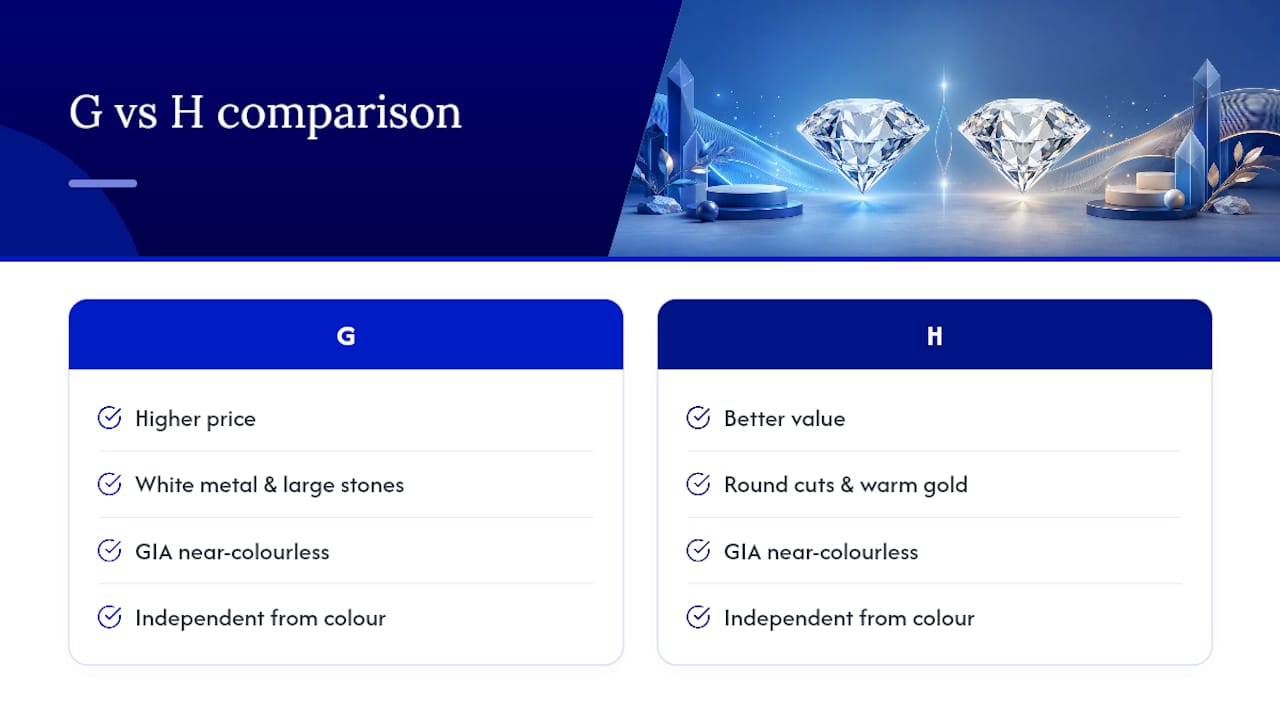
- Choose H if you’re setting a round brilliant in yellow or rose gold, or working to a tight budget.
- Choose G if you want extra safety margin in platinum or white gold, for stones over 2 carats, or for step cuts like emerald and asscher.
- Skip both debates entirely and spend the saved money on a better cut grade instead. It matters more.
Key Takeaways
Choosing between G and H diamond colour comes down to cut quality and setting metal, not the single grade letter on the certificate.
| Point | Details |
|---|---|
| Both grades are near-colourless | G and H sit together on the GIA scale, one grade apart, and typically read white when mounted. |
| H is the value pick | H saves roughly 10 to 15% versus G at 1 carat, with larger absolute savings at higher carat weights. |
| G suits specific situations | Choose G for stones over 2 carats, platinum or white gold settings, or step cuts like emerald and asscher. |
| Cut outranks colour | A well-cut H can look whiter than a poorly cut G because brilliance masks body tint. |
| Verify before you buy | Blackwell Jewellers checks the GIA report, face-up appearance, and setting on every pre-owned stone before sale. |
Table of Contents
- What do G and H mean on the GIA colour scale?
- Can you actually see the difference between G and H?
- How do cut and setting change perceived colour?
- What’s the price difference, and when is G worth it?
- A quick checklist for choosing between G and H
- How do you verify a diamond’s colour before buying?
- Ready to compare G and H in person?
- Frequently asked questions
- Sources
What do G and H mean on the GIA colour scale?
The GIA D to Z colour scale grades diamonds on how little colour they show, with D being completely colourless and Z carrying a noticeable yellow or brown tint. G and H both sit in the “near-colourless” bracket, alongside I and J, one full tier below the D to F “colourless” grades that command the steepest prices.
G is one step whiter than H on that scale. In practice, that single grade represents a barely perceptible difference in body colour, visible mainly to a trained grader under controlled lighting with the stone unset. Face-up in a finished ring, both typically read as white.
A few things worth knowing about how this actually works:
- Near-colourless stones (G to J) generally cost 15 to 35% less than colourless ones (D to F), for a similar face-up look.
- Grading happens under standardised, diffused lighting against a neutral background, which is nothing like how you’ll view the ring day to day.
- A GIA report is the trust signal to look for. It states the colour grade alongside a unique report number you can verify independently.
Can you actually see the difference between G and H?
Mostly, no. Once a diamond is mounted and you’re looking at it face-up in normal room light, the one-grade gap between G and H is usually invisible to an untrained eye. This is the entire reason H represents such good value: you’re paying less for a difference almost nobody will notice.
That said, “usually” isn’t “always.” A handful of situations can make the tint in an H stone more visible:
- Large carat weights. Colour is easier to see in bigger stones because there’s simply more diamond to look through. Above roughly 2 carats, the gap starts to show more readily.
- Direct, bright sunlight. Outdoor light is harsher and more revealing than indoor lighting, so a subtle warmth can surface.
- Cool-toned metal settings. Platinum and white gold reflect a whiter light back through the stone, which can expose faint yellow undertones that yellow or rose gold would otherwise mask.
- Step cuts and elongated fancy shapes. Emerald, asscher, and radiant cuts have large open facets that act like windows into the stone’s body colour, unlike round brilliants which scatter light and hide it.
For pairings: a round brilliant in yellow gold is the most forgiving combination going, where H will comfortably pass for G. An emerald cut in platinum is the least forgiving, where the jump to G (or even F) starts to earn its keep.
Pro Tip: Never judge colour under a jeweller’s spotlight alone. Ask to see the ring near a window in natural daylight and against a plain white background, ideally next to a comparison stone of a different grade. That’s the closest you’ll get to real-world conditions before you buy.
How do cut and setting change perceived colour?
A well-cut H diamond can look whiter than a poorly cut G, because cut quality controls how much light bounces back to your eye, and that brilliance and fire is what disguises body colour in the first place. A diamond cut to strong proportions scatters light in every direction, breaking up your view of the stone’s tint. A shallow or overly deep cut does the opposite, letting you see straight through to the colour underneath.
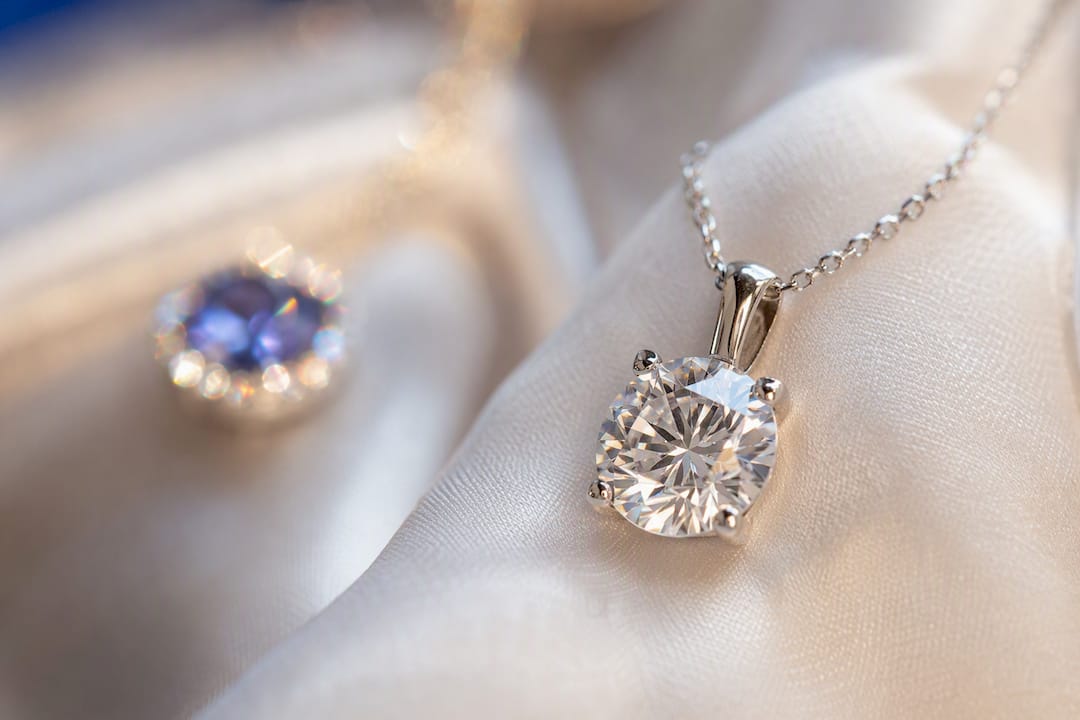
Shape matters just as much as cut grade. Round brilliants are the most forgiving shape for colour, thanks to their 57 or 58 facets working overtime to hide tint. Step cuts sit at the other end, their long, flat facets acting like a magnifying glass on any warmth in the stone.
Quick shape and metal guidance:
- Round, oval, cushion: H is usually safe in any metal, including platinum.
- Emerald, asscher, radiant: lean towards G, especially in white gold or platinum.
- Yellow or rose gold, any shape: H (even I) will typically face up white, since warm metal masks warm undertones.
Pro Tip: If your budget forces a choice, spend it on cut before colour. An Excellent or Ideal cut grade does more visible work than moving one letter up the colour scale.
What’s the price difference, and when is G worth it?
Money is where this decision gets real. At around 1 carat, a G typically costs 10 to 15% more than an equivalent H, which works out to roughly £330 to £480 in comparable listings. That percentage holds fairly steady as stones get bigger, but the absolute saving grows larger as carat weight increases, making H more cost-effective than G on bigger stones.
That scaling effect is the whole game. On a small stone, the G premium might be the price of a nice dinner out. On a large centre stone, it’s the price of a holiday. The question isn’t “is G better”, it’s “is G better enough, on this specific stone, in this specific setting, to justify what it costs.”
Here’s how to think about spending that money instead:
- If the stone is under 1.5 carats and set in a round brilliant, put the saving from H into a higher clarity grade or a better cut instead.
- If the stone is over 2 carats in platinum or white gold, the G premium buys real, visible peace of mind.
- If you’re choosing between G colour and a cut upgrade on the same budget, cut wins almost every time for visual impact per pound spent.
A quick checklist for choosing between G and H
- Decide your metal and shape first. White metal and step cuts point towards G; yellow gold and round brilliants make H an easy call.
- Check the cut grade before the colour grade. A poor cut undoes any benefit from paying more for colour.
- View the mounted stone face-up, in daylight, before deciding anything. Loose-stone comparisons under lab lighting don’t reflect how you’ll actually see the ring.
- Ask for the certificate and match the report number. This confirms the grade you’re being sold is the grade you’re getting.
- Compare the actual price gap on your specific stone, not a generic percentage. Sometimes it’s negligible; sometimes it’s not.
Worth asking your jeweller directly: which lab graded it, does the stone show any fluorescence, can you provide a 360° video, and what’s the return policy if the colour doesn’t look right once it’s set? If budget is genuinely tight, trading colour for savings is a far safer compromise than trading down on cut or clarity.
How do you verify a diamond’s colour before buying?
A GIA certificate is your baseline proof, not a marketing claim. Check that the colour grade, cut grade, and report number on the paperwork match what’s engraved or listed on the stone itself.
Beyond the paper, insist on seeing the stone properly:
- Ask for a 360° video or in-setting photos, not just a studio shot of the loose stone.
- View it face-up, mounted, in more than one lighting environment, ideally including daylight.
- For stones above 1.5 carats or in cool-toned metal, request video specifically in natural light before committing.
- Confirm the return window and whether the seller offers an independent appraisal.
How Blackwell Jewellers applies these rules to every stone
Every pre-owned diamond we sell has already been checked against exactly this list. Our jewellers verify the GIA report, view the stone face-up in its actual setting, and can provide video on request before you commit to anything.
- Confirm the GIA report matches the physical stone.
- Assess face-up appearance in the existing mount, not in isolation.
- Check mount metal and cut quality together, since one affects the other.
- Offer video review for anyone buying without visiting a store.
A note from the jeweller
Most customers who agonise over G versus H end up unable to tell them apart once the ring’s on the finger. Get a proper video or an in-person look before you pay the difference.
Ready to compare G and H in person?
If you’ve read this far, you already know the honest answer varies stone by stone, and that’s exactly the kind of decision that’s easier with real diamonds in front of you rather than another spec sheet. Blackwell Jewellers deals heavily in authenticated pre-owned diamonds, which means you’re often looking at G and H stones already mounted in finished rings, at prices well below new retail, with the GIA paperwork and hallmarking already verified in-house.

That matters here specifically because the whole point of this comparison is seeing the stone face-up, in its setting, before you decide the extra spend on G is worth it to you. Browse the current second-hand jewellery collection online, or visit the Maidstone store to view G and H stones side by side under proper lighting before you commit to either.
Frequently asked questions
Is H colour a good diamond grade? Yes. H sits firmly in the GIA near-colourless range and typically appears white once mounted, especially in a round brilliant or in warm-toned gold.
Is G or H better for an engagement ring? Neither is objectively better. G gives a small safety margin in white metal or on larger stones; H gives better value everywhere else, particularly in round cuts and warm gold settings.
Does H diamond colour clarity affect how white it looks? Clarity and colour are graded separately and don’t directly affect each other, though heavy inclusions can occasionally scatter light in ways that distract from colour perception.
Why does G diamond colour cost more than H?
Can a jeweller tell G and H apart without a certificate? Even experienced graders struggle to separate G from H reliably without controlled lighting and a comparison set of master stones, which is exactly why the GIA certificate exists.
Sources
- GIA — 4Cs: Colour
- DiamondCritics — G vs H colour round diamond
- GoodStone — Which diamond shapes show colour the most?