
TL;DR:
- Diamond cut significantly influences a stone’s brilliance, fire, and scintillation more than carat size.
- GIA grades round diamonds based on seven factors, with overall grade limited to excellent, very good, or good.
- Practical inspection of light performance in various settings is essential beyond certificate grades.
Most buyers walk into a jewellery shop with one number in mind: carats. It feels measurable, impressive, easy to compare. But diamond cut grade has a far more significant effect on perceived beauty and value than carat size alone. A poorly cut two-carat stone can look dull and lifeless beside a beautifully cut one-carat diamond that blazes with light. Whether you are searching for a pre-owned engagement ring, commissioning a bespoke piece, or evaluating a second-hand diamond in one of our Kent stores, understanding cut gives you a genuine edge. This guide walks you through exactly what cut means, how it is graded, what the paperwork misses, and how to make smarter buying decisions.
Table of Contents
- Understanding diamond cut: the most overlooked ‘C’
- How GIA cut grading works: what every UK buyer should know
- Beyond the certificate: what the numbers don’t reveal
- Applying your knowledge: smart buying tips for pre-owned and bespoke diamonds in the UK
- Why most buyers underestimate cut: lessons from the UK jewellery trade
- Ready to find your perfect diamond cut?
- Frequently asked questions
Key Takeaways
| Point | Details |
|---|---|
| Cut determines brilliance | Diamond cut has the greatest influence on sparkle and overall beauty. |
| GIA grades are not absolute | Certification is a strong indicator but practical inspection is essential for assessing cut. |
| Fancy shapes differ | Only round brilliant diamonds receive an official GIA cut grade, so fancy shapes require visual judgement. |
| Quality beats carat | A well-cut diamond often outshines larger stones of lower cut quality. |
| Smart buying pays | Applying cut knowledge results in better value and long-term satisfaction for UK buyers. |
Understanding diamond cut: the most overlooked ‘C’
When people talk about diamond cut, they often confuse it with shape. Shape is the outline you see from above: round, princess, oval, pear, and so on. Cut is something else entirely. It describes how well a diamond has been proportioned, faceted, and finished so that light travels through it in the most dramatic way possible.
Think of it like a mirror maze. A well-designed maze sends light bouncing perfectly, creating a dazzling effect. A poorly designed one just absorbs it. The same applies to diamonds. When light enters a well-cut stone, it reflects back through the top in a display of brightness, coloured flashes, and sparkling contrast. These three qualities have specific names:
- Brilliance: The total amount of white light reflected back to your eye
- Fire: The dispersion of light into rainbow colours, creating those flashes of colour you notice in certain lighting
- Scintillation: The pattern of light and dark areas, and the sparkle you see when the diamond or your eye moves
Together, these three effects are what make a diamond visually arresting, or completely forgettable.
As part of the 4 Cs of Diamonds, cut is widely considered the most technically demanding to assess. The Gemological Institute of America spent 15 years and over 70,000 observations building a system that reliably links specific proportions to visible beauty. That level of rigour reflects just how complex the relationship between geometry and light actually is.
GIA grades cut across seven factors, five of which directly determine the overall grade: brightness, fire, scintillation, weight ratio, and durability. Polish and symmetry are assessed separately. A diamond can score highly on most factors and still fall short if one key component underperforms.
A diamond’s cut can transform a modest stone into something extraordinary. A lower colour or clarity grade becomes far less important when the light return is exceptional.
For UK buyers shopping pre-owned, bespoke, or new, this means cut should be the first thing you examine, not the last.
How GIA cut grading works: what every UK buyer should know
GIA, the Gemological Institute of America, is the world’s most respected independent diamond grading authority. Their certificates are widely used across the UK trade and carry significant weight in resale and insurance valuations. When you see a GIA certificate with a stone, it represents a detailed, standardised evaluation.
The seven grading factors GIA assesses are:
- Brightness: White light reflected from the stone’s surface and interior
- Fire: The separation of that light into spectral colours
- Scintillation: Sparkle, including the balance of light and dark patterns
- Weight ratio: How the carat weight relates to the diamond’s diameter
- Durability: Whether proportions create structural vulnerabilities (such as a thin girdle, which is the outer edge of the stone)
- Polish: The smoothness of each facet surface
- Symmetry: How precisely the facets align and mirror one another
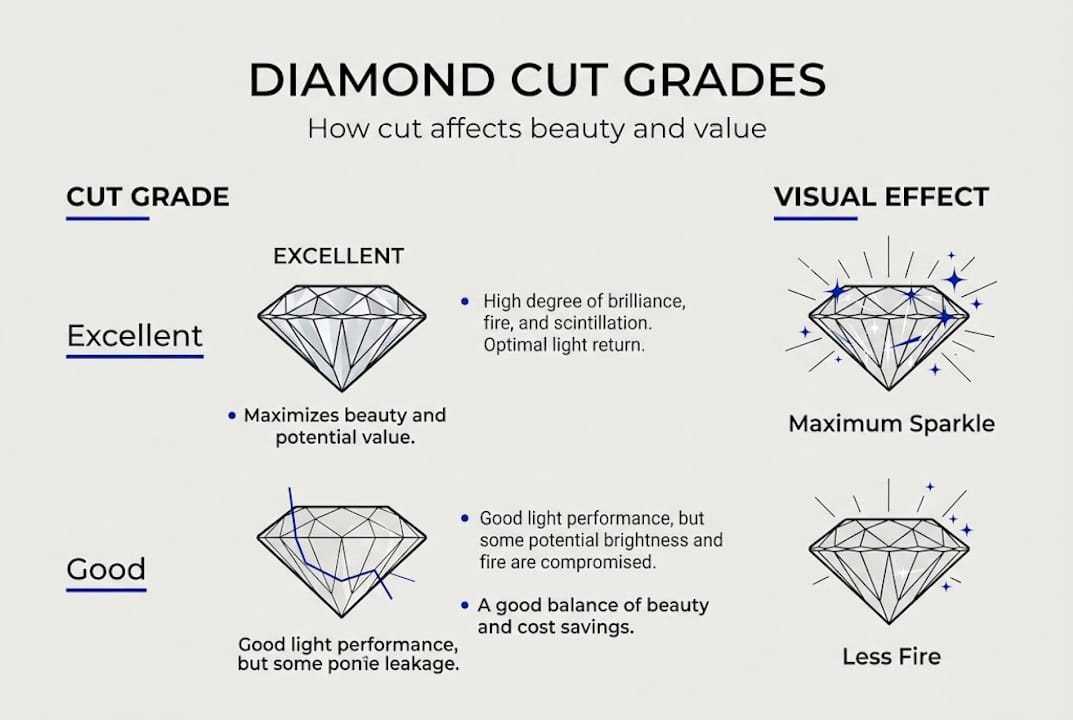
The cut grades explained in GIA documentation run from Excellent down through Very Good, Good, Fair, and Poor. Crucially, the overall grade is determined by the lowest-scoring core component, not the average. One weak area brings the whole grade down.
Here is a practical comparison for the three grades you are most likely to encounter:
| Grade | What you typically see | Best suited for |
|---|---|---|
| Excellent | Maximum brilliance, strong fire, vivid scintillation | Engagement rings, statement pieces |
| Very Good | Impressive sparkle with minor compromises | Everyday jewellery, great value |
| Good | Visible brilliance but less dramatic light return | Budget-conscious buyers, side stones |
One critical limitation: only round brilliant diamonds receive a formal GIA cut grade. Fancy shapes such as oval, cushion, and emerald are evaluated for polish and symmetry only. This makes following the diamond selection process even more important for non-round stones, since you cannot rely on a single cut grade number to guide your decision.
For UK shoppers, this has real implications. A pre-owned oval or princess cut stone may come with impressive-looking paperwork that simply does not tell you how it performs visually. Understanding what the certificate covers, and what it does not, is part of buying with confidence. You can also explore the GIA cut grading methodology directly to see the full technical picture.

Beyond the certificate: what the numbers don’t reveal
A GIA certificate is a snapshot. It was produced under controlled laboratory conditions, using specific equipment and angles. What it cannot capture is how a diamond actually looks on a hand, under a restaurant’s warm lighting, or in the dappled light of a British afternoon.
There are several practical realities that go beyond what any certificate will tell you:
- A large table (the flat top facet of the diamond) can create a glassy, window-like effect rather than sparkle. The stone looks large but flat, lacking the depth that makes diamonds compelling
- Deep cuts can cause a dark centre effect, where the middle of the stone appears shadowy even in good light. This is sometimes called a “nail head” appearance
- Thin girdles create a real durability risk. The girdle is the outermost edge of the stone, and a very thin one is vulnerable to chipping, particularly in settings where the edge is exposed
As edge cases like thin girdles or large tables demonstrate, two diamonds can share the same overall cut grade but behave very differently in real life. This is where physical inspection becomes essential.
Pro Tip: Always view a diamond in at least two types of lighting before committing. Bright, direct light (such as a spotlight) flatters almost every stone. The real test is how it performs in softer, ambient lighting such as daylight or a dimly lit room. Move it gently. A well-cut stone should still sparkle in motion.
Our guide to diamond UV light testing also covers additional ways to evaluate a stone’s character beyond the certificate. When buying pre-owned, a knowledgeable jeweller will walk you through these checks as a matter of course. If they do not offer to, ask.
Applying your knowledge: smart buying tips for pre-owned and bespoke diamonds in the UK
Knowing the theory is useful. Knowing how to apply it when you are standing in front of a stone is what matters. Here is a practical sequence for evaluating any diamond, whether pre-owned or being designed from scratch.
- Request the grading documentation first. Before viewing the stone, ask to see any certificates. Check the shape, carat weight, and stated cut grade against what you are physically looking at. Numbers and reality should match
- Assess the stone in varied lighting. Do not rely solely on the display cabinet’s spotlight. Ask to take the stone to a window or a differently lit area of the shop
- Look at the stone from the side. A diamond viewed from the side can reveal a disproportionately deep or shallow profile, which affects both light return and how it sits in a setting
- Check the girdle with a loupe. A loupe is a small magnifying glass used by jewellers. Even a basic inspection can reveal whether the girdle is dangerously thin or uneven
- Ask about the source and history. For pre-owned pieces, a reputable jeweller should be able to confirm the stone has been inspected and authenticated
For budget balancing, here is an honest framework: excellent cut quality can make lower colour or clarity diamonds appear far more valuable than their grade suggests. If budget is the constraint, compromise slightly on colour or clarity before you compromise on cut. The difference between an F and a G colour stone is nearly invisible to the eye. The difference between an Excellent and a Fair cut is not.
Pro Tip: When buying pre-owned, use cut quality as a negotiation anchor. A stone with a Good rather than Excellent grade has a verifiable, documented shortfall. That is a legitimate basis for a lower price, especially if you are also factoring in any setting wear or required repair work.
For those exploring best lab grown diamond options, the same cut principles apply. Lab grown stones follow identical grading standards, so cut quality remains your most reliable indicator of visual performance regardless of origin.
Why most buyers underestimate cut: lessons from the UK jewellery trade
After more than two decades working with buyers across Kent and beyond, a pattern is unmistakable. Buyers walk in focused on carats because carats feel concrete. You can say “one and a half carats” and feel like you are getting something measurable for your money. Cut feels abstract until you see two stones side by side.
Here is what the trade knows that most buyers do not: the most memorable pieces in our pre-owned collection are rarely the heaviest stones. They are the ones where someone, somewhere, prioritised the cut. A beautifully cut half-carat diamond in a considered setting will stop people in their tracks. A dull two-carat stone, regardless of its certificate, simply will not.
There is also a persistent myth that a high GIA grade guarantees a visually superior stone in every context. It does not. Lighting conditions, setting style, and your own eye all play a role. The grade tells you the stone performed well in a lab. Your job is to confirm it performs well in your life.
Looking at refurbished jewellery quality reinforces this point. A stone can be beautifully restored in its setting and still disappoint if the cut was never strong to begin with. Prioritise cut, then verify with your eyes across multiple lighting conditions. That combination will serve you far better than any single number on a certificate.
Ready to find your perfect diamond cut?
Translating knowledge into action is where your edge as a buyer comes alive. Here is how the right guidance turns cut knowledge into the ultimate jewellery find.

At Blackwell Jewellers, every stone in our second hand jewellery collection is inspected, authenticated, and assessed for visual quality by our expert team before it reaches the shop floor. If you are working with us on a bespoke diamond design, cut is the first conversation we have, because it shapes everything else. We also offer professional jewellery repair experts who can assess existing stones in inherited or pre-owned pieces, helping you understand exactly what you have. Visit one of our Kent stores or get in touch online for personalised guidance from people who genuinely know their craft.
Frequently asked questions
What is the difference between diamond cut and diamond shape?
Diamond cut is about performance, describing how well the stone is proportioned and finished to return light, while shape refers to its physical outline such as round, oval, or pear.
Which diamond shapes get an official cut grade?
Only round brilliants receive a formal GIA cut grade; fancy shapes such as oval or cushion are assessed for polish and symmetry only, not an overall cut performance score.
Can a well-cut diamond look better than a larger or clearer stone?
Absolutely. Cut can outweigh colour or clarity for visual beauty, and an excellent cut regularly makes a smaller or slightly included stone appear more brilliant than a larger, poorly cut one.
What are the main factors GIA uses to grade cut?
GIA assesses seven grading factors including brightness, fire, scintillation, weight ratio, durability, polish, and symmetry, with the five core performance components determining the final overall grade.
Recommended
- The 4 Cs of Diamonds: The Complete 2025 Guide for UK Buyers – blackwellonline
- Step-by-step diamond selection: A practical guide for UK buyers – blackwellonline
- Diamond UV light testing: what UK buyers must know – blackwellonline
- Colour & Clarity in Diamonds: What’s Worth Paying For? – blackwellonline