
Not always, and definitely not by the amount most people assume. Bespoke jewellery tends to cost more at the lower end of the budget scale, where mass production has economies of scale on its side, but it often becomes competitively priced or even better value once you’re spending on a serious piece with a decent stone. The main things that swing the answer are your budget level, the metal and gemstone you choose, and how complicated the design actually is. An experienced jeweller sees this play out with nearly every bespoke commission.
TL;DR:
- The main costs of bespoke jewelry are labor, metal choice, and gemstone selection, which can significantly vary based on complexity and material quality.
- Custom pieces with intricate design, multiple stones, or high-value materials tend to cost more due to increased handwork and material expenses.
- Using existing stones or selecting lab-grown diamonds and lower-karat gold can reduce costs without major design compromises.
- Turnaround times range from two to twelve weeks, with rush fees applying if you require faster delivery.
- Long-term repairability and personalized fit often justify the higher price of bespoke jewelry, especially when designed around your story or preferences.
Table of Contents
- How bespoke and ready-made prices are structured
- What actually makes up the cost of a bespoke piece?
- What does bespoke jewellery typically cost?
- How can you make bespoke jewellery more affordable?
- What is the bespoke process and how does timing affect price?
- When does bespoke actually deliver better value?
- What James has learned pricing bespoke commissions
- How Blackwell Jewellers can help you commission with confidence
- Sources
- FAQ
How bespoke and ready-made prices are structured
The honest answer is that you’re paying for completely different things, which is exactly why the comparison trips people up.
A ready-made ring or pendant has already had its design costs spread across hundreds, sometimes thousands, of identical pieces. The mould was made once. The CAD file was drawn once. A factory somewhere churns out the same setting on repeat, and every unit sold shaves a fraction more off the original design bill. That’s how a mainstream retailer can sell you a solitaire ring for a price that feels almost too reasonable, because you’re one of thousands sharing the tooling cost.
Bespoke flips that model entirely. Every design fee, every hour of hand fabrication, every finishing touch belongs to one piece and one customer. There’s no batch to spread it across.
Where the money actually goes tends to fall into three buckets:
- Stone cost — usually the single biggest line item once you move past a basic diamond
- Metal cost — tracks commodity markets and shifts with your choice of gold, silver or platinum
- Labour — the hours spent designing, modelling, casting and finishing by hand
Here’s a category-level example. A simple ready-made 9k gold band might sell for £150 to £250 because the design and tooling costs were absorbed years ago across a huge production run. Ask a bespoke jeweller to make you something structurally similar but shaped exactly to your finger and engraved with a private message, and you’re paying for design time and one-off labour that a factory never has to charge. As London Engagement Rings notes, ready-made genuinely offers better value at the lower end of the market. Bespoke starts closing that gap, and sometimes overtaking it, once the design gets more ambitious.
What actually makes up the cost of a bespoke piece?
Break a bespoke quote down, and five components usually explain the final number.
Metal choice moves the price more than most people expect. Nine-carat gold is cheaper than 18-carat because it contains less pure gold, and platinum sits above both because it’s denser and pricier per gram than gold. Gold and platinum both track commodity markets that shift week to week, so the same design can cost noticeably more or less depending on when you commission it.
Gemstones are where budgets stretch or snap. A lab-grown diamond typically costs a fraction of a natural stone of equivalent size, while carat weight and certification (GIA or similar) add cost on top of the stone itself. It helps to remember that carat weight isn’t the same as physical size either. Two diamonds of identical carat weight can look quite different depending on the cut, which matters when you’re trying to get visual impact for your money.
Labour is the quiet cost driver nobody budgets for properly. Hand-setting stones, engraving, milgrain detailing and pavé work all add hours, and hours are what a jeweller actually bills for.
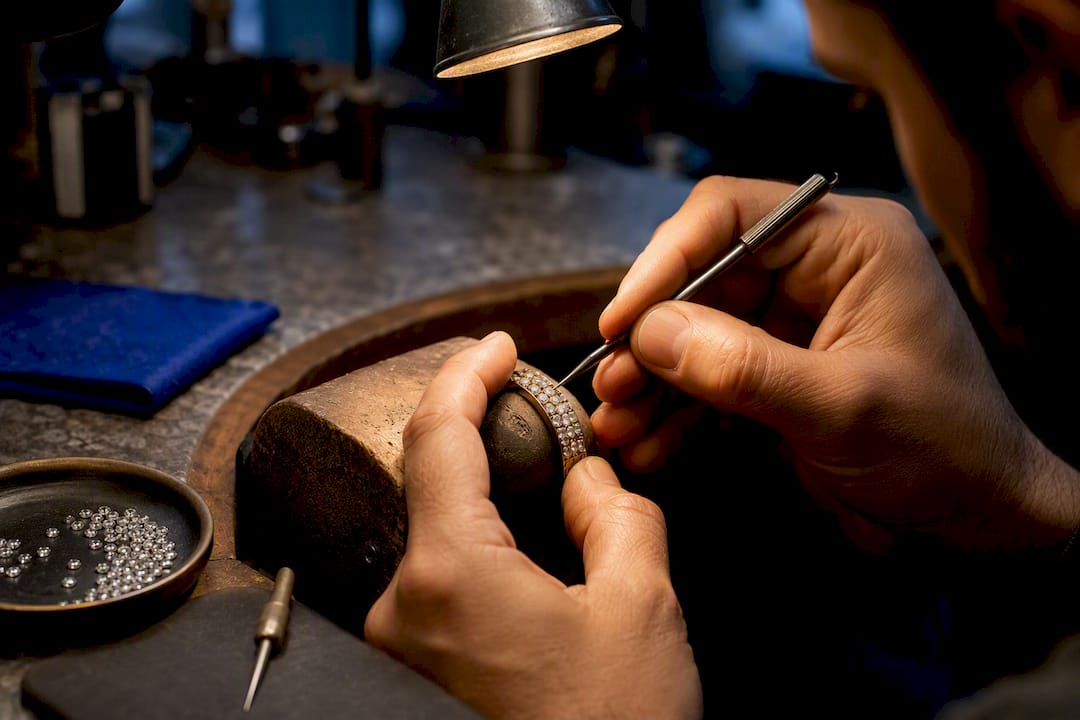
Design costs cover the consultation, CAD renders, revision rounds and any physical patternmaking before a single piece of metal gets touched.
Finishing and compliance round things out: rhodium plating for white gold, UK hallmarking, and sometimes insurance valuation once the piece is complete.
As a rough guide from industry pricing discussions, bespoke costs scale directly with design complexity and material choice, which is exactly why two rings that look similar on paper can land in very different price brackets, according to Hispek Diamonds.
- Metal: 9k, 14k, 18k, 22k gold, or platinum
- Stones: natural versus lab-grown, carat, certification
- Labour: setting, engraving, milgrain, pavé
- Design: consultation, CAD, revisions, modelling
- Finishing: plating, hallmarking, insurance
What does bespoke jewellery typically cost?
Numbers help more than percentages here, so treat these as indicative bands rather than a quote. Every commission is priced on its own merits.
- Simple bespoke rings generally start at a few hundred pounds with minimal detailing and modest metal weight.
- Standard bespoke engagement rings with a single stone and moderate setting complexity typically cost more but vary widely.
- Complex bespoke rings featuring multiple stones, intricate metalwork, or hand engraving have no fixed upper limit due to customization.
- Bespoke necklaces or bracelets vary greatly in price depending on chain complexity, stone count, and metal weight.
Swap a natural diamond for a lab-grown equivalent and a piece can drop a full band. Swap 18-carat gold for 9-carat and you’ll see a similar shift, sometimes more noticeably than the stone choice. Regional labour rates and the individual jeweller’s workshop overheads also nudge prices up or down, so two quotes for what looks like the same brief can legitimately differ by a few hundred pounds.
How can you make bespoke jewellery more affordable?
You don’t have to abandon the idea of a custom piece just because the first quote made your eyes water. A handful of tactics genuinely bring the cost down without gutting the design.
- Reuse existing stones. A diamond or sapphire from a grandmother’s ring or an old brooch can be reset into a new design, cutting out the single biggest cost line entirely.
- Consider lab-grown diamonds or alternative gemstones. They’re chemically identical to mined diamonds but priced well below them, and stones like moissanite or sapphire bring the cost down further still.
- Simplify the setting and reduce metal weight. A slimmer band or a lower-fineness gold (9k instead of 18k) both trim cost without necessarily changing how the piece looks on the hand.
- Ask for staged work and a clear cost breakdown. A jeweller should be able to itemise design, metal, stone and labour separately, and staging payments around each phase keeps you in control.
- Limit revision rounds. Every extra round of changes to a CAD design adds time, and time is billed.
Pro Tip: Ask your jeweller for a CAD-only stage before any physical modelling begins. Seeing the design as a 3D render first lets you approve or adjust proportions cheaply, rather than paying to remake a physical prototype.
What is the bespoke process and how does timing affect price?
Most bespoke commissions move through the same sequence: a consultation, initial sketches, CAD renders, your approval, manufacture, finishing, and finally UK hallmarking before the piece leaves the workshop. Understanding how bespoke jewellery design works in practice helps set expectations before you commit to a budget.
- Consultation and brief
- Sketches and concept approval
- CAD/3D render and revisions
- Final sign-off
- Manufacture and stone setting
- Finishing (plating, polishing)
- Hallmarking and quality check
A simple ring might take two to four weeks from consultation to collection. Something with multiple stones or intricate metalwork can run six to twelve weeks. Rush fees exist because compressing that timeline means paying a jeweller (or several) to prioritise your piece over others already in the workshop queue, and casting, setting and hallmarking all have physical time requirements that can’t be skipped. Booking early, particularly around engagement season, is the simplest way to avoid paying a premium for speed.
When does bespoke actually deliver better value?
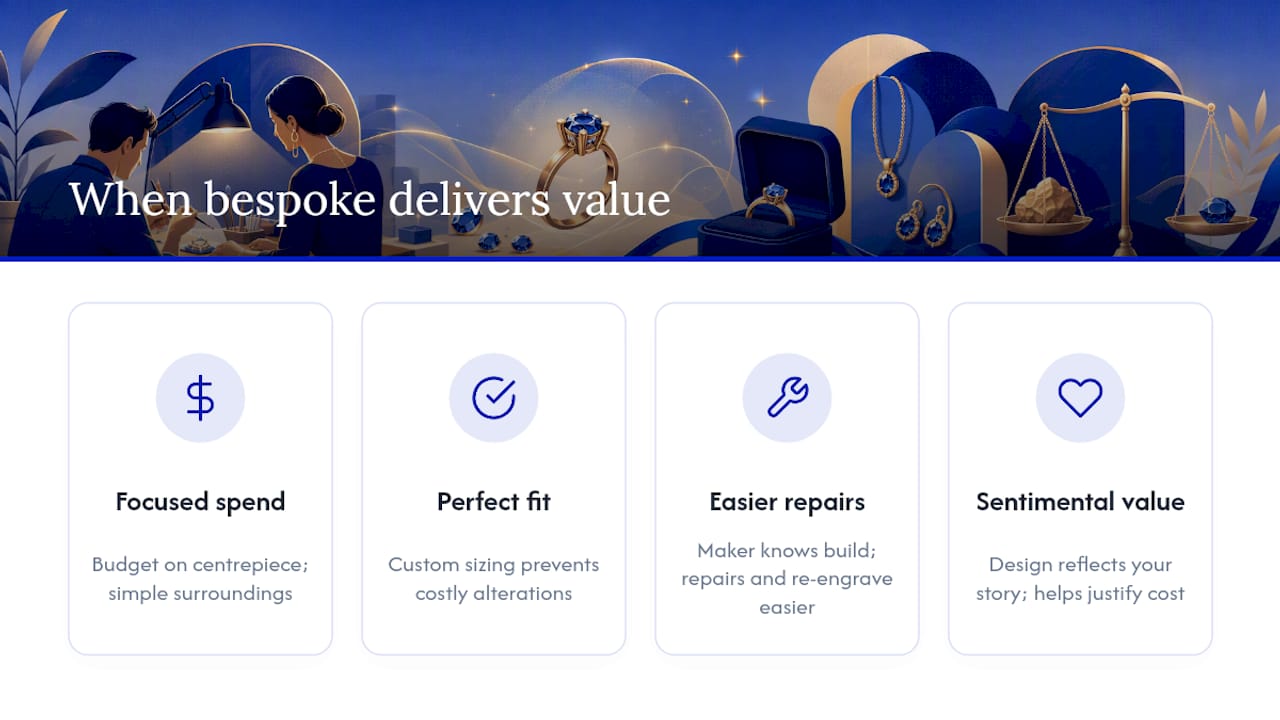
Bespoke earns its cost back when it lets you direct every pound towards what actually matters to you. Instead of paying for a factory setting with a mediocre stone, you put the budget into the centrepiece and keep everything around it simple.
Getting the proportions and fit right from the outset also avoids the expensive alterations that plague ill-fitting ready-made pieces, since custom sizing is built in rather than bodged in afterwards. Bespoke pieces are typically easier to repair and re-engrave over the years too, because the jeweller who made it understands exactly how it was built, which is why a professional jewellery repair service is invaluable for inherited or treasured items. That long-term repairability and the sentimental weight of a piece designed around your story is where bespoke often justifies its price tag.
What James has learned pricing bespoke commissions
Most customers arrive assuming bespoke means blowing the budget, and most leave having spent less than they feared. The commonest saving move James sees is reusing a stone from an inherited piece rather than buying new, followed closely by clients choosing 9-carat gold over 18-carat once they realise the visual difference is minor. Every upcycled stone gets properly inspected and hallmarked before it goes into a new setting, so provenance is never a guessing game.
— James
How Blackwell Jewellers can help you commission with confidence
Some jewellers build bespoke pieces in-house, meaning the person quoting your commission is the same person cutting, setting and finishing it, not a call centre relaying a factory’s estimate. That keeps pricing transparent and lets you have a genuine conversation about where your budget should go, whether that’s a bigger stone, a more detailed setting, or reusing a family heirloom.

If cost is the main hurdle, it’s worth knowing there’s a middle path between “buy off the shelf” and “commission from scratch.” Blackwell’s second-hand jewellery collection is fully inspected, authenticated and hallmarked, so you can pick up a genuine gold or diamond piece, or a loose stone, at a fraction of new-bespoke pricing and still know exactly what you’re getting. For pieces that need reworking rather than replacing, the jewellery repair service can rebuild or reset an existing item instead of starting a full commission from zero. Book a consultation to talk through your budget honestly before you commit to a design.
Sources
Check live gold and platinum futures for current metal pricing, and see how carat weight converts to size when comparing stones.
FAQ
Is it cheaper to have jewellery custom made?
It depends on your budget: at lower price points ready-made is usually cheaper because production costs are shared across many units, but bespoke becomes competitively priced or better value at higher budgets, particularly when you direct spend towards one standout stone.
What is the 2:1:1 rule in jewellery?
The 2:1:1 rule is a styling guideline used by retailers and stylists to balance metal, gemstone and design proportions when wearing multiple pieces together. It’s a styling principle, not a pricing formula.
What does “bespoke” mean in jewellery?
Bespoke means a piece is designed and made from scratch for one specific customer, covering everything from the initial sketch through CAD design to hand fabrication, rather than being selected from an existing range.
Are bespoke rings more expensive than ready-made rings?
Simple bespoke rings can cost more than an equivalent ready-made band because you’re covering one-off design and labour costs, but complex bespoke engagement rings often match or beat a comparable ready-made ring once you factor in stone quality and fit.