

Most bespoke engagement rings take several weeks from first consultation to collection, with a common completion time falling within the typical industry range of 4–12 weeks, depending on complexity and stone sourcing. If you’re planning a proposal, the safe rule of thumb is to order at least 12 weeks out — that buffer covers revisions, hallmarking, and the inevitable “I just want to tweak the setting slightly” moment. Rush options exist (more on those below), but the fastest realistic turnaround for a truly bespoke piece is a few weeks, and that usually means compromises. Blackwelljewellers, with over 20 years of in-house workshop experience, handles the full process under one roof in Kent, which trims handover time compared with jewellers who subcontract fabrication.
Table of Contents
- How long does each stage of the bespoke ring process take?
- What speeds up or slows down a bespoke commission?
- Rush orders: what’s actually possible and what it’ll cost you
- How far in advance should you order? The UK rule of thumb
- What to ask your jeweller before you commit
- Real-world timelines from the Blackwelljewellers workshop
- Final steps: hallmarking, resizing, delivery and insurance
- Key takeaways
- Why the “just order early” advice misses the point
- Blackwelljewellers’ bespoke service: reliable UK timelines, in-house craftsmanship
- Useful UK sources and further reading
How long does each stage of the bespoke ring process take?
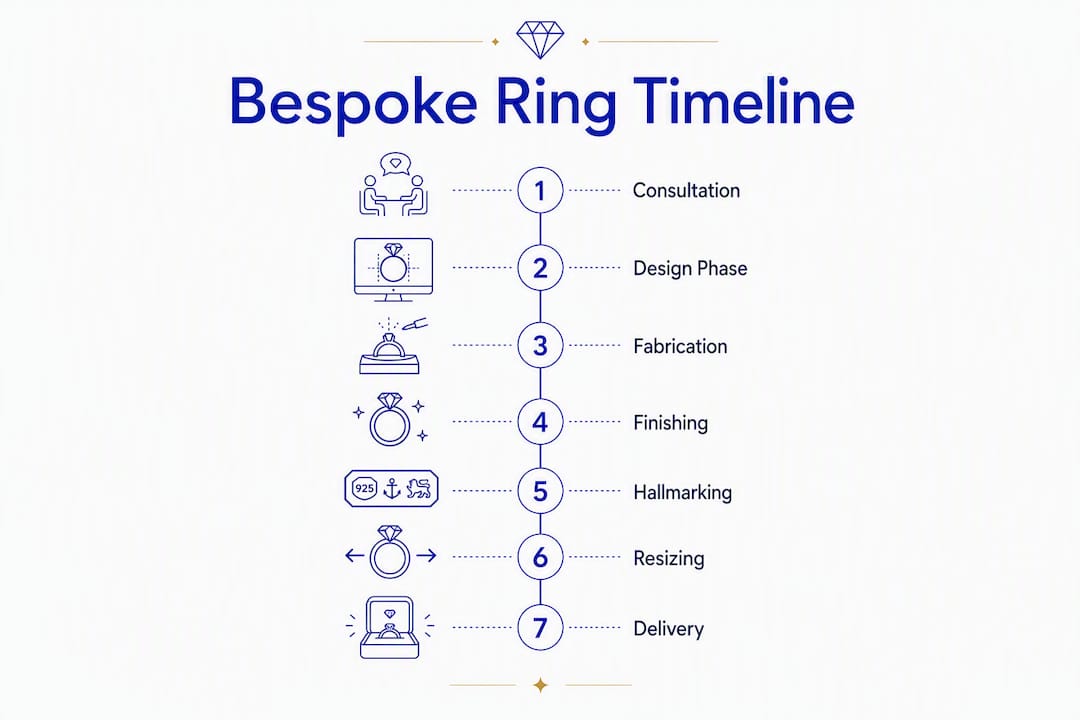
The bespoke ring creation process isn’t one long wait — it’s a sequence of distinct stages, each with its own clock. Understanding where the time actually goes helps you spot where delays are likely to creep in.
| Stage | Typical Duration | Notes |
|---|---|---|
| Initial consultation | Several days | In-person or remote; longer if you need multiple appointments |
| Design and CAD | Approximately one to two weeks | Client approval at end of this stage is critical |
| Stone selection / procurement | Several weeks | Rare or unusual stones may require additional time |
| Prototype / wax model (if used) | Several days | Not always required; adds confidence on complex designs |
| Casting and fabrication | Multiple weeks | The core bench work; overlaps partially with stone sourcing |
| Stone setting | Several days | Intricate pavé or multi-stone settings take longer |
| Finishing and polishing | Several days | Includes rhodium plating if specified |
| Final review and collection | Several days | Quality check, photography, packaging |
A few things worth flagging. Stages 3 and 4 often run in parallel — a good workshop will start fabricating the mount while the stone is in transit. That overlap can shave a week off the total. Where things tend to go sideways is at the client approval points: if you take five days to sign off a CAD when the jeweller expected two, that delay ripples through everything downstream.
Many jewellers quote 6–8 weeks once the design is finalised, but that clock starts after the consultation and design phase — so add those early weeks on top. The total elapsed time from first meeting to ring in hand is typically between four and twelve weeks for a standard commission, depending on the complexity of the design and stone availability.
Pro Tip: Confirm your stone choice before the design phase begins, not during it. Knowing the exact dimensions of your centre stone lets the CAD designer build the setting precisely, eliminating a whole revision round and potentially cutting a week from your custom ring timeline.
What speeds up or slows down a bespoke commission?
Some factors are within your control. Others are just the reality of working with rare materials and skilled craftspeople who are, frankly, in demand.
The big time-drivers, ranked by impact:
- Stone availability. A standard round brilliant from a UK supplier? Usually 1–2 weeks. A specific fancy-cut sapphire from Sri Lanka or a vintage old-cut diamond? That can add 3–4 weeks, sometimes more. Design complexity and custom stone settings are consistently the two biggest time drivers in bespoke commissions.
- Design complexity. A solitaire with a plain band is straightforward. A three-stone ring with a hand-engraved gallery and a custom milgrain edge is not. More detail means more bench hours.
- Revision rounds. Every revision to a CAD or wax model adds days. Two or three rounds of changes can add 2–3 weeks to the total. Clients who arrive with clear reference images and a firm idea of what they want move through this stage fastest.
- Workshop workload and seasonality. Scheduling practices and workload seasonality are documented reasons for longer lead times. The Christmas and Valentine’s periods are the worst. Workshops get booked up weeks in advance, and bench time becomes scarce.
- Hallmarking queues. The UK Assay Office (Birmingham, London, Edinburgh, or Sheffield) is a legal requirement for gold, silver, and platinum pieces over certain weights. Standard turnaround is a few working days, but busy periods can stretch this.
- Client response speed. This one is entirely on you. Slow email replies on CAD approvals or stone selections are the single most common cause of self-inflicted delays.
Quick risk-assessment checklist before you commission:
- Is your stone choice unusual or rare?
- Does the design include hand-engraving, pavé, or multiple stones?
- Are you ordering between October and February?
- Do you have a firm proposal date less than 10 weeks away?
If you answered yes to two or more of those, add at least two extra weeks to whatever timeline you’re quoted.
Rush orders: what’s actually possible and what it’ll cost you
Here’s the honest version. A fully bespoke ring — designed from scratch, with a custom setting and a sourced stone — cannot realistically be done in under three weeks without cutting corners somewhere. A made-to-order ring, where you’re selecting from existing design templates and choosing metal and stone options, can sometimes be completed in 5–10 days.
The distinction matters. Made-to-order is faster because the design work is already done; you’re essentially customising a proven template rather than building from a blank page. Fully bespoke means every element is created specifically for you, which takes time regardless of how much you’re willing to pay.
Common rush pathways:
- Prioritised bench time. Some workshops offer a rush premium that moves your job to the front of the queue. Expect to pay a surcharge for this.
- Simplified design. Agreeing to a cleaner, less intricate design removes fabrication complexity and can cut 1–2 weeks from the schedule.
- In-stock stone selection. Choosing from stones already held by the jeweller eliminates sourcing time entirely.
- Outsourced casting. Some workshops use external casting houses for rush jobs, which can be faster but removes some quality control from the process.
If you’re in a genuine time crunch, be upfront about your proposal date from the very first conversation. A good jeweller will tell you honestly whether your timeline is achievable — and if it isn’t, they’ll say so rather than take your deposit and disappoint you later.
How far in advance should you order? The UK rule of thumb
The standard advice across the UK bespoke jewellery industry is to commission at least 12 weeks ahead of your proposal date for a standard bespoke engagement ring. That gives you 8–10 weeks of production time plus a 2–3 week buffer for the unexpected.
For complex commissions — multi-stone designs, rare stones, hand-engraving — plan for a longer lead time. Seriously.
Seasonal adjustments:
- Christmas proposals (December): Order by mid-September at the latest. Workshops fill up fast from October onwards.
- Valentine’s Day (14 February): Commission by late November. December is already busy; you don’t want to be competing for bench time.
- Wedding season (May–July): If you’re proposing ahead of a summer wedding, aim to commission in January or February.
Pro Tip: Build in a two-week contingency buffer specifically for resizing. Even with accurate finger measurements, a ring sometimes needs a small adjustment after delivery — and you want that done before the proposal, not after.
What to ask your jeweller before you commit
Getting a bespoke ring made is a significant financial and emotional investment. The contract conversation matters as much as the design conversation. Here’s what to pin down in writing before you pay a deposit.
Milestone and timeline questions:
- What is the estimated completion date, and is it guaranteed?
- What are the key approval milestones, and how long do I have to respond at each?
- How many revision rounds are included, and what happens if I need more?
Financial questions:
- What is the deposit amount, and is it refundable if I cancel?
- When is the balance due — on completion, on collection, or on delivery?
- Are there additional charges for rush work, extra revisions, or late stone changes?
Practical questions:
- Who is responsible for the ring if it’s lost or damaged during production?
- How will you keep me updated during fabrication? (Photos and short video updates during creation are a common and genuinely useful practice — they speed approvals and reduce anxiety.)
- What is your policy on resizing after delivery?
The client-facing design journey at Blackwelljewellers walks through exactly these approval points, so you know what to expect at each stage. Getting answers to all of the above before you sign anything is not being difficult — it’s being sensible.
Real-world timelines from the Blackwelljewellers workshop
Rather than deal in abstractions, here are three illustrative project types that reflect the kind of work handled at the Blackwelljewellers workshop in Kent.
| Project type | Consultation to CAD | Fabrication and setting | Finishing and hallmarking | Total elapsed time |
|---|---|---|---|---|
| Simple solitaire remake (client’s own stone) | Several days | Multiple weeks | Several days | Approximately one month |
| Standard bespoke engagement ring (new stone) | Around one to two weeks | Several weeks | Several days | Approximately one and a half months |
| Complex multi-stone halo commission | Several weeks | Several weeks | Multiple days | Around two to three months |
A couple of things stand out from those numbers. The simple remake is fast partly because the stone sourcing step is eliminated — the client already has the diamond. Pre-owned stones used in remakes do require extra inspection and authentication time at Blackwelljewellers before they’re set, but that work typically runs concurrently with the design phase rather than adding to the total.
The multi-stone commission takes longer not because the bench work is dramatically harder, but because there are more approval points. Each stone placement needs sign-off, and the CAD for a halo design is more involved than a solitaire.
Blackwelljewellers handles fabrication and finishing in-house for the majority of bespoke commissions, which removes the handover delays that come with subcontracting. That’s a practical advantage when you’re working to a firm proposal date.
Final steps: hallmarking, resizing, delivery and insurance
You’ve got a finished ring. You’re not quite done yet. These final steps are where people consistently underestimate the time involved.
Hallmarking. Any gold, silver, or platinum piece above the minimum weight threshold must be hallmarked by a UK Assay Office before it can be sold. The four offices are in London, Birmingham, Edinburgh, and Sheffield. Standard turnaround is typically 3–5 working days, though busy periods can stretch that. Some workshops use a same-day or next-day premium service for urgent jobs, but that costs extra.
Resizing. Even with careful measurement, a ring sometimes needs a small adjustment. Resizing at a jeweller typically takes 1–5 working days depending on the complexity of the shank and whether the ring has stones set around the band. Allow for this before your proposal date, not after.
Finishing touches. If rhodium plating is specified (common for white gold), that adds a day or two. Engraving inside the band — a date, initials, a short phrase — typically takes 1–2 days. Final finishing and plating steps can add additional days depending on workshop workload.
Actions to plan before your proposal:
- Confirm the ring is hallmarked and has the correct paperwork.
- Check the fit before the proposal day — ideally a week before, not the night before.
- Arrange insurance before the ring leaves the workshop. Most home contents policies don’t cover jewellery adequately; a specialist policy is worth the small annual cost.
- If the ring is being shipped rather than collected, use an insured, tracked courier service. Royal Mail Special Delivery is the standard UK option for high-value items.
- Keep the original box and any certificates — you’ll need them for insurance and any future resizing or repair.
Key takeaways
A bespoke engagement ring typically takes a couple of months from first consultation to collection, and ordering well ahead of your proposal date gives you the buffer you need for revisions, hallmarking, and resizing.
| Point | Details |
|---|---|
| Typical total timeline | Allow four to twelve weeks for a standard bespoke commission; complex designs need longer. |
| Safe lead time | Order well in advance of your proposal date; allow extra time for complex or seasonal commissions. |
| Biggest delay risk | Client approval speed and stone sourcing are the two most common causes of timeline overruns. |
| Final steps add time | Hallmarking, resizing, and insured delivery can add additional time after the ring leaves the bench. |
| Blackwelljewellers | Contact the Kent workshop early for a personalised timeline estimate and in-house bespoke commission. |
Why the “just order early” advice misses the point
Here’s a take you won’t find on most bespoke ring guides: the advice to “order early” is correct but incomplete. The real variable isn’t how much time you give the jeweller — it’s how much time you give yourself to make decisions.
Most timeline overruns in bespoke commissions happen because clients arrive at the design stage underprepared. They haven’t thought seriously about metal colour, setting style, or stone shape. They approve a CAD, then change their mind. They pick a stone, then wonder if a different cut would look better. Every one of those moments costs days.
The clients who get their rings on time — or early — are the ones who do their homework before the first appointment. They know roughly what they want. They have reference images. They understand the difference between a bezel and a claw setting. They prepare stone choices and sign-off decisions before the design phase, not during it.
So yes, order early. But also: arrive prepared. The jeweller can only work as fast as you let them.
Blackwelljewellers’ bespoke service: reliable UK timelines, in-house craftsmanship
If you want a bespoke engagement ring made to a timeline you can actually trust, in-house fabrication is the difference between a quoted date and a guaranteed one.

Blackwelljewellers is a family-run Kent workshop with over 20 years of experience handling bespoke commissions from initial sketch through to hallmarked, finished piece — all under one roof. No subcontracting, no handover delays. The team works with ethical diamonds and can also incorporate pre-owned or inherited stones into a new design (with full authentication and inspection included). If you’re working to a firm proposal date, the first step is a consultation to map out a realistic stage-by-stage timeline for your specific design. Deposits and revision policies are discussed transparently at that first meeting. For rush commissions, the workshop will tell you honestly what’s achievable — and what isn’t. Get in touch via the Blackwelljewellers website to request a timeline estimate or book your first appointment.
Useful UK sources and further reading
A few places worth bookmarking as you plan your commission:
- How bespoke jewellery design works — Blackwelljewellers’ step-by-step walkthrough of the commission process, with stage-by-stage timing guidance.
- From sketch to reality: the bespoke jewellery design journey — A client-facing narrative of the design-to-delivery process, particularly useful for understanding where your approvals matter most.
- Bespoke diamond rings: how to design something one-of-a-kind — Covers the design decisions that most commonly add time and cost to a commission.
- Fine Jewelry Selection Workflow: A Confident Buyer’s Guide — Practical preparation advice for buyers; particularly good on how to arrive at a design consultation ready to make decisions.
- GIA (Gemological Institute of America) — The global authority on diamond grading and gemstone standards; useful for understanding the certificates that should accompany any stone in your commission.