

TL;DR:
- Jewellery repairs restore, resize, and structurally correct damaged pieces, preserving their beauty and value. In England, ring resizing costs range from £20 to £80, depending on metal and complexity, with in-house workshops offering better quality control and faster service. Always ask questions, obtain written quotes, and choose experienced jewelers to avoid common repair pitfalls and ensure long-term satisfaction.
Jewellery repairs is the professional practice of restoring, resizing, or structurally correcting damaged or ill-fitting pieces to preserve their beauty and long-term value. Whether you’ve snapped a necklace chain, lost a gemstone, or inherited a ring two sizes too small, the repair process is more accessible and affordable than most people assume. In England in 2026, ring resizing costs between £20 and £80 depending on the metal and complexity. Knowing what to expect before you walk into a jeweller saves you money, time, and the occasional awkward conversation.
What are the most common jewellery repairs and when do you need them?
The most common repair types cover a wider range than most people realise. It’s not just broken clasps and bent prongs. Here’s what professional jewellers deal with day in, day out:
- Ring resizing. The most requested repair in any workshop. Rings need resizing after weight changes, pregnancy, or simply buying second-hand. Most gold, silver, and platinum rings can be resized down up to 4 UK sizes and up by 2 to 3 sizes safely.
- Chain and necklace repair. Broken links, snapped clasps, and kinked chains are everyday casualties. A necklace repair service typically involves soldering the break and re-polishing the affected area.
- Bracelet fixing. Bracelet clasps wear out faster than most people expect, particularly on fine chains and tennis bracelets. Replacing a clasp or re-linking a bracelet is usually a quick, low-cost job.
- Gemstone replacement. Stones fall out when prongs wear down or get knocked. A jeweller will source a matching stone, re-set it, and check the surrounding prongs while they’re at it.
- Clasp and catch repairs. Box clasps, lobster clasps, and toggle catches all fail eventually. Replacing them is straightforward for an experienced goldsmith.
- Rhodium plating. White gold is actually yellow gold with a rhodium coating. That coating wears off over time, leaving a yellowish tinge. Re-plating restores the bright white finish.
- Prong re-tipping. Worn prongs are the leading cause of lost stones. A jeweller builds up the metal before it fails completely.
One thing worth knowing: not every metal plays by the same rules. Tungsten and titanium cannot be resized by traditional cutting and soldering. If you own a tungsten ring that no longer fits, the solution is an adjustable shank or a replacement ring entirely. Worth checking before you get attached to the idea of a quick fix.
What does the jewellery repair process actually involve?
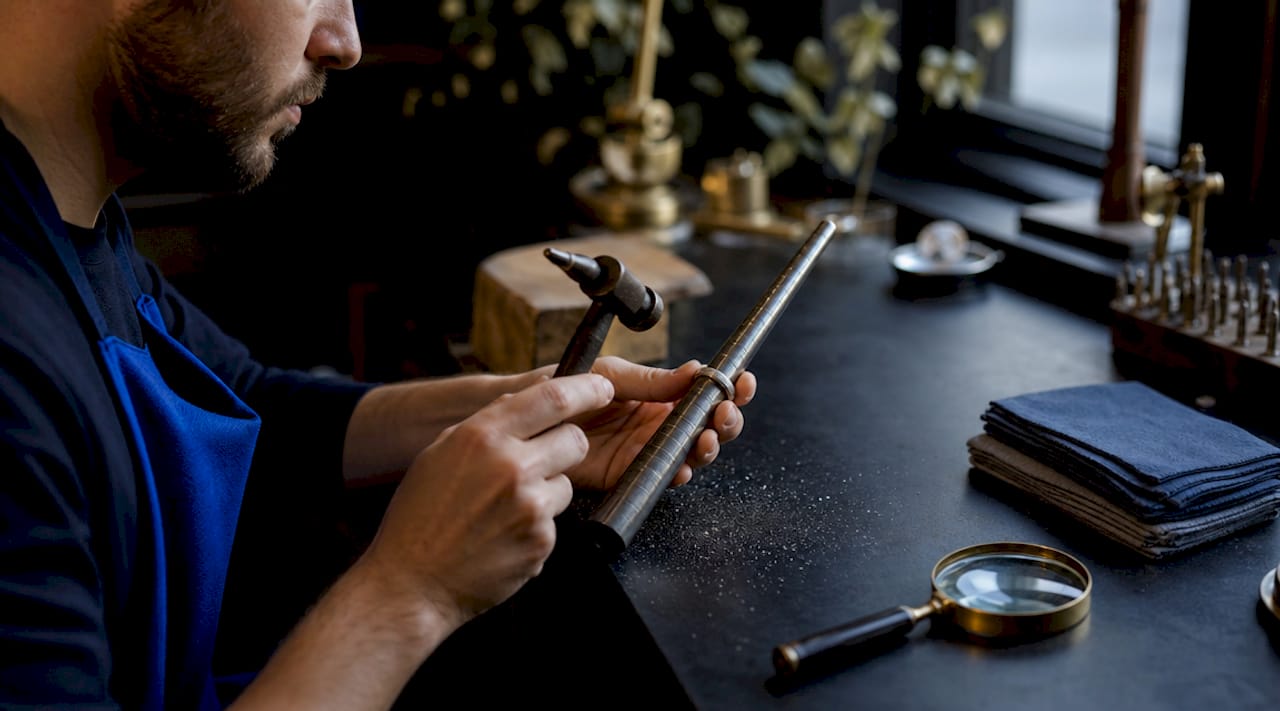
Most people hand over a piece and collect it a few days later without any idea what happened in between. That’s fine, but understanding the process helps you ask better questions and spot a shoddy job.
Ring resizing: the step-by-step reality
- The jeweller measures the current size and the target size, then assesses the ring’s construction, stone settings, and metal type.
- For sizing down, a section of the band is cut out, the ends are joined, and the seam is soldered. The ring is then shaped on a mandrel and polished.
- For sizing up, metal is either stretched (for small adjustments) or a new section of matching metal is inserted, soldered, and blended. This is why sizing up costs more than sizing down. More material, more labour.
- White gold rings almost always need rhodium plating after resizing to restore the uniform finish. That’s an additional step and an additional cost.
- The finished ring is inspected, cleaned, and polished before collection.
Techniques you might hear about
Laser welding is increasingly common in professional workshops. It’s precise, generates less heat than traditional soldering, and is particularly useful around delicate stones or intricate settings. Not every jeweller has the equipment, but those who do can handle repairs that would otherwise risk heat damage to surrounding stones.
Typical turnaround times vary by metal: silver rings take 1 to 2 working days, gold 1 to 3 days, white gold 2 to 4 days, and platinum 3 to 7 days. Platinum is denser and harder to work with, which is why it takes longer and costs more. Some high street jewellers offer a same-day rush service for an additional fee, which is worth asking about if you’re in a hurry.
In-house versus outsourced repairs
This matters more than most customers realise. In-house workshops give you direct access to the goldsmith doing the work, better quality control, and faster turnaround. When a jeweller sends your piece to a third-party workshop, you lose visibility over who handles it and when. Always ask whether the work is done on-site.
Pro Tip: Ask to see the workshop or speak directly to the person doing the repair. Any reputable jeweller will be happy to introduce you. If they can’t or won’t, that tells you something.
How much do jewellery repairs cost in England in 2026?
Here’s the honest answer: it depends. But “it depends” is not helpful on its own, so here are the actual numbers.
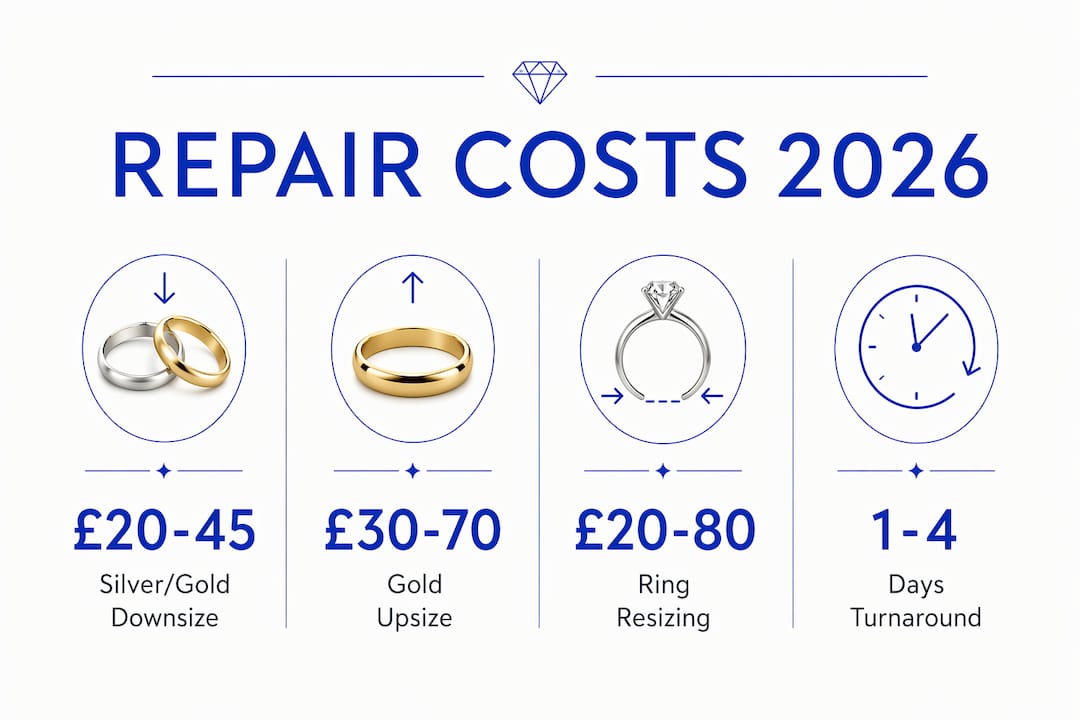
| Repair type | Typical cost range (England, 2026) |
|---|---|
| Ring sizing down (silver or gold) | £20 to £45 |
| Ring sizing up (silver or gold) | £30 to £80 |
| Rhodium plating (white gold) | £10 to £25 extra |
| Chain soldering (necklace repair) | £15 to £40 |
| Clasp replacement | £10 to £35 |
| Gemstone replacement (stone supplied) | £30 to £150+ depending on stone |
| Prong re-tipping | £20 to £60 per prong cluster |
Sizing down is simpler because it removes metal rather than adding it. Sizing up requires sourcing matching metal, inserting it cleanly, and blending the join. That extra labour and material is why the upper end of the range is higher. White gold adds another layer of cost because rhodium plating is almost always required afterwards to restore the finish.
Several major UK jewellers, including Ernest Jones and Goldsmiths, offer a free first resize within 30 days of purchase. If you’ve recently bought a ring and it doesn’t fit perfectly, check whether this applies before paying for a repair. Get the policy confirmed in writing at the point of sale.
Pro Tip: Always ask for a written quote before any work begins. A reputable jeweller will give you one without hesitation. If the quote seems unusually low, ask why. Cheap resizing can compromise metal integrity and reduce the long-term value of your piece.
How to choose a trustworthy jewellery repair service near you
Finding a good jeweller is not as hard as it sounds, but it does require a bit more effort than a quick Google search and clicking the first result.
Here’s what to look for:
- In-house workshop. The single most important factor. A jeweller with their own workshop employs goldsmiths on-site, which means faster turnaround, better accountability, and someone you can actually talk to about your piece. In-house services maintain clarity and control during complex repairs in a way that outsourced work simply cannot match.
- Verifiable expertise. Ask how long they’ve been doing repairs and whether they specialise in your metal type. Platinum repair, for example, requires different skills and equipment than silver work.
- Transparent pricing. A good jeweller quotes before they start. No surprises when you collect.
- Reviews and local reputation. Google reviews, Trustpilot, and word of mouth from friends in your area are all worth checking. Look specifically for reviews mentioning repairs, not just purchases.
- Clear communication. The jeweller should explain what they’ll do, how long it will take, and what the finished result will look like. If they’re vague or dismissive, walk away.
- Guarantees. Some jewellers offer a correction window if you’re not happy with the fit after resizing. Ask about this upfront.
For guidance on finding quality repair services across the UK, it’s worth doing your research before committing to a provider. High street jewellers, specialist workshops, and online services with secure postal options all exist. Online postal services can work well for straightforward repairs like chain soldering, but for anything involving resizing or stone work, an in-person assessment is always preferable.
Common pitfalls in jewellery repairs and how to avoid them
Even with a good jeweller, things can go wrong if you’re not informed. Here are the mistakes people make most often.
Resizing too many times. Multiple resizes over a lifetime are generally safe, but excessive resizing thins the band and risks cracking. If a ring has already been resized several times, tell the jeweller before they start. They need to assess whether the metal can take another adjustment.
Ignoring fit issues for too long. A ring that’s slightly too loose is a ring that’s going to fall off somewhere inconvenient. A ring that’s too tight is a ring that’s going to need cutting off in an emergency. Neither situation is ideal. Get fit issues sorted promptly.
Choosing the cheapest quote. Experts are consistent on this point: prioritising cost over quality when resizing risks compromising the band’s thickness and shape. A poorly executed resize can weaken the ring structurally and leave a visible seam. That’s not a saving. That’s a false economy.
Not using temporary solutions while waiting. If you’re waiting for a repair appointment or saving up for a proper fix, temporary sizing solutions like plastic ring guards, sizing bars, and liquid sizing products offer a reversible way to manage fit in the meantime. They’re cheap, widely available, and prevent the ring from slipping off.
“The most common regret we hear from customers is that they waited too long to get a repair done. A small issue becomes a bigger one. A loose stone becomes a lost stone. Act early.”
Pro Tip: If your ring has been resized and the fit still feels slightly off after a week of wearing it, go back and say so. Many jewellers will make a minor correction at no extra charge within a short window after the repair.
Key takeaways
Jewellery repairs done well by a skilled in-house goldsmith preserve both the structural integrity and long-term value of your pieces far better than cheap, rushed alternatives.
| Point | Details |
|---|---|
| Cost range for resizing | Ring resizing in England costs £20 to £80 in 2026, depending on metal and direction of sizing. |
| Sizing up costs more | Adding metal requires more labour and material than removing it, pushing prices toward the higher end. |
| In-house workshops matter | Direct access to the goldsmith means better quality control, faster turnaround, and clearer communication. |
| Avoid the cheapest quote | Poor resizing weakens the band and can reduce the piece’s long-term value and structural integrity. |
| Act early on fit issues | Loose rings get lost; tight rings get cut off. Temporary solutions exist while you arrange a permanent fix. |
What I’ve actually learnt from watching repairs go wrong
I’ve seen a lot of jewellery come through workshops over the years, and the pattern is always the same. The customers who get the best results are the ones who ask questions. Not annoying, relentless questions. Just the basics: who’s doing the work, how long will it take, and what does the finished result look like?
The customers who end up disappointed are almost always the ones who went with the cheapest option without asking anything at all. And look, I get it. Jewellery repairs feel like they should be simple. You hand something over, they fix it, you collect it. But a ring resize on a platinum band with a channel-set diamond row is not the same job as soldering a snapped silver chain. Treating them as equivalent is how you end up with a thinned band and a visible seam on a piece worth several hundred pounds.
My honest view: don’t compromise on the provider for repairs that matter. For a £15 clasp replacement on a costume piece, fine, go with whoever is convenient. For a wedding ring, an heirloom, or anything with genuine sentimental or financial value, find a jeweller with an in-house workshop and a goldsmith you can actually speak to. The extra effort is worth it every single time.
The other thing I’d say is this: vintage jewellery repair requires a different level of skill than modern piece repair. Older metalwork can be brittle, the alloys are sometimes unusual, and the construction methods are not always what a modern jeweller expects. If you’re bringing in something genuinely old, say so upfront and ask whether the jeweller has experience with antique or vintage pieces specifically.
— James
Get your jewellery repaired by Blackwelljewellers

Blackwelljewellers has been handling professional jewellery repairs from its Kent workshops in Maidstone, Gravesend, and Bexleyheath for over 20 years. The team works with gold, silver, platinum, and diamond pieces, offering ring resizing, jewellery restoration, gemstone replacement, and polishing, all carried out in-house by skilled goldsmiths. Pricing is transparent, the work is done on-site, and you can speak directly to the person handling your piece. Whether you need a quick clasp replacement or a full jewellery restoration service, Blackwelljewellers makes the process straightforward. Visit a store or get in touch online to arrange an assessment.
FAQ
How much does ring resizing cost in England?
Ring resizing costs between £20 and £80 in England depending on the metal type and whether you’re sizing up or down. White gold rings typically require rhodium plating afterwards, adding £10 to £25 to the total.
Can all rings be resized?
Most gold, silver, and platinum rings can be resized, but tungsten and titanium rings cannot be resized by traditional methods. Rings with full-eternity stone settings also have limited resizing options due to the stones running around the entire band.
How long does a jewellery repair take?
Turnaround times depend on the metal and repair type. Silver repairs typically take 1 to 2 days, gold 1 to 3 days, and platinum up to 7 days. Some jewellers offer a same-day service for straightforward repairs at an additional cost.
Is it worth repairing old or second-hand jewellery?
Absolutely. Restoring a pre-owned piece through professional jewellery restoration often costs far less than replacing it, and the sentimental or collector value is preserved. Blackwelljewellers specialises in authenticated second-hand pieces that are inspected and restored before sale.
How do I know if a jeweller is trustworthy?
Look for an in-house workshop, transparent written quotes, verifiable reviews, and a goldsmith you can speak to directly. Reputable jewellers explain the process clearly and offer a correction window if the result isn’t right.
Recommended
- Jewellery Repairs in Maidstone: What You Need to Know – blackwellonline
- Find quality ring repair services in the UK – Blackwell Jewellers
- How to fix a broken ring in the UK: complete repair guide – Blackwell Jewellers
- The Cost of Jewellery Repairs in the UK: What You Really Need to Know – blackwellonline