
TL;DR:
- Professional ring resizing involves cutting, soldering, and finishing to adjust fit and preserve value.
- Choosing an experienced jeweller with in-house workshops ensures quality and proper hallmarks are maintained.
- Ongoing care and inspection after resizing help prevent metal fatigue and preserve the ring’s authenticity.
A beloved ring that no longer fits is one of those quietly frustrating experiences. Whether it’s a family heirloom passed down through generations, a pre-owned diamond find, or a bespoke piece you’ve treasured for years, an ill-fitting ring deserves proper attention rather than a drawer. The good news is that professional ring resizing in the UK is a well-established craft, and when done correctly, it preserves both the beauty and the value of your jewellery. This guide walks you through every stage of the process, from understanding what’s possible to choosing the right jeweller and verifying the quality of the finished work.
Table of Contents
- Understanding ring resizing: methods and what’s possible
- Preparing for a resize: what you need and how to choose the right jeweller
- Step-by-step: the ring resizing process in UK workshops
- Troubleshooting, care and authenticating your resized ring
- What most people miss about ring resizing: why authentic craftsmanship matters
- Find trusted ring resizing and authentic jewellery services
- Frequently asked questions
Key Takeaways
| Point | Details |
|---|---|
| Know what’s possible | Not every ring can be resized, and materials or hallmarks may limit safe adjustments. |
| Choose your expert wisely | Look for jewellers who specialise in pre-owned and bespoke work for best results and authenticity. |
| Prioritise quality checks | Always confirm invisible joins, secure stones, and proper hallmarking after resizing. |
| Understand cost factors | Prices vary depending on the ring’s complexity, materials, and the jeweller you select. |
Understanding ring resizing: methods and what’s possible
To get started, let’s look at what ring resizing actually means and the limits you should be aware of.
At its core, ring resizing involves cutting the band, inserting matching metal, soldering, filing, and polishing to make it larger; or removing a section of band, soldering the ends, then refinishing to make the join invisible for a smaller fit. It sounds straightforward, but the reality depends heavily on the ring’s material, design, and condition.
There are two broad approaches jewellers use:
- Stretching or compression: For minor adjustments of half a size or less, some rings can be physically stretched on a mandrel or compressed. This avoids cutting but is only suitable for plain metal bands without stones.
- Cutting and soldering: The standard method for most resizing jobs. The band is cut, metal is added or removed, and the join is soldered and finished to be invisible.
Not every ring is a good candidate for resizing. Here’s a quick overview:
| Ring type | Resizable? | Notes |
|---|---|---|
| Plain gold or platinum band | Yes | Most straightforward |
| Solitaire with simple setting | Usually yes | Stone security must be checked |
| Full eternity band | No | Stones run all the way round |
| Vintage or fragile settings | Sometimes | Requires specialist assessment |
| Silver rings | Often yes | Metal is softer; care needed |
| Tungsten or titanium | No | Too hard to cut or solder |
UK hallmarks add another layer of consideration. Precious metals sold in the UK must carry a hallmark confirming their purity, and resizing can affect the position or legibility of that mark. In some cases, re-hallmarking is required after the work is completed.
Worth knowing: Repeated resizing weakens metal over time through a process called metal fatigue. If your ring has already been resized once or twice, a skilled jeweller will assess whether the band is strong enough to withstand further work before proceeding.
What can go wrong? Finish mismatches are common when a jeweller uses metal that doesn’t quite match the original alloy. On white gold rings, the rhodium plating that gives the metal its bright appearance is disturbed during soldering and must be reapplied. Skipping this step leaves a dull patch that’s immediately visible. Always ask whether rhodium replating is included in the quote for white gold work.
Preparing for a resize: what you need and how to choose the right jeweller
Once you understand the basic resizing process, it’s time to prepare for a successful adjustment.
Before you walk into any workshop, gather the following information about your ring:
- Metal type and purity: Gold (9ct, 18ct, 22ct), platinum, silver, or a combination.
- Existing hallmarks: Note what’s stamped on the inner band. This matters for authenticity and re-hallmarking.
- Gemstone settings: Are stones set in prongs, bezels, or channels? How many, and are any near the base of the band?
- Degree of adjustment: Do you need to go up or down, and by how many sizes?
- History of previous resizing: Has the ring been altered before?
For inspecting pre-owned rings before resizing, this preparation is especially important. A pre-owned piece may have undisclosed previous repairs, metal thinning, or stone instability that only a trained eye will catch.
Choosing the right jeweller matters enormously. Chain jewellers offer convenience and brand recognition, but in-house workshops provide better quality control and faster turnaround because the work stays on site. Independent jewellers with their own workshops can often offer more personalised attention, particularly for vintage and bespoke pieces.
Questions to ask any jeweller before committing:
- Is the resizing done in your own workshop or sent away?
- Will the hallmarks be checked and re-applied if needed?
- Is rhodium plating included for white gold?
- What is the expected turnaround time?
- Do you offer a guarantee on the work?
For hallmark care advice and understanding how alterations affect your ring’s certification, it’s worth reading up before your appointment. And if you’re working with a ring that’s been refurbished previously, ask the jeweller to assess the quality of that earlier work before proceeding.
Pro Tip: Always get a written quote before leaving your ring. A reputable jeweller will confirm the price, scope of work, and expected completion date in writing. This protects you and sets clear expectations on both sides.
Step-by-step: the ring resizing process in UK workshops
With everything in place, here’s how the actual resizing process unfolds in reputable UK workshops.
Stage 1: Assessment The jeweller examines the ring under magnification, checking metal condition, stone security, existing hallmarks, and any signs of previous repairs. This stage determines whether resizing is safe and what method is appropriate.
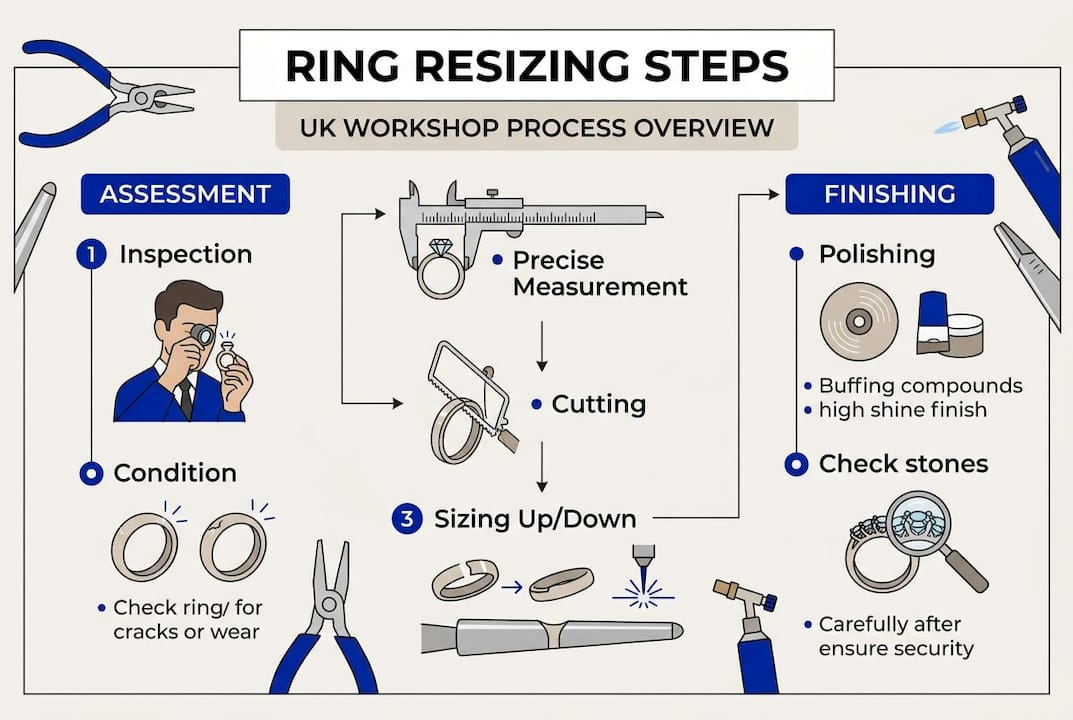
Stage 2: Cutting or stretching For sizing up, the band is cut at the base and spread. For sizing down, a measured section is removed. Stretching is only used for very minor adjustments on plain bands.
Stage 3: Metal insertion or removal When sizing up, a piece of matching metal is inserted and soldered into place. The soldering and filing process must be done precisely so the join is completely invisible once polished.
Stage 4: Finishing The ring is filed, shaped on a mandrel to restore its round form, then polished to match the original finish. For white gold, rhodium replating post-resize is applied at this stage.
Stage 5: Stone security check Every stone is checked for movement. Heat from soldering can loosen settings, so this step is non-negotiable in quality workshops.
Stage 6: Re-hallmarking if required If the hallmark has been disturbed or the metal altered, the ring may need to be submitted to an assay office for re-hallmarking.
For a detailed look at on-site workshop speed and what affects turnaround times, it’s worth understanding that simple resizes in an in-house workshop can often be completed the same day. Complex jobs involving vintage settings, multiple stones, or significant size changes may take five to seven working days.
Pro Tip: Ask to see the ring under a loupe or magnifying glass after the work is done. A quality resize should show no visible join, no colour difference in the metal, and no movement in any stones.
Quality indicator: The hallmark should remain legible and correctly positioned after resizing. If it’s been obscured or removed without re-hallmarking, that’s a red flag. For guidance on safe resizing specific to different ring types, consult a specialist before committing.
Troubleshooting, care and authenticating your resized ring
Understanding the resizing process is just one side; ensuring your ring remains beautiful and authentic afterwards is equally vital.
Once your ring is returned, take time to inspect it carefully. Here’s what to look for:
- The join: Run your finger around the inner band. You should feel no ridge or bump where the solder was applied.
- Stone security: Gently press each stone. There should be no movement whatsoever.
- Finish consistency: The polish or texture should be uniform all the way around, with no dull patches or colour differences.
- Hallmark legibility: The original hallmark should still be readable, or a new one should be present if re-hallmarking was required.
- Overall shape: The ring should be perfectly round, not slightly oval from improper mandrel work.
Ongoing care after resizing matters too. Metal fatigue from repeated resizing is a real risk, so avoid having the same ring resized more than twice in its lifetime if possible. Have the ring inspected annually, particularly if it contains stones, as the setting can shift subtly over time.

Resizing does affect resale value if done poorly. A visible join, a mismatched hallmark, or a thinned band will all reduce what a buyer or pawnbroker is willing to offer. Conversely, a professionally resized ring with updated documentation and a clean hallmark retains its value well.
For pre-owned rings, authentication after resizing is particularly important. Check that any paperwork or certificates reflect the current condition. If you’re uncertain about spotting fake rings or identifying genuine hallmarks, a second opinion from a trusted independent jeweller is always worthwhile.
Red flags to watch for: Solder that’s a different colour to the band, stones that rock in their settings, a hallmark that’s been filed away without replacement, or a ring that’s no longer truly round. These indicate poor workmanship and should be challenged immediately.
For advice on preserving hallmarks through alterations, speak to your jeweller before the work begins rather than after.
Pro Tip: Photograph your ring before and after resizing. This creates a simple record of its condition and is invaluable if you ever need to make a claim or dispute the quality of work.
What most people miss about ring resizing: why authentic craftsmanship matters
After all the practical steps, here’s a perspective often missed by those new to ring resizing.
Price is the first thing most people look at, and it’s often the wrong starting point. Chain jewellers versus independents is a genuine debate: chains bundle services at higher cost but offer comprehensive coverage, while independents can be cheaper and faster for simple jobs yet vary considerably in skill for complex or vintage work.
For a plain silver band, price-led decisions are probably fine. But for an heirloom engagement ring, a pre-owned diamond piece, or a bespoke commission, the stakes are entirely different. A botched resize on a meaningful ring doesn’t just look wrong. It can compromise the metal’s integrity, disturb stones, and erase hallmarks that are part of the ring’s provenance and history.
We’ve seen rings come through our workshops that have been resized cheaply elsewhere, and the damage is sometimes irreversible. The lesson is this: the cost of poor craftsmanship is always higher than the cost of doing it right the first time. For engagement ring pricing insights and understanding jewellery repair value, the principle is the same: invest in the right hands, not just the lowest quote.
Find trusted ring resizing and authentic jewellery services
If you value authentic service for resizing, here’s how to find it in one trusted place.
At Blackwell Jewellers, our ring resizing experts handle everything from straightforward size adjustments to complex vintage and antique ring work, all completed in our own on-site workshops across Kent. We specialise in pre-owned and bespoke pieces, understanding that these rings carry history and meaning that demands careful, skilled handling.

Whether you’re bringing in a second-hand find, a family heirloom, or a ring from our bespoke jewellery service, our team will assess, advise, and resize with full attention to hallmarks, stone security, and finish quality. Browse our authentic pre-owned rings or visit one of our Kent stores to speak with an expert in person.
Frequently asked questions
How much does ring resizing cost in the UK?
Resizing typically starts from £30 to £50 for simple jobs, with costs rising for complex, vintage, or bespoke rings. Chain versus independent pricing structures vary, so always get a written quote before leaving your ring.
Can any ring be resized?
Most gold and platinum rings can be resized, but full eternity bands and fragile settings may be unsuitable. As resizing requires cutting or compressing the band, always consult an expert before assuming your ring is a straightforward candidate.
Will resizing affect my ring’s hallmarks?
Resizing may require re-hallmarking, particularly if the band is cut near the existing stamp. In-house workshops will check hallmarks as part of the process, and antique or pre-owned rings need particular care to preserve their provenance marks.
How long does ring resizing take?
Simple resizes completed in an in-house workshop can be ready the same day or within a few hours. Complex jobs involving vintage settings or significant size changes may take up to a week, so always confirm the timeline before leaving your ring.