

TL;DR:
- Most rings can be professionally repaired in the UK, regardless of damage type or age.
- Choosing a specialist jeweller ensures high-quality restoration for antique, bespoke, or complex pieces.
- Proper aftercare and periodic inspections extend the ring’s lifespan post-repair.
How to fix a broken ring in the UK: complete repair guide
A broken ring is more than an inconvenience. Whether it’s a treasured heirloom, a carefully chosen second-hand piece, or a bespoke commission you saved months for, seeing it bent, cracked, or missing a stone can feel genuinely distressing. The good news is that most rings, regardless of age, metal, or complexity, can be professionally repaired to a high standard right here in the UK. This guide walks you through everything you need to know: how to assess the damage, what the repair process involves, what to expect once the work is done, and how to find the right specialist for your particular ring.
Table of Contents
- What to assess before repairing a broken ring
- Tools, materials and UK options for broken ring repair
- Step-by-step: how jewellers fix broken rings
- What to expect after a ring repair and how to verify quality
- What most advice misses about repairing rings in the UK
- Find the right UK jeweller for your ring repair
- Frequently asked questions
Key Takeaways
| Point | Details |
|---|---|
| Professional assessment first | Always have a qualified jeweller inspect your broken ring before considering repair options. |
| Choose repair specialist | Pick a jeweller experienced with your ring’s material and style, especially for bespoke or second-hand pieces. |
| Understand the process | Knowing repair steps and aftercare helps you evaluate results and protects your ring’s value. |
| Value aftercare | After a repair, follow quality checks and maintenance tips to extend the lifespan of your ring. |
What to assess before repairing a broken ring
Before you take your ring anywhere, it pays to understand exactly what you’re dealing with. A clear picture of the damage will help a jeweller give you an accurate quote, set a realistic timeline, and avoid any surprises during the repair process. Understanding the scope of damage aids in efficient repair, which means the more detail you can provide at your first appointment, the smoother the whole experience will be.
Ring damage generally falls into a few common categories. The most frequent problems jewellers encounter include:
- Bent or misshapen bands: Often caused by impact or wearing a ring during physical work. Gold and silver are particularly susceptible.
- Cracked or split shanks: The shank is the circular band of the ring. Cracks usually appear at thinning points caused by years of wear.
- Loose or lost stones: Prongs weaken over time, especially in older or heavily worn settings, allowing gemstones to shift or fall out entirely.
- Broken or damaged settings: Claw, bezel, and channel settings can all sustain damage that puts stones at serious risk.
- Snapped or damaged claws: A single broken claw is enough to lose a valuable gemstone, so it should be addressed immediately.
Before handing your ring over to anyone, do a quick visual check in good light. Note where the damage is, whether any metal looks discoloured or burnt (a sign of poor previous repairs), and whether any stones are present, loose, or already missing. Take a photograph as a reference point.
| Damage type | Urgency | Typical risk if ignored |
|---|---|---|
| Bent band | Medium | Worsening distortion over time |
| Cracked shank | High | Full break and possible stone loss |
| Loose stone | Very high | Permanent loss of gemstone |
| Broken claw | Very high | Immediate gemstone loss risk |
| Surface scratches | Low | Cosmetic only, no structural risk |
It’s tempting, particularly if you’re handy, to attempt a DIY fix. For low-value costume jewellery, that might be acceptable. For gold, silver, platinum, second-hand, or bespoke pieces, DIY attempts almost always make things worse. Superglue, for instance, can contaminate a metal surface and make soldering significantly more difficult. Forcing a bent band back into shape without the right tools can cause metal fatigue or cracking.
Pro Tip: Always check jewellery repair costs before assuming repair is too expensive. For most rings, even complex ones, a professional fix is far cheaper than replacing the piece.
A professional jeweller will assess the metal composition, the integrity of the setting, the condition of any stones, and the structural soundness of the entire piece before recommending any work. That holistic evaluation is simply not possible without specialist tools and years of hands-on experience.
Tools, materials and UK options for broken ring repair
Once you know what’s wrong with your ring, the next question is who should fix it and what the process will involve. Repair quality is directly linked to the tools, materials, and expertise of the jeweller you choose, so it’s worth understanding what a proper repair actually requires.
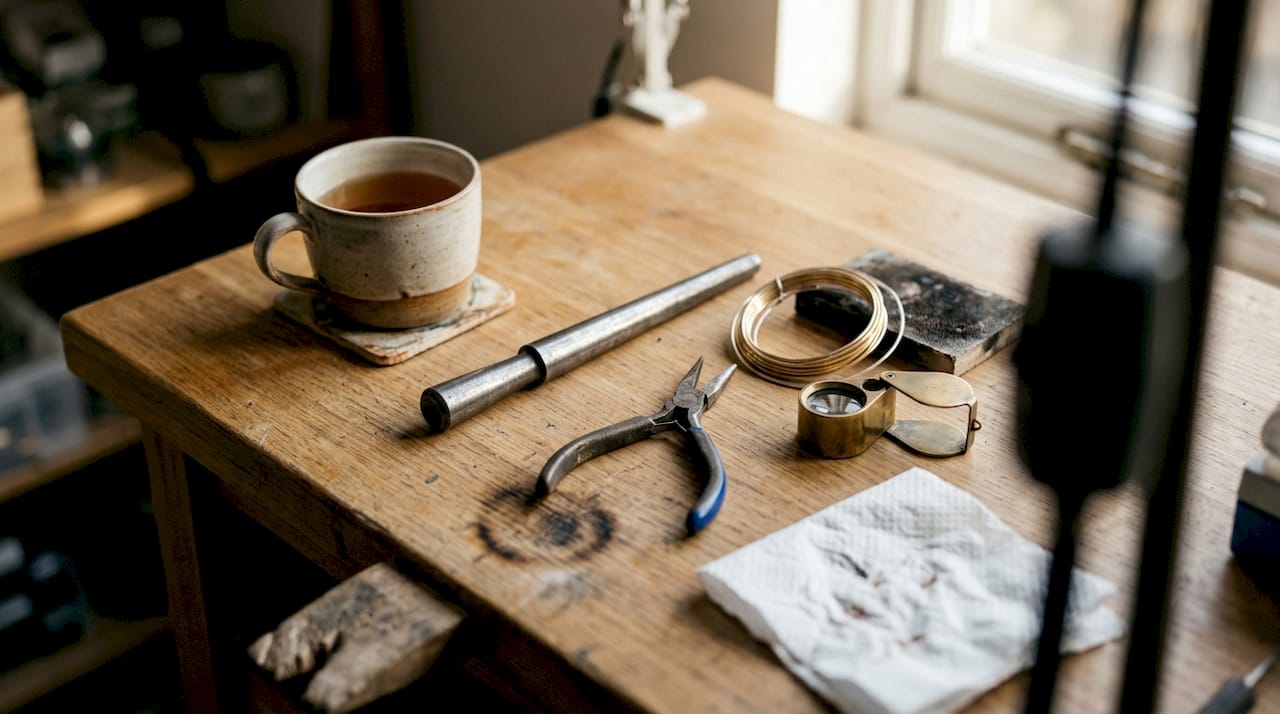
Jewellers use a specific set of tools to carry out ring repairs professionally:
- Ring stretcher and reducer: Used to resize bands without distorting the shape or stressing the metal.
- Soldering torch and solder: Used to fuse cracked or split metal. The solder must match the metal’s carat and composition precisely.
- Setting pliers and burnishers: Used to tighten or reshape prongs and secure gemstones back into their settings.
- Ultrasonic cleaner: Removes debris from crevices before and after repair work, essential for checking stone security.
- Polishing wheel and compounds: Restores surface finish after structural work is complete.
The materials needed will vary significantly depending on your ring. Yellow gold repairs require gold solder matched to the ring’s carat (9ct, 18ct, or 22ct). White gold often needs rhodium plating after repair to restore its bright finish. Silver repairs use silver solder but need careful temperature management to avoid melting. Platinum, which melts at a much higher temperature than gold, requires specialist equipment and skill that not every jeweller possesses.
For gemstone replacement, jewellers source replacement ring components and stones from specialist suppliers, though a reputable jeweller will always try to source a stone that matches the original in cut, colour, clarity, and carat weight.
When it comes to who performs the repair, you broadly have three options in the UK:
| Repair type | Typical provider | Best suited for |
|---|---|---|
| High street chain | National retailers | Simple, standard repairs on modern rings |
| Independent specialist | Local or regional experts | Complex, vintage, second-hand, bespoke pieces |
| Bespoke jeweller | Designer-maker specialists | Custom repairs, restorations, redesigns |
Repair services differ between retail jewellers and independent specialists in the UK, which is an important consideration. High street chains often send repair work to third-party workshops rather than carrying it out in-house, which can add time and reduce accountability. An independent specialist, particularly one with an on-site workshop, gives you direct access to the craftsperson doing the actual work.
For rings with complex histories, such as second-hand pieces with unknown previous repairs or bespoke commissions with unusual metal alloys or settings, in-store repair services from a specialist are strongly preferable. You want someone who will examine the piece thoroughly before starting work, not simply apply a generic repair solution.
If you’re unsure where to start, browsing professional repair options from a trusted independent jeweller can give you a clear sense of what services are available and what each type of repair involves before you commit.
Step-by-step: how jewellers fix broken rings
Knowing what actually happens during a repair makes the whole experience far less daunting. The ring repair process follows specific, careful stages for most types of jewellery, and understanding each one helps you ask the right questions and feel confident about the outcome.
Here is what a typical professional ring repair looks like from start to finish:
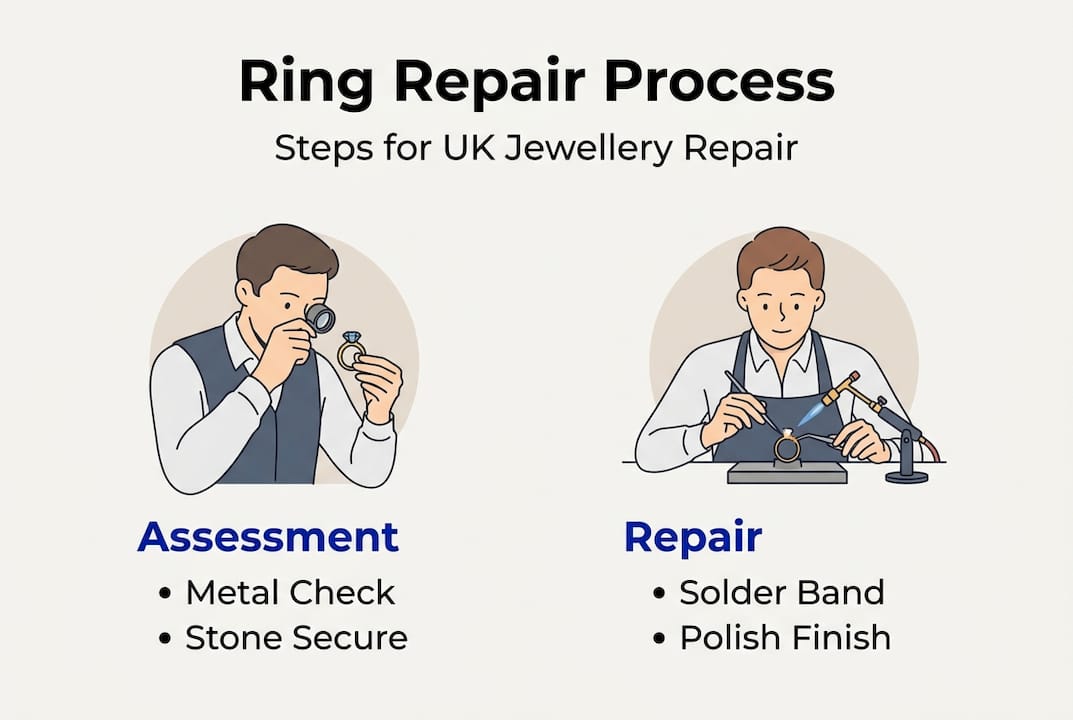
- Initial examination: The jeweller inspects the ring under magnification, checking the metal, settings, stones, and any previous repair work. They’ll look for hidden cracks, metal fatigue, or compromised prongs that might affect the repair plan.
- Cleaning: The ring is cleaned thoroughly, usually in an ultrasonic bath, to remove dirt, grease, and residue. This reveals the true condition of the metal and stones.
- Stone removal (if required): If the repair involves heat, such as soldering, any vulnerable stones are carefully removed first. Diamonds can generally withstand heat, but many coloured gemstones, pearls, and opals cannot.
- Structural repair: This is the core of the process. Cracked shanks are soldered, bent bands are reshaped on a mandrel (a tapered steel rod), broken claws are rebuilt or replaced, and settings are reformed.
- Stone resetting (if required): Once the metal work is complete and cooled, any removed stones are carefully set back into position and secured.
- Polishing and finishing: The ring is polished to restore its surface finish. White gold pieces receive rhodium plating at this stage.
- Final quality check: The jeweller inspects the completed ring under magnification once more, testing stone security and checking all repairs are sound before returning it to you.
Pro Tip: Before leaving your ring for repair, ask the jeweller to note any pre-existing condition issues in writing, including any chips on stones or surface marks. This protects both you and the jeweller and ensures total clarity about the ring’s condition before work begins.
“The best repairs are the invisible ones. When a jeweller truly knows their craft, you should not be able to tell the ring was ever damaged at all.”
A poorly executed repair, particularly a shoddy solder join or an improperly set stone, can actually reduce a ring’s structural integrity rather than restore it. This is why choosing the right craftsperson matters so much, especially for second-hand or bespoke pieces where the metal may have unusual characteristics or previous repairs.
What to expect after a ring repair and how to verify quality
Collecting your repaired ring should feel like a satisfying moment, but it’s also the right time to carry out a few important checks before you walk out of the door. A well-repaired ring should return to daily wear and retain its value, and any reputable jeweller will welcome your questions at the point of collection.
What to check when you collect your ring:
- Inspect the repair site in good light. There should be no visible solder lines, discolouration, or gaps in the metal.
- Check all stones are present, secure, and undamaged. Wiggle them gently with your fingernail to confirm there’s no movement.
- Confirm the ring shape is symmetrical and sits correctly on your finger.
- Ask whether any additional work was identified during the repair that might need attention in future.
| Quality indicator | Good repair | Poor repair |
|---|---|---|
| Solder joint visibility | Invisible when polished | Visible line or colour difference |
| Stone security | No movement when tested | Slight wobble or looseness |
| Surface finish | Smooth and consistent | Scratches, pitting, or dull patches |
| Ring shape | Perfectly round | Slightly oval or uneven |
| Metal colour | Consistent throughout | Discolouration near repair site |
Once you’re happy with the repair and have the ring back home, ongoing aftercare makes a significant difference to its longevity. Store your ring separately from other jewellery, since harder stones like diamonds can scratch softer metals and gems. Remove your ring before cleaning, gardening, or doing physical work. Clean it gently at home using warm water and a soft toothbrush every few weeks.
Book a professional inspection once a year. Many jewellers, including independent specialists, offer free or low-cost check-ups where they’ll test prong security and look for any early signs of wear. Catching a developing problem early is almost always cheaper and simpler than waiting for something to break again.
If a problem does reappear shortly after a repair, return to the jeweller who carried out the work promptly. Most reputable jewellers will address genuine repair failures without charge. The key is not to delay, since continued wear on a compromised ring can turn a minor issue into a much more significant problem.
For more guidance on ring repair outcomes and what the process looks like at different stages, it’s worth reading up before your first appointment so you arrive informed and ready.
What most advice misses about repairing rings in the UK
Most online guides treat ring repair as a purely mechanical process: take it in, pay the fee, collect it a week later. But there’s a dimension that rarely gets discussed, and it matters enormously if your ring is second-hand, bespoke, or simply old.
Older rings often benefit more from skilled repair than new mass-produced pieces do. A well-made vintage ring with a thick shank and a hand-cut stone is structurally worth investing in. A modern high-street ring with thin gold plating over base metal may not be. The true value of repairs lies not just in the cost of the work but in what the ring is worth, both financially and sentimentally, once restored.
Not all repairs are equal, and that’s something the industry doesn’t always say loudly enough. A generic workshop applying a standard solder fix to a Victorian-era ring with a non-standard alloy can do real damage. A specialist who regularly works with antique and second-hand pieces will approach the same ring with entirely different care, tools, and materials.
If your ring has a story, choose someone who understands that.
Find the right UK jeweller for your ring repair
Getting a broken ring repaired well means finding someone with genuine craft skills, the right equipment, and real accountability for the work they carry out.

At Blackwell Jewellers, our in-house team has repaired thousands of rings across Kent and for customers nationwide, including complex second-hand pieces and intricate bespoke commissions. Our jewellery repair specialists are equipped to handle everything from simple band soldering to full stone replacement and restoration. If you’re exploring your options beyond repair, our collection of second-hand rings offers authenticated, hallmarked pieces ready to wear, and our bespoke jewellery services can bring an entirely new vision to life. Whatever your ring needs, we’re here to help.
Frequently asked questions
Can all types of broken rings be repaired in the UK?
Most broken rings, including gold, silver, and gemstone settings, can be professionally repaired in the UK, although the method and cost will vary depending on the metal, the damage type, and the complexity of the setting.
How much does it typically cost to fix a broken ring?
Jewellery repair costs in the UK depend on metal and complexity, but a basic repair such as a simple solder join often starts from around £30, with more complex restorations running considerably higher.
How long does ring repair take in the UK?
Repair times generally range from a few days to a week, with most standard repairs completed within three to seven working days depending on the jeweller’s current workload and the complexity of the job.
Is it safe to repair valuable or antique rings?
Yes, but you should choose a jeweller with proven experience in second-hand and bespoke pieces. Specialist jewellers are recommended for valuable or antique rings because they understand the unique alloys, settings, and structural characteristics that older pieces often present.
What should I do if my ring breaks again after repair?
Return to the jeweller who performed the repair as soon as possible. Aftercare and warranty support are important for follow-up issues, and a reputable jeweller will investigate whether the original repair has failed or whether a new problem has developed.