
If you need a figure an insurer or HMRC will actually accept, book an in-person appointment with an IRV or JVA-registered valuer. Expect £75 to £125 for the first item, roughly one to two weeks’ turnaround, and a certificate that states clearly whether it’s an insurance, probate, or resale figure.
TL;DR:
- Valuations for insurance, probate, and resale are based on distinct figures: replacement value for insurance, open market value for probate, and realisable value for resale.
- Genuine valuation must be performed by IRV- or JVA-registered valuers, who physically inspect the jewellery and hold professional indemnity insurance.
- The cost typically ranges from £75 to £125 for the first item, with a turnaround of one to two weeks, depending on the complexity and time of year.
- Certificates must include detailed descriptions, valuation basis, hallmarks, gemstone specifics, and photographs to be accepted by insurers and HMRC.
- Grouping multiple items into one appointment can save costs, and credentials verification should be prioritized over convenience when selecting a valuer.
Table of Contents
- Finding jewellery valuation near me: insurance, probate or resale?
- Who can provide a valid valuation: memberships, qualifications and red flags
- What does a jewellery valuation cost and how long does it take?
- What must a jewellery valuation certificate include?
- How to choose and book a jewellery valuer
- Blackwell Jewellers’ approach to inspection and reporting
- Why most people book the wrong valuation first
- Book your jewellery valuation with Blackwell Jewellers
- Where to verify a valuer’s credentials
- Sources
Finding jewellery valuation near me: insurance, probate or resale?
Most people searching for jewellery valuation near me don’t actually know which type they need. That’s the first mistake, and it costs money.
There are three distinct bases of value, and they’re not interchangeable. Replacement value (used for insurance) is what it would cost to buy an equivalent piece new, at full retail, today. Open market value (used for probate) is what the item would realistically fetch if sold between a willing buyer and seller, neither under pressure. Realisable value (used for resale) is what a dealer or auction house will actually pay you for it, which is usually the lowest figure of the three.
The gap between insurance and probate figures is not small. Insurance valuations typically come in 30 to 50% higher than probate valuations for the exact same piece, because one assumes retail replacement and the other assumes a realistic sale. Executors who reuse an old insurance certificate for probate risk overstating the estate to HMRC, which can trigger unwanted scrutiny.
- Homeowner insuring a ring: needs replacement value, updated every few years as gold and diamond prices shift.
- Executor settling an estate: needs open market value only, itemised, proportionate to HMRC thresholds.
- Seller wanting cash: needs realisable value, which a valuation certificate won’t give you. This is where a dealer’s resale assessment matters more than a formal report.
If you’re managing an estate and also want to insure a few sentimental pieces you’re keeping, ask for both figures in the same appointment. Most valuers will do this for a modest extra fee rather than charging you twice.
Who can provide a valid valuation: memberships, qualifications and red flags
Not anyone with a jeweller’s loupe can issue a valuation an insurer or HMRC will honour. Look for membership of the Institute of Registered Valuers (IRV) or the Jewellery Valuers Association (JVA), ideally backed by a Gem-A gemmology qualification. These bodies set codes of conduct, and crucially, those codes prohibit valuing jewellery from photographs alone. A physical inspection lets the valuer check hallmarks, test metal purity with XRF analysis, and examine stones under magnification, none of which a phone photo can replicate.
Large insurers sometimes go further and specifically require an IRV or JVA-registered valuer once a piece passes a certain value threshold, so checking credentials before you book isn’t optional if you’re insuring anything significant.
Before booking, verify:
- The valuer’s membership number, checkable directly with IRV or JVA.
- Confirmation they hold professional indemnity insurance.
- A sample report you can review for clarity and completeness.
- Whether they physically test items or simply “assess by eye.”
Pro Tip: Ask to see the membership number and look it up yourself before the appointment. A genuine valuer will never hesitate, because they check this for a living too.
What does a jewellery valuation cost and how long does it take?
Fees follow a flat structure rather than a percentage of value, which is worth knowing before you’re quoted something odd. Typical UK rates run £75 to £125 for a first item, with each additional piece costing £35 to £65. Watches and complex pieces, especially anything with moving parts or unusual gem settings, often run £100 to £130 or more.
Roughly one in three UK valuers publish fixed, per-item pricing rather than quoting on request, which makes it far easier to compare providers before you commit to an appointment.
- Bringing several items in one sitting reduces the average cost per piece.
- Home visits attract a call-out supplement, reasonable for large collections but unnecessary for a single ring.
- Event days, often run in partnership with retailers, can be cheaper but rarely include full laboratory testing.
- Turnaround is usually one to two weeks, extending during December and pre-tax-year-end periods when probate work spikes.
What must a jewellery valuation certificate include?
A certificate is only as good as what’s written on it. If it’s missing key details, insurers and HMRC can both reject it, which defeats the entire purpose of paying for one.
Every valid certificate needs:
- The valuer’s name, qualifications and membership number.
- The date of inspection.
- A clear statement of the basis of value (insurance, probate, or open market).
- A detailed description: metal type, hallmarks, gemstone specifics, measurements and weight.
- Photographs of the item, ideally including any hallmark close-ups.
Insurance reports tend to carry more descriptive gemmological detail, since replacement depends on sourcing an identical equivalent. Probate reports can be leaner, focused on open market comparables rather than exhaustive stone-by-stone identification, which keeps costs proportionate for routine estate items. Our own guide on what a certificate actually needs to say breaks this down further.
| Report element | Insurance valuation | Probate valuation |
|---|---|---|
| Basis of value | Replacement cost | Open market value |
| Detail level | High gemmological detail | Concise, comparable-focused |
| Typical use | Renewing home contents cover | HMRC estate reporting |
| Common omission to challenge | Missing hallmark reference | Missing date of inspection |
Digital certificates are increasingly accepted by insurers, but always keep a printed copy too. Some older insurance policies still specify paper documentation.
How to choose and book a jewellery valuer
Booking shouldn’t feel like guesswork. Run through this before you pick up the phone.
- Confirm credentials (IRV, JVA, Gem-A) and professional indemnity insurance.
- Ask whether they’ve handled probate or insurer-specific reports before, not just general resale.
- Request a sample report to check clarity and completeness.
- Ask directly: “What basis of value will this be, and can you combine insurance and probate figures in one visit?”
- Confirm the fee structure, including any home visit supplement.
- Ask about turnaround time and whether it changes during busy periods.
Bring receipts, any previous valuations, original boxes, and serial numbers if the piece has them, particularly for watches. Provenance documents matter more for probate than people expect, since they help support the open market figure HMRC will accept.
Grouping items into one appointment is the simplest way to bring the average cost down, and it saves you booking separate slots for pieces that could easily be assessed together.
Blackwell Jewellers’ approach to inspection and reporting
Blackwell Jewellers has been trading for over 20 years across our Kent stores in Maidstone, Gravesend and Bexleyheath, and every piece that passes through our workshop, new or pre-owned, gets the same scrutiny.
Every item is physically inspected, hallmark-checked, and authenticated by an in-house jeweller before it’s photographed or documented. That’s not a courtesy step. It’s what separates a defensible report from a guess.
Our valuation workflow mirrors this: physical inspection first, hallmark and metal purity checks, provenance review where documents exist, then a photographed report structured to state clearly whether the figure is for insurance, probate or resale purposes. If you’re weighing a valuation against an outright sale, our piece on how gold jewellery is valued when sold explains where those figures diverge.
Why most people book the wrong valuation first
The conventional advice on this topic treats “getting it valued” as a single, generic task. It isn’t. The real failure point isn’t finding a valuer at all, it’s booking an appointment without deciding which figure you actually need first, then discovering the report doesn’t fit its purpose.
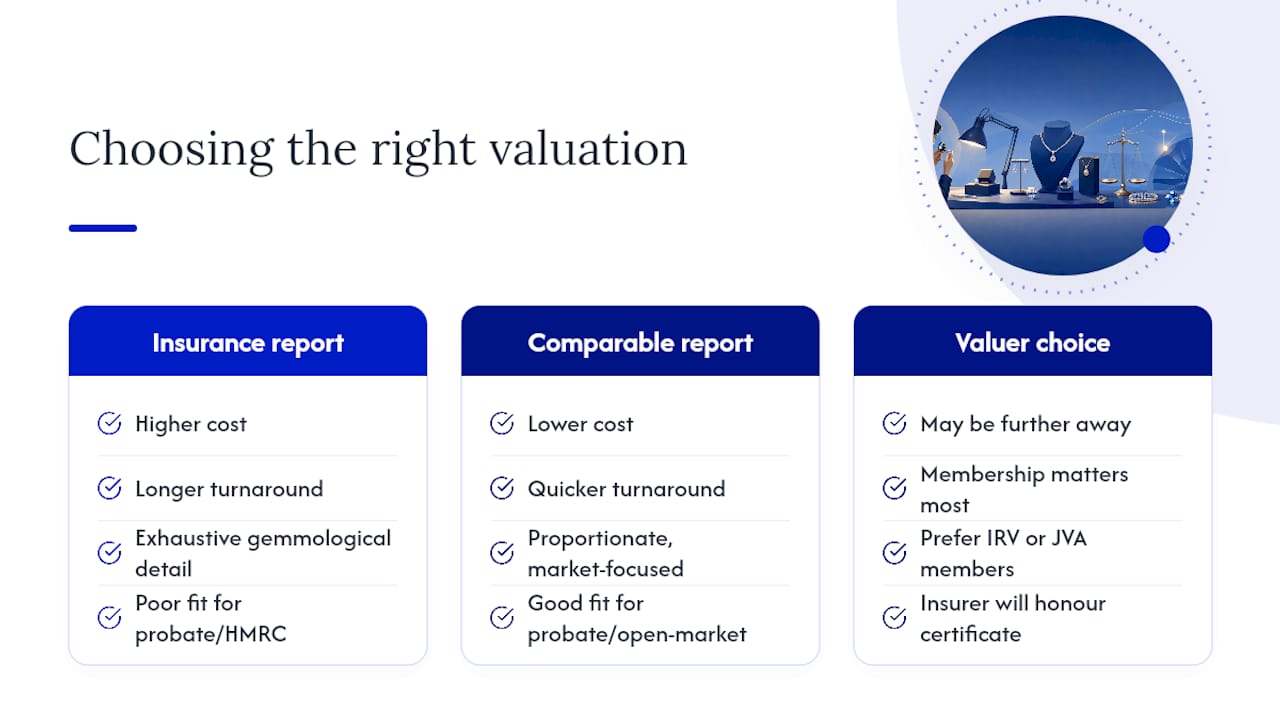
Executors are the group most exposed here. A full insurance-style report with exhaustive gemmological detail is often the wrong purchase for routine probate items. It costs more, takes longer, and HMRC doesn’t need that level of granularity for an open market figure. A proportionate, comparable-focused report does the job better and cheaper.
The other overlooked point: credentials matter more than proximity. A “jewellery valuation near me” search optimises for convenience, but an IRV or JVA-registered valuer twenty minutes further away will produce a certificate your insurer actually honours. Prioritise the membership check over the map pin. Everything else, fees, turnaround, paperwork, sorts itself out once you’ve got that right.
— James
Book your jewellery valuation with Blackwell Jewellers
Once you know which figure you need, booking is straightforward. Visit one of our Kent stores in Maidstone, Gravesend or Bexleyheath for an in-person appointment, or start with an online enquiry if you’d rather arrange drop-off first.

Every Blackwell report states its basis of value clearly, whether that’s insurance replacement cost, probate open market value, or a resale assessment, and includes full photographs and hallmark detail so it stands up to scrutiny. If your valuation reveals a piece needs restoration before insuring or selling, our jewellery repairs service handles that in-house, by the same jewellers who inspected it. And if you’re exploring resale rather than insurance, browse our authenticated second-hand collection to see how genuinely inspected pieces are priced and presented. Call ahead or use our online enquiry form to book your appointment and get a fee quote before you arrive.
Where to verify a valuer’s credentials
- Institute of Registered Valuers (IRV): the primary membership directory for checking a valuer’s registration status.
- Jewellery Valuers Association (JVA): a second accreditation body worth cross-checking, especially for probate specialists.
- Birmingham Assay Office: runs a nationwide valuation service and partner event days, useful for lower-cost in-person assessments.
Always confirm membership numbers directly before booking, and check event day listings if you want a cheaper first-item assessment.
Sources
- IASVC — prices
- Understanding the difference — Swift Values
- How to read a jewellery appraisal report — Louis Martin blog
- Birmingham Assay Office — jewellery valuations