

Choosing a ring finish is one of those decisions that sounds minor until you realise you’ll be looking at your hand every single day. Here’s the quick shortlist of the main ring finish types, with a one-line steer on each:
- High polish (mirror): Brilliant, reflective, classic. Best for: formal occasions and those who love a bright, clean look.
- Satin / fine matte: Soft, low-sheen, understated. Best for: daily wear where you’d rather not see every tiny scratch.
- Coarse matte: Noticeably textured, contemporary. Best for: modern styles and low-maintenance wearers.
- Brushed (linear): Directional grain, subtle shimmer. Best for: people who want texture without going full artisan.
- Hammered: Irregular facets, artisanal character. Best for: active lifestyles and anyone who hates the idea of a ring looking “worn.”
- Sandblasted / stardust: Micro-textured sparkle. Best for: two-tone accents and subtle light-catching effects.
- Florentine / machine pattern: Fine cross-hatched precision. Best for: two-tone work and vintage-influenced designs.
- Combination / edge treatments: Matte centre with polished bevel, millgrain edges. Best for: couples who want the best of both worlds.
The sections below cover how each finish looks up close, how it ages with daily wear, which metals it suits, and how to care for it properly.
Key takeaways
The single most practical decision you can make is to match your finish to your lifestyle before you fall in love with a look: a high-polish ring on an active wearer will need professional attention far sooner than a matte or hammered alternative.
| Point | Details |
|---|---|
| Match finish to lifestyle | Active wearers last longer between services with matte, brushed or hammered finishes. |
| High polish needs periodic care | Professional polishing removes a very small amount of metal per session; schedule repolishing at regular intervals for daily-wear rings. |
| White gold requires rhodium | Re-plate white gold every one to two years to maintain colour and surface protection. |
| Combination finishes restore more easily | Choose one dominant finish and one accent so future restoration doesn’t compromise both surfaces. |
| Blackwelljewellers handles it in-house | Repolishing, matte restoration and rhodium plating are all done in our Kent workshops, with a workmanship guarantee. |
Table of Contents
- What are the main ring finish types and how do they look?
- High polish: brilliant, classic and worth the upkeep
- Satin and matte: what’s the difference and which suits you?
- Brushed finish: directional texture that ages gracefully
- Hammered and hand-textured finishes: character that hides a multitude of sins
- Sandblasted, stardust and micro-textured finishes
- Florentine and machine patterns: precision you can see
- Combination finishes and edge treatments: getting the best of both
- Which finishes work best on which metals?
- How do ring finishes age and what maintenance do they need?
- How to choose the right ring finish for your lifestyle
- From our workshop: how Blackwelljewellers makes and restores finishes
- How ring finishes have been used through history
- How your finish choice affects engraving and customisation
- Environmental and ethical considerations in ring finishing
- The finishes we commonly recommend in store
- Bespoke finishes, restoration and inspection at Blackwelljewellers
- Sources
What are the main ring finish types and how do they look?
Kodega’s buyer’s guide to wedding rings lists the core options as mirror (polished), fine matte, coarse matte, hammered, sandblasted and stardust, and that’s a solid working catalogue. The industry term you’ll hear most often is “surface treatment,” though “ring finish” is perfectly understood by any jeweller.
High polish is the most common finish for plain wedding rings. It’s produced by progressively finer abrasives followed by a polishing compound, leaving a mirror-like surface that reflects light cleanly and makes metal colour pop. Yellow gold looks richer; platinum looks almost liquid.
Matte and satin finishes sit at the opposite end. They scatter light rather than reflect it, giving a quieter, more contemporary look. The difference between satin and matte is largely one of degree: satin has a very fine, almost silky texture; matte is more obviously non-reflective. Ideal Bride Magazine describes fine matte (sometimes called silk matte) as soft and non-reflective, while coarse matte has a more pronounced texture.
Brushed finishes use a wheel or pad to draw fine parallel lines across the surface. The grain direction matters: a lengthwise grain on a band reads as sleek and modern; a crosswise grain looks more decorative. Hammered finishes are created by striking the metal repeatedly with a rounded tool, leaving irregular facets that catch light unpredictably. Sandblasted and stardust finishes use abrasive particles or fine tools to create micro-texture across the surface, producing a subtle sparkle that’s quite different from high polish.
High polish: brilliant, classic and worth the upkeep
High polish is what most people picture when they think “wedding ring.” The surface is worked until it reflects like a mirror, emphasising the metal’s colour and making any gemstones look their best.
The trade-off? Scratches show. Every contact with a hard surface leaves a fine mark, and over time those marks scatter light rather than reflecting it cleanly. The ring doesn’t look damaged exactly, but it loses its snap.
The good news is that polishing restores it. DEEVE reports that professional polishing removes approximately 0.1–1 micron of metal per session, so the ring stays intact for many years of periodic treatment. For heirloom pieces, though, keep polishing infrequent to preserve weight and hallmarks over decades.
- High polish suits yellow gold, rose gold, platinum and sterling silver equally well.
- It emphasises gemstone settings by maximising contrast between metal and stone.
- Avoid wearing a high-polish ring during gardening, gym sessions or DIY work if you want to keep it looking sharp between services.
- A professional repolish at regular intervals is reasonable for daily-wear rings.
Pro Tip: Ask your jeweller to polish only the scratched areas rather than the whole ring if the piece has engraving or a combination finish nearby. Blanket polishing can soften fine detail.
Satin and matte: what’s the difference and which suits you?
Satin and matte are often used interchangeably, but they’re not quite the same thing. Satin is the finer of the two: a very light, even texture that gives a soft sheen rather than a flat non-reflective surface. Matte is more obviously textured and absorbs more light.
Then there’s the fine-versus-coarse distinction within matte itself. Fischer Trauringe’s finish lexicon lists variants including ice matte, exclusive matte and friction matte, some of which are engineered specifically for higher resistance. These aren’t just aesthetic choices; the production method affects how long the finish holds its character.
| Finish | Light behaviour | Scratch visibility | Ageing pattern |
|---|---|---|---|
| Satin | Soft, directional sheen | Low | Gradually gains slight polish |
| Fine matte | Diffuse, non-reflective | Very low | Smooths slowly with wear |
| Coarse matte | Flat, absorbs light | Very low | Retains texture longer |
Both satin and matte develop a gentle patina with daily wear. Ideal Bride Magazine notes that fine matte gradually develops a slightly polished look over time, which many wearers actually like. Coarse matte holds its character longer because the texture is deeper.
Pro Tip: If you work with your hands a lot, a coarse matte or an engineered matte variant (like ice matte) will hold its look far longer than a standard fine matte, which can polish out in patches within a year of heavy use.
Brushed finish: directional texture that ages gracefully
A brushed finish is made by drawing an abrasive across the metal in one direction, leaving fine parallel lines. The grain can run lengthwise along the band (the most common approach) or at an angle, and that choice changes the whole feel of the ring.
Lengthwise grain reads as clean and contemporary. Crosswise grain is more decorative and catches light differently as the hand moves. The finish sits somewhere between polished and matte in terms of reflectivity: it has a subtle shimmer, but nothing like the mirror effect of high polish.
How does it age? The grain softens gradually. High-contact areas, particularly the underside of the band, tend to smooth first. Jaume Labro’s guide on how wedding rings age notes that matte and satin surfaces (which include brushed) tend to smooth and become slightly more reflective over time rather than showing discrete scratches.
Restoration is straightforward. A jeweller uses a brushing wheel or pad to reinstate the grain direction, working in one pass to keep the lines consistent. The key is matching the original grain direction exactly, which is why it’s worth noting the orientation when you first buy the ring.
- Brushed finishes suit platinum and white gold particularly well, where the directional texture adds visual interest without relying on colour contrast.
- Yellow and rose gold brushed rings have a warmer, more tactile quality than their polished equivalents.
- Restoration typically takes under an hour for a straightforward band.
Hammered and hand-textured finishes: character that hides a multitude of sins
Hammered finishes are genuinely brilliant for active wearers, and here’s why: the irregular facets mean there’s no single “correct” reflective surface to compare against. A scratch on a hammered ring just… blends in. Ideal Bride Magazine confirms that hammered finishes are popular precisely because the texture disguises knocks and minor abrasions far better than a mirror polish.
The visual effect is striking. Each facet catches light at a slightly different angle, so the ring seems to shift as you move your hand. Bark finishes take this further, mimicking the organic texture of tree bark for a more rustic, artisanal look.
- Hammered finishes work on most metals but look particularly dramatic on yellow gold and platinum.
- Deep hammering limits engraving options: there’s simply less flat surface to work with.
- Stone settings in hammered rings need careful consideration; prong settings can catch on things if the surrounding texture is very pronounced.
- Bark and similar organic textures are almost always hand-applied, which means slight variation between rings.
Pro Tip: When choosing a hammered finish, ask to see both a fine and a coarse version. Fine hammering reads as elegant; heavy hammering reads as rustic. The scale changes the entire personality of the ring.
Sandblasted, stardust and micro-textured finishes
Sandblasted and stardust finishes both create micro-texture across the ring’s surface, but they do it differently. Sandblasting uses fine abrasive particles propelled at the metal, creating a uniform, slightly rough surface. Stardust uses a fine tool to create tiny, evenly spaced indentations that catch light and produce a subtle sparkle.
Kodega notes that micro-textured finishes can look very different in photographs compared to how they appear in person, and this is genuinely worth knowing. Stardust in particular has a quality that cameras struggle to capture. If you’re considering it, see a sample in person before committing.
Both finishes behave similarly in wear: they’re reasonably durable because the texture distributes contact across many small points rather than one flat surface. The downside is that micro-texture traps dirt, skin oils and soap residue more readily than smooth finishes.
- Clean sandblasted and stardust rings with a soft brush and warm soapy water, paying attention to the textured areas.
- Avoid ultrasonic cleaners for stardust finishes, as the vibration can affect the fine surface detail over time.
- Sandblasted finishes suit two-tone designs well, providing contrast against polished sections.
Florentine and machine patterns: precision you can see
The Florentine finish is a fine cross-hatched pattern applied by a specialist engraving tool, creating a surface of tiny intersecting lines. It’s one of the older decorative techniques in goldsmithing, and it reads as distinctly vintage or antique in character.
Machine patterns extend this idea into more geometric territory: engine-turned designs, barleycorn patterns and guilloche work are all produced by precision machinery and offer a level of regularity that hand-applied textures can’t match. Kodega’s finish guide notes that sand matte and similar precision finishes are particularly effective at emphasising colour contrasts in multi-coloured rings, making them a natural choice for two-tone work.
- Florentine finishes suit yellow gold and platinum; they look less effective on very pale metals where the contrast between the lines and the surface is minimal.
- Machine patterns require careful cleaning: a soft brush reaches into the grooves where dirt accumulates.
- These finishes are harder to restore than brushed or matte surfaces and typically require specialist re-engraving.
Combination finishes and edge treatments: getting the best of both
A matte centre with polished bevelled edges is one of the most popular combinations in UK wedding rings right now, and it’s easy to see why. The polished edge catches light and makes the ring look wider and more substantial; the matte centre stays looking fresh longer. You get the drama of high polish without committing the entire surface to it.
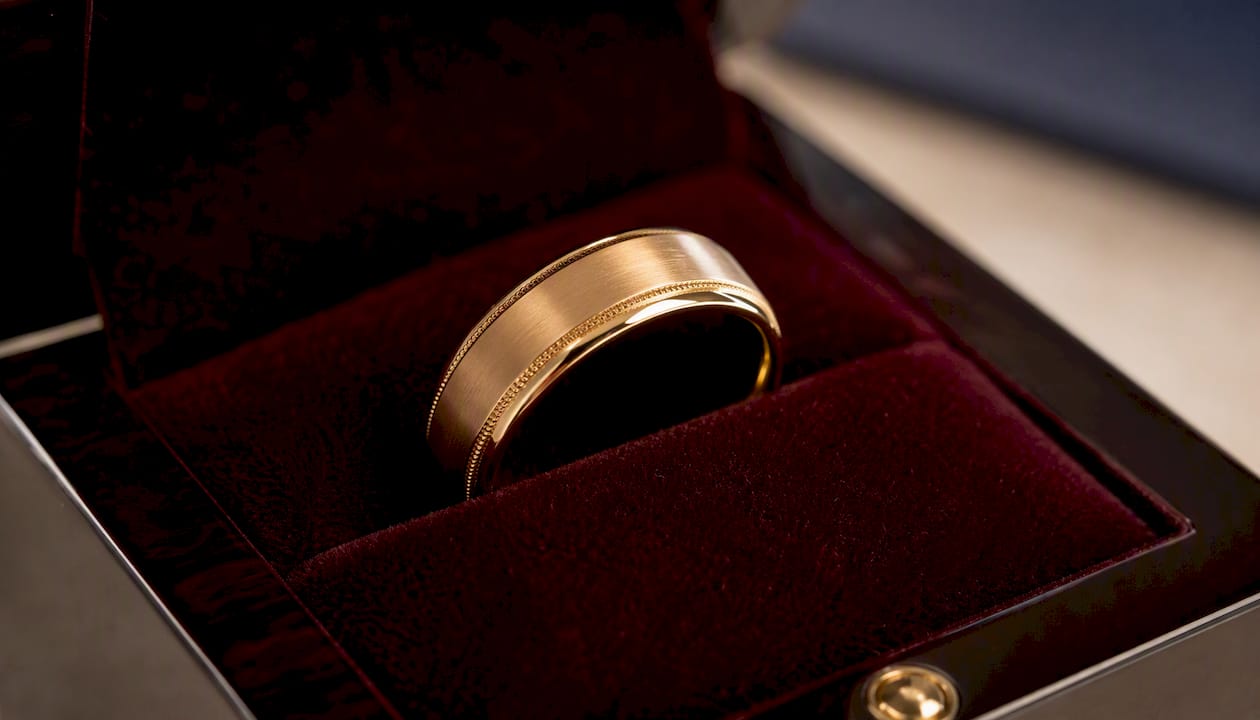
Millgrain edges are a related treatment: a row of tiny beads rolled along the edge of the band, giving a vintage, hand-crafted look. They work particularly well on yellow gold and rose gold, and they pair naturally with satin or matte centres.
Pro Tip: When choosing a combination finish, pick one dominant finish and one accent. A matte centre with polished edges is easy to restore because a jeweller can repolish the edges without touching the matte centre. Reverse it (polished centre, matte edge) and restoration becomes trickier.
A polished interior is worth considering even if the exterior is matte or brushed. It’s more comfortable against the skin and easier to clean. Most jewellers offer this as standard on wider bands.
For matching a combination finish to an engagement ring, the general rule is to echo one element: if the engagement ring has a polished shank, a wedding band with polished edges will sit alongside it naturally.
Which finishes work best on which metals?
Not every finish suits every metal, and hardness plays a big role. Harder metals hold fine textures longer; softer alloys show wear faster regardless of finish choice.
- Yellow gold (9ct, 18ct): Takes all finishes well. High polish on 18ct yellow gold is particularly rich. Softer alloys scratch more readily, so matte or brushed finishes are practical choices for daily wear.
- Rose gold: Polished rose gold is warm and distinctive. Brushed and hammered finishes suit it well; the colour contrast within the texture is appealing.
- White gold: Almost always rhodium-plated to maintain its white colour. Rhodium plating is standard UK practice for white gold and requires periodic re-plating as the coating wears. A polished white gold ring will need re-rhodiation more visibly than a matte one, because the yellow tint of the underlying alloy shows through polished surfaces first.
- Platinum: Harder than gold alloys and develops a natural patina (a slight greyish bloom) rather than scratching. High polish, brushed and hammered all work beautifully. Platinum doesn’t require rhodium plating.
- Sterling silver: Takes all finishes but tarnishes. Polished silver needs regular cleaning; matte silver can look attractive as it oxidises.
- Alternative metals (titanium, tungsten, cobalt chrome): Titanium accepts brushed and matte finishes well. Tungsten is extremely hard and holds a high polish exceptionally well, but cannot be resized or easily refinished by a standard jeweller.
For a deeper look at which finishes are gaining ground by metal type, the metal trends guide at Blackwelljewellers covers current popularity shifts.
How do ring finishes age and what maintenance do they need?
Here’s the honest picture. Jaume Labro’s ageing guide puts it clearly: high polish shows fine scratches and softens over time; matte and satin surfaces smooth gradually and gain a slight sheen; hammered finishes disguise wear better than any other option.
DEEVE’s research on gold wear confirms that professional polishing removes approximately 0.1–1 micron of metal per session. For most rings, that’s negligible over a lifetime of reasonable care. For heirloom pieces polished frequently over decades, it adds up.
Daily maintenance checklist:
- Remove your ring before heavy manual work, swimming in chlorinated water and applying hand cream.
- Clean weekly with warm water, a drop of washing-up liquid and a soft toothbrush.
- Store in a fabric-lined box or pouch when not wearing, away from other jewellery that could scratch it.
- Check the fit and condition every six months; a ring that’s become loose is more likely to knock against surfaces.
- Book a professional inspection annually if the ring has stone settings.
Service intervals (conservative UK guidance):
- Repolish a high-polish ring every two to three years, or when scratches become noticeable.
- Restore a brushed or matte finish every three to five years, or when the texture has visibly smoothed in high-contact areas.
- Re-rhodiate a white gold ring every one to two years for daily-wear pieces; less frequently for occasional wear.
How to choose the right ring finish for your lifestyle
Use this checklist before you commit. It works equally well in store or when ordering bespoke work online.
Decision checklist:
- Lifestyle: Do you work with your hands, exercise regularly or wear the ring 24/7? If yes, lean towards matte, brushed or hammered.
- Metal choice: Have you already chosen the metal? White gold requires rhodium plating, which affects how a polished finish ages. Platinum develops a patina regardless of finish.
- Daily contact: Will the ring sit next to an engagement ring or other jewellery? Mismatched hardness can cause one ring to scratch the other.
- Scratch tolerance: Are you the sort of person who notices every mark? High polish will drive you mad. Hammered or coarse matte won’t.
- Matching other rings: Do you want the wedding band to match or complement an existing ring? Matching engagement and wedding rings is easier when you echo one finish element rather than trying to replicate the whole look.
- Maintenance budget: Are you happy to bring the ring in for periodic servicing? High polish needs it more often than matte or hammered.
Questions to ask your jeweller:
- What does resurfacing this finish cost, and how long does it take?
- Will rhodium plating be needed, and how often?
- How will engraving interact with this finish? (Textured surfaces limit legibility.)
- Can the edges be repolished independently of the centre finish?
A typical decision example: A nurse who wears her ring every day, including during shifts, would do well with an 18ct yellow gold band in a coarse matte or brushed finish. It hides daily wear, doesn’t require rhodium plating, and a professional restoration every few years keeps it looking intentional rather than tired. For a broader guide to the whole selection process, the Blackwelljewellers wedding band guide covers everything from width to metal choice alongside finish.
From our workshop: how Blackwelljewellers makes and restores finishes
At Blackwelljewellers, every finish we apply or restore goes through a consistent in-house process. For repolishing, we work through progressively finer abrasive stages before a final polish compound, checking the surface under magnification at each stage. Brushed and matte finishes are reinstated using dedicated wheels and pads, always matching the original grain direction. Rhodium plating for white gold is carried out in-house using a controlled electrolytic bath, with the coating thickness checked before the piece is returned. Typical turnaround for a straightforward repolish or rhodium replate is three to five working days; more complex restoration work on bespoke or heavily worn pieces takes longer and is quoted individually.
Our in-house capabilities include:
- Hand finishing and machine brushing for new bespoke commissions
- Repolishing and matte/satin restoration for existing rings
- Rhodium plating and re-plating for white gold pieces
- Full inspection and hallmark check before any piece is returned
For a closer look at what bespoke in-house finishing actually involves, the Blackwelljewellers bespoke ring case study shows the process from start to finish. All restoration and repair work is backed by our workmanship guarantee.
How ring finishes have been used through history
Ring finishes aren’t a modern invention. High polish has been the dominant choice for precious metal rings since antiquity, partly because the tools to achieve it (progressively finer abrasives, leather strops, polishing compounds) have existed for thousands of years. A mirror-bright ring signalled wealth and craftsmanship in equal measure.
The Florentine finish has roots in Renaissance goldsmithing, where engravers developed fine cross-hatching techniques to add texture and visual depth to flat metal surfaces. It remained a mark of skilled hand-work through the Victorian era, when intricate surface decoration was fashionable across all jewellery categories.
Hammered finishes have a longer and more varied history. Hand-forged rings from pre-industrial periods often retained hammer marks as evidence of their making rather than as a deliberate aesthetic choice. The Arts and Crafts movement of the late 19th century reclaimed that quality deliberately, celebrating visible hand-work as a counter to machine production.
Matte and brushed finishes as deliberate choices are largely a 20th-century development, rising with modernist design sensibilities that favoured restraint over ornament. Scandinavian jewellery design from the mid-20th century was particularly influential in establishing the brushed and matte aesthetic that remains popular today.
How your finish choice affects engraving and customisation
This is something a lot of buyers don’t think about until it’s too late. Ideal Bride Magazine points out that very textured or deeply patterned surfaces limit the type and legibility of engraving compared with smooth polished surfaces. A date or message engraved inside a polished band reads clearly for decades. The same inscription on a heavily hammered or deeply textured surface can be difficult to read and harder to execute cleanly.
The practical rules:
- Interior engraving is largely unaffected by the exterior finish, since the inside of most bands is polished regardless. This is the safest option for personal inscriptions.
- Exterior engraving on a polished or fine matte surface works well for initials, symbols or short text.
- Exterior engraving on hammered or coarse matte is possible but requires a skilled engraver and the result will be less crisp.
- Florentine and machine-pattern surfaces are already engraved, in effect. Adding further engraving competes visually and is rarely recommended.
For wedding ring customisation options beyond finish, including width, profile and stone setting, the Blackwelljewellers customisation guide covers the full picture.
Environmental and ethical considerations in ring finishing
Finishing processes aren’t entirely without environmental impact, and it’s worth knowing what’s involved. Polishing compounds, abrasive wheels and the metal swarf produced during finishing all require responsible disposal. Reputable jewellers collect metal dust and swarf for recycling rather than discarding it, since even small quantities of gold or platinum have significant value.
Rhodium plating uses an electrolytic process that involves chemical baths. The rhodium itself is one of the rarest and most expensive metals on earth, mined primarily as a by-product of platinum and palladium extraction. Responsible plating workshops manage their chemical waste carefully and recover rhodium from spent solutions where possible.
Choosing a jeweller who works in-house rather than outsourcing finishing to anonymous third parties gives you more visibility into these practices. It also means the person finishing your ring is accountable to you directly. Bespoke and restored pieces that are finished in-house also tend to generate less transport-related carbon than pieces sent back and forth to external workshops.
If ethical sourcing matters to you across the whole piece, not just the finish, it’s worth asking about the metal’s provenance alongside the finishing process.
The finishes we commonly recommend in store
Honestly? Most daily-wear couples end up happiest with a brushed or matte finish, and I’ve seen this play out over and over. The ring looks intentional rather than worn, the maintenance is minimal, and you’re not wincing every time you catch it on a door handle.
For couples who want matching rings but have different lifestyles, a combination finish often solves the problem neatly. One partner gets a polished edge for the dressy look they want; the other gets a matte centre that suits their active day. Same ring, different emphasis.
High polish is still the right answer for people who genuinely love the look and are prepared to bring the ring in periodically. It’s not a bad choice; it just requires a bit more commitment. Platinum high polish, in particular, develops a beautiful natural patina that many wearers come to prefer over the original mirror surface.
The one finish I’d steer most people away from without seeing a sample first is stardust. It photographs terribly and looks completely different in person. See it in person before you decide.
Bespoke finishes, restoration and inspection at Blackwelljewellers
Getting the finish right on a ring you’ll wear every day is worth doing properly. At Blackwelljewellers, our Kent workshops handle bespoke finishing, repolishing, matte and brushed restoration, and rhodium plating entirely in-house, with no outsourcing and a workmanship guarantee on every job.

Whether you’re commissioning a new ring and want to see finish samples before you commit, or you’ve got an existing ring that needs its surface restored, we can help. Typical turnaround for repolishing and rhodium re-plating is three to five working days. Bespoke finishing on a new commission is quoted individually based on the work involved.
Book a jewellery repair or restoration appointment online or visit us in Maidstone, Gravesend or Bexleyheath to see finish samples in person. For a completely custom ring with your chosen finish from scratch, the bespoke service in Maidstone is the place to start.
Sources
- Surface overview for wedding rings | Fischer Trauringe
- The Buyer’s Guide to Wedding Rings Part Seven
- How do wedding rings age? - Jaume Labro
- How Gold Jewelry Wears Over Time: Karat, Abrasion & Maintenance | DEEVE
- Choosing Your Wedding Ring finish | Ideal Bride Magazine