
TL;DR:
- Most people assume gold is the obvious choice in jewellery, but silver can often surpass gold in quality and value. Hallmarks are legal guarantees that authenticate precious metals, with specific marks indicating purity and assay locations in the UK. Prioritizing authentic, hallmarked pieces over mere appearance ensures confident, lasting jewellery investments.
Let’s be honest. Most people walk into a jewellery shop (or scroll online at midnight) assuming gold is the obvious winner. More glamorous, more valuable, more… everything. But that assumption can cost you. A lot. Because in the UK jewellery market, a beautifully crafted sterling silver ring with a clean hallmark can outshine a shoddy gold-plated necklace on every single measure that actually matters. This guide is going to walk you through hallmarks, metal comparisons, spotting fakes, caring for your pieces, and making genuinely confident choices whether you’re buying pre-owned, commissioning something bespoke, or simply trying to understand what you already own.
Table of Contents
- How to tell real gold and silver: Understanding UK hallmarks
- Head-to-head: Gold vs silver in style, wear, and value
- Spotting fakes, plated, and fine jewellery: Protecting your purchase
- Caring for your gold and silver jewellery for generations
- What truly matters when choosing between gold and silver
- Find your perfect piece or restore your treasure
- Frequently asked questions
Key Takeaways
| Point | Details |
|---|---|
| Authenticity first | Always check UK hallmarks for proof of real gold or silver regardless of price or appearance. |
| Gold vs silver strengths | Gold offers classic warmth and is valued for resilience, while silver stands out for brightness and affordability. |
| Beware of plating | Plated jewellery lacks lasting value and can be unmasked by absence of a hallmark or misleading descriptions. |
| Care ensures longevity | Proper cleaning and professional checks help your jewellery remain valuable and beautiful for generations. |
How to tell real gold and silver: Understanding UK hallmarks
With the foundations set, let’s look at how to tell what you’re really buying — starting with the stamps every authentic piece should carry.
A hallmark is not decoration. It is a legal guarantee. In the UK, the Hallmarking Act 1973 requires that most precious metal items sold as gold, silver, or platinum above a certain weight carry an official hallmark. Without it, a seller technically cannot describe the item as gold or silver. Full stop.
So what does a hallmark actually look like? It is made up of several component marks, and UK hallmark systems use these to let you identify both purity (fineness) and the assay office that tested the item. The assay office mark tells you exactly where the jewellery was independently tested and verified. There are four in the UK: London (leopard’s head), Birmingham (anchor), Edinburgh (castle), and Sheffield (Yorkshire rose). Each has its own distinctive symbol, and that symbol is your extra layer of trust.
Here is a quick reference table to help you decode what you are looking at:
| Metal | Fineness mark | What it means |
|---|---|---|
| Gold | 375 | 9 carat (37.5% pure gold) |
| Gold | 585 | 14 carat (58.5% pure gold) |
| Gold | 750 | 18 carat (75% pure gold) |
| Silver | 925 | Sterling silver (92.5% pure silver) |
| Silver | 958 | Britannia silver (95.8% pure silver) |
| Silver | 999 | Fine silver (99.9% pure silver) |
One huge misconception worth tackling right now: people often confuse gold-plated with solid gold. They are not the same thing. Not even close. Gold-plated jewellery has a thin layer of gold over a base metal (often brass or copper). It looks the part for a while, then it fades, tarnishes, and betrays you. A genuine solid gold piece, properly hallmarked, will carry its value for decades.
“Always check the hallmark before you buy. If a piece has no hallmark, treat it as unverified until proven otherwise.”
You can find a thorough breakdown in our UK hallmarking guide, and if you want to go deeper on exactly what the numbers mean for gold specifically, our gold hallmark standards post covers it in plain English.
Head-to-head: Gold vs silver in style, wear, and value
Now that you can identify the real deal, let’s compare gold and silver head-to-head to help you match metals to your needs and style.
Style and aesthetics
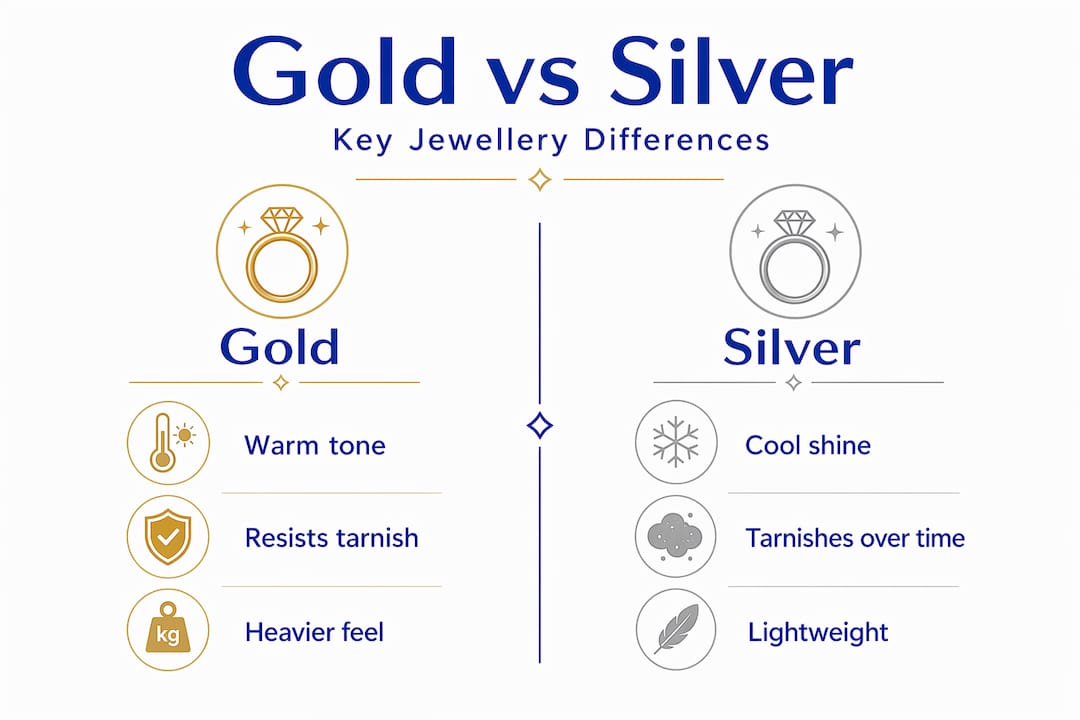
Gold brings warmth. Yellow gold in particular has a rich, almost earthy quality that complements deeper skin tones and pairs beautifully with vintage or antique designs. White gold and rose gold have broadened its appeal significantly over the past two decades, offering cooler tones without leaving the gold camp entirely.
Silver, on the other hand, is crisp, bright, and versatile. It leans contemporary. It works as well with jeans and a jumper as it does with an evening gown. For buyers who want a metal that shifts effortlessly across occasions, silver is often the smarter day-to-day choice.
Neither is objectively better. That is the point.
Durability and everyday wear
Gold is denser and generally more resistant to tarnish. Higher carat gold (18ct and above) is softer though, so it scratches more easily. Lower carat gold (9ct is the most common in the UK) contains more alloy metals, making it harder and more scratch-resistant, though slightly less vibrant in colour.

Silver tarnishes over time when exposed to air and moisture. That dark, oxidised layer people sometimes mistake for permanent damage? It cleans up. Easily. With the right method (more on that shortly), silver restores beautifully and repeatedly.
Here is a quick comparison of practical factors:
| Factor | Gold (9ct) | Gold (18ct) | Sterling silver |
|---|---|---|---|
| Tarnish resistance | High | High | Moderate |
| Scratch resistance | High | Moderate | Moderate |
| UK market resale value | Good | Very good | Variable |
| Best for everyday wear | Yes | With care | Yes |
| Price point | Mid-high | High | Lower |
Purity and what it actually affects
For silver, the common UK fineness standard for jewellery is sterling silver 925 (92.5%); higher-purity Britannia silver is 958 (95.8%). The difference in purity affects both the metal’s feel and its suitability for particular types of jewellery. Britannia silver is softer, so it is more common in flatware and decorative pieces than in everyday rings.
For gold, the difference between 9ct and 18ct is not just purity. It is feel, weight, and even how a piece ages. 18ct gold has a deeper, richer colour. 9ct gold, while more affordable, is technically a gold alloy where less than half the metal is actually gold.
Pro Tip: Always ask whether a piece is solid or plated before you buy. If the seller cannot answer that instantly, that tells you something. Reputable sellers (hi, that’s us) will have the hallmark details ready and waiting. Check out our guidance on how to maintain gold jewellery to keep your pieces performing their best.
Key things to remember when comparing metals:
- Gold typically holds its resale value better in the UK second-hand market
- Silver’s lower entry price makes it accessible for broader collections
- Neither metal is immune to damage without proper care
- Hallmarked solid pieces of either metal will always outvalue plated alternatives
For tips on keeping both metals looking their best, our guide on cleaning gold and silver is worth bookmarking.
Spotting fakes, plated, and fine jewellery: Protecting your purchase
Once you know which metal suits you, staying vigilant against fakes or misleading labels is essential to protect your investment.
This is where it gets a bit uncomfortable. Because the pre-owned jewellery market (which we love, obviously) does attract its fair share of sellers who are… let’s say, less than transparent. Some genuinely do not know what they have. Others absolutely do.
Here is what to watch for:
-
No hallmark at all. As mentioned above, this is a major red flag. Most UK-sold precious metal pieces above the required weight threshold must be hallmarked. No hallmark means no guarantee.
-
Worn or rubbed markings near joints or clasps. Plated pieces often wear through fastest at stress points, and the base metal shows through. Look closely.
-
Greenish tinge on skin. If wearing a piece leaves a green mark, that is a copper-based base metal reacting with your skin. Gold and silver should not do this.
-
Unusually low price for stated purity. If something is labelled as 18ct gold and costs the same as a coffee, something is wrong.
-
Vague descriptions. Terms like “gold-tone,” “gold-coloured,” or “silver-look” are legal descriptions for non-precious metals. But they are sometimes used to confuse less experienced buyers.
UK hallmark guidance and typical standards assume solid precious metal; when assessing a candidate piece, confirm it is described as solid and hallmarked where required, rather than plated or vermeil.
Quick checks before buying second-hand
Run a quick visual check with a loupe (magnifying glass) if you have one. Look for the fineness mark, the assay office symbol, and the maker’s mark. All three should be present on a properly hallmarked piece.
If buying online, always ask for a close-up photograph of the hallmark area specifically. Any seller worth their salt will provide it without fuss.
Pro Tip: Ask for the full metal description in writing before purchase. If buying second-hand from a private seller, that written description protects you legally.
We have detailed guides on how to identify fake silver and how to spot fake gold if you want the full breakdown with specific tests you can do at home.
Caring for your gold and silver jewellery for generations
Understanding what you own is just the start. Caring for your pieces guarantees they will stand the test of time.
UK hallmark guidance and best practice recommends regular inspection and careful cleaning to preserve both value and shine. This is not just good advice. It is the difference between a piece lasting a lifetime and one that deteriorates within a decade.
Here is what good ongoing care actually looks like:
- Store gold and silver separately. Metals scratch each other. Use individual pouches or compartmentalised jewellery boxes.
- Keep silver in anti-tarnish bags or cloth. Exposure to air and humidity is the enemy. Anti-tarnish strips in your jewellery box make a real difference.
- Clean gently and regularly. Warm water, a drop of washing-up liquid, and a soft toothbrush work brilliantly for most pieces. Avoid ultrasonic cleaners on gemstone settings or antique pieces without professional advice first.
- Take rings off before washing hands, cleaning, or swimming. Chlorine is particularly destructive to gold alloys. Repeatedly soaking silver in harsh chemicals dulls it permanently.
- Check clasps, prongs, and settings periodically. A loose prong is not an emergency until the stone falls out. Then it very much is.
- Polish carefully. Over-polishing can remove metal over time. Use a soft jewellery cloth, not abrasive cloths.
When should you actually call in a professional? If a prong is visibly bent, if a clasp is failing, if a stone looks loose, or if a piece has significant tarnish that home cleaning is not shifting, then it is time. Our resources on expert jewellery care and when to seek professional care give you clear guidance on where the DIY line ends.
For home routines, our guide on how to clean and care for your jewellery is practical, straightforward, and actually useful.
What truly matters when choosing between gold and silver
Here is our honest take. And it might ruffle a few feathers.
The gold-versus-silver debate, when you strip it right back, is often a distraction. People obsess over which metal is “better” and completely overlook the question that actually determines a piece’s worth: is it authentic, is it well made, and does it have a verified history?
We see this regularly. Someone comes in convinced they have a valuable heirloom because it looks like gold. Then we test it. Then we have an awkward conversation. Conversely, someone else dismisses their grandmother’s silver brooch as “just silver,” not realising it is Britannia standard with an Edinburgh assay mark dating back nearly a century. That piece has story, provenance, and genuine worth.
Chasing gold as inherently superior can make you miss extraordinary silver pieces. It can also make you vulnerable to sellers who know you will pay a premium for the word “gold” without checking what they actually mean by it.
What we would encourage instead is this: focus on understanding what you’re buying before you focus on which metal it is. A fully hallmarked, beautifully crafted 9ct gold ring purchased with verified provenance from a trusted jeweller is worth infinitely more than an unmarked “gold” piece bought on a whim from an unknown source.
Solid hallmarking is, genuinely, your best friend in this market. It is the paper trail that protects your investment, authenticates the piece for resale, and connects you to the legitimate chain of craftsmanship that made it. Do not let anyone talk you out of insisting on it.
The real joy of jewellery, whether gold or silver, antique or contemporary, lies in knowing exactly what you have and why it matters. That clarity is what transforms a purchase into a genuine heirloom.
Find your perfect piece or restore your treasure
If this guide has got you thinking about your next purchase (or that box of old jewellery sitting in the drawer), we would love to help. At Blackwell Jewellers, we have spent over 20 years building a collection and a reputation on exactly the principles this article outlines: authenticity, transparency, and genuine craftsmanship.

Every piece in our second-hand jewellery collection is inspected, authenticated, hallmarked, and restored before it reaches you. No guesswork. No vague descriptions. Just verified quality with real provenance. If you want something made specifically for you, our bespoke jewellery design service lets you work directly with our craftspeople to create exactly what you have in mind. And if a beloved piece needs attention, our jewellery repair service covers everything from prong retipping to full restoration. Come and find us in Kent, or browse online anytime.
Frequently asked questions
How can I tell if my jewellery is solid gold or just plated?
Check for a UK hallmark indicating the metal’s fineness. UK hallmark guidance confirms that standards assume solid precious metal; the absence of a hallmark on a piece sold as gold or silver is a strong indicator of plating or misrepresentation.
What are the main purity standards for silver jewellery in the UK?
Sterling silver 925 (92.5%) and Britannia silver 958 (95.8%) are the two most common UK standards, each carrying a distinct hallmark symbol that distinguishes them from one another.
Why is the assay office mark important when buying jewellery?
The assay office mark shows exactly where the metal was independently tested and verified, confirming authenticity through an officially recognised body rather than relying solely on the seller’s description.
Is gold always a better investment than silver?
Not automatically. Investment value depends on craftsmanship, authenticity, condition, and market timing. A solid hallmarked silver piece with strong provenance can hold and grow in value just as reliably as a lower-carat gold piece with no verifiable history.
Recommended
- Best Way To Sell Gold Jewellery in the UK (2025 Guide) – blackwellonline
- Compare the best gold price UK today: Smart buying guide – Blackwell Jewellers
- How Inflation Impacts Gold & Silver: What Buyers Must Know – blackwellonline
- How gold value is calculated when selling: a clear guide – Blackwell Jewellers