
TL;DR:
- Diamond clarity assesses internal imperfections and external blemishes, affecting rarity and price. Eye-clean grades like VS2 and SI1 look flawless to the naked eye, while cut quality has a more significant impact on sparkle. Always verify clarity with independent certification and consider inclusion location when selecting a diamond.
Diamond clarity is the measure of internal imperfections (called inclusions) and external blemishes present in a diamond, assessed by a trained grader under 10× magnification. It is one of the 4Cs of diamond grading, alongside cut, colour, and carat weight, and it directly influences a stone’s rarity and price. The Gemological Institute of America (GIA) developed the standard clarity scale used by jewellers worldwide, running from Flawless all the way down to Included. Understanding diamond clarity does not require a geology degree. It does require knowing what actually matters when you are spending real money on a stone.
What is diamond clarity and how is it graded?
Diamond clarity is formally defined as a grading of the visibility, size, number, position, and nature of a stone’s internal and external characteristics. The GIA clarity scale runs across six categories and 11 individual grades: Flawless (FL), Internally Flawless (IF), Very Very Slightly Included (VVS1 and VVS2), Very Slightly Included (VS1 and VS2), Slightly Included (SI1 and SI2), and Included (I1, I2, and I3). That is a lot of letters, but the logic is straightforward. The higher up the scale, the fewer and less visible the imperfections.
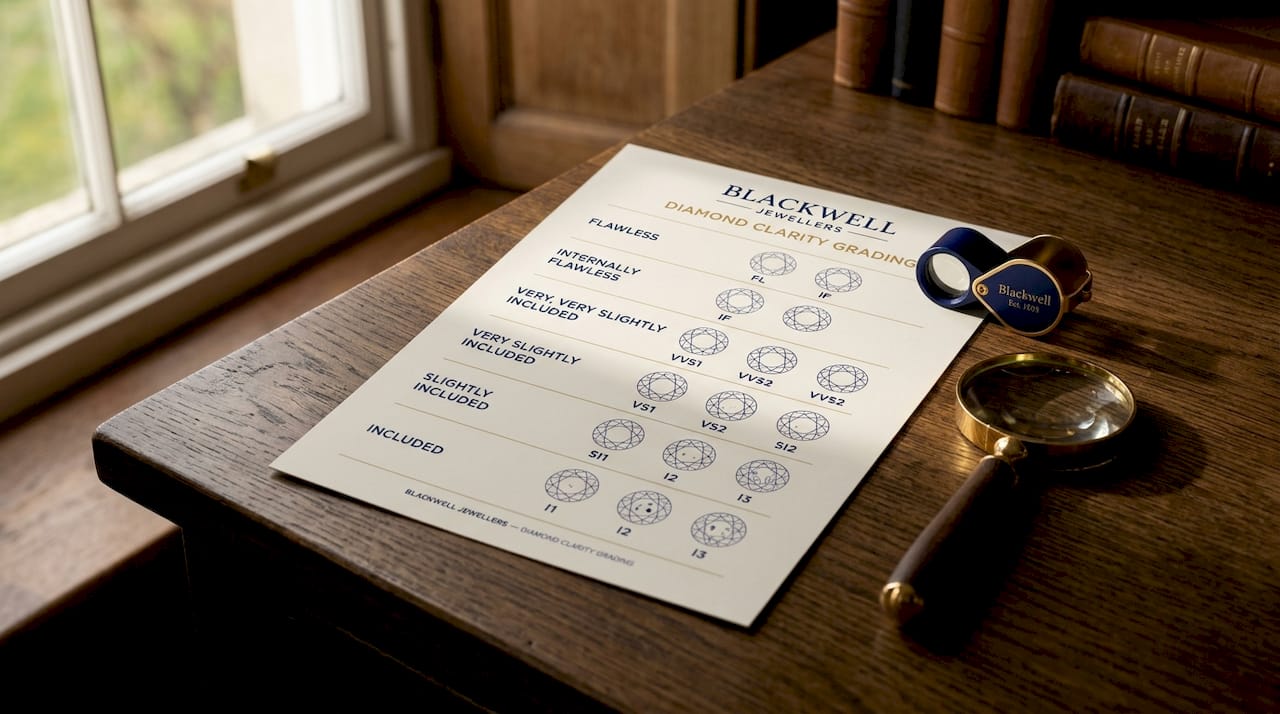
Graders examine every diamond face-up under 10× magnification. They are looking at five specific factors: the size of inclusions, how many there are, where they sit within the stone, what type they are (crystal, feather, cloud, needle, and so on), and how easily they catch the eye. A tiny crystal inclusion buried near the girdle is very different from a large feather fracture sitting dead centre under the table. Both might technically land in the same clarity category, but they behave very differently in real life.
The distinction between inclusions and blemishes matters here. Inclusions are internal. Blemishes are surface features such as scratches or nicks. Graders weigh both, though inclusions carry more weight in the final grade because they are harder to address and more likely to affect the stone’s integrity.
Pro Tip: Ask to see the clarity plot on any grading certificate before you buy. It is a diagram showing exactly where inclusions sit inside the stone. A diamond with a VS2 grade and inclusions clustered near the girdle will look cleaner to the eye than one with the same grade and inclusions under the table.
What does ‘eye-clean’ actually mean for buyers?
Eye-clean is not an official grading term. It is a practical standard that describes a diamond with no inclusions visible to the unaided eye at a normal viewing distance of roughly 25 to 30 centimetres. And honestly, for most buyers, this is the only standard that matters day to day.
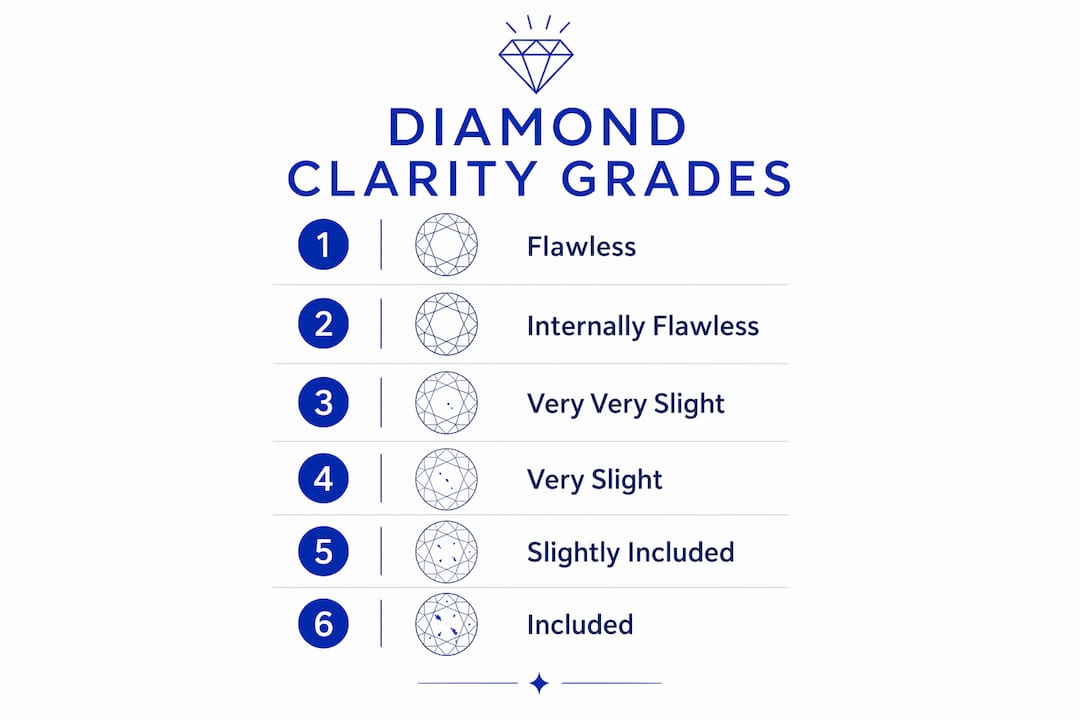
VS1, VS2, and most SI1 diamonds meet the eye-clean standard. I clarity grades (I1, I2, I3) generally do not. Inclusions in I-grade stones are typically visible without any magnification, which affects both the stone’s appearance and, in some cases, its structural integrity. That is a meaningful difference, not a subtle one.
Here is where inclusion position becomes genuinely interesting. Two diamonds with the same clarity grade can look completely different depending on where their inclusions sit. An inclusion near the girdle can be hidden by a prong or bezel setting. An inclusion under the table, right in the centre of the stone, catches light and draws the eye. Same grade on paper. Very different result in the ring.
“The grade on the certificate tells you what a grader saw under magnification. The eye-clean standard tells you what you will actually see when you wear it.” This distinction is the single most useful thing to understand when buying a diamond.
A few practical points on eye-clean buying:
- VS1 and VS2 are reliably eye-clean across almost all shapes and sizes.
- SI1 is usually eye-clean in round brilliants but may show inclusions in step-cut shapes like emerald or Asscher, where the facet pattern is less forgiving.
- SI2 is hit or miss. Always check a high-resolution video or view in person.
- I1 and below are not eye-clean. Full stop.
Pro Tip: For online purchases, always request a high-resolution video of the stone, not just photographs. Photographs flatten inclusions. Video under magnification shows you what the grader actually saw.
Diamond clarity vs cut: which one matters more?
Cut is the most important of the 4Cs for visual brilliance. Full stop. Visual sparkle is more affected by cut than by clarity grade alone. A poorly cut Flawless diamond will look duller than a well-cut VS2. That is not an opinion. It is physics. Cut determines how light enters, reflects, and exits the stone. Clarity determines whether there are imperfections in the path of that light.
This matters enormously for budget decisions. Many buyers instinctively chase high clarity grades because “fewer flaws” sounds obviously better. But overspending on clarity beyond eye-clean ranges delivers differences visible only under magnification, not to the naked eye. That money is almost always better spent on cut quality, which you will see every single day.
Here is how the 4Cs stack up in terms of visual impact and price sensitivity:
| The 4Cs | Visual impact | Price sensitivity | Buying priority |
|---|---|---|---|
| Cut | Highest. Determines brilliance and fire. | High. Excellent cut commands a premium. | Prioritise this above all else. |
| Colour | High in larger stones. Less visible in smaller ones. | High. Each grade step affects price noticeably. | Balance with clarity for your budget. |
| Clarity | Moderate. Eye-clean grades look identical to Flawless. | Moderate. Big jumps at FL/IF; smaller below VS2. | Stop at eye-clean. Do not overspend. |
| Carat weight | High. Size is immediately visible. | Very high. Price increases sharply at round numbers. | Choose slightly below round weights (0.9ct vs 1ct). |
You can explore how these factors interact in more depth in the 4Cs guide for UK buyers from Blackwell Jewellers. The short version: cut first, then colour and clarity together, then carat.
How to inspect and verify diamond clarity before you buy
Buying a diamond without an independent grading report is like buying a used car without a service history. You might get lucky. You might not. Here is a sensible process for assessing clarity with confidence.
-
Request an independent grading certificate. GIA and AGS (American Gem Society) are the most respected labs. A retailer’s own grading is not a substitute. Independent certification protects you from inflated grades and undisclosed treatments.
-
Read the clarity plot. The certificate includes a diagram of the stone with inclusion locations marked. Cross-reference this with the actual stone or video. An inclusion shown near the girdle is far less problematic than one shown under the table.
-
Check for treatments and enhancements. Laser drilling and fracture filling are legitimate treatments but they must be disclosed. A reputable certificate will flag these. If a stone has been clarity-enhanced, the price should reflect that.
-
Use high-resolution video for online purchases. Photographs are not sufficient for clarity assessment. A 360-degree video under magnification shows inclusions that photos hide. Reputable online retailers provide this as standard.
-
Verify the certificate digitally. QR-enabled certificates that link directly to a lab’s database are increasingly common in 2026. Scan the code and confirm the report number matches the lab’s records. This takes 30 seconds and eliminates the risk of a forged certificate.
-
Ask about the setting’s impact on clarity. If you are buying a loose stone to be set, discuss inclusion location with your jeweller before choosing a setting style. A bezel or pavé setting can mask girdle inclusions effectively.
For a step-by-step approach to the full buying process, the diamond selection guide for UK buyers from Blackwell Jewellers covers this in practical detail.
How to choose the right clarity grade for your budget
The goal is not the highest clarity grade you can afford. The goal is the best-looking stone you can afford. Those are different targets, and confusing them costs people real money.
Here is a practical framework:
- For engagement rings in round brilliant cut: VS2 or SI1 is the sweet spot. Both are reliably eye-clean, and the round brilliant’s facet pattern masks minor inclusions brilliantly. You will not see the difference between VS2 and VVS1 without a loupe.
- For step-cut shapes (emerald, Asscher, baguette): Go VS1 or higher. The open, mirror-like facets of step cuts show inclusions far more readily than brilliant cuts. This is not the place to economise on clarity.
- For smaller stones under 0.5ct: SI1 is often perfectly fine. Inclusions are harder to see in smaller stones regardless of shape.
- For pre-owned or vintage pieces: Clarity grades may be lower, but the price reflects this. A well-priced SI2 with a good cut can be excellent value, particularly in a setting that masks the inclusions.
The colour and clarity trade-off guide from Blackwell Jewellers is worth reading if you are trying to balance both factors on a fixed budget. The core principle: eye-clean clarity grades offer the best value because clarity premiums above VS2 represent differences only visible under magnification.
Key takeaways
Diamond clarity grades only matter in practice when inclusions are visible to the naked eye. Buying above eye-clean thresholds is spending money on what a loupe can see, not what you can.
| Point | Details |
|---|---|
| Eye-clean is the real standard | VS1, VS2, and most SI1 diamonds show no inclusions to the naked eye. |
| Cut outranks clarity for sparkle | Prioritise an excellent cut before chasing higher clarity grades. |
| Inclusion position changes everything | Girdle inclusions can be hidden by settings; table inclusions cannot. |
| Always get independent certification | GIA or AGS reports protect you from inflated grades and undisclosed treatments. |
| Step cuts need higher clarity | Emerald and Asscher cuts show inclusions far more readily than round brilliants. |
The thing most people get wrong about diamond clarity
Here is my honest take after years of working with diamonds at Blackwell Jewellers: clarity is the 4C that buyers most consistently misunderstand, and that misunderstanding costs them money.
The instinct is understandable. “Flawless” sounds better than “Slightly Included.” Of course it does. But when you are wearing a VS2 round brilliant on your finger, you are not looking at it under a loupe. You are looking at it in daylight, in a restaurant, across a table. And at that distance, a VS2 and a VVS1 are indistinguishable. I have shown both to experienced jewellers without telling them the grades, and they cannot reliably tell the difference with the naked eye either.
What I see far too often is buyers stretching their budget to reach VVS territory and then accepting a mediocre cut to compensate. That is the wrong trade. A well-cut VS2 will outshine a poorly cut VVS1 every single time. Cut is where the magic happens. Clarity is where the marketing happens.
The other thing worth saying: certification transparency has genuinely improved. QR-enabled certificates and digital verification mean you can confirm a stone’s grading report in seconds. Use that. Do not take a retailer’s word for a clarity grade when you can verify it independently in the time it takes to scan a code.
Buy eye-clean. Prioritise cut. Verify the certificate. That is the whole strategy, really.
— James
Explore certified diamonds at Blackwell Jewellers

At Blackwell Jewellers, every diamond we sell comes with full clarity disclosure and, where applicable, an independent grading certificate. Our ethical diamonds in Maidstone are carefully selected across a range of clarity grades, so you can choose a stone that suits your budget and your eye, not just a number on a scale. If you want something completely tailored, our bespoke jewellery service lets you choose your clarity grade, shape, and setting with guidance from our in-house team. Pop into one of our Kent stores in Maidstone, Gravesend, or Bexleyheath, or browse online. We are here to help you spend your money wisely.
FAQ
What is diamond clarity in simple terms?
Diamond clarity measures the presence of internal inclusions and external blemishes in a diamond, assessed under 10× magnification. The GIA scale runs from Flawless to Included across 11 grades.
Which clarity grade is best value for money?
VS1, VS2, and SI1 are generally the best value grades because they are eye-clean to the naked eye while costing significantly less than VVS or Flawless stones.
Does clarity affect how much a diamond sparkles?
Not directly. Cut has the biggest impact on sparkle. Clarity only affects brilliance if inclusions are large enough to interfere with light, which is rare in eye-clean grades.
Can a setting hide diamond inclusions?
Yes. Inclusions near the girdle can be masked by prong or bezel settings. Inclusions under the table, at the centre of the stone, are much harder to conceal.
Do I need a certificate to buy a diamond?
An independent grading report from GIA or AGS is strongly recommended. It confirms the clarity grade, discloses any treatments, and protects you from misrepresentation.
Recommended
- Step-by-step diamond selection: A practical guide for UK buyers – blackwellonline
- Diamond clarity guide UK: savvy ethical jewellery choices – Blackwell Jewellers
- Do Lab-Grown Diamonds Have the Same Clarity as Natural Diamonds? – blackwellonline
- Colour & Clarity in Diamonds: What’s Worth Paying For? – blackwellonline