

Your ring is not secretly turning back into brass. That yellow tinge is almost always the rhodium plating wearing thin, letting the warmer-toned gold alloy underneath show through. The fix is a rhodium replate, generally requiring periodic maintenance with a jeweller’s inspection first to catch any structural issues before the polishing wheel touches the metal.
TL;DR:
- Most white gold jewelry requires a rhodium replate every few years due to mechanical wear, especially at high-contact points like prongs and shank undersides.
- The yellow or warm tint visible on white gold is caused by the thinning of the rhodium plating, which is a microscopic electroplated coating, not a chemical change in the metal.
- Higher gold content, such as 18ct white gold, tends to show warmth faster and need replating more frequently than 9ct alloy, especially with daily wear.
- Avoid exposure to bleach, chlorine, heavy lotions, abrasive contact, and acidic skin chemistry, as these accelerate rhodium wear and discoloration.
- Regular inspections before replate sessions can catch structural issues early, and switching to platinum or palladium alloys can eliminate the need for periodic rhodium maintenance.
Table of Contents
- Why does white gold turn yellow in the first place?
- The mechanics of rhodium wear: why the “yellowing” isn’t chemical
- How long does the white finish actually last?
- What speeds up the yellowing: chemicals, friction, and skin chemistry
- Restoring the white finish: what a proper jeweller’s process looks like
- How to prevent yellowing and keep white gold looking sharp for longer
- When to see a jeweller before booking a replate
- Is it worth switching to platinum instead of replating?
- A jeweller’s honest view on replating rhythms
- Let Blackwell Jewellers take the guesswork out of replating
- Sources
- FAQ
Why does white gold turn yellow in the first place?
White gold isn’t naturally white. It’s yellow gold blended with paler metals such as nickel, palladium, silver, or zinc, and even a good alloy still carries a faint warm or greyish cast on its own. To get that bright, icy white finish you see in the shop window, jewellers plate the piece with rhodium, a platinum-group metal prized for its brilliant reflectivity and hardness.
Karat matters here too. A 9ct alloy contains less pure gold and more of the whitening metals, so it starts closer to white already. An 18ct piece has far more pure gold in the mix, which means once the rhodium wears away, the base colour shows through warmer and faster. That’s why two rings bought on the same day can age at visibly different rates.
Almost every commercial white gold piece sold today is rhodium plated. It’s not a marketing gimmick, it’s the only practical way to get that showroom whiteness on top of an alloy that would otherwise look slightly off-white or faintly yellow.
The mechanics of rhodium wear: why the “yellowing” isn’t chemical
Here’s the bit most owners never get told at the counter: rhodium plating is measured in microns. It’s a coating thinner than a human hair, bonded to the surface by electroplating, and every single day of wear rubs a tiny bit of it away.
The gold underneath is not oxidising, tarnishing, or reacting with anything. Goldconsul’s guide to white gold discolouration confirms this directly: the colour shift is mechanical exposure, not a chemical change in the metal itself. Nothing has “gone bad.” You’re simply looking at the alloy that was always there, now visible because its coat has thinned.
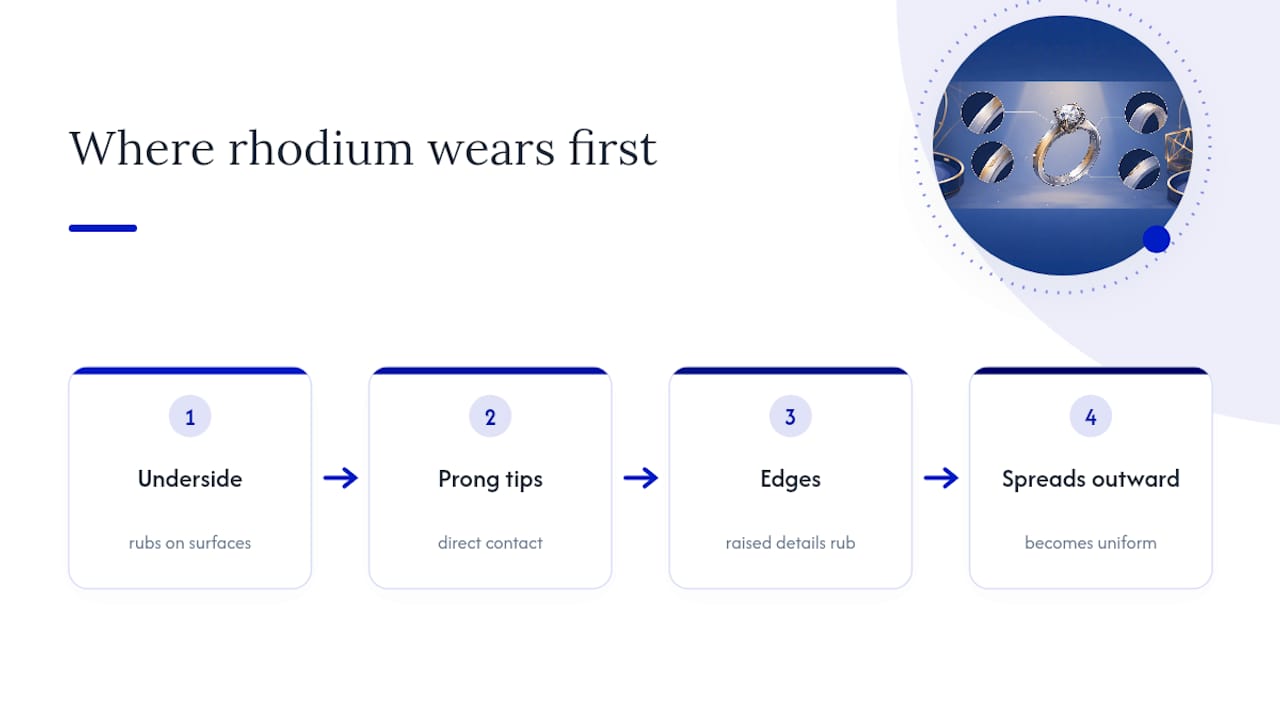
Wear isn’t even across a piece, which is why the change often looks patchy before it looks uniform. The underside of a ring shank, which rubs against desks, steering wheels, and door handles all day, tends to go first. Prong tips holding a stone are another early casualty, since they take direct contact every time you pick something up. Edges and any raised detailing follow the same pattern. If you’ve noticed your ring looking fine from the top but faintly gold along the bottom, that’s rhodium wear doing exactly what it does, starting at the highest-friction contact points and spreading outward.
How long does the white finish actually last?
Most jewellers estimate a period of approximately a few years before a piece needs replating, though the exact timing varies by wear and care. GoldSell’s explainer on how white gold is made puts the standard maintenance cycle in that same bracket, and it lines up with what turns up on a jeweller’s bench week to week.
Karat plays its part, as covered above: higher gold content tends to show warmth sooner. Finish type matters too. A high-polish surface wears differently to a brushed or satin finish, which can hide early wear a little longer simply because it was never mirror-bright to begin with. Then there’s the obvious variable: a ring worn every day doing manual work will outpace a pendant that comes out for dinner twice a month.
What speeds up the yellowing: chemicals, friction, and skin chemistry
Some habits strip rhodium far faster than ordinary wear ever would. The usual suspects are things people don’t think twice about:
- Household cleaning products, particularly anything with bleach or ammonia
- Chlorinated pool water and hot tubs
- Perfume, hairspray, and heavy lotion applied after the jewellery goes on rather than before
- Direct abrasive contact, gym equipment, desks, phone screens, steering wheels
- Highly acidic or alkaline skin chemistry, which varies noticeably from person to person
That last point catches people out. Two people wearing the identical ring can see completely different wear rates purely down to their own skin’s pH and how much they perspire. Brilliant Earth’s guide to rhodium plating lists soaps, lotions, and abrasive contact among the main accelerants worth avoiding if you want the finish to last.
Pro Tip: Run a thumb along the underside of the band once a month. If it feels slightly rougher or looks duller than the top, that’s your early warning that a replate is coming, well before the colour change is obvious to anyone else.
Restoring the white finish: what a proper jeweller’s process looks like
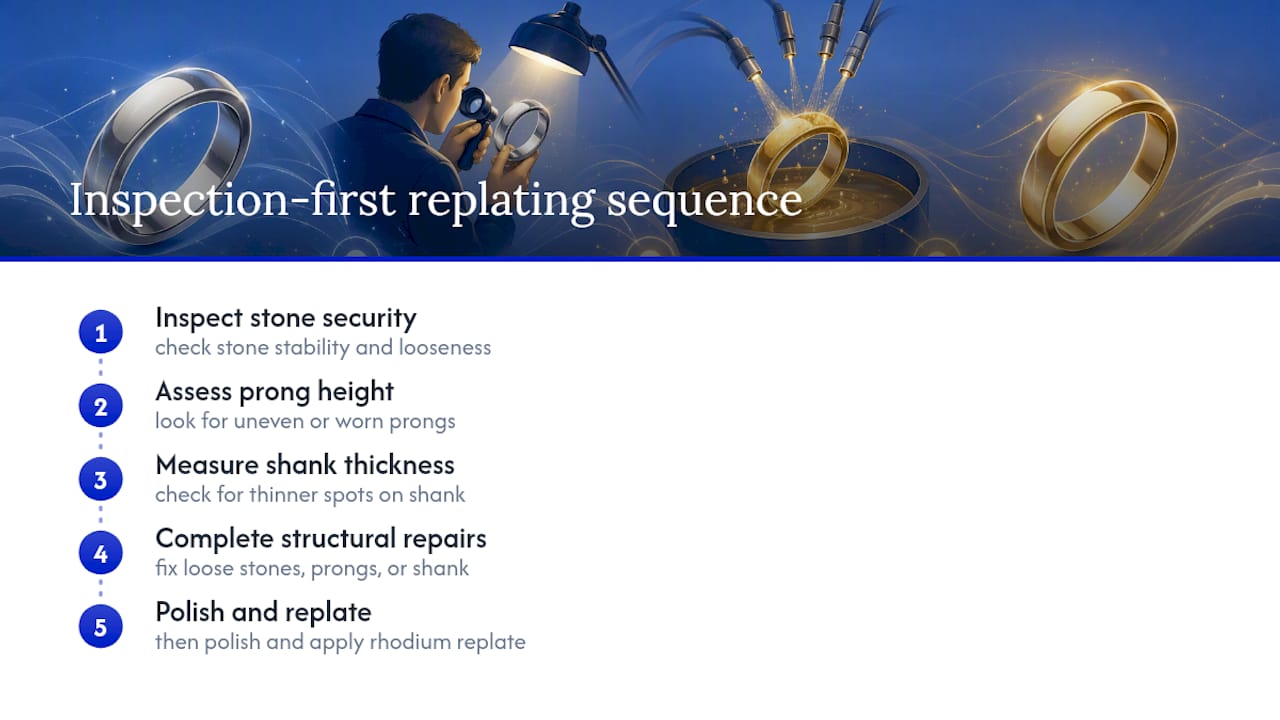
Restoration isn’t just “dunk it in rhodium and hope.” A jeweller doing this properly runs through a set sequence, and skipping steps is how people end up with a shiny ring that’s still structurally weak underneath.
- Inspection first. The jeweller checks for loose stones, worn prongs, and a thinning shank before anything else happens.
- Repairs, if needed. Any structural issues get fixed now. Replating over a weak prong or a paper-thin band doesn’t fix the problem, it just hides it under a fresh coat of shine.
- Polishing. The surface is cleaned and polished to remove scratches and prepare it for an even plate.
- Rhodium electroplating. The piece goes through the electroplating bath to lay down a fresh, even rhodium layer.
Inspection has to come before plating, not after, because a hidden crack or worn prong under a bright new finish is exactly how stones get lost. Restoration restores the look but doesn’t repair underlying wear on its own, which is precisely why the checks matter more than the shine.
Typical replating cycle: most white gold pieces need a fresh rhodium coat every few years, with more frequent replating possible for rings worn daily for manual work.
Cost and turnaround vary with the piece. A simple band takes less time and less rhodium than a large cocktail ring or a setting with lots of prongs and detail to work around, and complex settings naturally push the price up. If a piece needs prong repair or shank reinforcement first, that adds to both the bill and the timeline, which is exactly why a proper quote follows an inspection rather than a guess over the phone.
How to prevent yellowing and keep white gold looking sharp for longer
You can’t stop rhodium wearing altogether, it’s a consumable finish by design, but you can stretch the time between replates considerably with a few habits.
Cleaning:
- Use mild soap and warm water with a soft brush, nothing abrasive
- Rinse thoroughly and dry with a soft cloth, don’t let it air dry with residue on it
- Avoid bleach, chlorine-based cleaners, and anything with grit
Storage:
- Keep each piece in its own soft pouch or lined compartment, harder gems and metals will scratch a plated surface if they’re jumbled together
- Skip the bathroom cabinet, humidity does the finish no favours over time
- A cool, dry drawer beats a steamy shelf every time
Daily habits:
- Take rings off before cleaning, swimming, or gym sessions
- Apply lotion, perfume, and hairspray before putting jewellery on, not after
- If you notice dullness along the underside, that’s your cue to book a check rather than wait for the whole piece to look tired
When to see a jeweller before booking a replate
Not every dull-looking ring just needs a fresh coat of rhodium. If you notice a loose stone, a shank that feels thinner in one spot than another, or prongs wearing unevenly, get those looked at first. Replating over a structural problem just disguises it, it doesn’t fix it.
A proper inspection should check stone security, prong height, and shank thickness before anything goes near the polishing wheel. Keeping a simple record of when a piece was last checked or replated makes the next visit quicker, and it’s worth asking your jeweller to note down what they found. Blackwelljewellers’s guide to replating frequency covers this inspection-first approach in more detail.
Is it worth switching to platinum instead of replating?
If you’re tired of the replating cycle, platinum and palladium are worth a serious look. Both are naturally white, they don’t need rhodium at all, and platinum in particular is notably harder wearing against daily knocks. The trade-off is weight and price: platinum pieces feel noticeably heavier on the hand and typically cost more than an equivalent white gold design.
Palladium-based white gold alloys sit in the middle ground, giving a slightly whiter base colour than nickel alloys without the full cost jump to solid platinum. For an engagement ring worn every single day, that maintenance-free durability can be worth the extra spend. For an occasional-wear piece, sticking with rhodium-plated white gold and a routine replate every couple of years remains the more practical, budget-friendly route. Comparing platinum against gold side by side helps make that call properly.
A jeweller’s honest view on replating rhythms
Most owners are surprised how routine this actually is. A ring worn daily will show wear at the shank and prongs well before a year is up, and that’s normal, not a fault. Book an annual check with a jeweller you trust, ask them to look past the shine at the structure underneath, and you’ll rarely be caught off guard by cost or condition.
— James
Let Blackwell Jewellers take the guesswork out of replating
Skip the DIY polish kits and the online plating gambles. Professional jewellers inspect, repair, and rhodium replate in-house or through online repair services, so the structural check and the cosmetic fix happen under one roof, with people who catch loose stones and thinning shanks before they become expensive problems.

If your ring’s gone warm along the underside or the prongs are looking tired, book a proper jewellery repair and rhodium replating inspection rather than guessing at the cause yourself. Prefer to post it in? Our online rhodium plating service covers the same inspection-first process without needing to visit a store. And if you’re weighing up whether to restore an old piece or trade it toward something new, our second-hand jewellery collection is worth a browse first.
Sources
This article draws on jewellery-industry explainers covering rhodium plating mechanics, white gold alloy composition, and standard replating cycles, including Goldconsul, Jewelry Science, GoldSell, and Brilliant Earth. For anything specific to your own piece, a jeweller’s in-person inspection beats any guide.
- Does White Gold Turn Yellow? | Why It Happens And How To Fix It
- An introduction to White Gold
- How Is White Gold Made? | GoldSell
- What Is Rhodium? Rhodium plated jewellery FAQ
FAQ
How do you keep white gold from turning yellow?
You can’t stop rhodium wearing entirely, but removing jewellery before chores, swimming, and gym sessions, applying lotion before putting rings on, and cleaning gently with mild soap all slow the process noticeably.
How do you remove yellow stains from white gold?
A gentle soak in mild soapy water with a soft brush lifts surface grime, but if the warmth is coming from the alloy showing through worn rhodium, cleaning won’t fix it, only a professional replate will.
How do you restore yellowing white gold?
A jeweller inspects the piece for structural issues, repairs any worn prongs or thin sections, polishes the surface, then applies a fresh rhodium electroplate to bring back the white finish.
How long should white gold last?
The gold itself lasts indefinitely with normal care, but the rhodium finish typically needs replating every one to three years depending on how often the piece is worn and how it’s treated.