
Pick 9ct for everyday rings, heavier pieces and anything that takes a daily beating. Pick 18ct for engagement rings, heirlooms and anyone with sensitive skin who wants richer colour. Either way, the only thing that actually proves what you’re buying is a UK hallmark stamped 375 for 9ct or 750 for 18ct. No stamp, no guarantee.
TL;DR:
- 9ct gold contains 37.5% pure gold, while 18ct gold contains 75%, with hallmark stamps (375 and 750) serving as the only proof of purity.
- Hardness and durability differ: 9ct is harder and more scratch-resistant but more brittle, while 18ct is softer but better at absorbing stress over time.
- 18ct gold is roughly twice as valuable per gram as 9ct due to its higher pure gold content, but retail prices also depend on craftsmanship and branding.
- For everyday wear like wedding bands, 9ct often outperforms 18ct due to its hardness, while 18ct is better suited for heirlooms, engagement rings, and sensitive skin.
- Verify hallmarks and ask for assay paperwork before purchasing, especially for heavy or expensive items, to avoid buying unverified or misdescribed gold.
Table of Contents
- Quick takeaways: 9ct vs 18ct at a glance
- 9ct vs 18ct gold: purity, fineness and UK hallmark law
- How colour changes between 9ct and 18ct
- Durability and daily wear: hardness versus toughness
- Price and intrinsic value: what you’re really paying for
- Which carat suits your situation?
- A practical checklist for buying gold in the UK
- How Blackwell Jewellers checks every piece before it’s sold
- What actually matters when choosing between the two
- Buy with confidence: authenticated gold from Blackwell Jewellers
- Sources
Quick takeaways: 9ct vs 18ct at a glance
Before the detail, here’s the short version you can carry into a shop:
- Purity: 9ct is 37.5% gold (hallmarked 375). 18ct is 75% gold (hallmarked 750).
- Colour: 18ct shows a deeper, warmer yellow. 9ct is paler and, in some alloy mixes, can lean slightly green or brassy.
- Durability: 9ct is harder and more scratch resistant but more brittle. 18ct is softer, bends more easily, but resists metal fatigue better over decades.
- Price: 18ct carries roughly double the intrinsic gold value of 9ct gram for gram.
- Best for: 9ct suits wedding bands, signet rings and everyday studs. 18ct suits engagement rings, heirloom pieces and sensitive skin.
9ct vs 18ct gold: purity, fineness and UK hallmark law
The maths behind carat gold is simpler than most jewellers let on. Gold purity is measured out of 24 parts. Those percentages are exactly what the UK hallmark stamps confirm: 375 for 9ct, 750 for 18ct.
Under the Hallmarking Act, any item described and sold as gold above a set weight threshold must carry a hallmark applied by one of the UK’s assay offices. Gold items under 1 gram are exempt, which is why some very light earrings or charms slip through without a stamp, but anything heavier without one should raise questions.
Statistic callout: 9ct gold is the legal minimum purity that can be sold as “gold” in the UK, with a fineness of 375 parts per thousand. Anything below that cannot legally use the word.
The rules get stricter around plated pieces. UK guidance requires that gold-plated silver or bonded gold must be clearly described as such, and the plated layer itself must meet a minimum fineness of 375 parts per thousand before it can even be called “gold plated” in good faith. Vermeil and bonded gold have their own wording rules too, and a shop that’s vague about which one you’re holding is a shop worth walking away from.
Practical checks worth running before you buy:
- Look for the stamp inside the band, on the clasp, or near the fastening.
- Ask to see assay paperwork on anything expensive or unusually heavy.
- If it’s marked “plated” or “bonded” rather than solid, ask what percentage gold that layer actually is.
Our guide to understanding gold hallmarks and purity breaks down what each individual symbol on the stamp means, including the assay office mark and the sponsor’s mark.
How colour changes between 9ct and 18ct
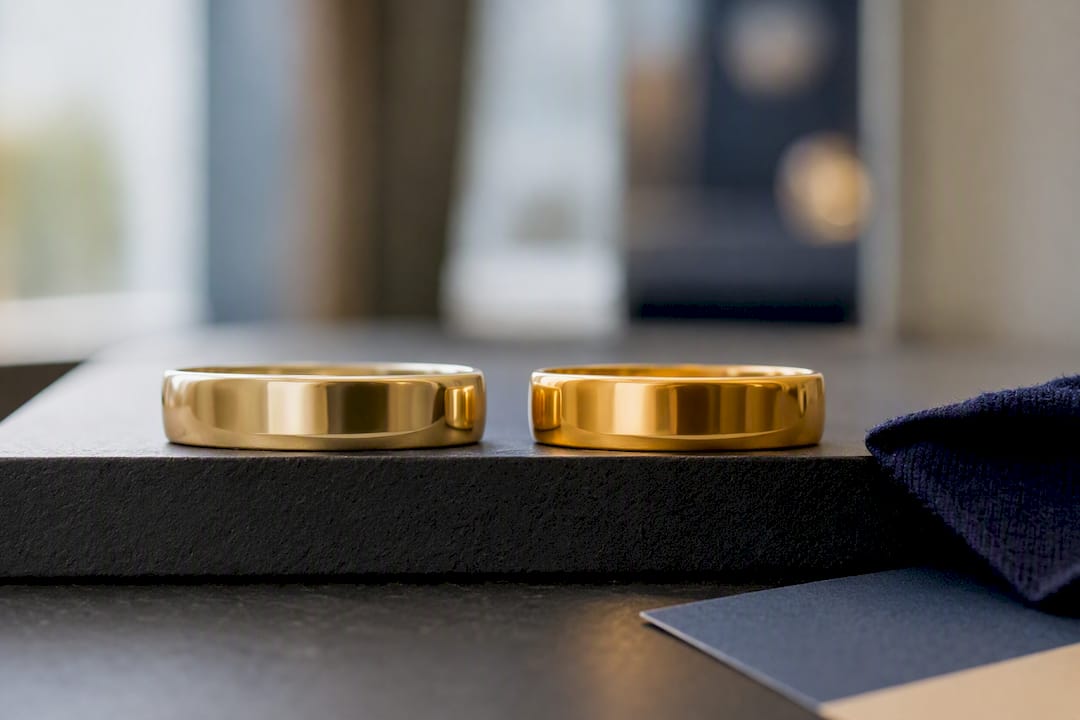
Put a 9ct and an 18ct band side by side under decent light and the difference is obvious. Eighteen-carat gold shows a noticeably deeper, richer yellow, because there’s simply more actual gold in the alloy and less of the other metals diluting the tone. Nine-carat gold is paler by comparison, and depending on the specific alloy mix, some pieces can take on a faintly greenish or brassy cast that some buyers find less appealing next to skin.
White gold complicates this comparison in a useful way. Almost all white gold, regardless of carat, gets a rhodium plating finish to achieve that bright, silvery look. That plating largely equalises the appearance between 9ct and 18ct white gold, so if you’re buying white rather than yellow, colour becomes less of a deciding factor and price or durability moves up the priority list instead.
Rose gold behaves differently again. It gets its pink tone from copper in the alloy, and because 9ct rose gold contains less pure gold overall, the copper’s influence is proportionally stronger, giving 9ct rose pieces a punchier, more obviously pink finish than their 18ct equivalents.
Pro Tip: If you’re buying online, check the product photos were taken in daylight rather than warm shop lighting. Yellow gold in particular looks noticeably richer under warm bulbs, which can make a 9ct piece look deceptively close to 18ct until it’s home under your own lights.
For UK wardrobes heavy on cooler tones (navy, grey, black), the paler warmth of 9ct yellow often reads better day to day than the deeper 18ct shade, which can look better against warmer autumn palettes and evening wear.
Durability and daily wear: hardness versus toughness
Hardness and toughness sound like the same thing. They’re not, and mixing them up is the single most common mistake buyers make when choosing between 9ct and 18ct.
- Hardness is scratch resistance. Nine-carat gold contains more alloy metal, which makes the surface harder and more resistant to the everyday scuffs of keys, worktops and door handles.
- Toughness is resistance to bending, cracking and fatigue. Eighteen-carat gold, despite being softer, tends to absorb stress and knocks more gracefully over years of wear, because its structure is less brittle even though it’s less scratch resistant.
- Common failure modes differ by carat. Nine-carat pieces are more prone to hairline cracking under sudden impact, particularly around claws and prongs. Eighteen-carat pieces are more likely to bend or lose their shape gradually rather than snap.
- Repair expectations follow the same pattern. A cracked 9ct prong often needs a full re-tip, while a bent 18ct band can usually be reshaped without replacing metal.
- Structural pieces favour 9ct. For heavy signet rings, thick chains and anything under regular physical stress, the engineered hardness of 9ct can actually outperform higher purity, whatever the price tag suggests.
If longevity of form matters more than resisting scratches, an 18ct wedding band that’s worn every single day for forty years is the one you’ll be less likely to need reshaping mid-life.
Price and intrinsic value: what you’re really paying for
Scrap value is the cleanest way to compare 9ct vs 18ct price, because it strips out branding and craftsmanship and leaves just the gold. The calculation is simple: pure gold content multiplied by the current market price per gram.
Because 18ct contains 75% gold against 9ct’s 37.5%, 18ct carries roughly double the intrinsic value of 9ct per gram of finished jewellery, all else being equal.
Statistic callout: Gram for gram, 18ct gold contains double the pure gold of 9ct gold, which is the single biggest driver behind the retail price gap between the two.
That’s the intrinsic side. Retail price adds craftsmanship, design complexity and brand markup on top, so two rings of the same carat can still sit far apart in price depending on who made them and how. This is exactly why checking our gold valuation guide before buying or selling helps separate what you’re paying for the metal from what you’re paying for the design.
The practical rule that follows: choose 18ct when the piece is meant to hold value, get passed down, or matter for decades. Choose 9ct when you want a bigger, bolder or more elaborate design within a fixed budget, since the lower gold content lets you buy more metal for the same money.
Which carat suits your situation?
Match the carat to the job the piece has to do, not just to your budget.
- Everyday wedding bands: 9ct usually wins here. It’s worn daily for decades, knocked against door frames and worktops constantly, and its extra hardness earns its keep.
- Engagement rings: 18ct is the stronger pick, particularly for anyone with sensitive skin who reacts to the higher nickel content sometimes found in 9ct white gold alloys.
- Heirloom pieces: 18ct again, since the higher intrinsic value and richer colour age better as something meant to be passed down generations.
- Large or heavy signet rings: 9ct, because the structural hardness matters more than colour depth on a piece that size.
- Gifts on a budget: 9ct lets you buy a more substantial-looking piece for less outlay, without pretending it’s something it isn’t.
White and rose gold add a layer of exception to all of this. Since rhodium plating largely equalises white gold’s appearance across carats, structural need and budget often matter more than the colour argument. And rose gold’s pink intensity, stronger in 9ct thanks to its higher copper content, might actually be the look some buyers prefer rather than a compromise.
A bespoke commission changes the calculation again, since a design built around a specific carat from the outset can lean into that metal’s strengths rather than fighting them.
A practical checklist for buying gold in the UK
Run through this before you hand over any money, in-store or online:
- Check for the 375 or 750 hallmark, and for anything heavy or expensive, ask whether assay paperwork is available.
- Ask about alloy composition, particularly whether white gold pieces are nickel-free, since nickel is the usual culprit behind skin reactions.
- Confirm the rhodium-plating status of white gold and ask how often re-plating is typically needed.
- Request the total weight and, ideally, the gold weight, so you can judge intrinsic value rather than relying on the sticker price alone.
- Ask about repair and warranty policy, and for pre-owned stock specifically, confirm the piece has been authenticated and restored rather than simply resold as-is.
Pro Tip: Weight thresholds mean gold under 1 gram doesn’t legally need a hallmark, which is why some delicate earrings or charms arrive unstamped. That’s not automatically a red flag, but it does mean you’re relying entirely on the seller’s word rather than an assay office’s, so buy from someone with a reputation worth trusting.
Our guide on how to authenticate gold jewellery walks through the exact checks worth running before purchase, and it’s worth pairing with our piece on how to spot fake gold jewellery if you’re buying second-hand from a source you don’t know well.
How Blackwell Jewellers checks every piece before it’s sold
Every piece that comes through Blackwell Jewellers, whether it arrives as a trade-in or gets bought at pawnbroking value, goes through hallmark verification before it’s authenticated and restored. That inspection routinely catches things a casual buyer would miss.
In trade practice, close inspection of pre-owned gold regularly turns up items that are underweight, misdescribed, or missing the hallmark entirely once you look properly. That’s exactly why an experienced jeweller’s inspection matters so much more with second-hand pieces than with anything bought new off a shelf.
In-store, the advice tends to split along practical lines: someone bringing in a heavy signet ring for daily wear gets steered towards 9ct for its structural hardness, while someone choosing an heirloom piece or an engagement ring gets steered towards 18ct for its richer colour and long-term value retention.
What actually matters when choosing between the two
Most guides on this topic treat carat choice as a straightforward hierarchy: higher is better, if you can afford it. That’s lazy advice, and it leads people to overpay for 18ct pieces that will get battered by exactly the kind of daily wear 9ct was built to handle.
The trade-off that gets underplayed constantly is toughness versus hardness. A harder metal scratching less feels like the obvious win in a shop under bright lights, but toughness, the ability to survive decades of knocks without cracking, matters far more for something worn every single day. That’s why a 9ct wedding band regularly outlasts an 18ct one in daily use, even though the 18ct piece is the “better” gold on paper.
What buyers should prioritise first isn’t carat at all. It’s the hallmark. A stunning piece with no 375 or 750 stamp, or vague talk of “gold plated” without a stated fineness, is a bigger risk than choosing the “wrong” carat ever will be. Get the hallmark right, then choose the carat that matches how the piece will actually be worn.
— James
Buy with confidence: authenticated gold from Blackwell Jewellers
Choosing between 9ct and 18ct only matters if you can trust what’s actually in the piece, and that’s the part most online listings gloss over. Every item in Blackwell Jewellers’s second-hand jewellery collection has already been hallmark-verified, authenticated and restored by our own jewellers before it ever reaches a shelf or a listing, so you’re not relying on guesswork or a seller’s word alone.

That inspection process is exactly what separates buying pre-owned from a specialist and buying from an unverified private seller. If you already own gold and want it valued, resized or brought back to wearable condition rather than replaced, our jewellery repairs service covers everything from re-tipping worn prongs to reshaping bent bands. Browse the current second-hand stock, check the hallmark listed on each piece, and get in touch if you’d like a specific carat sourced for you.
Sources
- Gov
- Hallmarking guidance notes November 2022
- 9ct vs 18ct gold: is higher carat always better for jewellery in the UK? — Jewellery magazine
- Gold purity explained: 9ct vs 18ct vs 24ct — London Gold Exchange