

Art Deco jewellery is the geometric, machine-age style that dominated jewellery design from roughly 1920 to 1939, with the 1925 Paris exposition marking its high point. You can usually spot it fast:
- Sharp geometry and mirror-image symmetry, not flowing curves
- Platinum settings holding diamonds in tight, architectural clusters
- Baguette and emerald-cut stones doing the structural work
- Black onyx or enamel snapping against white metal and diamonds
- Motifs borrowed from skyscrapers, sunbursts and Egyptian revival
Collectors chase this period because the design, materials and paper trail rarely line up this well anywhere else in jewellery history.
Key Takeaways
Authentic Art Deco jewellery is defined by geometric design, platinum and diamond construction, and period-correct hallmarks that together separate genuine 1920s and 1930s pieces from later reproductions.
| Point | Details |
|---|---|
| Know the era | Art Deco spans roughly 1920 to 1939, with the 1925 Paris exposition as its defining moment. |
| Check the visual signature | Geometry, symmetry, platinum, baguette and emerald cuts, and onyx contrast are the core identifiers. |
| Inspect construction closely | Hand-cut facets, millegrain settings and honest wear patterns separate originals from reproductions. |
| Verify hallmarks | UK Assay Office marks and maker’s stamps under magnification confirm metal and origin. |
| Buy with documented provenance | Blackwell Jewellers authenticates, hallmark-checks and condition-reports every pre-owned piece before sale. |
Table of Contents
- What makes art deco jewellery instantly recognisable
- How to identify genuine art deco pieces
- Typical art deco items and the makers collectors watch for
- How to buy and authenticate art deco jewellery
- Caring for and repairing vintage art deco jewellery
- Where to see authentic art deco pieces and research provenance
- Why art deco jewellery still commands collector loyalty
- Buy authenticated art deco pieces with confidence at Blackwell Jewellers
- Frequently asked questions about art deco jewellery
- Sources
What makes art deco jewellery instantly recognisable
Forget anything with a soft curve. Art Deco jewellery is built on straight lines, repeated shapes and a kind of architectural discipline that mirrors the skyscrapers going up at the same time. Symmetry isn’t a nice touch here, it’s the whole point. A brooch that’s slightly off-balance almost certainly isn’t from this period.
The motif vocabulary is distinctive and worth memorising. Look for double-clip brooches (two matching clips that combine into one piece or separate to be worn individually), long sautoirs dripping past the waist, stepped ziggurat outlines lifted straight from Art Deco architecture, scarabs borrowed from the Egyptian revival after Tutankhamun’s tomb was opened in 1922, lightning bolts, and stylised palmettes.
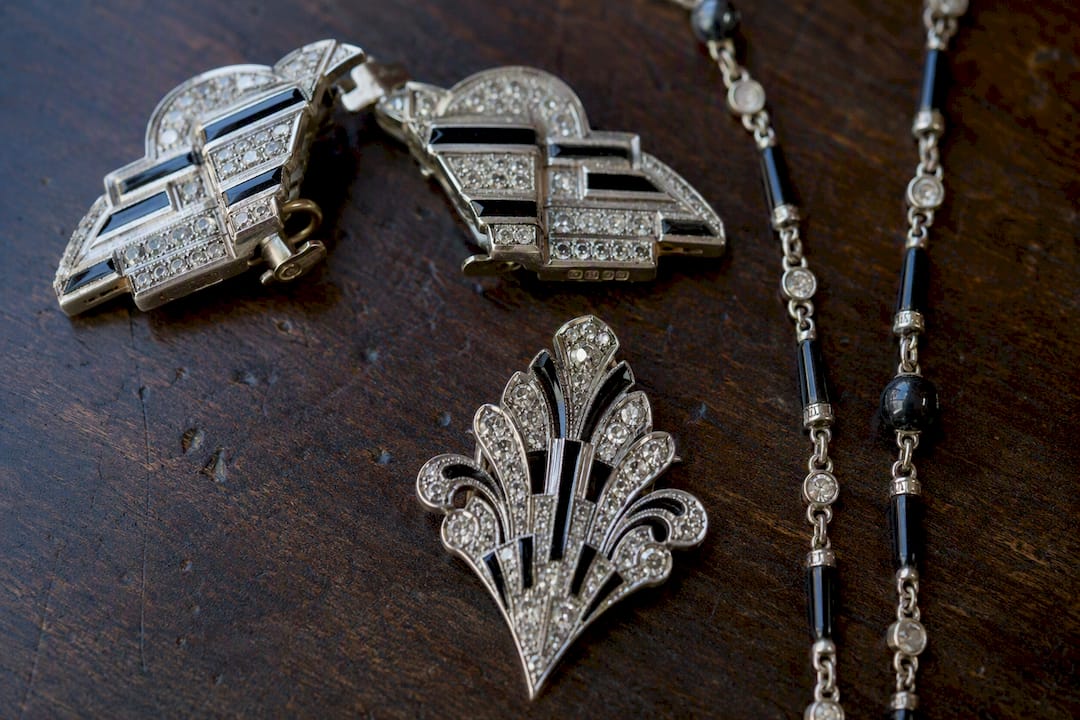
Materials tell you almost as much as shape. Platinum became the metal of choice because its strength let jewellers hold diamonds with minimal metal, producing that crisp, almost see-through setting look. Diamonds dominate, but you’ll also find onyx, rock crystal, coloured gemstones, enamel and, increasingly through the 1920s, cultured pearls, which had just become commercially viable and fashionable.
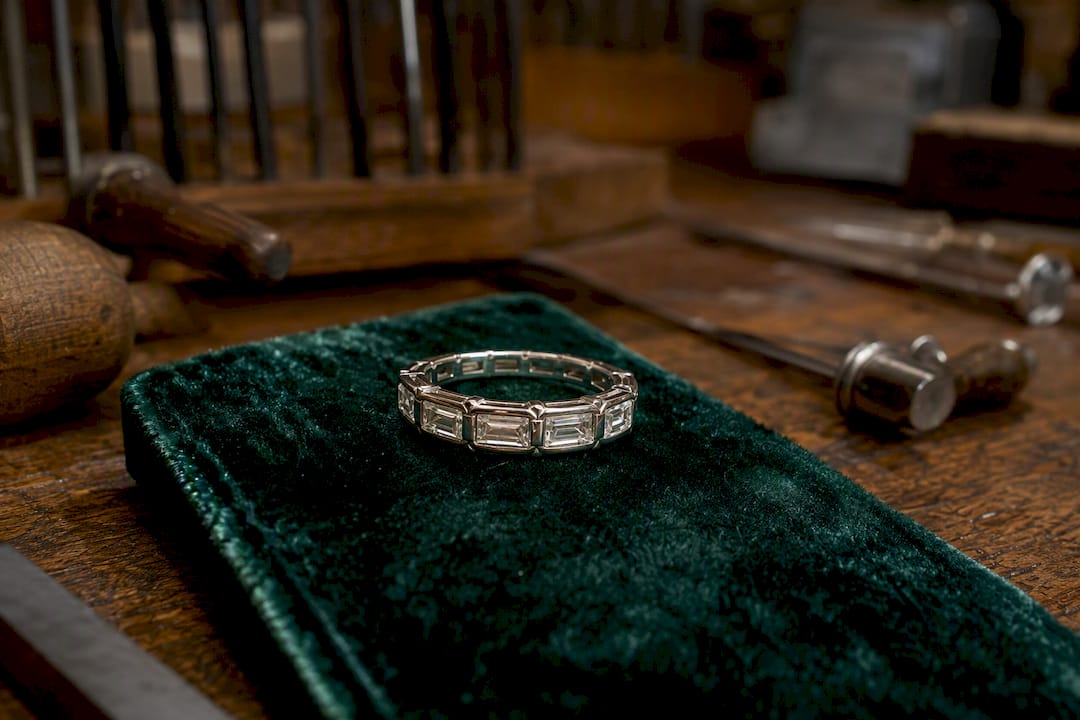
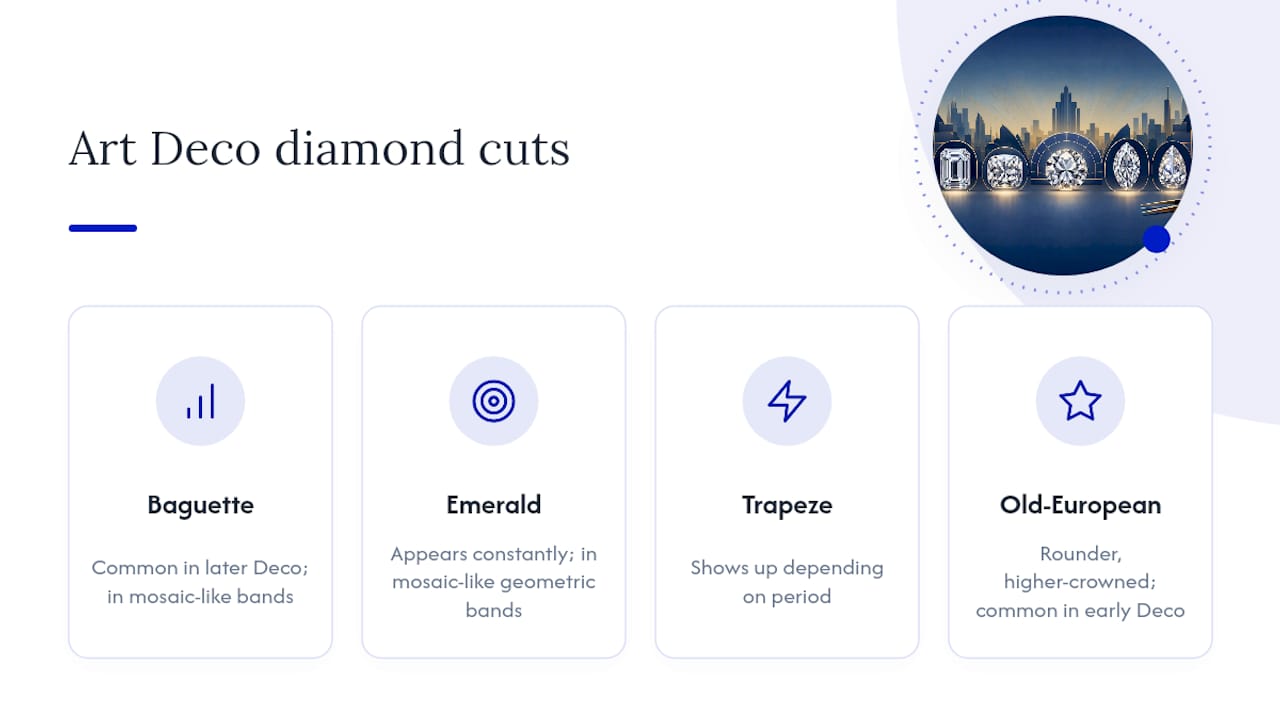
Cuts matter enormously for dating a piece. Baguette and emerald cuts appear constantly, often arranged in mosaic-like geometric bands. Trapeze cuts and old-European cuts (a rounder, higher-crowned precursor to the modern round brilliant) both show up depending on where in the period a piece sits.
Pro Tip: Early Deco (roughly 1918 to 1925) leans more feminine and uses more colour and old-European cuts. Later Deco (1925 to 1939) turns starker and more industrial, with more platinum, more baguettes, and far less ornamentation. If a piece feels austere and mechanical, it’s probably from the second half of the period.
How to identify genuine art deco pieces
Authenticating a Deco piece is part detective work, part material science. Work through it in order.
- Examine the construction. Original Deco settings use hand-fabricated millegrain edges and tightly calibrated stones, cut and set to fill a space almost seamlessly, unlike the more generic prong settings on later reproductions.
- Check wear patterns. Genuine age shows as soft rounding on high points, tiny scratches under magnification and slight thinning on shanks, not uniform, factory-fresh polish.
- Look for soldering and repair marks, especially around clip mechanisms and hinges, which are the first parts to fail on double-clip brooches.
- Request close-up photographs of any hallmarks or maker’s marks, ideally under magnification.
- Read the assay marks properly. In the UK, genuine antique platinum and gold pieces should carry marks from a recognised UK Assay Office (London, Birmingham, Sheffield or Edinburgh), stamped with metal fineness and a date letter where applicable.
A few extra signals separate the real from the reproduction:
- Hand-cut baguettes have slightly irregular facets under magnification; modern machine-cut baguettes are almost too perfect.
- Pavé work from the period sits slightly proud and hand-finished, whereas modern micro-pavé looks uniform and mechanically repeated.
- Reproductions often use cubic zirconia or synthetic spinel in place of onyx or rock crystal, which weighs and reflects light differently.
Pro Tip: A trustworthy condition report should state the metal, stone weights (estimated, not guessed), any replaced parts, evidence of restoration, and an honest note on wear. If a report is vague about repairs or omits weights entirely, treat it as a warning sign, not paperwork.
Typical art deco items and the makers collectors watch for
Certain object types turn up again and again because they suited the era’s design language so well: double-clip brooches, long sautoirs, cocktail rings with strong geometric footprints, hinged geometric bracelets, wristwatches (a genuinely new category, since wristwatches only became socially acceptable for men after the First World War), and clip earrings.
Maker attribution moves the price more than almost anything else. A few names to know:
- Cartier helped define the Deco look itself and remains one of the strongest names at auction for the period, according to BBC Culture’s history of Jazz Age jewellery.
- Van Cleef & Arpels pioneered the mystery setting, allowing gems to appear held by nothing at all, a technical leap still referenced by modern designers working in geometric styles.
- Tiffany and Bulgari both produced strong Deco lines, with Bulgari’s Italian output leaning bolder and more colour-driven than the French houses.
- Raymond Templier and Fouquet represent the more avant-garde, sculptural end of French Deco, prized by specialist collectors even where the pieces are less famous to a general buyer.
Condition and documented provenance sit alongside the maker’s name as the three real price drivers. A brooch with a house mark, an intact clip mechanism and a paper trail will outsell an unmarked equivalent by a wide margin.
How to buy and authenticate art deco jewellery
Buying vintage jewellery at a distance, whether online or through an auction house, comes down to asking the right questions before money changes hands.
- Ask directly whether the piece has been restored, and if so, what was done.
- Request magnified, well-lit photographs of every hallmark and maker’s mark.
- Ask for any known provenance: previous owners, receipts, or auction history.
- Confirm the seller’s return policy and whether shipping is insured.
- Where possible, ask for an independent appraisal or at minimum a written condition report.
Documents worth chasing before you commit include high-resolution hallmark shots, a written condition report, any past receipts or invoices, and auction catalogue references if the piece has sold publicly before. Catalogue entries from major houses often carry detailed technical descriptions and provenance notes that are hard to get anywhere else.
For online purchases specifically, check that photos show the piece from multiple angles including the back and underside of settings, ask whether magnified detail shots are available, confirm an independent appraisal is possible after purchase, and check the return window before you pay.
Blackwell Jewellers built its second-hand process around exactly this gap in trust. Every pre-owned piece goes through in-house inspection, hallmark verification, a written condition report and a documented restoration history before it’s offered for sale, following the sort of workflow our expert inspection process sets out for pre-owned pieces generally.
Pro Tip: Commission an independent specialist appraisal for anything above a few thousand pounds, particularly signed pieces. Budget accordingly, since a proper written appraisal from a qualified gemologist costs a fraction of what a misattributed purchase can cost you.
Caring for and repairing vintage art deco jewellery
Vintage settings are more delicate than they look, and the wrong clean can undo a century of good condition.
- Do use a soft brush and lukewarm soapy water for platinum and diamond pieces; avoid ultrasonic cleaners on anything with foiled stones, enamel or emerald cuts with visible inclusions.
- Don’t use household solvents or jewellery dips on enamel or onyx, both of which can be damaged by harsh chemicals.
- Store sautoirs flat or gently coiled, never hanging under their own weight, and keep pearls away from perfume and direct sunlight.
- Favour sympathetic, reversible repairs (re-tipping prongs, careful clip mechanism repair) over full re-setting, which strips originality and can reduce collector value.
Pro Tip: Conservation-style repairs that preserve original stones, settings and patina hold value far better than a full re-polish or re-plate, which often erases the very wear patterns that prove age.
Where to see authentic art deco pieces and research provenance
Build your eye before you buy. Solid starting points include:
- Christie’s and Sotheby’s online archives for past catalogue entries and realised prices
- The V&A and other major museum jewellery collections for dated, documented examples
- Specialist reference books and exhibition catalogues from the period
- Auction house catalogue notes, which often include technical descriptions and provenance history useful for cross-checking a piece you’re considering
Why art deco jewellery still commands collector loyalty
Deco jewellery reflects a genuine cultural pivot: women’s newly independent lives after the First World War, paired with a design language borrowed from machines rather than gardens. That combination of visible technical skill and social meaning is why the geometry still reads as modern a century on. Buy authenticated pieces with proper provenance and condition reports, always.
Buy authenticated art deco pieces with confidence at Blackwell Jewellers
Buying vintage online usually means gambling on photographs and hoping the hallmarks are what the listing claims. Blackwell Jewellers removes that gamble: every piece in our second-hand collection has already been inspected, hallmark-verified and documented in-house before it ever reaches a listing.

That means you’re not relying on a stranger’s word for provenance or condition, you’re relying on a written report from jewellers who’ve handled the piece directly. Our guarantees on every pre-owned item include full in-house inspection, hallmark and assay verification, a documented restoration history where relevant, and secure insured shipping with a clear returns policy. If you’d rather see a piece in person first, our Maidstone second-hand showroom takes viewing requests directly. Get in touch to request a condition report or arrange a viewing on any Art Deco piece currently in stock.
Frequently asked questions about art deco jewellery
What’s the difference between Art Nouveau and Art Deco jewellery? Art Nouveau (roughly 1890 to 1910) favours flowing, organic lines and semi-precious stones with enamel work, while Art Deco embraces geometry, symmetry and machine-age materials like platinum and diamonds. Some designers, notably René Lalique, worked across both styles as tastes shifted through the 1920s.
How can I tell if a piece is really from the 1920s and not a later reproduction? Check hallmarks under magnification, examine construction for hand-finished millegrain settings, look for honest wear patterns rather than uniform polish, and request a written condition report from the seller.
Are Art Deco engagement rings a good investment? Genuine, well-documented Art Deco rings with strong maker attribution and provenance have historically held value well, though condition and originality of the setting matter more than any single feature.
What should I avoid when cleaning vintage Art Deco jewellery? Avoid ultrasonic cleaners on foiled stones or enamel, and never use household solvents on onyx or enamel surfaces, both of which can be permanently damaged.
Sources
- A collector’s guide to Art Deco jewellery | Christie’s
- Art Deco: The Period, the Jewelry (DOI journal article)
- Dazzled by pattern: how geometric design captured the imaginations of jewellery designers | Sotheby’s
- The jewellery of the Jazz Age | BBC Culture
Auction catalogue entries frequently include provenance notes and technical descriptions that prove invaluable when authenticating a piece yourself.