
TL;DR:
- Buying vintage jewelry online requires thorough research and careful seller evaluation.
- Trustworthy retailers provide guarantees, clear photos, transparent policies, and provenance information.
- Properly purchasing vintage pieces offers meaningful stories, sustainability benefits, and supports artisans.
There is something genuinely thrilling about spotting a 1920s Art Deco ring or a Victorian mourning brooch listed online. You get that little rush, the “I must have this” feeling, and then… the doubt creeps in. Is it real? Is the seller legit? What if it arrives looking nothing like the photos? Buying vintage jewellery online is one of those things that can be completely wonderful or a total headache, depending entirely on how you approach it. This guide is here to make sure it is the former.
Table of Contents
- What to know before you buy vintage jewellery online
- Step-by-step: How to shop for vintage jewellery online safely
- How to check authenticity and ethical sourcing
- Troubleshooting: Common mistakes and how to avoid them
- Why safe online vintage jewellery buying is about more than just safety
- Discover vintage jewellery you can trust
- Frequently asked questions
Key Takeaways
| Point | Details |
|---|---|
| Check for authenticity | Always demand proof of authenticity, such as certificates and hallmarks, from the retailer. |
| Prioritise buyer protections | Only use secure payment methods like credit cards or PayPal for added peace of mind. |
| Choose reputable sellers | Shop with dealers that offer guarantees, insured shipping, and clear return policies. |
| Verify ethical sourcing | Ethically sourced and refurbished jewellery ensures both quality and a clear conscience. |
| Enjoy the discovery | Safe vintage jewellery buying is a chance to connect with history and embrace sustainable style. |
What to know before you buy vintage jewellery online
Let’s be honest. The online vintage jewellery market is brilliant but it is also full of pitfalls. Reproductions sold as originals, vague descriptions hiding serious damage, listings with no hallmark photos, and sellers who vanish the moment you ask a question. Sound familiar?
Before you start searching, you need to understand what separates a trustworthy retailer from a risky one. The good news is that the signs are usually pretty obvious once you know what to look for.
What reputable online vintage jewellery retailers offer:
- Written authenticity guarantees or certificates
- Clear, high-resolution photos of hallmarks and condition
- Transparent return and refund policies
- Insured, tracked shipping as standard
- Detailed provenance information (where the piece came from, its history)
- Responsive customer service before and after sale
According to trusted seller features, reputable UK sites offer authenticity guarantees, free returns, and insured shipping as a baseline. If a seller does not tick most of those boxes, walk away.
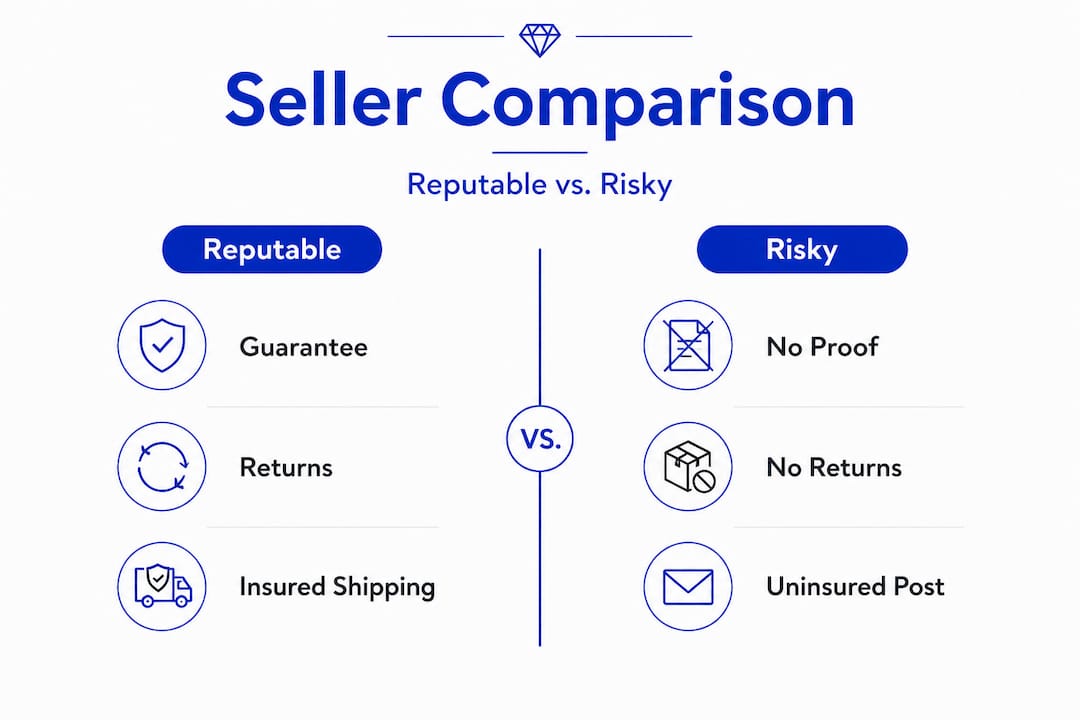
Here is a quick comparison to help you judge sellers at a glance:
| Feature | Reputable seller | Risky seller |
|---|---|---|
| Authenticity guarantee | Yes, in writing | None or vague |
| Hallmark photos | Clear, detailed | Missing or blurry |
| Return policy | Free, transparent | No returns or unclear |
| Shipping | Insured and tracked | Uninsured, no tracking |
| Provenance details | Provided upfront | Absent or invented |
| Communication | Fast and informative | Slow or evasive |
It is also worth knowing that online fraud involving second-hand goods, including jewellery, has increased year on year. In the UK, Action Fraud recorded tens of thousands of online shopping fraud cases annually, and vintage goods are a popular category for scammers because values are subjective and buyers are often emotionally invested.
If you want to make authenticated jewellery buying less intimidating, start by understanding these red flags, and then let them guide your entire search process.
Pro Tip: If a price looks too good to be true, it almost certainly is. A genuine Georgian gold brooch is not going to be listed for £15 with free postage. Unrealistically low prices are one of the most common scam tactics in the vintage jewellery market. Check comparable prices across multiple platforms before committing.
One more thing. If you are just starting to build a collection, reading some vintage jewellery collection tips will help you understand periods, styles, and what to prioritise when building your eye for quality pieces.
And for those of you who want to know about saving on authentic pieces without sacrificing quality, that is entirely possible when you shop with knowledge on your side.
Step-by-step: How to shop for vintage jewellery online safely
With the basics in place, here is your practical, easy-to-follow process for successfully buying vintage jewellery online in the UK.
Think of this as your buying workflow. Follow it every single time, especially for higher-value pieces.
-
Research the seller first. Look for reviews across multiple platforms (Google, Trustpilot, social media). How long have they been trading? Do they have a physical address? A family-run shop with over 20 years of trading history is infinitely more reassuring than a nameless online account created last month.
-
Scrutinise the listing carefully. Read every word of the description. Look for vague language like “gold-coloured” (not actual gold), “vintage-style” (reproduction), or “as-is condition” (could mean anything). Good sellers are specific: metal type, carat, period, dimensions, weight.
-
Check for hallmarks. UK hallmarking law means that items sold as gold, silver, or platinum above a certain weight must carry a hallmark. Ask for close-up photos of the hallmark if they are not already provided. Learning to read basic UK hallmarks (assay office marks, date letters, standard marks) is genuinely useful here.
-
Verify return and shipping policies. Before you pay, confirm exactly what happens if the item is not as described. Is return postage covered? How many days do you have? Is the item insured during transit?
-
Request additional photos or documentation. Any reputable seller will happily send you extra photos of a specific area, or provide a written statement of authenticity. If they hesitate or refuse, that is your answer.
-
Pay securely. More on this below.
Here is a quick reference for red flags versus green lights in any listing:
| What you see | What it means |
|---|---|
| “Gold-tone” or “gold-coloured” | Not real gold |
| No hallmark photos | Possible authenticity issue |
| “All sales final” | No recourse if problems arise |
| Weight and dimensions listed | Seller knows their product |
| Provenance story included | Transparency and care |
| Uninsured shipping only | Risk falls on you |
The basic buying advice from experienced vintage buyers consistently emphasises doing your homework on the seller before falling in love with any individual piece. Sensible advice.
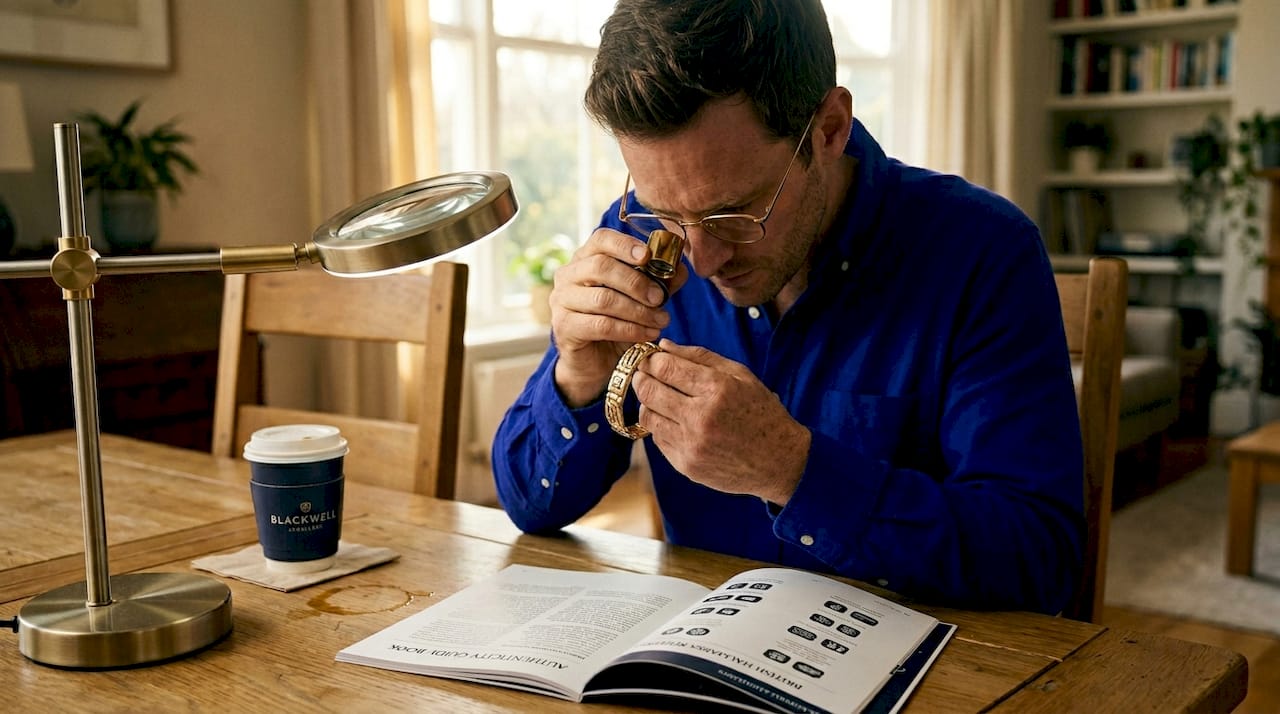
For a deeper look at what happens when you inspect a piece properly, our expert inspection tips walk you through exactly what trained jewellers look for, which is surprisingly useful knowledge even when shopping from a screen.
To find sellers who already meet these standards, our guide to best trusted retailers covers the most reliable names in the UK pre-owned jewellery market.
Pro Tip: Always pay with a credit card or PayPal when buying vintage jewellery online. Both offer chargeback and dispute protections if the item turns out to be misrepresented or never arrives. Paying by bank transfer gives you almost no recourse. Never do it for an item you have never seen in person.
How to check authenticity and ethical sourcing
Knowing the steps is vital, but confirmation of authenticity and sourcing is where safety truly lies.
Authenticity is about more than just whether a piece is “real.” It covers metal purity, period accuracy, repair history, and where the item came from. Ethical sourcing asks bigger questions: was this item obtained legally? Has it changed hands responsibly?
Here is how to build a clear picture before you buy:
- Ask for a certificate of authenticity. Not all vintage pieces will have one, but established retailers should be able to provide written documentation of what the piece is and where it came from.
- Learn the major UK hallmarks. The lion passant (sterling silver), the crown or orb (gold in certain assay offices), and the date letter system all tell a story. Knowing even the basics means you can spot when something does not add up.
- Request repair history. Has the clasp been replaced? Has a stone been reset? Good sellers will tell you. This is not necessarily a problem, but you deserve to know.
- Check ethical sourcing disclosures. For diamond pieces especially, ask whether the stones are conflict-free or lab-grown. Reputable sellers will have an answer ready.
- Consider requesting a lab test or independent appraisal. For higher-value pieces, a written report from a professional gemmologist is worth every penny. Any trustworthy seller will support this.
When it comes to understanding authentication, the key is learning to think like the seller: what would they need to prove in order for you to feel confident? Then ask for exactly that.
And if you are still getting your head around UK hallmarks explained, there is a lot more detail available on what each mark means and how to read them on different metal types.
“The safest vintage jewellery purchases happen when sellers volunteer information rather than making you chase it. Authenticity guarantees, free returns, and insured shipping are the baseline, not a bonus.” Inspired by trusted seller standards.
For inspiration on collecting genuine pieces, there is also a wonderful world of styling advice out there once you feel confident in your buying process.
Troubleshooting: Common mistakes and how to avoid them
Now that you know how to check for authenticity, let us make sure you sidestep the most common buying blunders.
Even experienced buyers make these mistakes. Do not feel embarrassed. Just learn from them.
The most common mistakes:
- Not reading the full description. Skimming listings is how people end up with silver-plated pieces they thought were solid silver.
- Ignoring missing hallmark photos. If the hallmark is not shown, it may not exist. Always ask.
- Skipping the returns policy. “No returns” is a massive warning sign for vintage jewellery. Sellers who are confident in their pieces have no reason to refuse returns.
- Failing to communicate in writing. If a seller makes verbal promises over the phone but the written listing says something different, you will struggle in a dispute. Get everything confirmed via email.
- Overpaying out of excitement. Emotional buying is real. If you feel urgency (“only one left!”), slow down rather than speed up.
- Not checking overall seller feedback. One bad review among hundreds is fine. A pattern of “item not as described” complaints is not.
Quick resolution tips if something does go wrong:
- Contact the seller in writing immediately and be specific about the problem.
- Keep all emails, screenshots, and listing photos as evidence.
- If unresolved, raise a dispute through PayPal, your credit card provider, or the platform you purchased through.
- For serious issues, the Citizens Advice consumer helpline and Trading Standards are there for you.
Pro Tip: Screenshot the listing the moment you purchase. Sellers can (and do) edit or delete listings after a sale. Having a saved copy of exactly what was described protects you enormously in any dispute.
Understanding the benefits of buying second-hand jewellery goes well beyond just price. Pre-owned pieces carry character, history, and often better craftsmanship than modern mass-produced alternatives. But you do need to protect yourself to enjoy those benefits fully.
For vintage style inspiration once you have your piece safely in hand, there is no shortage of creative ways to wear what you have found.
Why safe online vintage jewellery buying is about more than just safety
Here is where most buying guides stop short: they treat the whole process as risk management. Avoid this, watch out for that, do not get scammed. And yes, all of that matters.
But safe buying is not just defensive. It is actually the gateway to one of the most genuinely satisfying shopping experiences you can have.
Think about it. When you buy a piece of vintage jewellery properly, with provenance confirmed and authenticity verified, you are not just owning a piece of metal and stone. You are owning a piece of someone’s story. That Edwardian sapphire ring belonged to someone. It was worn, loved, perhaps passed down, perhaps sold in difficult times. Knowing its history makes it more meaningful, not less.
There is also the sustainability angle, which I genuinely believe matters more now than ever. Buying pre-owned jewellery is one of the most ethical choices you can make as a consumer. No new mining. No new manufacturing footprint. You are participating in a circular economy that extends the life of beautiful, skilled craftsmanship rather than demanding new resources.
And here is the thing that often gets overlooked: buying vintage supports skilled artisans and small businesses. Specialist retailers, independent jewellers, restoration experts, they all benefit when you choose pre-owned over fast-fashion accessories. It is a purchase with ripple effects.
The process of vintage trends in the UK right now is genuinely exciting. Art Deco, Mid-Century Modern, and Victorian revival styles are having a real moment. Safe buying means you get to enjoy that trend properly rather than being stung by a reproduction at full vintage price.
Safe buying done well is not a chore. It is the difference between an anxious transaction and a genuinely joyful one.
Discover vintage jewellery you can trust
Ready to buy with confidence? Here is how Blackwell can help you take your next step.
At Blackwell Jewellers, every single piece in our curated second-hand jewellery collection has been personally inspected, authenticated, hallmarked, and restored by our in-house team of expert jewellers. We are a family business with over 20 years of trading from our Kent stores, and our online platform brings that same rigour to customers across the UK.
We do not list a piece until we are confident we would wear it ourselves. You get full provenance details, clear hallmark photography, and the reassurance of dealing with a real, accountable business. If you ever need it, our aftercare and cleaning services keep your vintage pieces in beautiful condition long after purchase. Browse our collection or get in touch with any questions. We genuinely enjoy talking about jewellery.
Frequently asked questions
How can I tell if vintage jewellery is fake when shopping online?
Ask for certificates of authenticity, detailed photos of hallmarks, and shop from retailers offering free returns and guarantees as standard practice.
What are the safest payment methods for buying vintage jewellery?
Credit cards and PayPal offer buyer protection if anything goes wrong with a purchase, and reputable sellers offering authenticity guarantees will have no objection to either method.
Are return policies important when buying vintage jewellery?
Yes, always look for a retailer with a fair, transparent return policy; reputable UK retailers treat free returns as a baseline rather than an exception.
Can I trust vintage jewellery listed on auction sites?
Some auction platforms are reputable, but you should always confirm authentication, return policies, and payment security before bidding, as standards vary widely unlike established specialist retailers.
Why choose vintage jewellery over new pieces?
Vintage jewellery offers unique style, genuine historical connection, and is a sustainable, ethical choice that supports a circular economy rather than new resource extraction.