

Yes, you can pawn a gold watch, chain or bracelet at most UK pawnbrokers. The National Pawnbrokers Association confirms that gold, jewellery and watches are among the most commonly accepted items precisely because they are easy to value, store and resell. Whether your item is a 9ct gold chain, a solid gold bracelet or a luxury timepiece, a pawnbroker will typically lend against it — provided you can show it is what you say it is.
The short version of what determines acceptance and loan size:
- Purity and karat (9ct, 18ct, 22ct, 24ct gold)
- Weight in grams
- Hallmarks and whether they are legible
- Brand and model (for watches especially)
- Working condition and completeness
- Damage and whether repairs are needed
Before you go anywhere, do these four things:
- Weigh the item if you have kitchen scales.
- Check for a hallmark (usually inside a clasp, on the case back or on the inner band).
- Gather your ID and any proof of ownership you have.
- Decide your minimum acceptable loan figure before you walk in.
That is genuinely all the preparation most people need. The rest of this guide fills in the detail.
Key takeaways
Pawning a gold watch, chain or bracelet in the UK is straightforward when you know your item’s weight, karat and hallmark status, and arrive with ID and written terms in hand.
| Point | Details |
|---|---|
| Gold items are widely accepted | Solid gold chains, bracelets and watches are among the most commonly pawned items in the UK. |
| Valuation uses weight, purity and demand | Loan offers are based on grams × karat purity × gold price, plus brand premium for watches. |
| LTV ranges vary by item type | Scrap-based gold jewellery typically attracts 30–60% of scrap value; branded watches can reach 50–70% of resale value. |
| Your pawn ticket is a legal document | It must show loan amount, interest rate, redemption date and your statutory rights under the Consumer Credit Act. |
| Blackwelljewellers offers in-store valuations | In-house hallmark checks, repair services and FCA-compliant pawnbroking across Kent stores. |
Table of Contents
- Can you pawn a gold watch, chain or bracelet? What pawnbrokers accept
- How pawnbrokers value your gold items
- Broken or damaged items — will a pawnbroker still lend?
- What to bring and how to prepare before you visit
- How the pawnbroking process works in the UK and your rights
- What loan amount can you realistically expect?
- Should you pawn or sell your gold watch, chain or bracelet?
- Questions to ask a pawnbroker and red flags to spot
- Why a jeweller-pawnbroker makes a real difference
- Transparent pawnbroking and valuations at Blackwelljewellers
- Sources
Can you pawn a gold watch, chain or bracelet? What pawnbrokers accept
Most pawnbrokers will happily take the following:
- Solid gold chains in any karat (9ct, 14ct, 18ct, 22ct, 24ct)
- Solid gold bracelets, bangles and cuffs
- Gold-cased watches, including dress watches and sports models
- Luxury-brand watches with gold components or significant market demand
- Fully hallmarked items with clear assay marks
The NPA notes that gold and watches sit at the top of the list because they hold value, do not perish and have an active second-hand market. That is good news for you.
A few categories get a more cautious reception:
- Gold-plated items — a pawnbroker can usually spot plating within seconds, and the loan will reflect scrap value of the base metal, not gold.
- Fashion jewellery without hallmarks — no hallmark means no easy way to confirm purity, so expect a lower offer or outright refusal.
- Items with unclear provenance — not a legal barrier, but missing receipts or boxes can reduce confidence and therefore the offer.
For watches specifically, two things matter beyond the metal: does it run, and do you have the original box and papers? A working watch with its box and service history is worth considerably more to a pawnbroker than a non-running one in a tatty bag. That said, non-running watches are not automatically refused. They are just valued differently, which the next section covers.
How pawnbrokers value your gold items
Valuation is not guesswork. Pawnbrokers use a fairly consistent method, and once you understand it, you can estimate a rough figure yourself before you go.
For gold chains and bracelets, the starting point is always:
Weight (grams) × purity fraction × live gold price per gram = scrap value
A 9ct gold chain is 37.5% pure gold (9 divided by 24). An 18ct bracelet is 75% pure. The live gold price fluctuates daily, so the figure you calculate at home is a ballpark, not a guarantee.
For watches, the calculation adds a layer. The FCA’s pawnbroking sector review confirms that pawnbrokers apply both intrinsic metal value and market demand factors — brand, model, movement and condition — when valuing items. A desirable branded watch can attract a significant premium above its scrap metal value.
| Factor | Effect on loan value |
|---|---|
| Higher karat (18ct vs 9ct) | Higher scrap value per gram |
| Heavier item | Proportionally higher scrap value |
| Rising gold price | Higher base value across all gold items |
| Luxury brand with demand | Premium above scrap value |
| Original box and papers | Increases offer, especially for watches |
| Working movement | Higher offer than non-running equivalent |
| Damage or missing parts | Reduces offer; may push to scrap-only |
| Aftermarket modifications | Often reduces value (non-original parts) |
Pro Tip: To estimate scrap value at home, weigh the item on kitchen scales, note the karat from the hallmark, and multiply: grams × purity fraction × today’s gold price per gram. This gives you a floor figure. A pawnbroker’s loan will typically be a percentage of that, not the full amount.
Bear in mind that pawnbrokers are lending money and taking on resale risk. Their offer will always be below the item’s full market value. That is not a rip-off; it is the cost of a secured, short-term loan with no credit check.
Broken or damaged items — will a pawnbroker still lend?
Short answer: often yes, but the loan will be lower.
Many pawnbrokers will lend on damaged or non-running items, typically at or near scrap value. Here is how common damage scenarios tend to play out:
- Non-running watch — usually accepted at a reduced rate; the pawnbroker factors in repair costs and resale risk.
- Missing bracelet links — accepted, but weight-based value drops proportionally.
- Broken clasp — minor issue; most pawnbrokers accept this without much reduction.
- Damaged dial or crystal — reduces the watch’s resale appeal significantly; expect a lower offer.
- Replaced or non-original parts — can substantially reduce value, especially on branded watches where authenticity matters to buyers.
- No hallmark visible — the pawnbroker may test the metal (acid test or XRF scanner) or offer a conservative estimate.
The question of whether to repair before pawning comes down to one calculation: does the estimated uplift in loan value exceed the repair cost? If a £60 clasp repair could push a loan offer from £150 to £250, that is worth doing. If the repair quote is £200 and the likely uplift is £40, accept the lower offer and save the hassle.
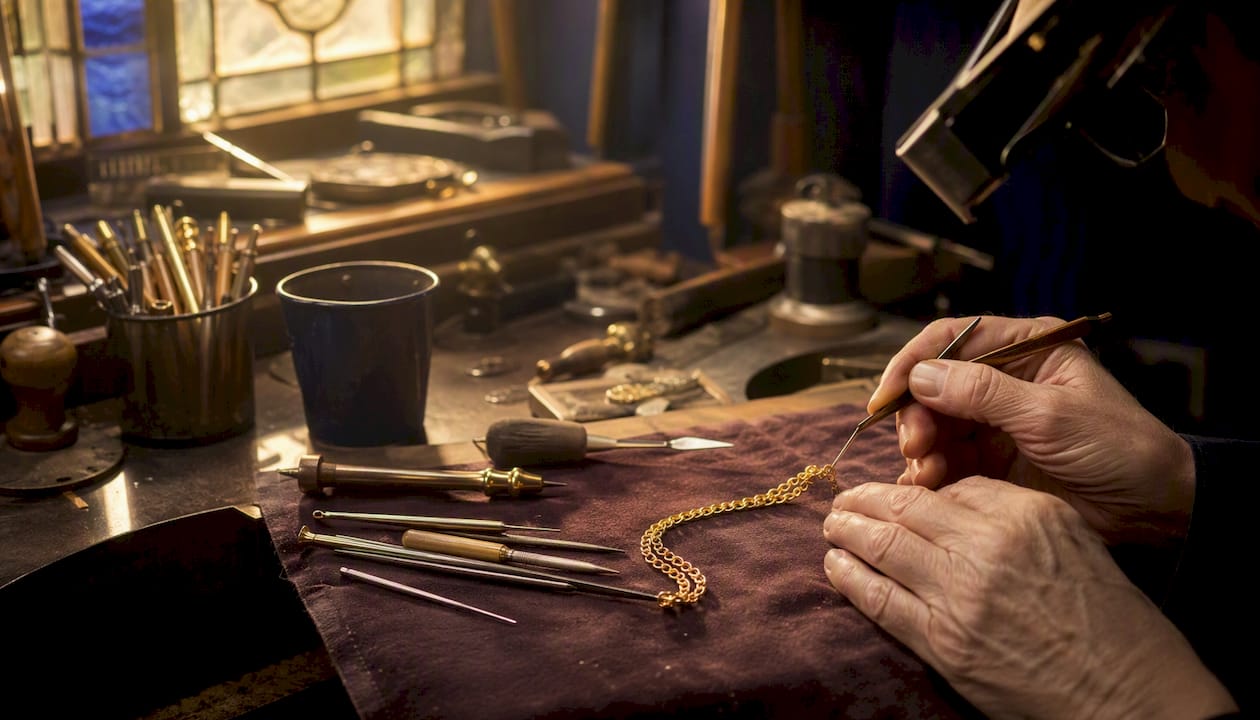
Blackwelljewellers offers in-house jewellery repairs alongside pawnbroking, which means you can get a repair estimate and a loan estimate in the same visit. That is a genuinely useful combination — you are not guessing whether the repair is worth it.
What to bring and how to prepare before you visit
Getting this right saves time and often gets you a better offer. Here is the checklist:
- Photo ID — a passport or driving licence. This is a legal requirement; pawnbrokers must verify your identity under anti-money laundering rules.
- Proof of address — a recent utility bill or bank statement (usually within three months).
- Proof of ownership — receipts, original boxes, certificates of authenticity, service history for watches. None of these are legally required, but they all increase the pawnbroker’s confidence and your loan offer.
- The item itself — clean it gently with a soft cloth beforehand. Not a deep clean; just remove obvious grime so hallmarks are visible.
- Any paperwork — warranty cards, original tags, appraisal certificates.
Pro Tip: Before you leave home, photograph the item from multiple angles, including a close-up of the hallmark and any serial numbers. Note the weight if you have scales. If there is ever a dispute about condition or identity, those photos are your evidence.
One thing people often forget: note the hallmark details before you go. UK hallmarks include the assay office mark, the purity mark (e.g., 375 for 9ct, 750 for 18ct) and the date letter. Knowing these means you can cross-check the pawnbroker’s purity assessment on the spot.
How the pawnbroking process works in the UK and your rights
This is the bit most people do not bother reading until something goes wrong. Read it now.
Step by step:
- You bring the item in. The pawnbroker examines it, checks hallmarks and makes a loan offer.
- You agree (or negotiate) the loan amount and terms.
- The pawnbroker issues a pawn ticket (also called a pawn receipt) and a regulated credit agreement if the loan falls under the Consumer Credit Act.
- You leave the item with the pawnbroker and take the ticket.
- You repay the loan plus interest within the agreed redemption period to get your item back.
- If you do not repay, the pawnbroker can sell the item after the redemption period expires.
Your statutory rights:
Citizens Advice confirms that pawnbrokers must give you a ticket and hold your goods for at least six months before they can sell them. If you lose the ticket, you can still reclaim your item — the process depends on the loan amount, and for larger sums may involve a sworn declaration or magistrate steps.
Under CONC 6.6, FCA-authorised pawnbrokers must keep detailed records of pawn receipts, redemptions and sales, and apply Consumer Credit Act provisions throughout. The Consumer Credit (Agreements) Regulations 2010 set out exactly what information must appear on a pawn receipt when it forms part of a regulated consumer credit agreement.
What must appear on your pawn ticket:
- Your name and address
- Description of the item pawned
- The loan amount
- The interest rate and how it is calculated
- The redemption date
- The pawnbroker’s name and address
- A statutory notice of your rights
Key protection: The FCA’s pawnbroking sector review found that firms must provide transparent pre-contract information and have clear policies on acceptable items. If a shop cannot give you written terms before you hand over your item, walk away.
Pro Tip: Ask for a written schedule of interest and all charges before you agree anything. Confirm the redemption date in writing on the ticket. These two steps eliminate almost every dispute that comes up later.
What loan amount can you realistically expect?
Loan-to-value (LTV) ratios vary between pawnbrokers and depend heavily on item type and condition. For gold jewellery and watches, typical ranges work roughly as follows:
- Scrap-based gold jewellery (chains, bracelets without brand premium): 30–60% of scrap value
- Branded or desirable watches: up to 50–70% of estimated resale value, sometimes higher for very liquid models
Here are three worked examples using hypothetical items. Gold prices fluctuate, so treat these as illustrative of the method, not current quotes.
- A 9ct gold chain example illustrates how scrap value is calculated using weight and purity.
- An 18ct gold bracelet example similarly shows the process.
- A branded gold-cased watch example highlights how resale value can significantly exceed scrap value, influencing loan offers.
These figures will shift with the gold price and local demand. Always get offers from more than one shop if the item is valuable.
Should you pawn or sell your gold watch, chain or bracelet?
This is the question people agonise over, and the honest answer is: it depends on whether you want the item back.
Reasons to pawn:
- You get cash quickly with no credit check.
- You keep ownership — pay the loan back and the item is yours again.
- The process is regulated for FCA-authorised shops, so terms are documented.
- It suits short-term cash needs where you expect to repay within the redemption period.
Reasons to sell instead:
- No interest or fees to worry about.
- For items with strong resale demand, a private sale or specialist dealer may offer more than a pawnbroker’s loan.
- If you know you will not redeem the item, pawning just delays the inevitable and costs you interest along the way.
A useful comparison of pawning versus selling can help you think through which route suits your situation.
Ask yourself these four questions before deciding:
- Do I genuinely want this item back, or am I just hoping I will?
- How soon do I need the cash, and for how long?
- What is the item’s realistic resale value versus the likely loan amount?
- Can I comfortably cover the loan repayment plus interest within the redemption period?
If the answer to question 1 is “probably not,” sell. If the answer to question 4 is “not really,” sell. Pawning an item you cannot afford to redeem is just a slower, more expensive way of selling it.
Questions to ask a pawnbroker and red flags to spot
Not all pawnbrokers are equal. Here is a short script of questions worth asking before you hand anything over:
- Are you FCA-authorised? (You can verify on the FCA register.)
- What is the interest rate, and is it monthly or annual?
- Are there any additional fees — storage, insurance, administration?
- What is the exact redemption date?
- What appears on the pawn ticket?
- Where will my item be stored, and is it insured?
Red flags that should make you hesitate:
- Refusal to provide a written pawn ticket or regulated agreement.
- Vague or shifting explanations of interest and fees.
- Pressure to accept an offer immediately without time to think.
- No ID checks (a legal requirement — if they skip it, ask why).
- Valuation carried out off-site or out of your sight.
Pro Tip: Check the FCA register before you visit. Search the firm’s name at register.fca.org.uk. An authorised firm will appear with its permissions listed. If it is not there, the shop is not operating under Consumer Credit Act protections — and you have no statutory recourse if something goes wrong.
The FCA’s review found that firms should have clear, documented policies on acceptable items and must not blur the line between regulated pawnbroking and unregulated sale-and-buy-back arrangements. If a shop is vague about which category your transaction falls into, that is worth clarifying before you sign anything.
Why a jeweller-pawnbroker makes a real difference
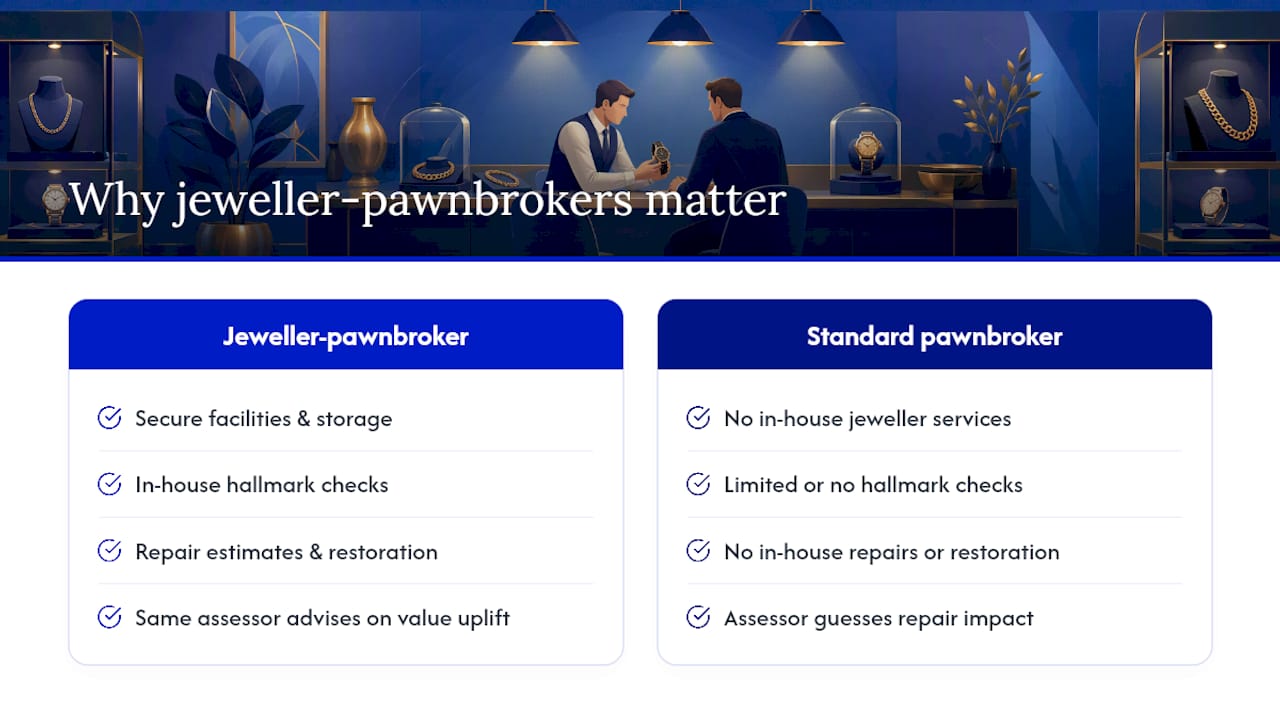
High-street pawnbrokers that are also working jewellers bring something genuinely useful to the table: in-house expertise. The NPA notes that jeweller-pawnbrokers have secure facilities and the skills to carry out hallmark checks, repair estimates and proper storage — all in one place.
Blackwelljewellers has been doing exactly this for over 20 years, with stores in Maidstone, Gravesend and Bexleyheath. Every item that comes in for pawnbroking is inspected and hallmark-verified by jewellers who also handle authentication and restoration of pre-owned pieces. That matters because the same person assessing your chain for a loan is the same person who can tell you whether a repair would increase its loanable value.
When a jeweller-pawnbroker can assess, repair and lend against an item under one roof, you get a more accurate valuation and a clearer picture of your options — not just a quick scrap-price offer.
The practical upshot: if your watch needs a service or your bracelet has a broken clasp, you can get a repair estimate and a loan estimate in the same appointment. Ask whether the repair cost can be offset against the loan, or whether the uplift in value after repair justifies the spend before you commit.
Pro Tip: When visiting a jeweller-pawnbroker, ask specifically: “If I had this repaired here, how would that change the loan offer?” A shop with in-house repair capability can give you a concrete answer. One without it is guessing.
The practical bit nobody tells you
Look, most guides on pawning gold jewellery are either too vague (“get multiple quotes!”) or too dry (wall-to-wall legislation). What I have tried to do here is give you the actual numbers, the actual questions and the actual red flags — the stuff you can use in the shop, not just read about afterwards.
The worked examples in the loan section are not gospel. Gold prices move, and pawnbrokers vary. But the method is sound: know your item’s weight and karat, understand the LTV range you are likely to be offered, and walk in with a floor figure in mind. Use the questions checklist. Check the FCA register. Keep the pawn ticket somewhere you will actually find it.
If you do those things, you are already better prepared than most people who walk into a pawnbroker.
Transparent pawnbroking and valuations at Blackwelljewellers
If you are ready to get a loan against a gold watch, chain or bracelet and you want to deal with people who actually know what they are looking at, Blackwelljewellers is worth a visit. With over 20 years of experience in gold, pre-owned jewellery and in-house repairs, the team brings genuine expertise to every valuation — not just a scales-and-calculator approach.

The pawnbroking service covers gold jewellery, watches and bracelets, with clear written terms, FCA-compliant paperwork and in-house hallmark verification. If your item needs a repair before it reaches its best loan value, the jewellery repair team is on site. Stores in Maidstone, Gravesend and Bexleyheath mean you are never far from a face-to-face valuation. Pop in, bring your ID and the item, and get a written offer with no obligation to proceed.
Sources
These are the primary sources worth bookmarking if you want to verify your rights or read the full rules:
- Pawnbroking sector review | FCA
- The Consumer Credit (Agreements) Regulations 2010
- Pawnbrokers - Citizens Advice
- How Pawnbroking Works, What is Pawnbroking? | The NPA
This article is general information, not a substitute for advice from a qualified financial advisor. Consult a qualified financial professional about your own circumstances before acting on anything here.
Recommended
- How much can you get for pawning jewellery in the UK? – Blackwell Jewellers
- Pawning jewellery vs selling gold: which is better? – Blackwell Jewellers
- Top 6 selling gold jewellery vs pawning jewellery 2026 – Blackwell Jewellers
- Get cash for pawned jewellery: UK market worth £1991m in 2024 – blackwellonline