

TL;DR:
- Selling gold outright provides higher immediate cash than pawning. Pawning allows you to reclaim your item within a set period but may incur high interest costs.
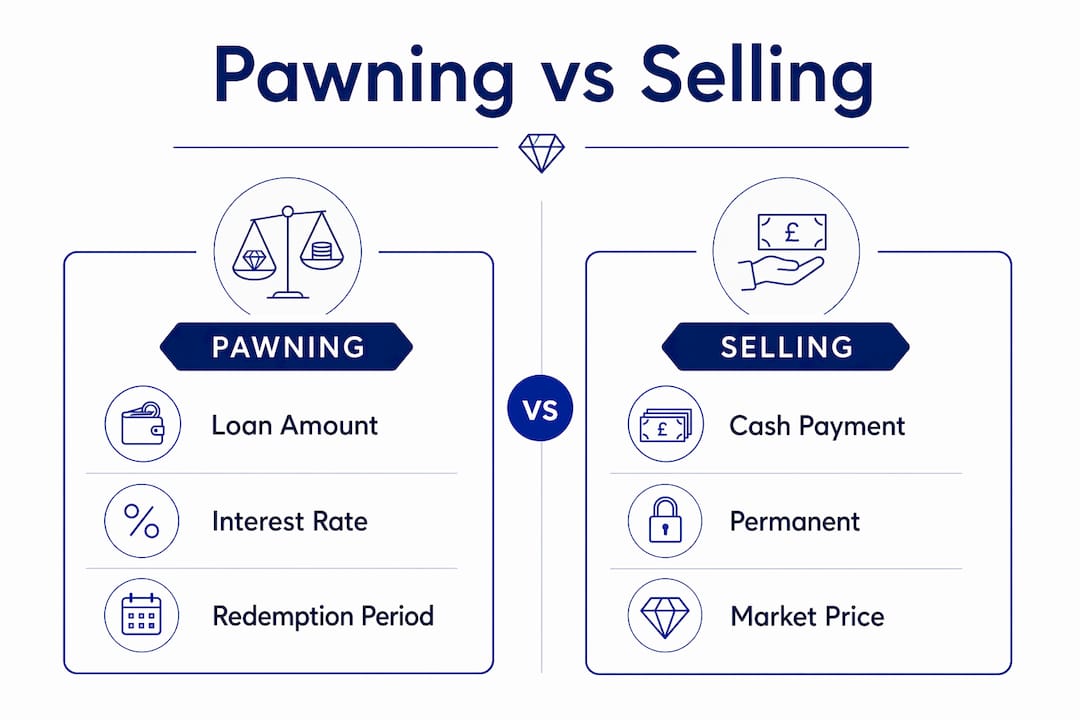
Selling gold outright is defined as the permanent exchange of your jewellery for immediate cash, while pawning is a secured loan arrangement where you keep the right to reclaim your item. When comparing pawning jewellery vs selling gold, which is better depends entirely on whether you need a short-term cash fix or the maximum possible payout. Selling gold almost always yields more cash upfront. Pawning makes sense only when you genuinely intend to get your item back. Blackwelljewellers, with over 20 years of trading across Kent including stores in Maidstone, Gravesend, and Bexleyheath, handles both options daily and sees the consequences of each choice up close.
Pawning jewellery vs selling gold: what each option actually means
Pawning jewellery is a form of high-cost credit, regulated by the Financial Conduct Authority (FCA). You hand over your item as collateral, receive a loan, and pay interest until you redeem it. You do not sell ownership. You borrow against it.

All UK pawnbrokers must be FCA authorised, which means they are legally required to show you the full interest rate, all fees, and the exact terms before you sign anything. Typical redemption periods run six to seven months. If you do not repay within that window, the pawnbroker can sell your item to recover the debt.
Here is the part most people miss: if the pawnbroker sells your item for more than the outstanding loan amount, the excess must be returned to you under FCA rules. That is a genuine consumer protection worth knowing about before you walk in.
Selling gold, by contrast, is permanent. You hand over the piece, you receive cash, and that is the end of the relationship between you and the jewellery. No interest, no redemption period, no paperwork beyond a receipt. The trade-off is that you lose the item entirely, regardless of sentimental value.
How much will you actually get when selling gold?
Payout rates vary enormously depending on where you sell. Online gold specialists pay 78–85% of spot price, which is the daily market rate for gold. That is the best return most private sellers can realistically achieve.
High street pawn shops offering outright purchase sit considerably lower. Pawn shops typically pay 30–50% of spot price for gold they buy outright, though they offer immediate cash and zero waiting. That speed comes at a real cost to your payout.
Local independent jewellers sit in a strong middle ground, often paying 70–80% of spot price with same-day payment. They can refurbish and resell pieces rather than simply melting them down, which means they can afford to offer more. For sellers in Kent, this makes a well-regarded local jeweller a genuinely competitive option.
Selling channels range widely from auction houses to private sales, with payout rates from 40–95% of retail or spot price depending on the item and the buyer. Auction houses work well for antique or designer pieces with collector appeal. Private sales can achieve the highest returns but require time, trust, and effort.
Pro Tip: Before accepting any offer, check the live gold spot price on a site like the London Bullion Market Association (LBMA) and calculate what percentage of spot you are being offered. If a buyer cannot explain their offer in those terms, walk away.
Gold purity and weight drive every offer. A 9ct gold chain and an 18ct gold chain of identical weight will fetch very different prices. Always know your hallmark before you go in. Check tips for maximising your sale price before you commit to any buyer.
Pawning vs selling jewellery: the honest pros and cons
Neither option is universally better. Each suits a different situation. Here is the breakdown without the waffle.
Reasons to sell your gold outright:
- You receive the maximum immediate cash value, typically higher than any pawn loan offer on the same item.
- There is no interest accumulating, no redemption deadline, and no risk of losing the item through non-payment.
- The transaction is clean and final, with no ongoing financial obligation.
- If you have no emotional attachment to the piece, selling removes all future risk.
Reasons to pawn instead of sell:
- You keep the right to reclaim your item within the six to seven month redemption period, which matters enormously for sentimental pieces.
- Cash arrives immediately, often on the same day, without a permanent sale.
- If your financial situation improves quickly, you can redeem the item and the total cost may be lower than you expect.
- Pawning suits short-term cash gaps, not long-term financial problems.
The catch with pawning:
Pawnbroking contracts can be extended by paying accrued interest and re-pledging the item. That sounds helpful. In practice, it raises the total cost of the loan significantly. If you extend twice, you may end up paying more in interest than the item is worth as a pawn loan. That is when pawning stops making financial sense.
The honest truth is that pawning jewellery is worth it only if you have a clear, realistic plan to repay within the redemption period. Without that plan, selling outright is almost always the better financial decision.
How to decide: practical steps for Kent residents
Choosing between pawning and selling comes down to five practical questions. Work through them honestly before you commit.
-
Do you need the item back? If the answer is yes, and you can genuinely afford to repay the loan plus interest within six months, pawning is worth considering. If the answer is no, or you are unsure, sell.
-
How urgent is the cash need? Both options can deliver same-day payment. Urgency alone is not a reason to choose pawning over selling. Do not let time pressure push you into a worse financial outcome.
-
Have you checked the buyer’s FCA status? Any legitimate pawnbroker in the UK must be FCA authorised. Check the FCA register at fca.org.uk before handing over anything. Unregulated buyers have no legal obligation to protect you.
-
Do you know what your jewellery is worth? Get an independent valuation before you accept any offer, whether for a pawn loan or an outright sale. Knowing the hallmark, weight, and approximate spot value puts you in a far stronger negotiating position. Read about what jewellery you can pawn to understand typical loan values by item type.
-
Have you read the full contract? This sounds obvious. Most people skip it. The interest rate, any additional fees, and the exact redemption date must all be stated clearly in writing under FCA rules. If they are not, that is a red flag.
Pro Tip: Bring your original purchase receipt, any certificates of authenticity, and a valid photo ID to any valuation appointment. Documentation consistently improves offers, particularly for diamond pieces or branded jewellery.
For Kent residents specifically, the advantage of using a local jeweller like Blackwelljewellers is access to in-person expert valuation, transparent terms, and a physical address you can return to if questions arise. Online buyers can offer strong payout rates, but they cannot offer that accountability.
Key takeaways
Selling gold outright delivers higher immediate cash value than pawning in almost every scenario, making it the better financial choice unless you have a firm plan to reclaim the item.
| Point | Details |
|---|---|
| Selling yields more cash | Outright gold sales return 70–85% of spot price through reputable buyers, far above typical pawn loan values. |
| Pawning preserves ownership | A pawn loan gives you six to seven months to reclaim your item, but interest accumulates throughout. |
| FCA authorisation is non-negotiable | Only use FCA-authorised pawnbrokers. Check the register before signing anything. |
| Extensions increase total cost | Extending a pawn contract raises your overall borrowing cost and can exceed the item’s loan value. |
| Local jewellers offer strong value | Independent jewellers in Kent often pay 70–80% of spot price with same-day payment and genuine accountability. |
What I have actually seen working in Kent jewellery
People come in thinking pawning is the “safe” option because they get to keep the item. I understand that instinct completely. But I have watched customers extend their contracts twice, pay more in interest than they originally borrowed, and still lose the piece in the end. That is not safety. That is expensive delay.
The customers who get the best outcomes are the ones who come in knowing their hallmark, having checked the spot price that morning, and with a clear idea of whether they actually need the item back. Those people negotiate well. They leave satisfied, whether they pawn or sell.
My honest view: if you are on the fence, sell. The financial case for selling outright is almost always stronger. Pawning makes sense for a grandmother’s ring or a piece with real personal history, where the emotional cost of permanent loss outweighs the financial cost of interest. For a gold chain you have not worn in three years? Sell it, get the best price, and move on.
One thing I will say firmly: avoid any buyer who cannot tell you clearly what percentage of spot price they are offering. That opacity is not an accident. Check how pawnbroking works at a local jewellers if you want to understand what a transparent process actually looks like before you commit.
— James
Blackwelljewellers: pawning and selling gold in Kent, done properly
Blackwelljewellers offers fully FCA-compliant pawnbroking services across its Kent stores in Maidstone, Gravesend, and Bexleyheath, with transparent loan terms, clear interest rates, and no hidden fees. If selling is the right move for you, the team provides expert in-person valuations on gold, silver, and diamond pieces, with competitive offers based on live spot prices.

Whether you are weighing up a short-term pawn loan or looking to sell gold jewellery for the best possible price, Blackwelljewellers gives you the information you need before you decide. Visit the second-hand jewellery page to see how the buying and selling process works, or walk into any Kent store for a no-obligation valuation from an expert who will give you a straight answer.
FAQ
What is the difference between pawning and selling jewellery?
Pawning is a secured loan where you keep the right to reclaim your item after repaying the loan plus interest, typically within six to seven months. Selling is a permanent exchange of your jewellery for cash, with no ongoing obligation.
Is pawning jewellery worth it?
Pawning is worth it only if you have a realistic plan to repay the loan within the redemption period. Without that plan, the interest costs accumulate and you risk losing the item anyway, making an outright sale the better financial choice.
How much can I get for pawning gold jewellery?
Pawn loan values are typically lower than outright sale prices, as pawnbrokers factor in the risk of non-redemption. Outright gold sales through reputable buyers return 70–85% of spot price, while pawn loans are generally offered at a lower percentage of the item’s value.
Do I need to use an FCA-authorised pawnbroker?
Yes. All legal UK pawnbrokers must be FCA authorised, which means they are required to disclose full interest rates, fees, and redemption terms before you sign. You can verify any pawnbroker’s status on the FCA register at fca.org.uk.
What happens if I cannot repay my pawn loan?
If you do not repay within the redemption period, the pawnbroker can sell your item to recover the debt. If the sale price exceeds the outstanding loan amount, the pawnbroker must return the surplus to you under FCA rules.