

TL;DR:
- Choosing in-house jewelers ensures direct communication and accountability from design to fabrication. Always ask for UK hallmarking and a written New Replacement Value to ensure proper insurance coverage. Blackwelljewellers offers over 20 years of in-house expertise with transparent processes and full hallmarking support.
Commissioning custom gold jewellery made by in-house jewellers gives you one accountable workshop, direct communication between designer and bench jeweller, and a hallmarked, handmade piece you can insure and service locally. The short version: book a consultation with a workshop where the person who designs your piece and the person who makes it are in the same room. That single fact changes everything about quality, accountability and aftercare.
Here is what you need to know before you pick up the phone:
- Choose in-house over outsourced — when design and fabrication happen under one roof, errors get caught before casting, not after.
- Confirm hallmarking — under the Hallmarking Act 1973, gold items above 1 gram must carry a legally recognised hallmark before sale in the UK.
- Ask for a New Replacement Value at handover, not a second-hand valuation — your insurer needs the former.
- Book early — standard bespoke commissions run several weeks; complex pieces take longer.
- Blackwelljewellers, with stores across Kent (Maidstone, Gravesend and Bexleyheath), offers exactly this: an in-house workshop, named bench goldsmiths, and full hallmarking support.
Table of Contents
- What does “custom gold jewellery made by in-house jewellers” actually mean?
- How the commissioning process works, step by step
- Materials, karats and gemstone choices for your bespoke gold piece
- How bespoke gold pieces are priced in the UK
- How long does a bespoke commission take?
- Why in-house craftsmanship gives you something outsourced work cannot
- Questions to ask at your first consultation (and red flags to watch for)
- Blackwelljewellers’ in-house credentials and what that looks like in practice
- Key takeaways
- Why I think the “in-house” question is the only one that really matters
- Start your bespoke commission with Blackwelljewellers
- Useful UK sources for hallmarking and commissioning guidance
What does “custom gold jewellery made by in-house jewellers” actually mean?
Most people assume any jeweller who takes a commission makes the piece themselves. Plenty do not. A significant portion of the industry sends briefs to a trade workshop elsewhere, sometimes overseas, and the piece arrives back finished. You never meet the person who made it, and if something goes wrong, accountability gets murky fast.
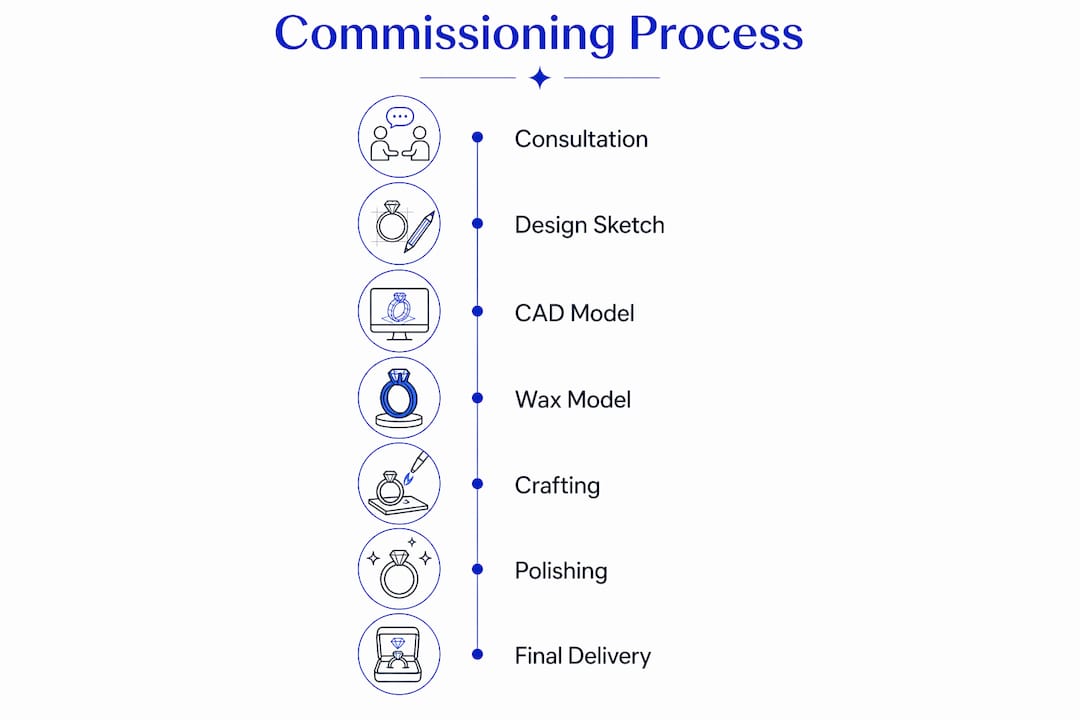
In-house bespoke means the designer and the bench jeweller work in the same workshop. Your brief goes directly from conversation to the hands of the craftsperson who will execute it. No telephone game. No lost-in-translation moments between your vision and the finished metal.
The typical services you should expect from a genuine in-house workshop:
- Sketch and CAD design — digital drawings you approve before anything is made
- Wax model or 3D-printed prototype — a physical preview of the form before casting
- Hand fabrication and casting — the actual goldsmithing, done on-site
- Stone setting — claw, bezel, flush or pavé, performed by the same bench team
- Hallmark submission — sent to a UK Assay Office for independent purity verification
- Finishing and polishing — the labour-intensive final stage that defines the look
Pro Tip: Ask specifically whether the bench jeweller attends your consultation. If the answer is no, you are dealing with a design-only studio that outsources the making. That is not necessarily bad, but it is not the same thing.
How the commissioning process works, step by step
The bespoke design journey follows a logical sequence, and knowing it in advance means you will not be surprised by fees, timelines or approval stages.
-
Discovery and moodboard — You share references, sketches, Pinterest boards, or a rough description. The designer (and ideally the bench jeweller) listens, asks questions about lifestyle and wear frequency, and identifies any technical constraints. This stage is usually free or covered by a small consultation deposit.
-
Sketch and CAD — The designer produces hand sketches, then moves to CAD software for precise 3D modelling. CAD fees vary; some workshops bundle them into the total price, others charge separately. Revision fees typically apply after the second round of changes, so be specific early.
-
Wax model approval — A 3D-printed wax or resin model lets you hold the piece before a gram of gold is committed. This is your last low-cost chance to adjust proportions. Approve it in writing.
-
Casting and fabrication — The wax is invested and cast in your chosen gold alloy, or the piece is hand-fabricated from sheet and wire. The bench jeweller handles this entirely.
-
Stone setting and finishing — Hand finishing, stone setting and inspection are where the majority of bench hours are spent. This is where the in-house maker adds tangible, measurable value: tapered shanks, reinforced bezels, mirror polishes.
-
Hallmarking — The finished piece is submitted to a UK Assay Office. A hallmark comprises a sponsor’s mark, a fineness mark, an Assay Office mark and optionally a date letter. This is independent verification of metal purity, not a formality.
-
Handover — You collect or receive the piece with its hallmark certificate and, critically, a written New Replacement Value for insurance.
Materials, karats and gemstone choices for your bespoke gold piece
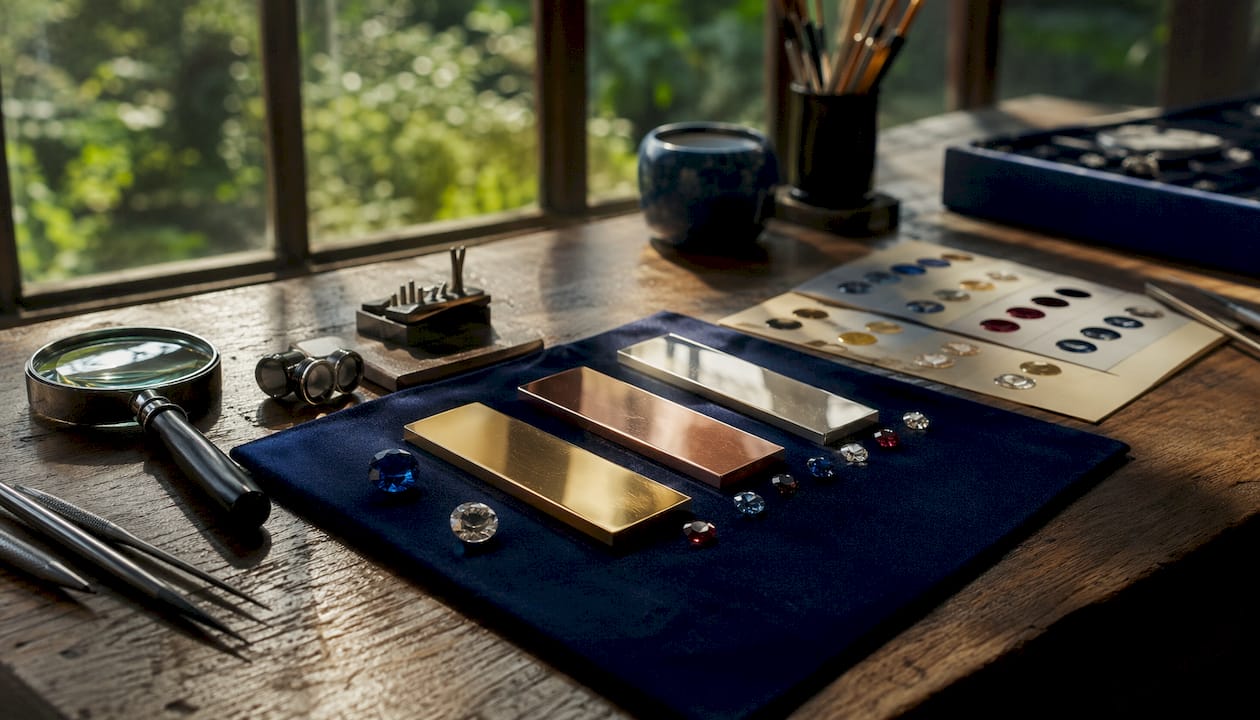
Gold in the UK is sold in three main fineness levels, each with a different character:
- 9ct gold (375 parts per thousand) — the most durable and the most affordable; the alloy metals give it resilience, making it popular for everyday rings.
- 14ct gold (585 parts per thousand) — a middle ground common in European and American markets, increasingly available from UK workshops.
- 18ct gold (750 parts per thousand) — richer colour, higher purity, softer. The standard for fine jewellery and the preferred choice for high-value stone settings.
Colour options (yellow, rose, white) are determined by the alloy metals mixed with the gold. White gold requires rhodium plating to achieve its bright finish; that plating wears over time and needs periodic re-plating, typically every 1–3 years depending on wear. Worth knowing before you commit.
On gemstones: the setting type affects longevity as much as the stone itself. Claw settings show more of the stone but are more vulnerable to snagging. Bezel settings wrap the stone in metal and suit active wearers. Flush (or gypsy) settings sit the stone level with the surface, the most protected option of all.
Pro Tip: If you want to understand the difference between solid gold and plated alternatives before your consultation, this guide on solid gold versus vermeil is a clear starting point.
Ethical sourcing matters here too. Blackwelljewellers sources ethically and can work with recycled gold practices that reduce the environmental footprint of your commission. If you want to bring family gold for reworking, that is possible, but it comes with a caveat: not all workshops accept customer gold for remelting. A bench test for alloy purity is standard. Unknown contaminants or low fineness may mean the metal is used as fill or combined with new alloy rather than remelted wholesale. A reputable in-house workshop will test and explain your options rather than promise a straightforward remelt with no checks.
How bespoke gold pieces are priced in the UK
Cost is the question everyone has and nobody wants to ask first. Here is a straightforward breakdown.
Key cost drivers:
- Metal weight and current gold spot price
- Stone quality (carat, cut, clarity, colour for diamonds; origin and treatment for coloured stones)
- Bench hours (complexity of fabrication and finishing)
- CAD and mould fees
- Hallmarking fees (paid to the Assay Office)
Independent makers typically allocate around 60% of the price to materials and labour, compared with roughly 25% at large chains where showroom costs and marketing absorb the rest. More of your money reaches the physical piece.
| Piece type | Approximate UK price range | Main cost driver |
|---|---|---|
| Simple gold pendant (9ct, no stones) | £150 | Metal weight and bench time |
| Bespoke engagement ring (18ct, mid-range diamond) | £1,500 | Stone quality and setting complexity |
| Heavy sculptural gold piece (18ct, complex form) | £4,000 | Extended bench hours and finishing |
These are illustrative bands. Your actual quote depends on the current gold price, stone selection and the specific workshop’s labour rate.
One thing many clients miss: always request a New Replacement Value for insurance, not a second-hand valuation. The New Replacement Value reflects the current cost to commission an identical piece, including labour, materials and design fees. A second-hand valuation will be lower and will leave you underinsured if the piece is lost or stolen.
How long does a bespoke commission take?
Workshops commonly report 4–8 weeks for standard bespoke pieces. Complex commissions, particularly those with intricate stone arrangements or sculptural forms, regularly run to 8–12 weeks or beyond.
| Stage | Typical duration |
|---|---|
| Discovery and moodboard | 1–3 days |
| Sketch and CAD | 1–2 weeks |
| Wax model production and approval | 3–7 days |
| Casting and fabrication | 1–2 weeks |
| Stone setting and finishing | 1–2 weeks |
| Hallmarking (Assay Office turnaround) | 3–8 weeks |
| Total (standard commission) | 4–8 weeks |
Rush options exist but come at a cost, both financial and in terms of the bench jeweller’s capacity to give your piece full attention. If you have a wedding date, anniversary or birthday in mind, build in at least two weeks of buffer beyond the estimated lead time. Engagement and wedding seasons (late winter through spring) are the busiest periods for UK workshops; book early or expect to wait.
Why in-house craftsmanship gives you something outsourced work cannot
When designer and bench jeweller work in the same workshop, communication is direct and design-to-production errors fall sharply. That is not marketing copy; it is a practical reality. A bench jeweller who sat in your consultation understands why the band needs to be tapered or why the bezel needs extra depth. That context does not survive a brief sent to a trade shop.
Trust signals to look for when assessing any in-house claim:
- Named bench goldsmiths — can you find out who will make your piece?
- Visible workshop — can you visit it, or at least see it?
- Hallmarking process — do they submit to a UK Assay Office directly?
- Written warranty — what does it cover and for how long?
- Aftercare and repair policy — will they service the piece after handover?
- Ethical sourcing statement — is it specific, or just a vague pledge?
Blackwelljewellers ticks each of these. The role of in-house jewellers in ethical sourcing is something the team takes seriously, not as a marketing exercise but as a practical commitment backed by over 20 years of trading.
Questions to ask at your first consultation (and red flags to watch for)
Walk into any consultation with this list. A good studio will answer every question without hesitation.
Selection criteria checklist:
- Can I visit the workshop?
- Do you have a portfolio of completed bespoke commissions?
- Are your pieces hallmarked by a UK Assay Office?
- Do you provide a written New Replacement Value at handover?
- What is your warranty and aftercare policy?
- Do you carry professional indemnity insurance?
Direct questions to ask:
- Who will physically make my piece, and can I meet them?
- Where is the piece made — on these premises?
- Which Assay Office do you use for hallmarking?
- If I bring family gold, how do you test the alloy before accepting it?
- What happens if the piece needs a repair six months after handover?
- Can you provide a written New Replacement Value for insurance purposes?
For more on working with a jewellery designer, Blackwelljewellers has a practical guide that covers exactly this ground.
Red flags: vague answers about where the piece is made; refusal to show the workshop; no clear hallmarking process; a valuation offered as “second-hand” rather than New Replacement Value; no written warranty.
Blackwelljewellers’ in-house credentials and what that looks like in practice
Blackwelljewellers has been trading for over 20 years, with in-house workshops across its Kent stores. The bench team handles everything from simple resizing to complex bespoke commissions, and the same goldsmiths who make the pieces are available for aftercare and jewellery repairs after handover.

Two examples of what in-house capability looks like:
Reworked family gold: A client brings a grandmother’s 18ct yellow gold chain, worn and broken, with sentimental value that far exceeds its weight. The bench team tests the alloy, confirms purity, and discusses options: remodel into a pendant, incorporate into a new ring shank, or combine with new gold for a more complex form. The piece is hallmarked after fabrication, so the client receives a legally verified piece with a clear provenance story. The process of refurbishing and reworking gold is documented and transparent at every stage.
Bespoke engagement ring: A client arrives with a rough sketch and a stone budget. The bench jeweller attends the consultation, flags that the preferred claw setting would not suit the client’s active lifestyle, and suggests a low-profile bezel instead. CAD is produced, a wax model approved, and the finished ring is hallmarked at the London Assay Office before handover, complete with a written New Replacement Value.
In-house proofs: named workshop locations, 20+ years of trading history, direct Assay Office submission, portfolio available in-store and online, written aftercare and warranty policy on request.
Key takeaways
Commissioning bespoke gold jewellery from a genuine in-house workshop means one accountable team, direct communication, and a hallmarked piece you can insure and repair locally.
| Point | Details |
|---|---|
| Choose in-house over outsourced | Designer and bench jeweller in the same workshop reduces errors and improves accountability. |
| Confirm UK hallmarking | Gold above 1 gram must be hallmarked under UK law; ask which Assay Office your jeweller uses. |
| Request New Replacement Value | A second-hand valuation underinsures a bespoke piece; always ask for New Replacement Value in writing. |
| Budget for the full process | Materials, bench hours, CAD, mould and hallmarking fees all contribute to the final price. |
| Blackwelljewellers | Over 20 years of in-house goldsmithing across Kent, with named bench jewellers, hallmarking and written aftercare. |
Why I think the “in-house” question is the only one that really matters
Here is the thing nobody says plainly enough: the word “bespoke” has been stretched so thin it barely means anything any more. Plenty of jewellers will take your brief, send it to a trade workshop in Birmingham or abroad, and hand you back a finished piece with their name on it. Technically, they designed it. But they did not make it, and crucially, they cannot tell you exactly what happened between the CAD file and the casting.
The in-house question cuts through all of that. Not because outsourced work is always bad, but because in-house work gives you something outsourced work structurally cannot: a single person, or a small team, who is accountable for every decision from first sketch to final polish. When something needs adjusting, they know why they made that choice. When you come back two years later for a resize or a re-plate, they remember the piece.
The premium for in-house bespoke is real. But it is not a luxury surcharge. It is what you pay for the bench jeweller’s expertise, their time, and the fact that more of your money reaches the physical piece rather than a showroom’s rent bill. That framing matters when you are deciding whether to commission or buy off the shelf.
Start your bespoke commission with Blackwelljewellers
Blackwelljewellers offers something most high-street jewellers cannot: a bench jeweller present at your consultation, CAD and wax previews before a gram of gold is committed, and full hallmarking and New Replacement Value guidance at handover.

To book, visit any of the Kent stores (Maidstone, Gravesend or Bexleyheath) or get in touch online. Bring your moodboard, any existing gold you want reworked, your budget range and, for rings, your finger size. The team will walk you through material choices, realistic timelines and a transparent quote. If you are curious about custom jewellery design in Bexleyheath, there is a dedicated guide covering exactly what to expect from a local consultation.
For aftercare, repairs and hallmarking queries after handover, the jewellery repairs service is available in-store. Book your consultation and bring your ideas.
Useful UK sources for hallmarking and commissioning guidance
- Hallmarking: how businesses can comply with the law — GOV.UK guidance on the legal obligations for selling hallmarked precious metals in the UK.
- Hallmarking guidance notes — the official UK Assay Office guidance covering fineness marks, sponsor’s marks and exempt articles.
- Hallmarking Act 1973 — the primary legislation governing hallmarking in the UK, including minimum weight thresholds and approved marks.
- GOV.UK hallmarking summary — a plain-English summary of what must be hallmarked, minimum thresholds and buyer protections.
For New Replacement Value guidance, ask your jeweller directly at handover, or consult a qualified independent valuer registered with the National Association of Jewellers.
Recommended
- 1oz of Pure Gold | Handmade Mount Crafted the Old Way by Blackwell Jew – Blackwell Jewellers
- How We Hand-Made a Cannabis Leaf in Solid Gold | Bespoke Jewellery – Blackwell Jewellers
- Designing Your Dream: How to Start Creating Your Own Bespoke Jewellery – blackwellonline
- Master Jeweller Reacts To YouTube Jewellery Makers (Novice → Expert) – Blackwell Jewellers