

Diamond traceability rests on two provable things: an independently verifiable origin test, and an unbroken chain of custody. Miss either one, and what you’re holding isn’t proof. It’s a story.
Traceability, properly done, means you can point to evidence showing where a diamond came from and who handled it on the way to your finger. That evidence takes two forms, and buyers need to know the difference before they trust either one.
- Scientific origin verification — laboratory testing (such as the GIA Diamond Origin Report) that matches a polished stone back to the rough it came from.
- Chain-of-custody records — documentation, often ledgered on platforms like Tracr or Everledger, that logs who held the stone at each transfer point.
The Kimberley Process sits underneath both, certifying shipments of rough diamonds at the border. It sets a base level but does not cover all aspects of traceability. The AIDI provenance framework is the clearest tool for judging whether a claim is real or decorative, and we’ll come back to it.
Key Takeaways
Credible diamond traceability requires both an independently verifiable scientific origin test and an unbroken, checkable chain-of-custody record, and a claim resting on only one of these is incomplete.
| Point | Details |
|---|---|
| Demand two forms of evidence | Ask for a scientific origin report and custody documentation; either alone is an incomplete provenance claim. |
| Kimberley Process has limits | It certifies rough shipments at border level and does not verify labour conditions or track individual polished stones. |
| Origin testing needs rough-stage data | GIA-style origin reports only work if the diamond was analysed before polishing, so many older stones can’t retroactively qualify. |
| Blockchain records aren’t audits | Ledgers like Tracr and Everledger log what’s entered; check whether that entry was made at the mine or added later by a retailer. |
| Watch vague marketing language | Phrases like “fully traceable” mean little without a report number, laser inscription, or checkable ledger entry attached. |
Table of Contents
- Diamond traceability and the gap between custody and origin
- How blockchain-based diamond supply chain tracking actually works
- What a GIA Diamond Origin Report can and can’t tell you
- A verification checklist before you buy, and what it costs
- Provenance claims that sound convincing but prove nothing
- How Blackwelljewellers verifies pre-owned diamonds before they reach a customer
- The history and development of diamond traceability initiatives
- Why ethical sourcing and fair trade practices depend on traceability
- Has diamond traceability actually reduced conflict diamonds?
- Beyond blockchain: spectroscopy, DNA tagging and the next verification tools
- Who’s responsible for traceability: miners, dealers and retailers
- The legal and regulatory frameworks shaping diamond traceability
- Choosing verified pre-owned diamonds with confidence
- What actually matters when you’re evaluating a provenance claim
- Sources
Diamond traceability and the gap between custody and origin
Here’s where most buyers get confused, and honestly, most sales staff don’t clear it up either. Chain of custody and origin verification sound like the same thing. They’re not, and the gap between them is where weak provenance claims hide.
Chain of custody tracks movement. Every time a diamond changes hands, from mine to cutter to wholesaler to retailer, a record gets created: an invoice, a certificate, a ledger entry. Done properly, this builds an audit trail. It tells you the stone travelled through legitimate, documented channels.
Origin verification tracks geology. It answers a completely different question: does this specific polished diamond actually come from the mine everyone says it does? You can’t answer that with paperwork alone. It needs laboratory science, because paper trails can be forged, mislabelled, or simply lost, while a diamond’s physical characteristics can’t lie in the same way.
This is exactly why the AIDI provenance framework treats provenance as a two-part test:
- Origin specificity — how precisely can the source be identified? Country-level is weak. Mine or district level is strong.
- Chain-of-custody integrity — is the paper or digital trail unbroken from that source to the point of sale?
A diamond that passes only one test has an incomplete story. A retailer with flawless paperwork but no scientific origin data can tell you where the stone allegedly started, not confirm it. And a lab report confirming origin without custody records can’t tell you the stone in the report is the same one in the ring box.
How blockchain-based diamond supply chain tracking actually works
Ledger platforms don’t test diamonds. They record what people tell them about diamonds, then make that record hard to quietly alter afterwards. That distinction matters more than the marketing usually lets on.
In practice, a platform like De Beers’ Tracr registers a rough stone’s characteristics near the point of mining, then logs each subsequent transfer as the diamond moves through cutting, polishing, and distribution. Everledger works on a similar principle, building tamper-evident records that trade partners and, increasingly, consumers can check. By the time a stone reaches a shop counter, a customer might scan a QR code or enter a report number and see a summarised journey: mined here, cut there, certified on this date.
Academic research into blockchain traceability shows the technical model behind this is genuinely solid. Combining a blockchain ledger with off-chain storage systems like IPFS and QR-based identifiers can deliver consumer-facing verification while keeping data costs manageable. The same research flags the catch: the system is only as honest as whoever enters the first record, and industry-wide adoption is still patchy.
- Ledgers record what’s entered; they don’t independently verify it at the point of entry.
- Most consumer-facing platforms are brand-controlled, not third-party audited.
- A tamper-evident log stops retroactive edits. It doesn’t stop bad data going in on day one.
Pro Tip: Ask whether the ledger entry was created at the mine or added later by a retailer. An origin record logged at extraction carries far more weight than one added at the point of sale.
What a GIA Diamond Origin Report can and can’t tell you
A lab report is the closest thing the diamond trade has to a lie detector, but it only works if the stone was tested before it was polished. That’s the part most buyers never hear.
The GIA Diamond Origin Report uses rough-to-polish matching alongside spectroscopic analysis to confirm where a diamond actually originated. GIA examines the rough stone before cutting, records its optical and physical fingerprint, then compares that fingerprint against the finished, polished diamond later. If they match, origin is scientifically confirmed rather than merely claimed.
- Rough-to-polish matching: comparing measurable features of the uncut stone to the same stone once faceted.
- Spectroscopic analysis: reading how a diamond absorbs and reflects light to build a chemical and structural profile.
- Inclusion mapping: charting internal features unique enough to act almost like a fingerprint.
Gemmological research backs this up beyond GIA specifically: inclusion mapping and spectroscopy can validate country-of-origin claims and even help flag treated or synthetic stones.
Here’s the constraint nobody advertises: this only works on diamonds submitted before polishing. A stone that’s already cut and sitting in a display case, with no rough-stage record, simply cannot get this certification retroactively. That’s not a flaw in the science. It’s a hard limit on when the science can be applied, and it explains why so much of the market’s older stock has no origin report at all.
A verification checklist before you buy, and what it costs
Walk into any jeweller and ask one question: “What paperwork proves this?” The answer tells you almost everything.
- Request the lab report number. A genuine GIA report has a unique number you can look up independently, not just a certificate someone printed.
- Check for a laser inscription. Many certified diamonds carry a microscopic inscription on the girdle matching the report number, viewable under 10x magnification.
- Ask for Kimberley Process paperwork on rough stones, though remember this only covers the shipment, not the individual polished stone in front of you.
- Check whether a blockchain or ledger record exists, and ask who created the entry and when.
- Ask who paid for testing. Origin reports are usually commissioned by the mining company, cutter, or retailer earlier in the chain, not the end customer, which is worth knowing before anyone tries to upsell you an “on the spot” test.
Turnaround for a full origin report typically runs to several weeks, since it depends on rough-stage data being captured months or years earlier. Costs vary by stone size and service tier, and they’re usually built into the retail price rather than charged separately to the shopper.
Pro Tip: If a jeweller can’t produce a report number you can verify independently, treat any origin claim as a sales pitch, not a certificate. Our ethical diamond selection checklist walks through exactly what to ask for in-store.
Provenance claims that sound convincing but prove nothing
“Fully traceable” is one of the most confident-sounding phrases in the jewellery trade, and one of the least regulated. Nobody polices what it means, so it means whatever the seller wants it to mean that day.
Watch for these gaps:
- Brand-only claims with no independent audit. A retailer’s own ledger is a useful record, but it’s brand-assured, not third-party verified, unless stated otherwise.
- Shipment-level tracking presented as stone-level tracking. The Kimberley Process certifies parcels of rough diamonds crossing borders. It says nothing about the individual polished stone once mixing and cutting occur, because rough from multiple sources often gets processed together.
- Vague language with no attached documents. “Responsibly sourced” and “conflict-free” mean nothing without a report number, a certificate, or a named framework behind them.
If a claim can’t point to a document, a laser inscription, or a checkable ledger entry, it’s marketing language wearing a lab coat.
How Blackwelljewellers verifies pre-owned diamonds before they reach a customer
Every pre-owned diamond piece Blackwelljewellers takes in goes through the same discipline the industry’s best origin science demands: check before you trust, document before you sell.
- Each stone is authenticated against existing hallmarks and, where present, cross-checked against any lab report numbers already associated with the piece.
- Where a laser inscription exists on the girdle, it’s verified under magnification against the paperwork on file.
- Listings state what documentation accompanies the piece, so buyers know exactly what’s confirmed and what isn’t.
- After-sale, customers can raise provenance queries directly with in-house jewellers rather than a call centre.
This mirrors the retail provenance workflow the wider trade is slowly standardising: confirm the paperwork, check the physical markers, and hand the buyer a consolidated packet rather than a verbal assurance. Browse the current second-hand jewellery collection to see how listings present that documentation in practice.
The history and development of diamond traceability initiatives
Diamond traceability didn’t start as a consumer feature. It started as damage control.
The Kimberley Process launched in 2003, born directly out of the conflict diamond crises of the 1990s, when rough stones from war zones in West and Central Africa were funding armed conflict. The scheme required participating countries to certify that shipments of rough diamonds were conflict-free before crossing borders, and for a while it was the entire industry’s answer to the ethics question.
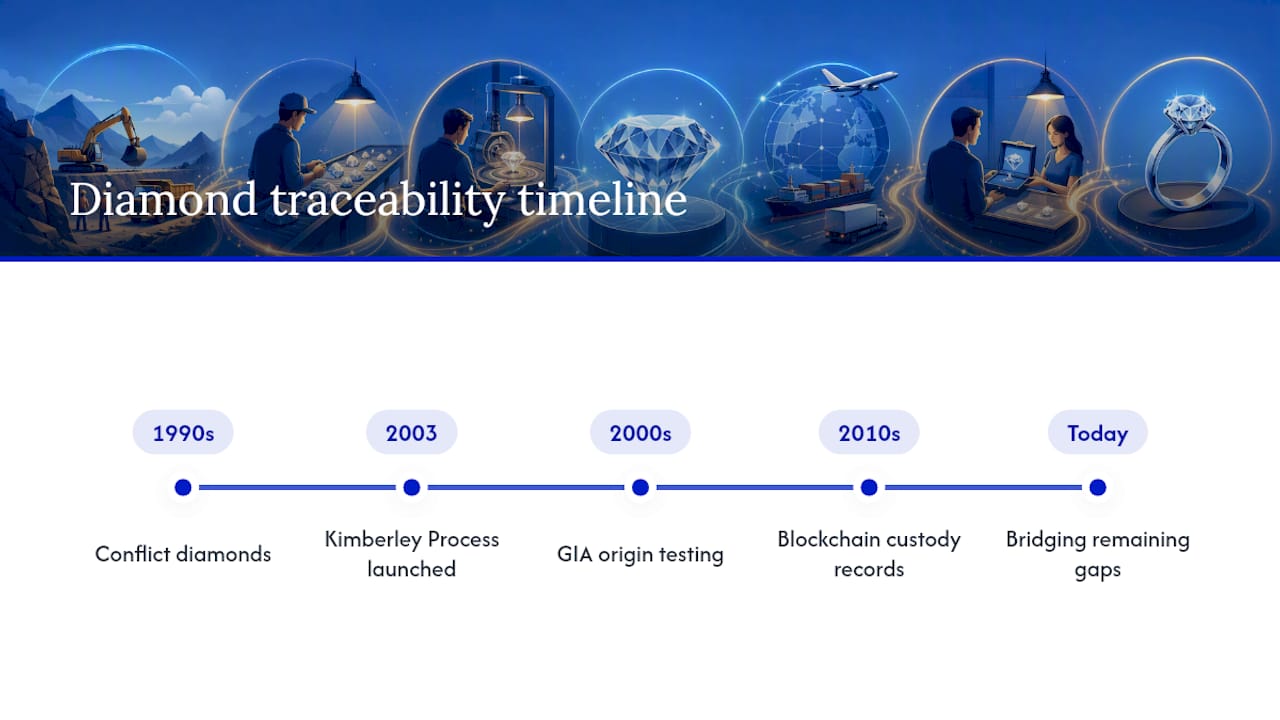
It was never designed to do more than that. As reporting on conflict-free certification has pointed out repeatedly, the Kimberley Process addresses trade in rough stones between governments. It says nothing about labour conditions at a mine, environmental damage, or what happens to a stone after it’s cut and polished.
The next wave arrived once gemmological labs realised chemistry could do what paperwork couldn’t. GIA began developing origin-testing methods that used a diamond’s own physical properties as evidence, rather than relying purely on documentation supplied by traders.
Blockchain entered the picture more recently, promising to digitise and harden the custody trail that paper certificates had always struggled to keep intact. Tracr and Everledger emerged as industry-scale attempts to give retailers and consumers a checkable record, not just a printed certificate that could be photocopied or misplaced.
Each generation of tools solved a problem the previous one left open. None of them, individually, closes the whole gap.
Why ethical sourcing and fair trade practices depend on traceability
Ethical sourcing is a promise. Traceability is what turns that promise into something you can check.
A retailer can claim ethical sourcing sincerely and still have no mechanism to prove it, because “ethical” covers ground the Kimberley Process never touched: fair wages for miners, safe working conditions, community investment near mine sites, and environmental restoration afterwards. None of that shows up on a shipment certificate.
This is where the two traceability routes earn their keep. Chain-of-custody records, when kept honestly from mine to market, can show which specific supply channel a stone travelled through, which matters if that channel is tied to a mining operation with known labour and environmental standards. Scientific origin testing adds the layer that custody paperwork alone can’t: confirmation that the stone genuinely came from the source being claimed, not just a source someone wrote down.
Fair trade practices in the diamond trade lean heavily on this combination. A mine that pays fair wages and invests in local communities only translates into a meaningful consumer choice if the stones from that mine can be reliably distinguished from stones mixed in from elsewhere during cutting and polishing. Without traceability, “ethical” and “unverified” are indistinguishable on a shop counter.
For buyers who want this distinction to matter in practice, it’s worth looking at ethical diamond alternatives and how sourcing claims are documented, rather than simply advertised.
Has diamond traceability actually reduced conflict diamonds?
The honest answer is: partly, and mostly at the border, not beyond it.
The Kimberley Process was built specifically to curb the flow of conflict diamonds funding armed insurgencies, and on that narrow measure it’s had real effect. Government-issued certificates and sealed shipments created friction that didn’t exist before 2003, making it harder for rough stones from conflict zones to enter legitimate international trade channels undetected.
But the scheme’s own limits are well documented. It operates at shipment level, relying on government-validated certificates, and once diamonds are polished and mixed with stones from other sources, that shipment-level trail effectively ends. A certificate covering a parcel of rough diamonds tells you nothing about which individual polished stone in a display case came from where.
This is precisely the gap that scientific origin testing and ledgered custody systems are trying to close. Where the Kimberley Process stops at the border, rough-to-polish matching and blockchain-recorded transfers attempt to carry a form of accountability further down the chain, stone by stone rather than shipment by shipment. Neither does it perfectly yet, but together they cover more ground than either the certification scheme or the technology could alone.
Reducing conflict-financed trade required a certification floor first. Reducing it further, at the level of individual stones, is the unfinished work that origin science and digital ledgers are now attempting.
Beyond blockchain: spectroscopy, DNA tagging and the next verification tools
Blockchain gets most of the headlines, but it’s not where the hardest technical problems in diamond traceability actually sit. The harder problem is proving physical origin, and that’s a gemmology problem, not a database problem.
Spectroscopic analysis, already central to reports like GIA’s origin testing, reads how a diamond interacts with light across different wavelengths to build a structural and chemical signature. Combined with inclusion mapping, which catalogues the internal features unique to a specific stone, this gives labs a way to match a polished diamond back to rough-stage records with genuine scientific confidence.
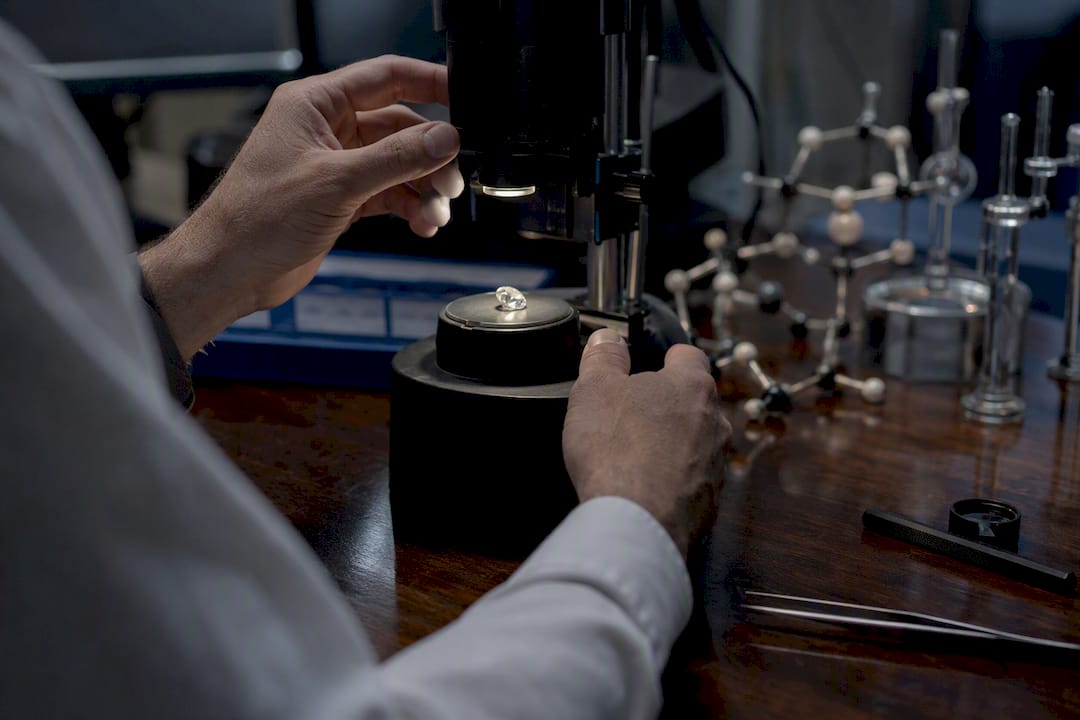
DNA-style tagging, borrowed conceptually from anti-counterfeiting techniques in other industries, has been trialled as a way to physically mark diamonds with a unique, near-impossible-to-replicate signature at the mine. It’s a promising idea, though far less standardised across the trade than laboratory spectroscopy, and adoption remains uneven.
The technological challenge that connects all of these methods, blockchain included, is the same: data has to be captured correctly at the very first point in the chain, or everything built on top of it inherits that weakness. Research into blockchain-enabled traceability makes this explicit. The ledger technology itself works. What limits it is inconsistent data entry and the cost of getting every party in a long, fragmented supply chain to participate properly.
The next real leap in diamond traceability probably won’t be a flashier ledger. It’ll be better instruments at the mine, capturing better data, earlier.
Who’s responsible for traceability: miners, dealers and retailers
Traceability breaks down whenever one link in the chain treats it as someone else’s job. It rarely breaks down because the technology failed.
Miners and mining companies hold the earliest and arguably most important responsibility: capturing accurate rough-stone data before a diamond ever leaves the ground. Origin testing like GIA’s process depends entirely on this first record existing and being accurate. Skip this step, and no amount of downstream ledger technology can retroactively invent origin data.
Cutters and polishers carry the responsibility of maintaining the link between rough and finished stone. This is the physical pinch point where mixing happens, where a batch of stones from different sources can get processed together, and where custody records are most likely to blur if nobody’s being careful.
Dealers and wholesalers are responsible for passing documentation forward honestly rather than treating certificates as optional paperwork that slows down a sale.
Retailers, including jewellers selling directly to the public, carry the final and most consumer-visible responsibility: presenting only what’s actually documented, rather than dressing up an unverified claim as certainty. This is the layer where “fully traceable” either gets used honestly or gets used as a selling phrase.
Every stakeholder up that chain is relying on the stakeholder before them having done their job properly. That’s precisely why independent, checkable evidence, a report number, an inscription, a ledger entry created at source, matters more than any single party’s word.
The legal and regulatory frameworks shaping diamond traceability
Diamond traceability sits in an odd regulatory position: heavily governed at the border, loosely governed everywhere else.
The Kimberley Process remains the dominant international framework, built through a UN-backed agreement among participating governments to certify rough diamond shipments as conflict-free. It has genuine legal teeth at customs checkpoints, since non-certified rough diamonds can be blocked from crossing borders between participating countries.
Beyond that border control, regulation gets considerably thinner. There’s no equivalent international legal requirement forcing retailers to obtain scientific origin reports, disclose chain-of-custody ledgers, or prove provenance claims before using phrases like “responsibly sourced” in marketing. Consumer protection law in the UK still applies to false or misleading claims generally, but there’s no diamond-specific statute requiring a jeweller to produce a laser inscription or lab report number before making a provenance statement.
This regulatory gap is exactly why industry frameworks like AIDI’s provenance guidance matter as much as they do. They’re not law. They function as the closest thing the trade has to a shared standard for what a credible provenance claim actually requires, filling space that legislation hasn’t caught up to yet.
For buyers, the practical takeaway is straightforward: don’t assume regulation is doing more work than it is. The Kimberley Process protects the border. Almost everything past that point relies on voluntary industry standards and the specific documentation a seller chooses to provide.
Choosing verified pre-owned diamonds with confidence
If you’ve read this far, you already understand more about diamond provenance than most people buying a diamond this week. That puts you in a strong position, provided you act on it rather than just filing it away.
Blackwelljewellers’ second-hand jewellery collection is built around exactly the documentation standards this article has walked through: authentication against hallmarks, cross-checked lab report numbers where they exist, and transparent listings that state what’s confirmed rather than implied. If you’d rather see pieces in person and ask questions face to face, the Maidstone showroom carries authenticated pre-owned stock with the same inspection standard applied before anything goes on display.
Considering a piece that needs restoration, a new inscription check, or a professional once-over before you commit? The jewellery repairs and authentication service can assess structural condition and verify existing markings, giving you a clearer picture of what you’re actually buying before money changes hands.
What actually matters when you’re evaluating a provenance claim
Most guidance on diamond traceability treats blockchain and lab science as competing solutions, pick one, trust it, move on. That framing is wrong, and it’s led a lot of buyers to over-trust whichever piece of technology sounds newest.
The uncomfortable truth is that neither route works well alone. A ledger entry proves nothing about physical origin if nobody checked the stone’s rough-stage characteristics. A lab report proves nothing about custody if there’s no record connecting that specific certified stone to the one actually in your ring setting. The two systems answer different questions, and treating either as sufficient by itself is where most “fully traceable” claims quietly fall apart under scrutiny.
What buyers should prioritise first isn’t the newest technology on offer. It’s the boring paperwork: a checkable report number, a laser inscription you can verify under magnification, and a straight answer about who created any ledger entry and when. Retailers who can produce that without hesitation are demonstrating something real. Retailers who lean on the phrase “ethically sourced” without a document in sight are asking for trust they haven’t earned yet.
— James
Sources
For readers who want to check the underlying evidence themselves rather than take a retailer’s word for it, these sources cover the science, the standards, and the technology discussed above.
- The GIA Diamond Origin Report: Diamond Traceability Based on Science
- Blockchain enabled traceability in the jewel supply chain
- Provenance - Association of Intelligent Diamond International
Recommended
- How to Tell if Your Diamond Is Real: 6 Simple Tests You Can Try at Hom – blackwellonline
- How to Verify the Authenticity of a Lab-Grown Diamond? – blackwellonline
- The 100-Year Diamond Lie EXPOSED | Lab-Grown vs Natural Explained – Blackwell Jewellers
- Diamond fluorescence: does that blue glow matter? – Blackwell Jewellers