
TL;DR:
- Most of the premium paid on gold jewellery, such as making charges and taxes, is unrecoverable upon resale.
- Buyers should verify hallmarking and purity with official tools, and prefer simpler, high-karat designs for better value.
Gold jewellery has a genuine allure as an investment. It’s tangible, beautiful, and tied to an asset that has stored value for thousands of years. But here’s what most people don’t tell you upfront: a huge chunk of what you pay when buying gold jewellery investment tips into practice poorly is simply… gone the moment you walk out the shop. Making charges, taxes, design premiums. None of it comes back on resale. This article cuts through the glamour and gives you nine practical, no-nonsense tips so your gold jewellery actually works as a financial asset, not just a pretty expense.
Table of Contents
- Key takeaways
- 1. Understand making charges before you spend a penny
- 2. Verify hallmarks and purity rigorously
- 3. Choose the right karat for your investment goals
- 4. Fit gold jewellery into a broader gold investment strategy
- 5. Prioritise pre-owned jewellery for better entry prices
- 6. Maintain your jewellery to preserve its resale value
- 7. Understand the resale mechanics before you buy
- 8. Keep your paperwork obsessively
- 9. Time your purchases with market awareness
- My honest take on gold jewellery as an investment
- Explore Blackwelljewellers’ gold jewellery collection
- FAQ
Key takeaways
| Point | Details |
|---|---|
| Making charges are unrecoverable | Premiums paid on craftsmanship are lost on resale; buyers pay only for gold content. |
| Hallmarking is non-negotiable | Always verify purity and authenticity before buying; use official tools like the BIS CARE app. |
| Simpler designs retain more value | Plain, high-carat pieces yield better resale returns than ornate, stone-heavy jewellery. |
| Jewellery suits a hybrid strategy | Allocate most gold holdings to ETFs or bonds; keep jewellery as a smaller physical allocation. |
| Documentation protects your exit | Retain invoices and certificates to maximise credibility and price when reselling. |
1. Understand making charges before you spend a penny
This is the single biggest blind spot for new investors in gold jewellery.
Making charges are the labour and design premium added on top of the raw gold price. They typically range from 5 to 25% depending on design complexity, and some artisan or handcrafted pieces go even higher. On top of that, GST applies at 3% on the gold value and 5% on the making charges themselves.
Here’s the brutal truth: making charges and GST are sunk costs. When you sell, buyers value the jewellery purely on tested gold content multiplied by the spot price. They do not care what you paid the jeweller for their artistry.
So your effective investment premium on entry can easily be 12 to 25% above the metal’s real value. That’s the gap your gold price needs to close before you break even.
Pro Tip: Ask any jeweller for an itemised bill showing the gold value, making charges, and tax separately. If they won’t provide one, walk away.
Practical negotiation moves that actually work:
- Choose simpler, machine-made designs over handcrafted ones (lower making charges, same gold weight)
- Buy during off-peak periods; demand spikes around festivals and weddings push charges up
- Purchase larger pieces or multiple items in one transaction. Jewellers will often reduce the percentage when the overall spend is significant
- Get quotes from at least three sellers and convert any flat-rate-per-gram charges into a percentage so you’re comparing like for like
2. Verify hallmarks and purity rigorously
Buying unverified gold jewellery is a gamble you really don’t want to take, especially as an investor.
Hallmarking is the official certification of a piece’s gold purity. In the UK, look for the assay office mark alongside the millesimal fineness (e.g., 750 for 18 carat, 916 for 22 carat). In markets like India, the BIS (Bureau of Indian Standards) system uses a six-character HUID (Hallmark Unique Identification) that consumers can verify instantly using the BIS CARE app.
Why does this matter so much? Because verification plus documentation are your primary defences against fraud. If an HUID search returns nothing, that’s your red flag. Stop the transaction.
For UK buyers, Blackwelljewellers has a useful guide on spotting fake gold jewellery that walks you through the key tests and marks to look for before committing your money.
- Always check the hallmark is present, legible, and from a recognised assay office
- Retain the original invoice showing carat, weight, and purchase price
- If buying pre-owned, insist on documented provenance or a jeweller’s authentication certificate
Pro Tip: A reputable jeweller will never be offended when you ask to verify a hallmark. If they seem irritated, that itself tells you something.
3. Choose the right karat for your investment goals
Not all gold is equal in investment terms, and the karat you choose has a real impact on your returns.
24 carat is pure gold. Beautiful, valuable, and far too soft for most wearable jewellery. It scratches and bends with daily use, which means condition degradation over time. 22 carat (91.6% pure) is the sweet spot for most investors because it combines high gold content with enough durability to hold its shape and finish.
18 carat pieces contain 75% gold and carry a correspondingly lower resale value per gram of total weight. They may look identical to a 22 carat piece in the display case, but the maths at resale is noticeably different.
| Karat | Gold purity | Relative investment efficiency | Best use |
|---|---|---|---|
| 24K | 99.9% | High (but fragile) | Coins, bars |
| 22K | 91.6% | High | Rings, bangles, chains |
| 18K | 75% | Moderate | Intricate set jewellery |
| 9K | 37.5% | Low | Fashion pieces only |
Plain gold pieces (chains, bangles, simple rings) also win on resale because plain, higher-carat jewellery retains more value than ornate designs laden with stones or enamel. Non-gold components add weight to the piece but subtract from the recovered gold value at resale.
Pro Tip: Before you buy, look at the piece and ask yourself: if this were melted down, what percentage of its total weight is actually gold? That mental check will save you from many poor purchases.
If you want help navigating the range of styles available, the Blackwelljewellers jewellery style guide is a genuinely useful starting point.
4. Fit gold jewellery into a broader gold investment strategy
Gold jewellery should not be your entire gold investment. Full stop.
The World Gold Council frames gold as a long-term diversification asset that complements equities and bonds. It carries no credit risk, provides liquidity, and tends to hold value during market stress. Those benefits apply across all gold products, but they are most efficiently accessed through instruments like ETFs, Sovereign Gold Bonds, or allocated bullion accounts.
Physical jewellery is the least efficient delivery mechanism for pure gold exposure, precisely because of the premiums you’ve already read about. The smarter approach is a hybrid allocation strategy: put 70 to 80% of your gold holdings into ETFs or bonds, and keep 20 to 30% in physical gold if cultural, personal, or aesthetic ownership matters to you.
“Many investors do not fully grasp that premiums paid on jewellery are rarely recoverable, so jewellery’s investment appeal lies in personal and cultural value as well as gold exposure.”
That framing is the honest one. Jewellery gives you something a digital ETF cannot: wearable, tangible asset that your family can inherit, use, and appreciate. That has real value, just not purely financial value.
Be aware of market dynamics too. Jewellery fabrication fell 23% year on year in early 2026 as spot prices surged 70%. High gold prices reduce consumer demand for new pieces, which affects both availability and pricing in the secondary market.
5. Prioritise pre-owned jewellery for better entry prices
Here’s a tip that the traditional jewellery industry is quietly uncomfortable with: buying pre-owned gold jewellery is almost always a smarter investment move than buying new.
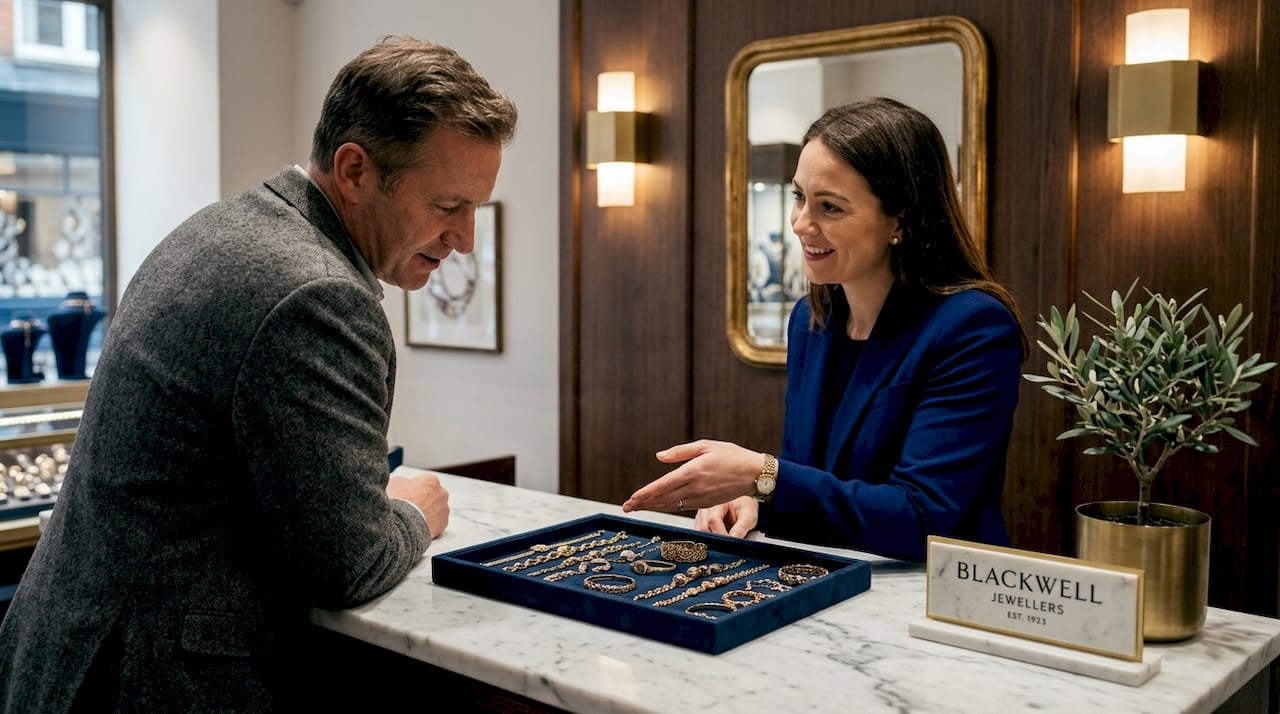
Why? Because the original buyer already absorbed the making charges and taxes. When you buy a pre-owned piece at market value, you’re typically paying much closer to the intrinsic gold value. The premium is dramatically reduced, and your break-even point is correspondingly lower.
Pre-owned jewellery investment tips from experienced buyers all converge on the same point: the condition, authenticity, and documentation of the piece matter more than whether it came from a shop window or a previous owner.
At Blackwelljewellers, every pre-owned piece is rigorously inspected, hallmarked, and restored before sale. That’s the kind of buying experience that actually protects your investment rather than inflating it.
- Look for pre-owned pieces with full hallmarks and original paperwork where available
- Have any pre-owned piece independently weighed and tested if you are spending significant sums
- Avoid private purchases without documentation unless you can physically test purity on the spot
6. Maintain your jewellery to preserve its resale value
This one sounds obvious. It isn’t practised nearly enough.
Condition affects resale value far more than most investors appreciate. A heavily scratched, bent, or dirty gold chain will receive lower offers, not because the gold content changed, but because buyers factor in their own restoration costs. A piece in excellent condition commands more confidence at the counter.
Keep jewellery stored properly (separate pouches, away from abrasive surfaces). Have pieces professionally cleaned and inspected periodically. If a clasp is weak or a setting is loose, get it repaired before it causes further damage. Professional jewellery repairs are not an extravagance; they’re maintenance on a financial asset.
Consider also the impact of online pricing trends in 2026 on resale demand. Digital platforms are making price comparison faster and more transparent, which means buyers are better informed. Condition is increasingly the differentiating factor when two similar pieces are listed side by side.
7. Understand the resale mechanics before you buy
Most people only think about how to sell when they urgently need to. That’s too late to plan.
When you walk into any buyer or dealer with a gold piece, the resale valuation formula is simple: tested purity multiplied by weight multiplied by spot price, minus any non-gold components. That’s it. Your original making charges are irrelevant. The GST you paid is irrelevant. The beautiful box it came in is irrelevant.
Understanding this formula before you buy changes which pieces you choose to buy. Heavy, plain, high-carat gold with minimal non-gold mass will always outperform on resale efficiency.
- Selling outright gives you spot-based value and full liquidity
- Exchanging at a jeweller typically offers credit toward new pieces (sometimes better than cash offers)
- Pawning provides short-term liquidity while retaining ownership, useful if you expect gold prices to rise further
For a proper breakdown of which exit route suits which situation, the Blackwelljewellers guide on selling versus pawning is well worth your time.
Pro Tip: Get at least three valuations before selling. Offers can vary by 10 to 15% between buyers, and a few phone calls can be worth hundreds of pounds.
8. Keep your paperwork obsessively
Sounds boring. Absolutely non-negotiable.
Every purchase should generate a receipt showing the gold’s weight, carat, and price paid. If you have a hallmark certificate, keep it. If the piece comes with a gemological report for any stones, keep that too. This documentation does three things for you:
First, it proves authenticity to future buyers and dramatically speeds up resale negotiations. Second, it supports insurance claims if the piece is lost or stolen. Third, it establishes provenance for estate planning and inheritance.
The absence of documentation doesn’t make gold worthless, but it does make it harder to sell at the price it deserves. Treat your paperwork like you’d treat the piece itself.
9. Time your purchases with market awareness
You can’t perfectly time the gold market. Nobody can. But you can avoid obviously bad timing.
Buying gold jewellery during peak demand periods (major festivals, wedding seasons, Valentine’s Day) means paying inflated retail premiums on top of already high spot prices. Retailers know demand is price-inelastic during these windows and charge accordingly.
Buying during quieter retail periods, or when spot prices have pulled back from recent highs, gives you a structurally better entry point. The gold price itself will fluctuate, but controlling what you pay over spot is entirely within your grasp.
Watch spot price trends and factor them into your buying schedule. Collecting gold jewellery over time with a drip-feed approach (rather than one large purchase at a peak) smooths your average entry price and reduces timing risk meaningfully.
My honest take on gold jewellery as an investment
I’ve seen a lot of investors come to gold jewellery with misplaced expectations. They assume the beauty and the gold price are doing the same job. They’re not.
In my experience, the investors who do best with physical gold jewellery are the ones who go in with clear eyes. They know the making charges are a cost of ownership, not a mystery fee to resent. They choose pieces with investment logic, not just aesthetic logic. And they hold for the long term, letting the gold price do the heavy lifting while the jewellery serves its secondary role as something wearable and meaningful.
I genuinely believe gold jewellery has a place in a diversified portfolio. But it should sit alongside, not replace, more efficient gold instruments. The hybrid approach is the one I keep coming back to: efficient exposure through ETFs or bonds for the bulk, and carefully chosen physical pieces for the part of gold ownership that actually feels human.
The investors I’ve watched struggle are the ones who buy ornate pieces on impulse during high-demand seasons, skip the hallmark checks, and then wonder why resale offers are 30% below what they paid. The tips in this article aren’t theoretical. They’re the things that separate a smart gold jewellery investment from an expensive piece of wearable regret.
— James
Explore Blackwelljewellers’ gold jewellery collection
Whether you’re building a long-term gold portfolio or looking for a single high-quality piece to hold, Blackwelljewellers offers something most high-street retailers can’t: properly authenticated, hallmarked, and restored pieces with full transparency on provenance and condition.

The second-hand jewellery collection is ideal for investment-conscious buyers who want genuine gold value without paying new retail premiums. If you want something designed around your specific requirements, the bespoke jewellery service in Maidstone lets you control design and making costs from the start. Need to access liquidity from pieces you already own? The pawnbroking service provides a transparent, accountable option. And for maintaining the condition (and therefore value) of your holdings, professional jewellery repairs are available in-store across Kent.
FAQ
Are making charges recoverable when selling gold jewellery?
No. When selling gold jewellery, buyers value the piece on its tested gold content and current spot price only. Making charges and taxes paid at purchase are not recoverable on resale.
What karat gold is best for investment purposes?
22 carat gold offers the best balance of high gold purity (91.6%) and wearable durability, making it the most practical choice for investment-focused gold jewellery buyers.
How do I verify that gold jewellery is authentic before buying?
Check for a recognised hallmark and retain your purchase invoice. In India, use the BIS CARE app to confirm HUID authenticity instantly. In the UK, look for an assay office mark and millesimal fineness stamp.
Is pre-owned gold jewellery a good investment?
Pre-owned gold jewellery can offer significantly better value than new pieces because the original buyer has already absorbed the making charges and tax premiums, bringing your entry price much closer to the intrinsic gold value.
How should gold jewellery fit within a broader investment portfolio?
Treat gold jewellery as the physical, personal component of your gold allocation. The case for strategic gold is strong, but jewellery works best as a smaller portion alongside more liquid instruments like ETFs or sovereign bonds.