
TL;DR:
- Not all gold jewelry holds equal value as an investment; factors like hallmarking, provenance, and purity determine its true worth. In the UK, legal hallmarking and detailed documentation provide verification and protection, making considered purchases less risky. Compared to bullion, gold jewelry often includes craftsmanship premiums and collectability, which can occasionally surpass melt value, especially with rare or designer pieces.
Not all gold jewellery is created equal, and if you think buying any shiny piece with a yellow tint is a sound investment strategy, well, good luck with that. The truth is, the UK has a particularly nuanced set of rules, laws, and cultural factors that determine whether your pre-owned gold ring is a smart long-term asset or an overpriced keepsake. Hallmarking, provenance, craftsmanship, and purity all play a role, and once you understand how these elements interact, buying pre-owned gold jewellery becomes far less of a gamble and far more of a considered, intelligent decision.
Table of Contents
- What makes gold jewellery valuable as an investment?
- Gold jewellery versus bullion: Understanding the difference for investors
- How to assess and verify investment gold jewellery in the UK
- Potential risks and rewards: What every UK investor should know
- What most investors overlook about UK gold jewellery
- Find investment-worthy gold jewellery and expertise at Blackwell Jewellers
- Frequently asked questions
Key Takeaways
| Point | Details |
|---|---|
| Check hallmark and purity | Always verify UK hallmarking and carat when considering gold jewellery as an investment. |
| Resale value is complex | Jewellery resale price depends on gold content and any proven collectable or craftsmanship premium. |
| Authenticity protects investment | Legal UK hallmarking protects buyers from misrepresented gold and supports real value retention. |
| Know the risks | Understand retail markups and liquidity limitations before investing in pre-owned gold jewellery. |
| Combine enjoyment and value | The best gold jewellery investments balance pleasure in wearing with careful value assessment. |
What makes gold jewellery valuable as an investment?
Now that we’ve dispelled the myth of equal value, let’s examine the actual drivers of value in investment-grade gold jewellery for UK buyers. And there are quite a few of them worth understanding properly.
First up: gold purity, measured in carats (spelled “carats” in the UK, not “karats” as in the US). Pure gold is 24 carat. You’ll more commonly find UK jewellery at 9ct, 18ct, or 22ct. The higher the carat, the greater the gold content, and therefore the higher the intrinsic metal value. A 9ct piece contains roughly 37.5% gold, while 18ct contains 75%. That difference matters enormously when you’re calculating investment value.
Second, and this is where the UK really stands out: hallmarking. For UK investors, the core mechanics of gold jewellery value are gold purity and verifiable authenticity, specifically through hallmarking and provenance. The Hallmarking Act 1973 defines what assay office marks are and underpins the entire legal consumer-protection framework for precious metal claims in the UK. This means when you buy a hallmarked piece, you’re not just taking someone’s word for it. You have legal backing.
Understanding UK gold hallmarks is genuinely useful here. Every official hallmark includes:
- Maker’s mark: identifies the manufacturer or sponsor
- Assay office mark: confirms which office tested it (London, Birmingham, Edinburgh, or Sheffield)
- Purity/fineness mark: states the metal content
- Optional date letter: shows the year of assay
This is worlds apart from buying gold-plated jewellery, which contains only a thin layer of gold over base metal and carries essentially zero investment value. If there’s no hallmark, walk away. Seriously. For a thorough breakdown of every mark and what it means, the complete hallmark guide is well worth your time.
Beyond purity and hallmarking, condition, original packaging, and provenance add further value. A vintage 18ct Cartier bracelet with its original box, papers, and receipt is worth considerably more than the same bracelet sans documentation. Collectors and serious buyers care deeply about these extras.
| Factor | Why it matters | Investment impact |
|---|---|---|
| Gold carat (purity) | Determines intrinsic metal content | High |
| Hallmarking status | Legally verifies authenticity | High |
| Condition | Affects wearability and resale appeal | Medium to high |
| Provenance/documentation | Adds collectible premium | Medium |
| Original packaging | Supports resale price and trust | Low to medium |
Pro Tip: Avoid any piece that lacks clear hallmarking or verifiable provenance. If a seller can’t confirm these basics, that’s your cue to find another seller.
Gold jewellery versus bullion: Understanding the difference for investors
Having defined what underpins value in gold jewellery, it’s logical to compare how gold jewellery stacks up against bullion for an investor’s portfolio. Because these are quite different beasts.

Bullion, whether gold bars, coins like Sovereigns or Britannias, or ETFs, tracks the spot price of gold fairly directly. Investment demand for bars, coins, and ETFs can be structurally stronger than jewellery fabrication volumes in certain market conditions, according to World Gold Council data. Bullion is easier to price, easier to liquidate, and you’re not paying a craftsmanship premium that evaporates the moment you leave the shop.
Gold jewellery is different. When you buy a retail piece, the price includes manufacturing, design, and retailer markups that simply aren’t fully recoverable on resale. If your main goal is purely financial returns from the metal price, jewellery is structurally disadvantaged compared to bullion. That’s just the reality.
But here’s the interesting bit. There are scenarios where jewellery absolutely outperforms:
- Highly collectible or antique pieces: A Georgian mourning ring or an Art Deco brooch doesn’t compete on gold weight alone. Rarity, history, and collector demand push prices well above melt value.
- Signed designer pieces: Jewellery by recognised makers such as Bulgari, Van Cleef, or British goldsmiths with strong provenance can command significant premiums at auction.
- Pre-owned purchases at below-retail prices: Buying pre-owned means you skip the initial retail markup, so you’re already closer to melt or fair market value from day one.
- Pieces bought during low gold price periods: Timing your purchase around the gold price per gram can meaningfully improve your potential return.
Knowing how to use a valuation guide to calculate your baseline melt value is essential before any purchase.
| Attribute | Gold jewellery | Gold bullion |
|---|---|---|
| Tracks spot gold price | Partially | Directly |
| Includes craftsmanship premium | Yes | No |
| Liquidity | Lower | Higher |
| Collector/artistic upside | Yes | No |
| VAT applicable (UK) | Yes | No (investment gold) |
| Enjoyment while holding | Yes | Not really |
“Know your resale objective before you buy. Are you chasing melt value, or are you buying a piece that could attract a collector at auction? These are genuinely different strategies, and confusing them is how people end up disappointed.”
Pro Tip: Before committing, decide whether your goal is to maximise melt value or collectability. Then buy accordingly. These two goals require very different purchasing criteria.
How to assess and verify investment gold jewellery in the UK
With the main differences between jewellery and bullion covered, you can now apply a practical framework to assess authentic pre-owned gold jewellery in the UK. This is the bit most people skip, to their own detriment.
A solid methodology for buying pre-owned gold jewellery as an investment involves verifying hallmark status, documenting provenance, assessing condition carefully, and then pricing against a melt-value baseline to understand your premium at risk. Here’s how to do it step by step.
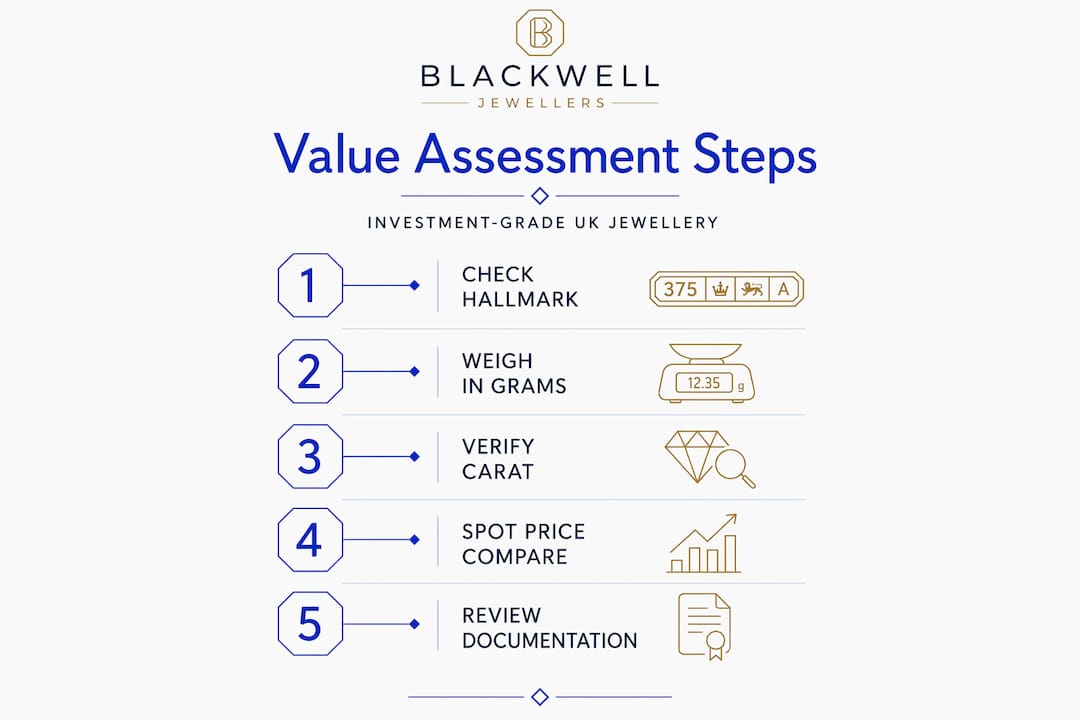
Step 1: Check for hallmarks and assay office marks
This is non-negotiable. Inspect the piece carefully, often with a loupe (a small magnifying glass), and look for the four key marks described earlier. UK law requires hallmarking above certain weight thresholds, so anything heavy enough to qualify should have marks. No marks? Big red flag. For a detailed guide on spotting counterfeits, how to spot fake gold is incredibly useful.
Step 2: Review documentation
Ask for anything the seller has: original receipts, certificates, valuations, insurance documents, even photographs. The more paper trail, the better. Provenance isn’t just about trust; it directly supports resale value.
Step 3: Physically inspect for alterations, repairs, or missing elements
- Check clasps, settings, and solder points for signs of repair or replacement
- Look for inconsistencies in hallmarking (e.g., a hallmark that doesn’t match the stated carat)
- Check for any missing stones, bent prongs, or structural weaknesses
- Examine the surface for heavy wear, deep scratches, or polishing that may have reduced weight
A repaired piece isn’t automatically bad, but undisclosed repairs are a problem. Always ask directly.
Step 4: Price it against the gold weight and spot price
Weigh the piece (in grams), confirm the carat, and calculate the melt value using the current spot price. Then compare that to the asking price. The difference is your “premium at risk,” basically the portion of your purchase price you might not recover at resale. For a broader look at how to buy authenticated second hand jewellery, we’ve covered this in depth elsewhere.
Pro Tip: Always request documentation from the seller and inspect the piece in person where possible. Photos are helpful, but they simply cannot substitute for holding something in your hand and examining it properly.
Potential risks and rewards: What every UK investor should know
After learning how to assess gold jewellery, every investor should understand the risks and rewards before purchasing. Because yes, there are real risks here, and glossing over them would be doing you a disservice.
The risks:
- Liquidity: Unlike bullion, there’s no standardised market for gold jewellery. Resale requires finding a willing buyer, a dealer, or an auction house. That takes time.
- Markup recovery: At resale, buyers typically pay primarily for metal content, not the craftsmanship or retail premium you may have originally paid. That premium is usually gone.
- Fakes and misrepresentation: Without proper verification, you can end up with gold-plated base metal, incorrect carat stamps, or pieces with undisclosed repairs that affect value.
- Overpaying for design: A beautifully designed piece that commands a high retail premium may yield only melt value at resale. If the design is trendy rather than timeless, the premium risk is even higher.
The rewards:
- Collectability: Rare, antique, or designer pieces can genuinely appreciate beyond gold price movements. This is the exciting bit.
- Wearable asset: Unlike a gold bar sitting in a safe, jewellery can be worn and enjoyed daily. That’s a form of value that doesn’t appear on a spreadsheet.
- Sentimental value: For many buyers, this is real. And while sentimental value doesn’t directly translate to resale price, it does influence how long you hold a piece, which can work in your favour if gold prices rise.
- Tax considerations: Pre-owned gold jewellery sold privately in the UK may be subject to Capital Gains Tax, but many individuals fall within their annual CGT allowance. Worth discussing with an accountant.
“The biggest mistake we see is buyers overestimating what they’ll recover on a resale. They pay retail, fall in love with the design, and assume the next buyer will too. They often don’t.”
For guidance on approaching resale strategically, selling gold jewellery and finding trusted gold buyers are both worth a read before you make any commitments.
What most investors overlook about UK gold jewellery
Here’s the honest, slightly uncomfortable truth that rarely makes it into polished investment guides: most people who buy gold jewellery as a “pure investment” are actually buying something much more human than that. And that’s not a bad thing. It’s just worth being clear-eyed about it.
The real advantage of gold jewellery, especially pre-owned pieces with history and character, is that it blends asset value with emotional return and wearable beauty. That’s a genuinely unique combination. You can’t wear a gold bar to a dinner party (well, you could, but it would be odd). A beautiful Victorian gold locket? That goes with anything.
What we’ve noticed, after more than 20 years in this business, is that the buyers who are most satisfied are the ones who buy deliberately. They understand the gold content, they’ve verified the hallmark, they know what they paid versus melt value, and then they enjoy the piece. They’re not nervously watching the spot price every morning. They know they bought well, and that gives them confidence.
The buyers who end up disappointed are usually those who were sold a “guaranteed investment” without understanding the resale landscape. They paid a significant retail premium for a design they didn’t love, expecting to recover it all on resale. That’s not how it works. Understanding how to value your gold at home before you buy is one of the most underrated bits of pre-purchase research you can do.
Our honest view? Buy gold jewellery for a combination of reasons. Let the gold content provide the financial foundation. Let the craftsmanship, rarity, or history provide the potential upside. And let the beauty provide daily enjoyment. That’s a genuinely balanced reason to invest, and it’s far more satisfying than a bar of gold gathering dust.
Find investment-worthy gold jewellery and expertise at Blackwell Jewellers
If you’re ready to explore the next step in your investment journey, here’s how Blackwell Jewellers can support you. We’ve spent over two decades doing exactly this: sourcing, verifying, and restoring pre-owned gold jewellery so our customers can buy with real confidence.

Every piece in our pre-owned gold jewellery collection is inspected, authenticated, and hallmarked by our in-house team before it ever reaches a display case. You’re not guessing. You’re buying with verified history behind it. If you have something specific in mind, our bespoke jewellery service can create or redesign pieces to your exact specification. And if you already own gold jewellery that needs attention before resale, our jewellery repairs team handles everything from structural restoration to full refurbishment. We’re in Maidstone, Gravesend, and Bexleyheath, or available online nationwide.
Frequently asked questions
Is gold jewellery a good investment in the UK?
Gold jewellery can be a sound investment when you verify hallmarking, purity, and provenance, but it typically delivers the best value when craftsmanship and collectability combine with solid gold content. The core mechanics of value are purity and verifiable authenticity.
How do you check if gold jewellery is real before buying?
In the UK, ensure the jewellery carries an official hallmark from a recognised assay office. UK hallmarking ties metal to a specific assay process, and pieces above legal weight thresholds must be assayed and marked by an official office.
Can you sell gold jewellery for its full value?
Usually not at retail price. Buyers at resale typically pay primarily for metal content rather than the original craftsmanship or design premium, unless the piece is highly collectible or signed by a recognised maker.
What legal protection do UK gold jewellery buyers have?
The Hallmarking Act 1973 ensures only jewellery officially hallmarked by a recognised assay office can be sold as gold above legal thresholds, giving buyers meaningful legal protection against misrepresentation.
Recommended
- Best Way To Sell Gold Jewellery in the UK (2025 Guide) – blackwellonline
- How to value your gold in the UK: get the best price – blackwellonline
- Compare the best gold price UK today: Smart buying guide – Blackwell Jewellers
- Gold price per gram UK: Your essential guide to getting value – Blackwell Jewellers