

TL;DR:
- Pawnbroking involves a short-term secured loan using valuable items as collateral, with repayment restoring ownership. Expert valuation at local jewellers ensures fair loan offers based on resale value, not retail price, and the process is regulated by FCA standards. Choosing a reputable jeweller provides better valuation, secure storage, and transparent legal terms, making pawnbroking a practical financial option.
Pawnbroking is a secured short-term loan where you hand over a valuable item as collateral, receive cash, and reclaim your item once you repay the loan plus interest. At a local jewellers, this process is handled by qualified professionals who know exactly what your gold ring or diamond pendant is worth on the resale market. Businesses like Blackwelljewellers and H&T Pawnbrokers have made this service a trusted part of their offering, combining expert valuation with genuine customer care. Understanding how pawnbroking works at a local jewellers means knowing what to expect at every stage, from the moment you walk in to the moment you walk out with cash in hand.
How does pawnbroking work at a local jewellers, step by step?
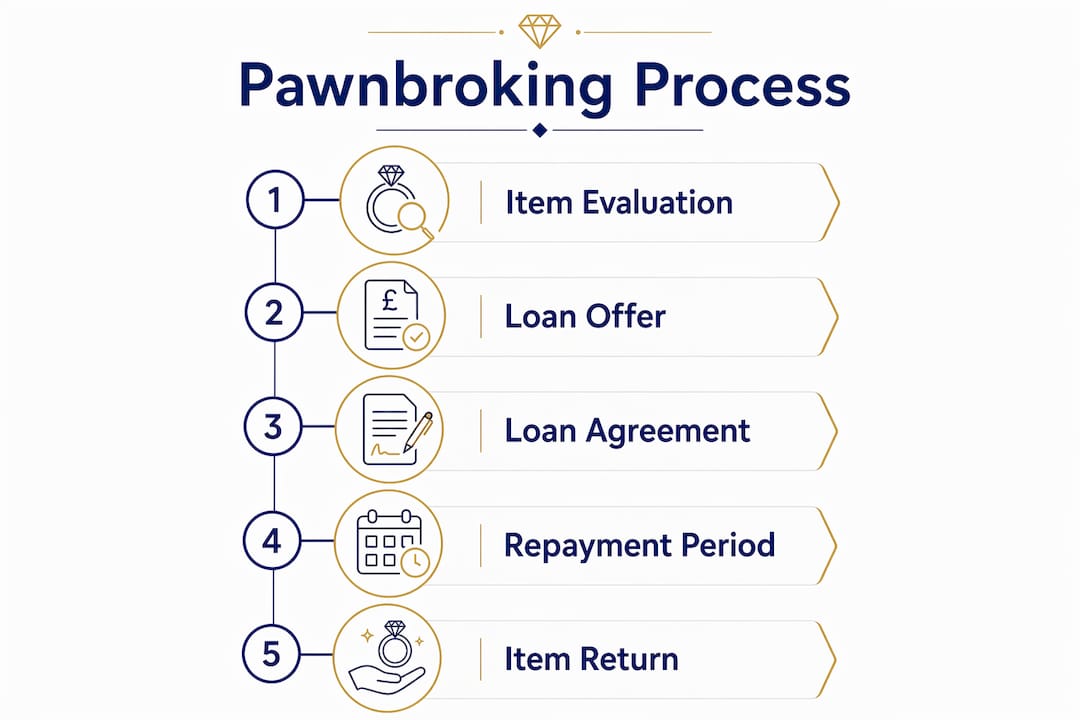
The pawnbroking process explained simply: you bring an item, a jeweller assesses it, you agree on a loan amount, and you sign a contract. Here is exactly what happens at each stage.
-
Bring your item in for appraisal. The jeweller examines your piece, checking metal type, weight, gemstone quality, condition, and current market demand. This is not a quick glance. A reputable jeweller uses testing equipment and real expertise.
-
Receive a loan offer. Pawn shop loans typically range from 25% to 60% of the resale value of the item, not the retail or sentimental value. A gold ring you paid £500 for might fetch a loan offer of £125 to £300. That gap surprises a lot of people, so go in with realistic expectations.
-
Sign the pawn ticket. This is the legally binding part. Pawn tickets act as loan agreements containing the loan amount, interest rate, fees, and repayment deadline. Keep it safe. You cannot reclaim your item without it.
-
Receive your cash. Once you sign, the money is yours. No credit check, no proof of income. You do need valid ID and sometimes proof of ownership, but that is it.
-
Repay within the agreed term. Repayment terms generally run between 30 and 90 days, with interest and fees accruing throughout. Pay up in full and your item comes straight back to you.
-
Reclaim your item or let it go. If you cannot repay, the pawnbroker can sell the item without any further financial obligation on your part. Your credit score is unaffected. Some jewellers also offer loan renewals if you pay the accrued interest and fees.
Pro Tip: Ask about renewal options before you sign. Knowing you can extend the term for a fee gives you a genuine safety net if your finances are tight that month.
How do local jewellers value jewellery for pawnbroking?
Jewellery valuation for pawnbroking is based on resale value, not what you paid for it or what it means to you. That distinction matters enormously.
Here is what a jeweller actually looks at when assessing your piece:
- Metal type and weight. Gold, silver, and platinum are weighed and tested for purity. A 9ct gold chain is worth considerably less per gram than an 18ct piece.
- Gemstone quality. Diamonds are assessed using the four Cs: cut, colour, clarity, and carat weight. Stones without certification fetch lower offers because the jeweller cannot verify their grade.
- Condition. Scratches, missing stones, broken clasps, and worn hallmarks all reduce the offer. A piece in wearable condition commands a better loan.
- Market demand. Certain styles and designers sell faster. A plain gold band moves quickly. An ornate vintage brooch might sit on a shelf for months, so the loan offer reflects that slower liquidity.
- Provenance and documentation. Certificates, original boxes, and receipts add confidence to the valuation. They are not mandatory, but they help.
The loan offer depends on resale value and liquidity rather than retail price, which often surprises customers expecting full market value. A local jeweller with genuine expertise, like the team at Blackwelljewellers in Kent, can give you a more accurate and often more generous assessment than a general pawn shop, precisely because they understand the jewellery market in detail.
Comparison: Local Jeweller vs. General Pawn Shop Valuation

| Factor | Local Jeweller | General Pawn Shop |
|---|---|---|
| Valuation expertise | Specialist jewellery knowledge | Broad but less detailed |
| Equipment used | Acid testing, loupe, scales | Basic testing tools |
| Gemstone assessment | Full four Cs evaluation | Visual estimate only |
| Provenance handling | Understands certificates and hallmarks | Limited documentation review |
| Loan offer accuracy | Higher confidence, often better offer | More conservative offers |
Pro Tip: Bring any certificates, original receipts, or hallmark documentation you have. Even a photograph of the original purchase can support a stronger valuation.
What are the loan terms, costs, and your legal protections?
Understanding pawnbroking services means understanding the numbers. Here is the honest picture.
Typical pawnbroker interest rates range from 20% to 25% per month, alongside possible storage or appraisal fees. On a £200 loan over 90 days, that adds up quickly. Read the pawn ticket carefully before you sign.
What you might pay beyond the principal:
- Monthly interest on the outstanding loan amount
- A storage or handling fee for keeping your item secure
- A redemption fee on some contracts when reclaiming the item
- A renewal or extension fee if you need more time
In the UK, pawnbrokers are regulated by the Financial Conduct Authority (FCA). This means they must provide clear written contracts, hold your item securely, and cannot charge fees beyond what is stated in the agreement. You also benefit from a minimum holding period, meaning the jeweller cannot sell your item the moment the deadline passes.
| Cost Type | Typical Range | Notes |
|---|---|---|
| Monthly interest | 20%–25% per month | Accrues on outstanding principal |
| Storage fee | Varies by jeweller | Not always charged |
| Redemption fee | Varies by contract | Confirm before signing |
| Extension fee | Interest plus admin | Paid to renew the loan term |
The big upside? Pawnbroking loans do not require credit checks or proof of income. If you cannot repay, the item is sold and the debt is cleared. Nothing goes to a collections agency. Nothing hits your credit file. For someone in a tight spot, that is genuinely useful. You can read more about responsible jewellery lending to understand how to approach this sensibly.
Why choose a local jeweller over a general pawn shop?
Pawning jewellery at local shops run by specialist jewellers offers real advantages over walking into a generic pawnbroker. Here is why it matters.
Local jewellers like Blackwelljewellers and businesses such as Martin Rees Jeweller and H&T Pawnbrokers maintain long-term customer relationships and offer personalised pawnbroking services with expert valuations. That community trust is not just a nice feeling. It translates into better offers, more careful handling of your items, and a clearer contract.
The practical advantages of a local jeweller:
- Specialist knowledge means a more accurate valuation, which often means a higher loan offer
- Your item is stored securely on-site by people who understand its value
- You can ask questions and get straight answers from someone who knows jewellery
- Many local jewellers also offer jewellery repairs and bespoke services, so you are dealing with a business invested in the long-term care of your pieces
- Stricter regulatory compliance is common among established jewellers who have a reputation to protect
“Pawnbroking services at local jewellers provide a vital financial resource during personal or economic hardship, allowing quick capital access while customers retain ownership of sentimental jewellery.” Wrexham.com
The consideration worth acknowledging is convenience. A local jeweller may have limited opening hours or a single location. If you are in Kent, Blackwelljewellers operates stores in Maidstone, Gravesend, and Bexleyheath, which helps. But if you are elsewhere, do your research. Check FCA registration, read reviews, and ask about their valuation process before you hand anything over. You can also compare your options by reading about pawning versus selling to make sure pawnbroking is the right route for you.
Key takeaways
Pawnbroking at a local jewellers is a secured loan service where your item’s resale value, not its retail price, determines the cash you receive, and repayment within 30–90 days returns your item in full.
| Point | Details |
|---|---|
| Loan based on resale value | Expect 25%–60% of resale value, not what you paid at retail. |
| Pawn ticket is legally binding | Keep it safe. You need it to reclaim your item. |
| No credit check required | Valid ID is all you need. Your credit score is unaffected. |
| Interest rates are significant | Monthly rates of 20%–25% mean short-term loans are best repaid quickly. |
| Local jewellers offer better valuations | Specialist expertise typically produces more accurate and generous loan offers. |
The bit nobody tells you before you walk in
Here is my honest take, having seen how this plays out for people time and again. The single biggest mistake people make with pawnbroking is walking in expecting a loan based on what they paid for their jewellery. That retail price is completely irrelevant to the pawnbroker. What matters is what they can sell it for if you do not come back. Once you accept that, the whole process makes a lot more sense and you stop feeling short-changed.
The second mistake is ignoring the interest rate because the loan term feels short. Twenty-five percent per month sounds manageable until you roll it over twice and suddenly you owe significantly more than you borrowed. Go in with a clear repayment plan. Treat the pawn ticket like a bill with a hard deadline, not a vague promise to yourself.
Choosing a reputable local jeweller matters more than people realise. An FCA-regulated jeweller with a physical presence and a community reputation has every incentive to treat you fairly and handle your item with care. A less scrupulous operator has none of those incentives. The UK pawnbroking market is worth serious money, which means there are serious operators in it. Find one of those.
Pawnbroking used responsibly is a genuinely useful financial tool. It is not a last resort for desperate people. It is a practical option for anyone who needs short-term cash and owns something valuable. Just go in informed.
— James
Blackwelljewellers pawnbroking services in kent
If you are considering pawning jewellery and want to deal with people who actually know what they are looking at, Blackwelljewellers is worth your time. With over 20 years of trading and stores across Kent in Maidstone, Gravesend, and Bexleyheath, the team offers transparent valuations, secure item storage, and clear loan agreements that comply fully with FCA regulations.

Whether you are pawning a gold chain, a diamond ring, or a vintage watch, Blackwelljewellers brings genuine jewellery expertise to every assessment. That expertise means you get a fair offer, not a guess. Visit the Blackwelljewellers pawnbroking page to find out more or book an appointment at your nearest store. If you are in Maidstone specifically, the Maidstone pawnbroking service has everything you need to get started.
FAQ
What does a pawnbroker actually do with your jewellery?
A pawnbroker holds your item as collateral against a short-term cash loan. If you repay the loan plus interest within the agreed term, your item is returned to you in full.
How much will i get for pawning jewellery at a local jeweller?
Loan offers range from 25% to 60% of the item’s resale value. A local jeweller with specialist knowledge often provides a more accurate and competitive offer than a general pawn shop.
Does pawning jewellery affect my credit score?
No. Pawnbroking loans do not require a credit check and non-repayment does not affect your credit file. The item is simply sold to cover the outstanding loan.
How long do i have to repay a pawnbroking loan?
Repayment terms typically run between 30 and 90 days. Many jewellers offer extensions if you pay the accrued interest and fees before the deadline passes.
What happens if i lose my pawn ticket?
Your pawn ticket is the legal proof of your transaction and is required to reclaim your item. Contact the jeweller immediately if you lose it. They can verify your identity and reissue documentation, though the process varies by business.