

TL;DR:
- Professional jewellery cleaning involves ultrasonic, steam, and hand polishing methods to restore shine and detect damage.
- Blackwelljewellers offers in-house workshops across Kent with quick turnaround times and comprehensive inspection services.
The fastest answer? Take your piece to a trusted local jeweller. Blackwelljewellers has in-house workshops across Kent (Maidstone, Gravesend and Bexleyheath) where qualified jewellers handle everything from ultrasonic cleaning to rhodium plating. Drop in, call ahead, or use the store locator to check turnaround before you go.
Here’s what you get when you book a professional clean:
- Ultrasonic cleaning removes built-up grime from settings and crevices using high-frequency sound waves.
- Steam cleaning blasts residue from metal surfaces without abrasives.
- Hand polishing restores surface shine on gold, silver and platinum.
- Rhodium replating brings white gold back to its original bright finish.
- Stone and setting inspection catches loose claws or cracked stones before they become a real problem.
- Same-day or 48-hour turnaround is often available for straightforward cleans; plating or repairs take longer.
Use the store locator or call your nearest Blackwelljewellers branch to confirm availability before you drop off.
Table of Contents
- What professional jewellery cleaning services actually include
- How much does professional jewellery cleaning cost, and how long does it take?
- What actually happens when you drop your jewellery off for cleaning?
- When professional cleaning can actually damage your jewellery
- How to choose a jewellery cleaning service you can actually trust
- How to book a cleaning appointment at Blackwelljewellers
- Why Blackwelljewellers is worth trusting with your jewellery
- Key takeaways
- The bit I actually want you to take away
- Get your jewellery cleaned and polished at Blackwelljewellers
- Useful resources
What professional jewellery cleaning services actually include
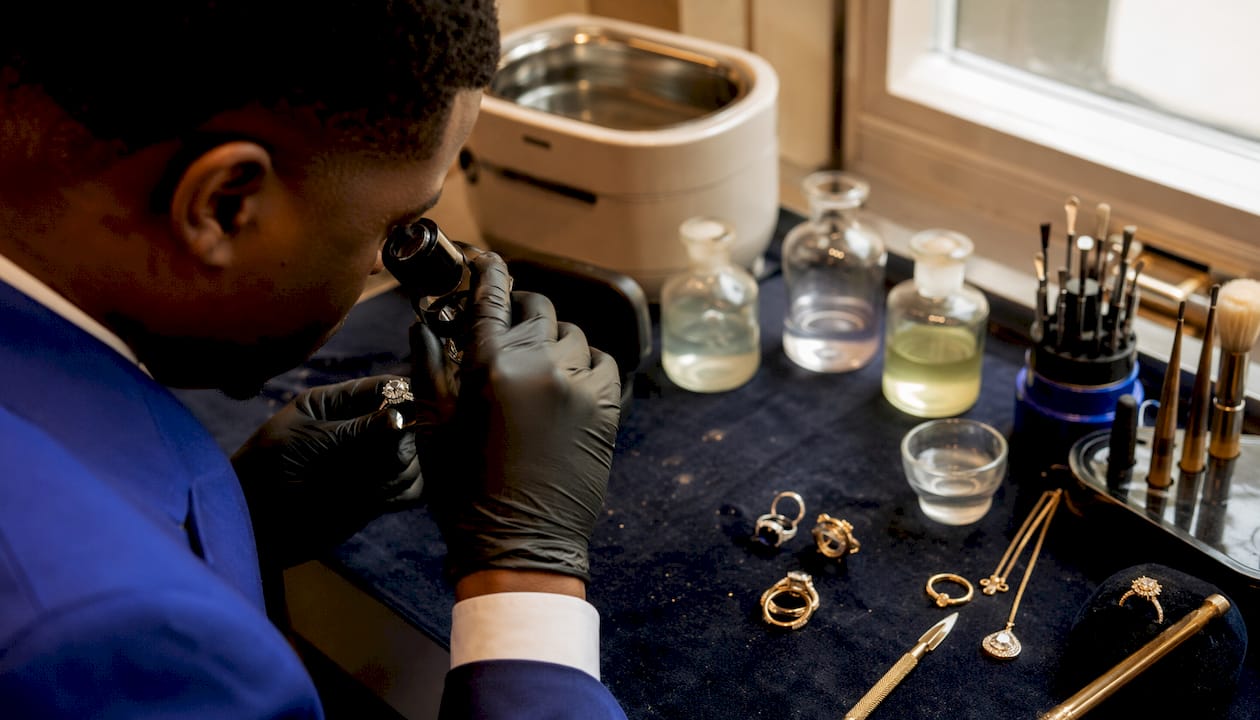
Most people picture a quick buff and a rinse. The reality is a bit more involved, which is exactly why it’s worth going to a professional rather than attacking your grandmother’s ring with a toothbrush.
- Ultrasonic cleaning works by sending ultrasonic waves through a liquid solution, creating tiny bubbles that dislodge dirt from even the tightest settings. It’s the go-to for gold, platinum and most hard gemstones.
- Steam cleaning follows ultrasonic cleaning in many workshops. High-pressure steam removes loosened debris and leaves metal surfaces looking sharp. Brilliant for diamonds and sapphires.
- Hand polishing uses polishing compounds and a rotating wheel to remove fine surface scratches and restore lustre. This is where a skilled hand genuinely makes a difference.
- Rhodium replating is specifically for white gold. White gold is naturally a pale yellow; the bright white finish comes from a rhodium coating that wears off over time. Replating restores it. Silver de-tarnishing uses different chemistry entirely, often involving specialist dips or polishing cloths.
- Stone and setting checks happen alongside cleaning. A good jeweller will examine every claw, bezel and channel setting while the piece is in the workshop.
Blackwelljewellers recommends annual professional checks for everyday pieces. Between visits, a gentle home clean can keep things presentable, but it won’t replace what a workshop inspection catches.
How much does professional jewellery cleaning cost, and how long does it take?
Pricing varies by metal, stone type, and how much work the piece actually needs. Here’s a realistic overview for UK customers:
| Service | Typical UK cost | Typical turnaround |
|---|---|---|
| Basic ultrasonic clean | £10–£20 | Same day or 48 hours |
| Steam clean + hand polish | £20–£40 | 48 hours |
| Silver de-tarnishing | £10–£20 | Same day or 48 hours |
| Rhodium replating (white gold) | £40–£70+ | 3–7 days |
| Full refurbishment (clean + polish + plate) | £60–£100+ | 5 days |
A few things push the price up: heavily worn pieces, complex settings, multiple stones, or any structural repair flagged during inspection. Rhodium plating and restoration are quoted as separate jobs because they extend the scope considerably.
Most jewellers give a written estimate before starting work. If yours doesn’t offer one, ask. Deposits are sometimes required for longer or higher-value jobs.
What actually happens when you drop your jewellery off for cleaning?
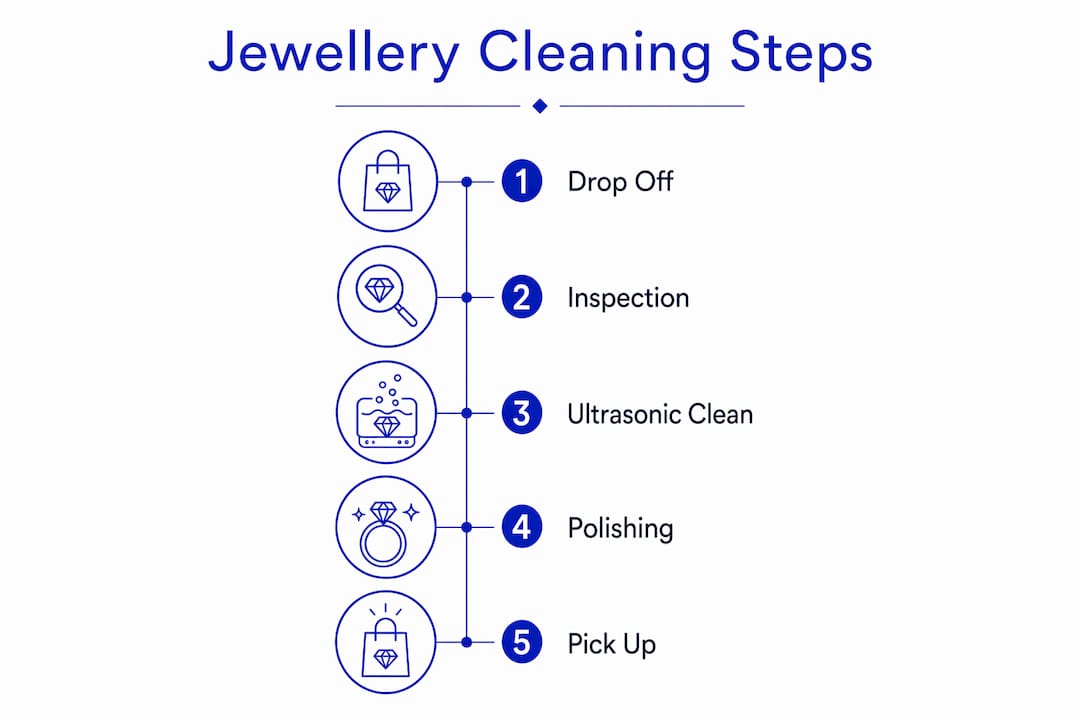
No mystery, no magic. Here’s the process, step by step:
- Assessment on arrival. The jeweller examines the piece under magnification, checking for loose stones, worn claws, cracks, or structural issues. This happens before any cleaning starts.
- Written job note. Your item gets labelled and logged with a description, your contact details, and an estimated completion time. Keep your receipt.
- Method selection. Based on the metal, stones, and condition, the jeweller chooses the appropriate cleaning method. A pearl ring gets very different treatment from a diamond solitaire.
- Cleaning and polishing. Ultrasonic, steam, hand polish, or a combination, depending on what the piece needs. This is the actual work.
- Post-clean inspection. The piece is checked again after cleaning. Any issues spotted during the process get flagged at this stage.
- Report and repair recommendation. If the jeweller finds something that needs fixing (a loose claw, a worn shank), you’ll get a written recommendation and a separate quote. You decide whether to proceed.
- Collection. You pick up the piece, check it over, and ask any questions. A reputable jeweller will walk you through what was done.
Pro Tip: Before you drop anything off, take a photo of the piece on your phone. It takes ten seconds and gives you a clear record of its condition before the workshop touched it.
Items with fragile settings or unusual construction may be sent to a specialist outside the store. A good workshop will tell you upfront if that’s the case and give you a revised timeline.

When professional cleaning can actually damage your jewellery
Ultrasonic cleaning is brilliant for diamonds. It is genuinely terrible for certain other stones and materials. Knowing the difference saves you a nasty surprise.
- Pearls should never go near an ultrasonic machine. The vibrations damage the nacre. Full stop.
- Opals are porous and heat-sensitive. Ultrasonic and steam cleaning can cause cracking or colour loss.
- Emeralds are often treated with oil or resin to fill natural inclusions. Ultrasonic cleaning strips that treatment out.
- Enamel and antique finishes can be damaged by aggressive polishing or chemical dips. Some vintage pieces have intentional patina that a heavy-handed polish will destroy permanently.
- Foil-backed stones (common in antique jewellery) react badly to any liquid immersion.
Pro Tip: Always tell your jeweller if a piece is antique, has been repaired before, or contains any stones you’re unsure about. The more information they have, the safer the outcome.
One more thing worth saying plainly: cleaning is not the same as repair. Deep scratches, bent settings, and structural damage don’t polish away. If a piece has a cracked shank or a missing stone, that needs a repair service, not a clean. Rhodium replating also isn’t a permanent fix; white gold typically needs replating every one to three years depending on wear.
How to choose a jewellery cleaning service you can actually trust
There are a lot of jewellers out there. Some are brilliant. Some will hand your ring back looking worse than when you brought it in. Here’s how to tell the difference before you hand anything over.
Questions worth asking:
- Do you have an in-house workshop, or do you send work out?
- Are your jewellers qualified (NAJ membership, City & Guilds, or similar)?
- Is the piece insured while it’s with you?
- Do you provide a written estimate before starting?
- What cleaning methods do you use, and are they appropriate for my stone type?
- What’s your turnaround time, and is that guaranteed?
Red flags to watch for:
- No written estimate offered (and reluctance to provide one when asked).
- Prices that seem unrealistically low. A £5 “full clean and polish” is not a thing.
- No in-house inspection capability. If they can’t examine the piece before cleaning, they shouldn’t be cleaning it.
- Vague answers about method. “We just clean it” is not an answer.
- No clear process for flagging damage or repairs found during the job.
Value indicators include an in-house workshop, published care guides, clear pricing, and a booking system or store locator. Blackwelljewellers ticks all of those.
Pro Tip: Check whether the jeweller can handle hallmarking and repairs in-house. A workshop that does both is almost always more experienced than one that only offers cleaning.
How to book a cleaning appointment at Blackwelljewellers
Getting your jewellery cleaned at Blackwelljewellers is straightforward. Here’s what to do:
- Use the store locator on the Blackwelljewellers website to find your nearest Kent branch (Maidstone, Gravesend or Bexleyheath).
- Call ahead to confirm turnaround time and whether same-day cleaning is available for your piece.
- Drop in during opening hours if you prefer. The team will assess the piece on the spot and give you an estimate.
- Prepare your item by placing it in a small clean bag or box. Loose stones or broken clasps should be noted when you hand it over.
- Bring ID and a contact number. The workshop will log your details and give you a job reference.
- Ask about same-day availability. Basic ultrasonic cleans are sometimes completed the same day; rhodium plating and refurbishment jobs take longer.
The jewellery repairs page on the Blackwelljewellers website has full service details and contact information for each store.
Why Blackwelljewellers is worth trusting with your jewellery
With many years of trading experience. Family run. Multiple Kent stores with in-house workshops. That’s the short version.
The longer version matters more. Blackwelljewellers handles pre-owned and second-hand jewellery as a core part of the business, which means every piece that comes through the door gets inspected, authenticated, and restored before it goes anywhere near a customer. That level of process discipline carries directly into the cleaning and polishing service.
Key trust signals:
- In-house workshop capability for cleaning, polishing, rhodium plating and structural repairs.
- Written inspection reports and repair recommendations provided as standard.
- 20+ years of in-house refurbishment experience, including restoration of antique and vintage pieces.
- Published care guides covering home cleaning methods and metal-specific advice.
- Authentication and hallmarking as part of the second-hand refurbishment process.
- National online presence alongside physical Kent stores, so you can get advice even before you visit.
The jewellery repair process at Blackwelljewellers follows the same assessment-first workflow described in this article, which means no surprises at collection.
Key takeaways
Professional jewellery cleaning and polishing from a qualified local jeweller is the most reliable way to restore your piece’s condition and catch hidden damage before it becomes expensive.
| Point | Details |
|---|---|
| Book a local professional | Use the Blackwelljewellers store locator or call to confirm turnaround before dropping off. |
| Know your service options | Ultrasonic, steam, hand polish, and rhodium plating each suit different metals and stones. |
| Budget realistically | Basic cleans typically cost a moderate fee; rhodium replating costs more accordingly. |
| Protect fragile pieces | Pearls, opals, and enamel need specialist handling — always declare unusual stones upfront. |
| Trust Blackwelljewellers | Over 20 years of in-house workshop experience across Kent stores, with written estimates and inspection reports as standard. |
The bit I actually want you to take away
Here’s something most cleaning guides won’t say: the clean itself is almost secondary. What you’re really paying for is the inspection. A good jeweller will spot a claw that’s about to give way, a crack in the shank, or a stone that’s shifted in its setting. The polish is the visible result; the inspection is the thing that stops you losing a stone down a drain six months later.
People often put off professional cleaning because it feels like a luxury. It isn’t. For a ring you wear every day, an annual professional check and cleaning is basic maintenance, the same way you’d service a car. The cost of a clean is a fraction of the cost of replacing a lost diamond.
The other thing worth saying: don’t hand your jewellery to anyone who can’t tell you exactly what method they’ll use and why. Vague reassurance is not a substitute for actual knowledge. Ask the question. If the answer is confident and specific, you’re in the right place.
Get your jewellery cleaned and polished at Blackwelljewellers
Blackwelljewellers offers something most high-street options don’t: a genuine in-house workshop where qualified jewellers assess, clean, and polish your piece under one roof, with a written report included. No sending your ring off to an unknown third party. No vague timelines. Just transparent pricing, a clear process, and staff who actually know what they’re looking at.

Basic cleans are often available same-day or within 48 hours. Rhodium replating and full refurbishment jobs are quoted individually, with no work started until you’ve agreed the price. Whether it’s a silver chain that’s lost its shine or a white gold engagement ring that needs replating, the team at Blackwelljewellers can handle it.
Visit the jewellery repairs page to see the full service list, or use the store locator to find your nearest Kent branch and call ahead to book a slot.
Useful resources
Blackwelljewellers care guides and service pages:
- Cleaning jewellery at home: safe methods — retailer-approved home cleaning techniques between professional visits.
- Safe cleaning methods for gold, silver and platinum — metal-specific guidance on what works and what doesn’t.
- When to bring your jewellery to a professional — signs that a home clean isn’t enough.
- How jewellery is refurbished — the full refurbishment process, including rhodium plating and restoration.
- Jewellery repairs service page — Blackwelljewellers’ primary repairs and cleaning landing page.