

TL;DR:
- Postal jewellery repairs allow sending your items to professionals for inspection, repair, and return without visiting a shop. The process involves requesting a free quote, insured shipping, professional assessment, and tracking, with repairs backed by a 60-day warranty. Proper packaging, detailed descriptions, and choosing reputable providers ensure a secure and reliable experience.
Postal jewellery repairs are a professional service that lets you send your precious items to expert craftspeople by post, have them inspected, quoted, repaired, and returned to you without ever visiting a shop. The jewellery repair process by mail follows a clear sequence: online quote request, secure insured shipping, professional inspection, repair approval, and tracked return delivery. Reputable services offer free quotes before any work begins, a no-work-unless-approved policy, and warranties on completed repairs. If you have a broken chain, a loose stone, or a ring that no longer fits, sending jewellery for repair by post is a practical, secure option backed by industry-standard practices.
What are the key steps in postal jewellery repairs?
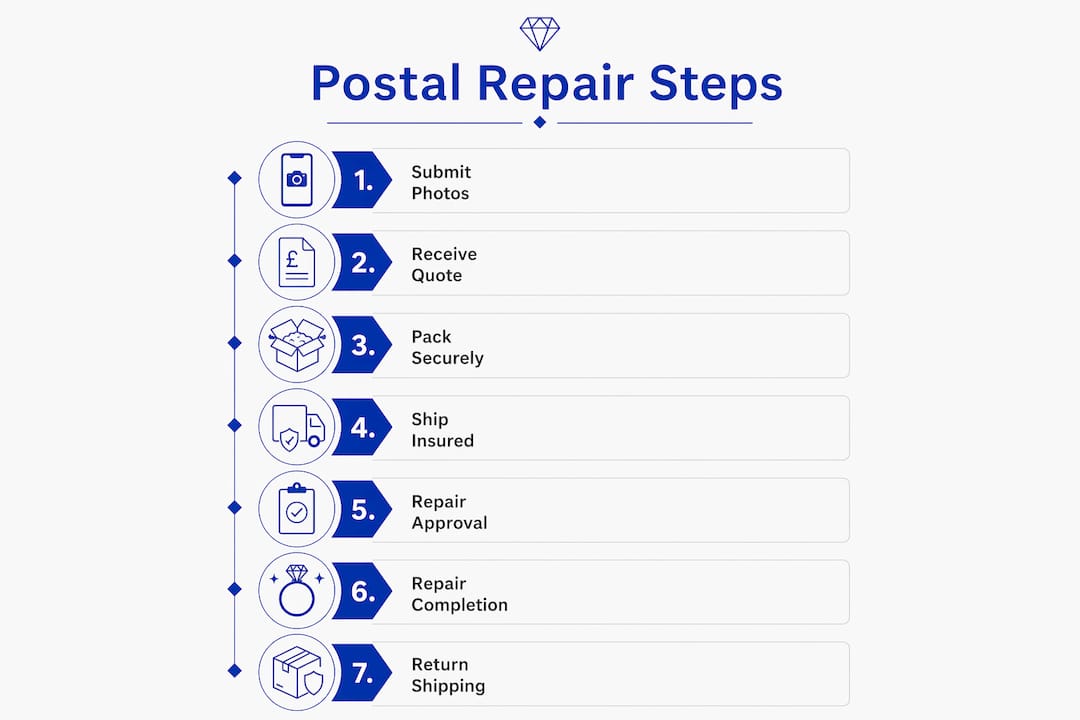
The postal repair workflow follows a consistent sequence across reputable services. Knowing each stage removes the guesswork and helps you feel confident about handing over something valuable. Here is how the process typically runs, from first contact to getting your piece back on your wrist.
-
Submit your repair request online. Take clear photos of the damage from multiple angles and describe the problem as specifically as you can. “The clasp is broken” is fine. “The lobster clasp on my 9ct gold bracelet snapped at the hinge” is better. The more detail you give, the more accurate your initial quote will be.
-
Receive a preliminary quote. The repairer reviews your photos and description, then provides a free estimate. No payment is taken at this stage. This is your chance to ask questions, clarify the scope of work, and decide whether to proceed.
-
Pack and send your jewellery. Use a small rigid box with padding inside, seal it securely, and send it via a tracked insured service. Royal Mail Special Delivery is the standard choice in the UK because it offers full insurance cover and a guaranteed next-day delivery window.
-
Professional inspection and final cost confirmation. Once your item arrives, the jeweller inspects it in person. The final quote is confirmed at this point. If the cost differs from the initial estimate, you are contacted for approval before any work starts. You can decline and have your item returned if the price does not suit you.
-
Repair and quality checks. The craftsperson carries out the agreed work, whether that is soldering a broken chain, resizing a ring, resetting a stone, or replating a worn surface. Quality checks follow every repair to confirm the work meets the required standard.
-
Secure return shipping. Your repaired piece is cleaned, polished, and sent back to you via tracked, insured post. The packaging is handled by the repairer, so your item is protected for the return journey.
Pro Tip: Photograph your jewellery from every angle before you send it. If anything goes wrong in transit, those photos are your proof of condition and will support any insurance claim.
How are costs and timelines determined?
Repair pricing depends on the type of work, the material, and whether any parts need sourcing. A simple chain solder costs far less than a full stone reset or a replating job. Understanding what drives the price helps you assess whether a quote is fair.
The key factors that affect cost include:
- Type of repair. Chain fixes and ring resizing sit at the simpler, lower-cost end. Stone setting, structural rebuilding, and replating or restoration work cost more because they require additional materials and time.
- Metal type. Gold, platinum, and silver each require different techniques and tools. Platinum work, for example, demands specialist equipment and commands a higher labour rate.
- Parts availability. If a specific stone, clasp, or component needs sourcing, that adds to both cost and turnaround time.
- Restoration versus repair. These are not the same thing. Repair fixes specific damage. Restoration can include replating, rebuilding worn areas, or refinishing an entire surface. Knowing the difference helps you understand why two jobs that look similar on the surface can carry very different price tags.
Turnaround times range from 3 business days to 5 weeks depending on complexity and parts availability. A straightforward chain repair can be back with you within a few days. A bespoke restoration involving sourced components will take longer. The best services give you a realistic timeframe upfront and keep you updated if anything changes.
Reputable providers take payment only after approval. Repair fees typically cover craftsmanship, any replacement parts, cleaning, polishing, and return shipping. There are no hidden extras if you choose a transparent provider.
How to prepare and safely send your jewellery
Preparation is where most people go wrong. Flimsy packaging, no insurance, and a vague description of the damage are the three mistakes that cause the most problems. Avoid all three and the process is straightforward.
Follow these steps before you drop anything in a postbox:
- Photograph everything. Take photos in good light, close up, showing the damage clearly and the overall condition of the piece. Store these somewhere you can find them.
- Use rigid, padded packaging. A small jewellery box with cotton wool or foam padding inside is ideal. Wrap the item in tissue or bubble wrap first, then place it in the box. Put the box inside a padded envelope or a small outer box for extra protection.
- Choose tracked and fully insured post. Royal Mail Special Delivery covers items up to £2,500 and provides a tracking number and signature on delivery. For higher-value pieces, declare the full value and pay for the appropriate cover level.
- Include a clear written note. Write down your name, contact details, the repair you need, and any relevant history of the piece. Do not rely on the repairer to remember your email conversation.
- Keep your tracking number. Record it and check delivery confirmation. Contact the repair service as soon as you know the item has arrived.
Pro Tip: Never use a standard letter envelope for jewellery. Items shift in transit, and a thin envelope offers no protection against crushing. A small rigid box costs pennies and could save you a very expensive headache.
What warranties and guarantees are standard?

A reputable postal jewellery service backs its work with a clear warranty. The industry standard is a 60-day warranty on completed repairs, covering workmanship including soldering, stone setting, and resizing. That means if the repair fails within 60 days through no fault of your own, the repairer fixes it at no additional charge.
What warranties typically cover:
- Workmanship defects on the specific repair carried out
- Soldering joints, stone settings, and resizing integrity
- Structural failures directly related to the repair work
What warranties typically exclude:
- Normal wear and tear after the repair
- Accidental damage unrelated to the original repair
- Pre-existing issues that were not part of the agreed work
Most reputable services also include ultrasonic cleaning and polishing as standard. This is not just a nice touch. It means your piece comes back looking renewed, not just fixed. A ring that went in with a cracked shank comes back with the repair done and the whole piece gleaming.
“A warranty is only as good as the repairer behind it. Choose a provider who puts their policy in writing and makes it easy to contact them if something is not right.”
Always ask for the warranty terms in writing before you send your item. If a service cannot tell you clearly what they guarantee, that tells you something important.
What should you expect when your jewellery is returned?
The return experience is the moment of truth. A good postal repair service sends your item back in renewed, wearable condition, polished and clean, with secure packaging that mirrors what you sent. Here is what to do when it arrives.
-
Inspect the packaging before opening it. If the outer packaging is damaged, photograph it before you touch anything. This protects you if you need to make a transit damage claim.
-
Check the repair carefully. Look at the specific area that was worked on. Test it gently. A resoldered chain should feel solid. A resized ring should sit correctly on your finger. A reset stone should not move.
-
Compare against your pre-send photos. This is why you took them. Confirm the piece is in the same or better condition than when you sent it.
-
Report any concerns promptly. Contact the repairer as soon as possible if anything is not right. Most warranty claims need to be raised within the warranty period, so do not wait. A good repairer will respond quickly and resolve the issue without argument.
-
Store your repair records. Keep the quote, the invoice, and the warranty details together. If you ever sell the piece or need further work done, that documentation adds to its provenance.
The whole process builds trust precisely because it is transparent at every stage. For anyone without a local jeweller, or anyone who simply prefers the convenience, a well-run postal repair service is a genuinely reliable alternative.
Key takeaways
Postal jewellery repairs follow a clear, transparent process: secure shipping, professional inspection, approved repair, and warranted return, making them a reliable option for customers across the UK.
| Point | Details |
|---|---|
| Free quotes before work begins | Reputable services provide estimates upfront and take payment only after you approve the final cost. |
| Turnaround varies by complexity | Simple repairs take as little as 3 business days; complex restoration work can take up to 5 weeks. |
| Insured tracked post is non-negotiable | Royal Mail Special Delivery is the UK standard for sending jewellery safely with full insurance cover. |
| 60-day warranty is the industry benchmark | Standard warranties cover workmanship on soldering, resizing, and stone setting for 60 days after repair. |
| Document condition before sending | Photographs taken before shipping protect you in transit disputes and support any insurance or warranty claim. |
My honest view on postal jewellery repairs
I have seen a lot of people hesitate before sending a piece of jewellery through the post. Completely understandable. You are putting something irreplaceable into a box and trusting a stranger with it. That hesitation is healthy. It means you will take the right precautions.
Here is what I have found: the process works well when you choose a transparent provider and do your part with the packaging. The failures I have seen almost always come down to two things. Either the customer used a padded envelope and a prayer, or they gave a description so vague the repairer had to guess what was actually needed. Both are avoidable.
The warranty question is where I get a bit opinionated. A 60-day workmanship warranty is the floor, not the ceiling. If a service offers less than that, or cannot tell you clearly what is covered, walk away. There are plenty of reputable providers who put their policy in plain writing. The most common jewellery repairs are well within the capability of any skilled craftsperson working remotely, and a good postal service handles them routinely.
One thing people underestimate is the value of the cleaning and polishing that comes with a proper repair. Your piece does not just come back fixed. It comes back looking like it did years ago. That alone is worth the postage.
— James
Blackwelljewellers postal repair service
Blackwelljewellers has been repairing jewellery for over 20 years, with expert craftspeople working across stores in Kent and a national postal service that brings the same standard of workmanship to customers anywhere in the UK.

Every postal repair comes with a free quote, a no-work-unless-approved policy, and a 60-day warranty on completed work. Professional polishing and ultrasonic cleaning are included as standard, so your piece comes back in the best possible condition. Tracked, insured return shipping is handled by Blackwelljewellers, so you do not need to worry about the return journey. If you are considering a repair or want to understand the cost of jewellery repairs before committing, get in touch for a free, no-obligation quote.
FAQ
How does postal jewellery repair work?
You submit photos and a description online, receive a free quote, send your item via tracked insured post, approve the final cost after inspection, and receive your repaired piece back by secure return delivery.
How long does a postal jewellery repair take?
Turnaround ranges from 3 business days for simple repairs to up to 5 weeks for complex work requiring sourced parts or full restoration.
Is it safe to send jewellery by post for repair?
Yes, provided you use a rigid padded box and a fully insured tracked service such as Royal Mail Special Delivery, which covers items and provides proof of delivery.
What is the difference between jewellery repair and restoration?
Repair addresses specific damage such as a broken clasp or loose stone. Restoration involves broader work such as replating or rebuilding worn areas, and typically costs more and takes longer.
What warranty should I expect on a postal jewellery repair?
The industry standard is a 60-day warranty covering workmanship on soldering, stone setting, and resizing, with ultrasonic cleaning and polishing included as part of the service.