
A rose cut diamond is an antique-style cut with a flat or barely-there base and a domed crown covered in triangular facets, built to throw off a soft, candlelit glow rather than the fireworks display you get from a modern brilliant. That’s the whole story in one sentence. Everything else is detail.
Here’s what actually matters if you’re eyeing one up:
- Face-up size: rose cuts sit shallow, so more of the carat weight shows up when you look at it head-on — often 25 to 50% larger looking than a brilliant of the same weight.
- Clarity over colour: because the facets are open and shallow, inclusions show more readily. Prioritise clarity when you’re comparing stones.
- No standard grading: most rose cuts never get a GIA cut grade at all, because they’re hand-cut and don’t fit the modern grading mould. You’re judging with your eyes, not a certificate.
If you’ve spent any time browsing engagement rings, you’ve probably clocked one of these stones without realising it. They look almost sleepy compared to a brilliant. That’s the point.
Key Takeaways
A rose cut diamond trades modern brilliance for face-up size and antique character, and buying one well depends more on your own inspection than on any certificate.
| Point | Details |
|---|---|
| Definition | A rose cut has a flat or shallow base and a domed crown of 3 to 24 triangular facets, giving a soft glow instead of intense sparkle. |
| Size advantage | Rose cuts can look 25 to 50% larger face-up than a brilliant of equal carat weight, because weight isn’t hidden in a pavilion. |
| Clarity comes first | Prioritise clarity over colour, since open facets reveal inclusions more readily than in a brilliant cut. |
| Setting choice | Bezel or low-prong settings protect the shallow girdle and suit the cut’s low, wearable profile. |
| Buy from Blackwelljewellers | Every second-hand piece is inspected, authenticated, hallmarked and restored before sale, easing the certification gap rose cuts carry. |
Table of Contents
- What is a rose cut diamond, and how does it differ from a brilliant?
- Where did the rose cut diamond come from?
- Rose cut vs brilliant cut: which actually looks better?
- Should you buy a rose cut? Weighing the pros and cons
- How can you tell a genuine rose cut from a modern imitation?
- What settings suit a rose cut diamond best?
- What should you expect to pay, and how do you look after one?
- How does an experienced jeweller actually inspect a rose cut?
- Why do rose cuts still earn their place in fine jewellery?
- How Blackwelljewellers can help you find the right rose cut
- Where to read more on rose cut diamonds
- Frequently asked questions about rose cut diamonds
- Sources
What is a rose cut diamond, and how does it differ from a brilliant?
Picture a dome, not a cone. That’s the entire structural secret of a rose cut diamond, and it explains basically everything else you’ll read about them.
A modern round brilliant has a crown and a pavilion, that deep inverted-cone bit underneath the stone that does all the heavy lifting on sparkle. A rose cut skips the pavilion almost entirely. Instead, you get a flat or very shallow base topped with a domed crown, faceted with triangular cuts arranged in rings, typically somewhere between 3 and 24 facets depending on how elaborate the cut is. The classic “rose cut” with 24 facets is sometimes called a full Dutch rose. With fewer facets, you’re looking at a simpler antique-style cut.
Without a pavilion to bounce light back up through the crown, a rose cut can’t do the thing a brilliant does. Modern round brilliants are engineered like little optical machines, precisely angled to fire light back out through the top in that fierce sparkle jewellers call scintillation. Rose cuts don’t have that machinery. Light passes through more gently, scattering across the dome and giving you a soft, milky luminosity instead of a firework display.
That flatness is also why rose cuts punch above their weight visually. Carat weight in a brilliant is partly “hidden” down in the pavilion, invisible from above. A rose cut has almost nowhere to hide its weight, so nearly all of it registers as face-up diameter. This is the single biggest reason people fall for these stones. A 1 carat rose cut can look startlingly bigger, ring to ring, than a 1 carat round brilliant sat next to it.
Symmetry matters enormously here, more than it does with a modern cut, because there’s no depth to distract the eye from a wonky facet. A well-cut rose diamond has an even, radiating pattern from the table out to the girdle edge. A poorly cut one looks lopsided even to an untrained eye.
Pro Tip: When you’re judging a rose cut from a photo, look at it dead-on from directly above first. Uneven facet triangles or a table that isn’t centred will jump out immediately in a straight top-down shot, far more obviously than in an angled “pretty” photo a seller has chosen to flatter the stone.
Where did the rose cut diamond come from?
Rose cuts aren’t a modern fashion revival. They’re one of the oldest deliberate diamond shapes in existence.
The cut dates to the 16th century, a period when diamond cutting was still a fairly primitive craft. Cutters lacked the tools and the optical understanding to engineer a pavilion the way we do now, so a flat-bottomed, domed stone was simply what the technology of the day could reliably produce. It stuck around for centuries because it worked with the lighting people actually had.
A rough timeline looks something like this:
- 16th century: early rose cuts emerge as one of the first faceted diamond styles, moving beyond simple polished points.
- Georgian era (roughly 1714 to 1837): rose cuts become a staple of fine jewellery, frequently set in silver and foil-backed to maximise brightness.
- Victorian era (1837 to 1901): the cut remains popular, particularly in mourning jewellery and sentimental pieces, alongside old mine cuts.
- Edwardian era into the early 20th century: rose cuts persist in delicate, lace-like platinum settings before the brilliant cut’s rise eventually overtakes them.
The foil backing detail is worth dwelling on, because it explains a lot of what you’ll find in genuine antique pieces today. Before electric light, jewellers backed rose cuts with thin metal foil, sometimes tinted, to reflect candlelight back through the stone and amplify what little brilliance the cut naturally produced. It’s a clever bit of pre-industrial engineering, and it’s well documented in period jewellery. If you handle an authentic Georgian piece today, that foil is often still there, and it’s part of the antique’s character rather than a flaw to be stripped out.
Rose cut vs brilliant cut: which actually looks better?
Wrong question, honestly. They don’t compete on the same terms, so “better” depends entirely on what you’re after.
A brilliant cut is built for maximum fire and scintillation under strong light. Walk into a brightly lit shop and a round brilliant will throw rainbow flashes and sharp white sparkle across the room. A rose cut, under that same harsh light, looks comparatively quiet. But shift the lighting, dim it down, put it under candlelight or soft evening lamplight, and the rose cut comes alive with a gentle, romantic glow that a brilliant simply doesn’t produce in the same way. Brilliants are shouting. Rose cuts are murmuring, but they’re murmuring something lovely.
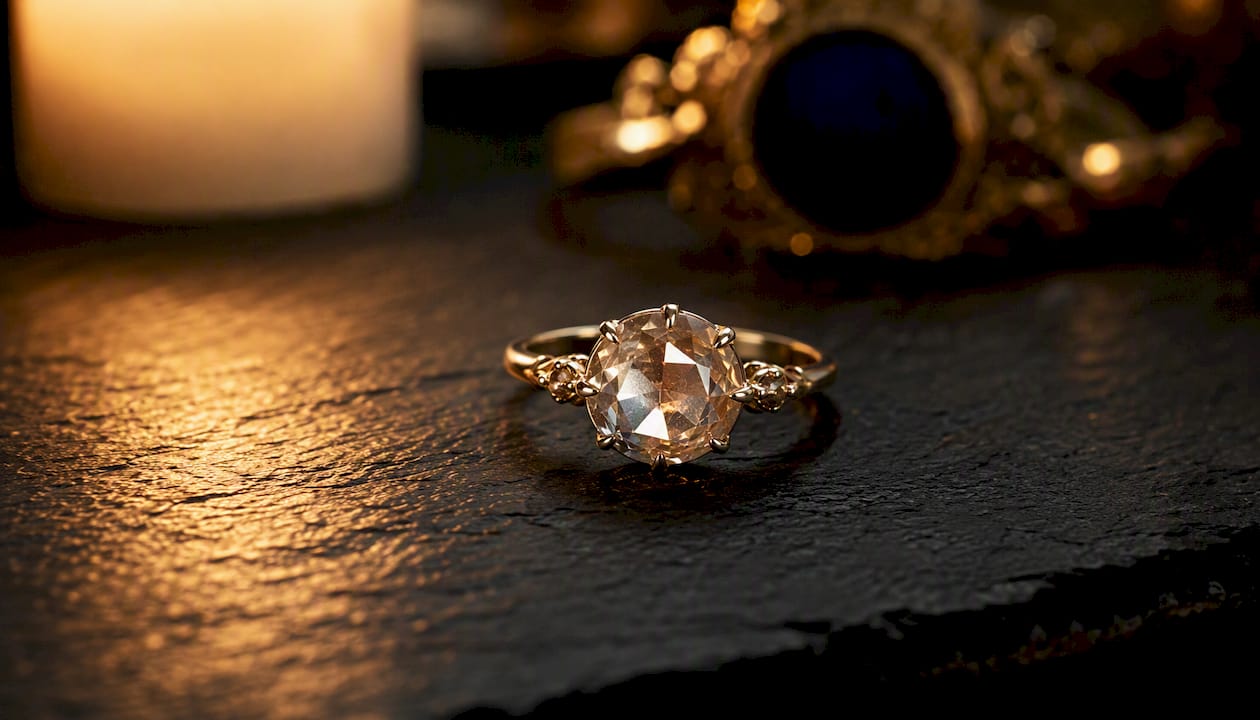
Face-up size is where the practical difference really bites for buyers. Take a 1 carat stone of each: the round brilliant sits with real depth, most of its weight tucked beneath the girdle in that pavilion, so its visible diameter is fairly modest for the weight. The rose cut, with next to no pavilion, spreads that same carat weight almost entirely across the face-up area, which is why rose cuts can appear 25 to 50% larger than an equivalent brilliant when you’re looking at them from above.
| Feature | Rose cut | Modern brilliant |
|---|---|---|
| Facet count | 3–24 facets | 24 facets |
| Base shape | Flat or very shallow, minimal pavilion | Deep inverted pavilion |
| Light behaviour | Soft, diffuse glow | Intense scintillation and fire |
| Best lighting | Candlelight, soft ambient light | Bright daylight, spotlighting |
| Face-up size per carat | Larger appearance for the weight | Smaller appearance for the weight |
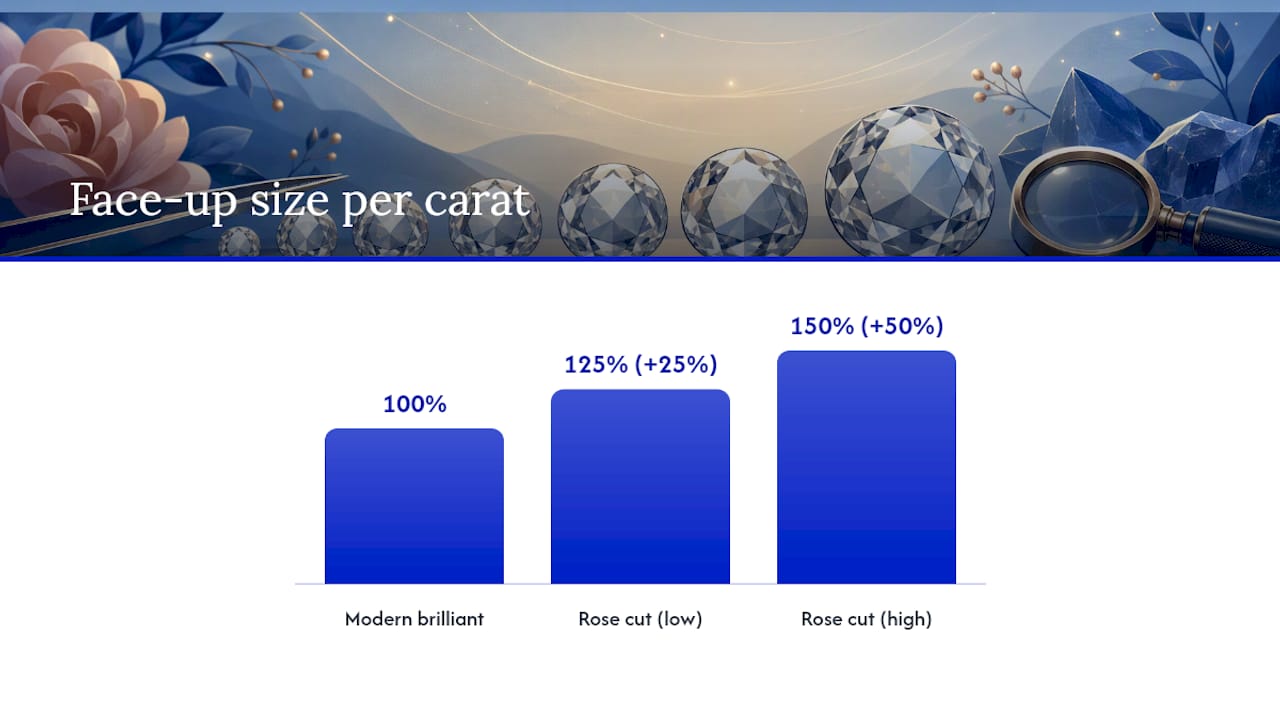
That shallow profile carries a real trade-off, though. With so little depth to disguise flaws and so much open surface facing the viewer, inclusions and tinting are considerably easier to spot in a rose cut than in a brilliant of comparable clarity grade. And because most rose cuts skip formal GIA cut grading altogether, you’re relying far more on your own eyes, decent photography, and a seller you trust than on a certificate that ranks the cut itself.
Should you buy a rose cut? Weighing the pros and cons
There’s no universally “correct” answer here, but the trade-offs are pretty clear once you lay them out.
What rose cuts give you:
- A face-up presence that outperforms the carat weight on paper, which matters if budget is tight but you want visual impact.
- A low, wearable profile that sits close to the finger, less prone to catching on jumpers and hair than a tall brilliant setting.
- Genuine antique character. No two hand-cut Georgian or Victorian stones are identical, which appeals to anyone who finds mass-produced brilliants a bit soulless.
- Historically lower cutting costs relative to modern precision cuts, though this narrows once clarity requirements are factored in.
Where they fall short:
- Noticeably less sparkle and fire under strong artificial light or bright daylight, if that’s the look you’re chasing.
- Inclusions and colour tinting show up more readily, pushing up the clarity grade you’ll realistically need to buy.
- Genuine antique stones and skilled rose-cutting are less widely available than standard brilliants, so sourcing takes more patience.
- The certification gap means more legwork verifying quality yourself rather than leaning on a graded report.
If you’re someone who wants maximum sparkle under gallery lighting for a big reveal moment, a brilliant will serve you better. If you’re drawn to something with age, softness, and a story, particularly for a vintage-inspired engagement ring or a pendant meant for evening wear, the rose cut earns its keep.
How can you tell a genuine rose cut from a modern imitation?
Buying online or from a photo, you need a checklist, because the differences between a well-cut antique stone and a mediocre modern imitation aren’t always obvious at a glance.
Start with the basics before you get anywhere near a purchase decision:
- Ask for a straight top-down photo, a side profile shot showing the crown height and flat base, and at least one loupe-magnified close-up of the facets.
- Check the face-up diameter against the stated carat weight. If a “1 carat” rose cut looks suspiciously small in the photo, something doesn’t add up.
- Look for even, radiating facet symmetry from table to girdle. Genuine hand-cut antiques often have slight, charming irregularities. Poorly made modern copies often have facets that are just wrong, not charmingly imperfect.
- Ask directly whether the stone is foil-backed, whether it’s been recut or repolished, and whether any provenance paperwork exists.
Clarity deserves particular attention here, because industry guidance commonly points to VS1 as a sensible minimum for larger rose cuts specifically because the open facet structure exposes internal flaws that a brilliant’s pavilion would otherwise hide. If you want a deeper primer on what clarity grades actually mean before you start comparing stones, our plain-English clarity guide is worth ten minutes of your time.
Red flags worth walking away from include an over-polished antique that’s lost its original facet texture, a modern setting mismatched with a supposedly antique stone, and any seller who can’t or won’t answer basic questions about provenance. A genuinely old rose cut usually shows some wear consistent with its age. A stone that looks brand new but is being sold as Georgian should raise your eyebrow.
Pro Tip: Ask for the stone’s measurements in millimetres, not just carat weight. Two “1 carat” rose cuts can differ noticeably in diameter depending on how they were cut, and the measurement tells you far more about how it’ll actually look on the finger than the weight alone.
What settings suit a rose cut diamond best?
The shape dictates the setting far more strictly than it does with a brilliant, mostly because there’s less structure to work with and, in antique pieces, real fragility to consider.
Bezel settings are the standard recommendation, and for good reason: a metal rim wraps the entire edge of the stone, protecting that shallow girdle from knocks and giving the piece a clean, low profile that suits the cut’s understated character. Low-prong settings work similarly well, holding the stone securely without adding height that would fight against the flat, close-to-finger look rose cuts are known for. Both approaches are widely recommended specifically because they protect the girdle while keeping the profile low.
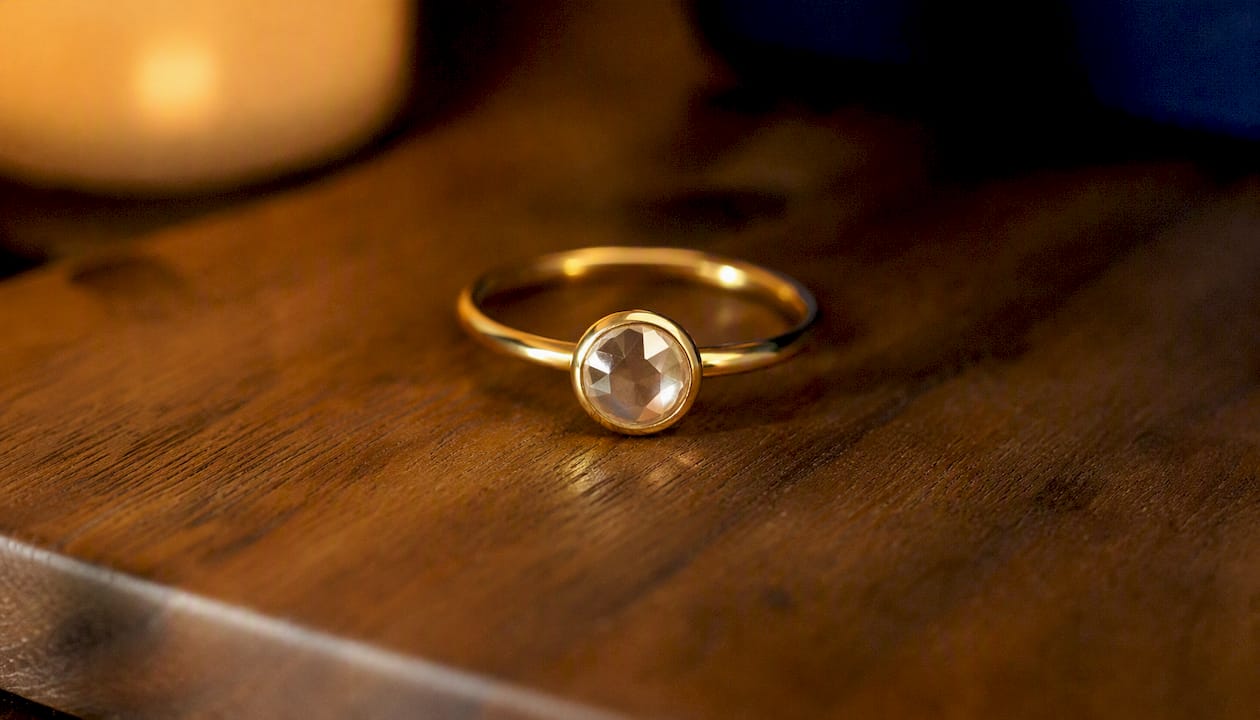
If you want more visual presence without raising the stone’s height, look at halo settings, a ring of smaller accent diamonds circling the rose cut, or cluster arrangements that group several rose cuts together for a textured, antique-inspired look. Warm metals like 14ct or 18ct yellow gold, or rose gold, tend to flatter the softer, warmer glow of a rose cut far better than a cool white metal, which can make the stone’s diffuse light look a little flat by comparison. For a sense of how that cluster aesthetic actually looks in a finished piece, this rose gold ruby and diamond cluster ring is a useful visual reference, and if vintage styling more broadly appeals to you, this vintage moonstone ring shows the same low-profile, everyday-wearable logic applied to a different stone.
One genuine caution if you’re buying an antique piece: original foil backing is delicate, and it isn’t something a general jeweller should poke around with casually. If a foil-backed stone needs resetting or repair, that work needs specialist handling, or you risk damaging a two-hundred-year-old detail that can’t be replaced. For general setting guidance beyond rose cuts specifically, our guide to jewellery setting types covers the wider landscape.
What should you expect to pay, and how do you look after one?
Sourcing a rose cut takes more legwork than walking into any high street shop and picking a brilliant off a tray, because mainstream retailers rarely stock them. Specialist antique dealers, vetted online specialists, and jewellers who genuinely handle pre-owned and antique stock, rather than treating “vintage” as a marketing word, are your realistic options.
Price depends heavily on size, clarity, and whether you’re buying a genuine antique with documented provenance or a newly cut stone in the rose style.
| Stone size (approx.) | Typical price range | Notes |
|---|---|---|
| 5 mm round rose cut | typically moderate price range | Varies with clarity and colour grade |
| — | typically higher price range | High-quality white stones tend to be pricier |
Those figures come from a rose cut pricing reference and, worth flagging, they’re quoted in US dollars as the market source states them, so treat them as a directional guide to sizing rather than a fixed UK price. Provenance adds a premium on top: a Georgian-era stone with documented history commands more than an unprovenanced antique-style cut of similar quality, purely because the story and rarity are part of what you’re paying for.
Care is straightforward day to day but needs a lighter touch on anything genuinely antique. For general cleaning, warm water with a mild soap and a soft brush works fine, avoiding ultrasonic cleaners on foil-backed stones, since vibration can loosen old foil or fragile settings. Have any antique piece checked periodically by someone who can assess whether the setting or foil needs attention before it becomes a real problem. And if you’re buying second-hand, always confirm the piece carries a proper hallmark and has been independently inspected, rather than taking a seller’s word on metal purity and stone authenticity.
How does an experienced jeweller actually inspect a rose cut?
There’s a proper sequence to checking one of these stones properly, and it’s not complicated, but skipping steps is exactly how people end up disappointed.
The process in-store typically runs like this: start with a visual top-down inspection to check facet symmetry and table alignment, then move to a profile check confirming the crown dome and base flatness match what you’d expect for a genuine rose cut. A loupe check follows, hunting for inclusions and assessing how visible they are given the open facet structure. Measuring the actual face-up diameter against stated carat weight catches sellers who round generously. Then comes the foil-backing test, because knowing whether a stone is foil-backed changes how it should be cleaned, set, and valued. Finally, a check for prior repairs or restoration work, looking for solder marks, replaced foil, or evidence of recutting that would affect both authenticity and value.
Provenance and hallmarking matter more with rose cuts than with almost any other diamond shape, precisely because certification is so limited. A reputable seller of pre-owned antique jewellery should be able to speak to where a stone came from and back that up with documentation where it exists. Bespoke cutting decisions, whether a stone has been reshaped from a larger rough or left in its original form, also shift price meaningfully, and it’s the kind of detail an inexperienced buyer wouldn’t know to ask about.
One anonymised example from routine inspection work: a pre-owned Victorian-era ring came in with a rose cut that, on first glance, looked slightly cloudy under normal light. A loupe check revealed the cloudiness was actually the intact original foil backing showing through a naturally included stone, not damage, and not a treatment. Once cleaned gently and reset in a protective bezel, the stone’s soft glow came through exactly as intended. The lesson: what looks like a flaw at first glance is sometimes just the cut doing precisely what a 200-year-old cutter designed it to do.
Pro Tip: If a rose cut is being sold as a significant investment piece, above roughly $5,000, request an independent appraisal from a source unconnected to the seller before you commit. It costs little relative to the purchase and protects you against inflated provenance claims.
If you want to understand how clarity, colour, and cut interact more broadly across diamond shapes before you narrow in on rose cuts specifically, our 4 Cs guide for UK buyers lays out the fundamentals clearly.
Why do rose cuts still earn their place in fine jewellery?
There’s something genuinely refreshing about a stone that isn’t trying to dazzle you from across the room.
Modern jewellery culture is obsessed with maximum sparkle, biggest fire, most facets per millimetre. A rose cut deliberately walks away from all of that, and the appeal, once you’ve handled a few, becomes obvious. It’s a quieter kind of beauty, one that rewards close attention rather than demanding it from a distance. That’s not a compromise. It’s a different set of priorities entirely, and once a buyer understands what the cut is actually offering, the “less sparkle” complaint tends to fall away.
The practical guidance running through this piece, prioritise clarity, check symmetry carefully, protect the girdle with the right setting, isn’t just technical box-ticking. It’s what lets that quieter beauty actually come through rather than getting lost under a poor mount or an undisclosed flaw. Buy a rose cut for what it is, not for what a brilliant is, and it rarely disappoints.
How Blackwelljewellers can help you find the right rose cut
Sourcing a genuine rose cut well means having someone check the things a certificate can’t tell you, and that’s exactly where Blackwelljewellers’s approach to pre-owned jewellery pays off. Every piece in our second-hand collection is inspected, authenticated, hallmarked and restored by our own jewellers before it ever reaches a customer, which matters enormously for a cut like this one that rarely carries a standard cut grade in the first place.

If you’re weighing up a rose cut, start by browsing our authenticated second-hand jewellery collection online, where provenance and condition are already verified rather than left for you to guess at from a few photos. Found an antique piece elsewhere that needs a foil backing checked, a setting reinforced, or a hallmark verified? Our jewellery repair service handles exactly that kind of specialist work across our Kent stores and nationally online. And if a rose cut isn’t quite your style but you like the idea of an ethically sourced stone in a bespoke setting, our ethical diamonds range is worth a look too. Book a consultation or browse the collection to see what’s currently available.
Where to read more on rose cut diamonds
A handful of sources are worth bookmarking if you want to go deeper before you buy. The GIA’s guide to diamond shapes is the closest thing to an industry baseline for how cuts are structured and classified. The Diamond Pro’s rose cut buying guide covers sourcing and historical context in useful detail, while Natural Diamonds’ explainer does a good job on the lighting and aesthetic side. For antique specifics, Lang Antique Jewellery University’s rose cut entry is a genuinely useful reference on period shapes and rarity. None of these will replace a proper in-hand inspection, and face-up size claims of 25 to 50% larger are the kind of figure worth verifying against the actual stone in front of you, not just taking on faith from a listing photo.
Frequently asked questions about rose cut diamonds
Is a rose cut diamond worth less than a brilliant cut? Not necessarily. Cutting costs can be lower, but genuine antique provenance and the clarity demands of the open facet structure often bring prices back in line with brilliants on a face-up basis.
Do rose cut diamonds sparkle at all? Yes, but differently. Expect a soft, diffuse glow rather than sharp fire, particularly noticeable and most flattering under candlelight or gentle ambient lighting.
Can you get a rose cut diamond certified? Standard GIA cut grades typically aren’t issued for rose cuts, since the grading system was built for modern brilliants. Clarity and colour can still be graded; the cut itself usually can’t.
What’s the difference between a rose cut and an old mine cut or old European cut? Old mine and old European cuts retain a pavilion and cushion-shaped or round outline with genuine depth, sitting between rose cuts and modern brilliants in both age and optical behaviour. Rose cuts are flatter still, with no meaningful pavilion at all.
Are modern rose cut diamonds as valuable as antique ones? Generally no. Documented antique provenance carries a premium that a newly cut stone in the rose style, however well made, doesn’t replicate.
How do I know if a rose cut diamond has been treated? Ask the seller directly, request loupe photographs, and look for inconsistencies between the stone’s apparent age and its condition. A specialist or independent appraiser can confirm treatments a listing photo can’t reveal.
Sources
- Guide to diamond shapes — GIA 4Cs blog
- Rose Cut Diamonds: Buying Guide | The Diamond Pro
- Rose cut diamonds: Discover their timeless appeal (Natural Diamonds)
- Rose cut diamonds (Moissanite by Aurelia) — round rose cut explanation and face-up size claim
- Rose cut vs brilliant cut: what’s the difference (Diamond Gold Melbourne)
Recommended
- The 4 Cs of Diamonds: The Complete 2025 Guide for UK Buyers – blackwellonline
- Diamond Cut Grades Explained: Why They Matter – blackwellonline
- Diamond cut explained: maximise beauty and value in the UK – Blackwell Jewellers
- Step-by-step diamond selection: A practical guide for UK buyers – blackwellonline