
TL;DR:
- A diamond certificate is an independent grading report that documents a diamond’s physical characteristics without assigning a monetary value or guaranteeing its beauty.
- Verifying certificates through laboratory websites and matching laser inscriptions helps prevent fraud and confirms the stone’s identity.
- However, certificates do not assess aesthetic qualities, ethical sourcing, or market value, requiring buyers to use their judgment alongside the report.
A diamond certificate is an independent grading report issued by a specialised gemological laboratory that documents a diamond’s measurable physical characteristics without assigning a monetary value or guaranteeing its beauty. The most widely recognised labs producing these reports are GIA (Gemological Institute of America) and IGI (International Gemological Institute). If you’re buying a diamond and someone hands you a piece of paper claiming to prove its quality, this is what you’re looking at. Understanding what that document actually says (and what it doesn’t) is the difference between a confident purchase and an expensive mistake.
What does a diamond certificate include?
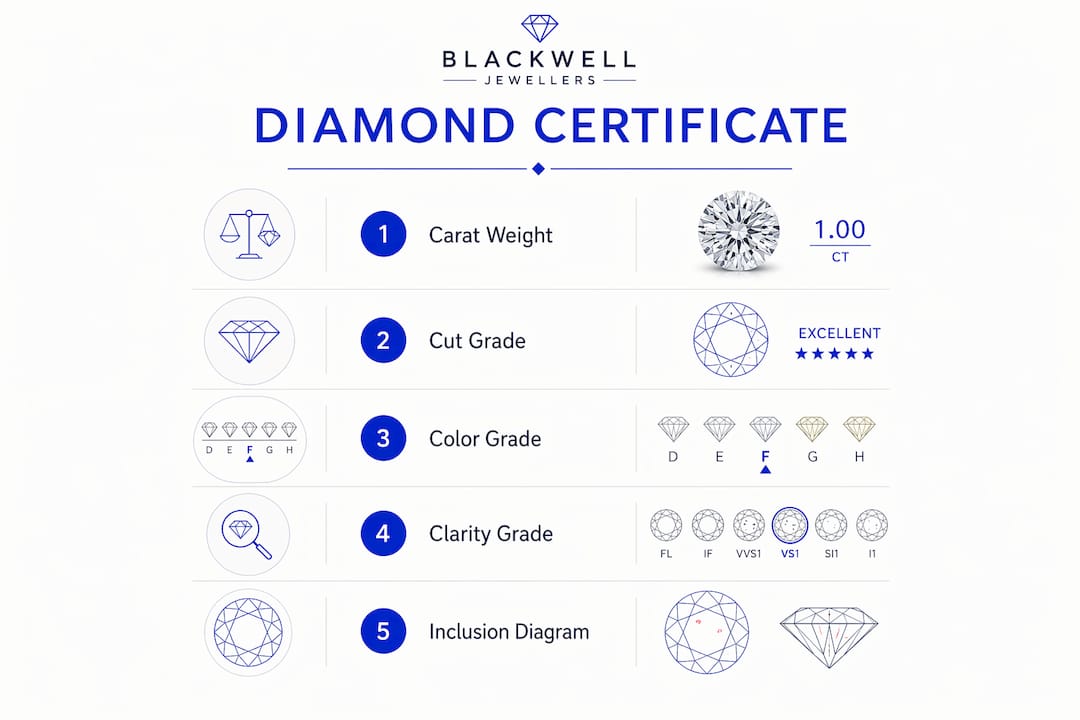
A diamond grading report documents the four core physical characteristics of a stone, collectively known as the 4Cs: Cut, Colour, Clarity, and Carat weight. These are the universally accepted measures that allow any two diamonds to be compared objectively, regardless of who’s selling them or what price tag is attached.
Beyond the 4Cs, a thorough certificate from a reputable lab will also record:
- Fluorescence (how the stone reacts under ultraviolet light)
- Polish and symmetry grades (how well the facets are finished and aligned)
- Measurements in millimetres (length, width, depth)
- Inclusion diagrams (a plotted map of internal and surface characteristics)
- A unique report number and, in many cases, a laser inscription on the stone’s girdle matching that number
Trained gemologists compile these reports using precise scientific instruments, including microscopes and proportion analysers. The process is designed to be objective and repeatable. Certification is typically reserved for stones above 0.25 carats, since smaller diamonds rarely justify the cost of a full independent report.
Pro Tip: When you receive a certificate, check whether it includes an inclusion diagram. A certificate without one is less detailed and harder to cross-reference against the physical stone. GIA and IGI both include these as standard.
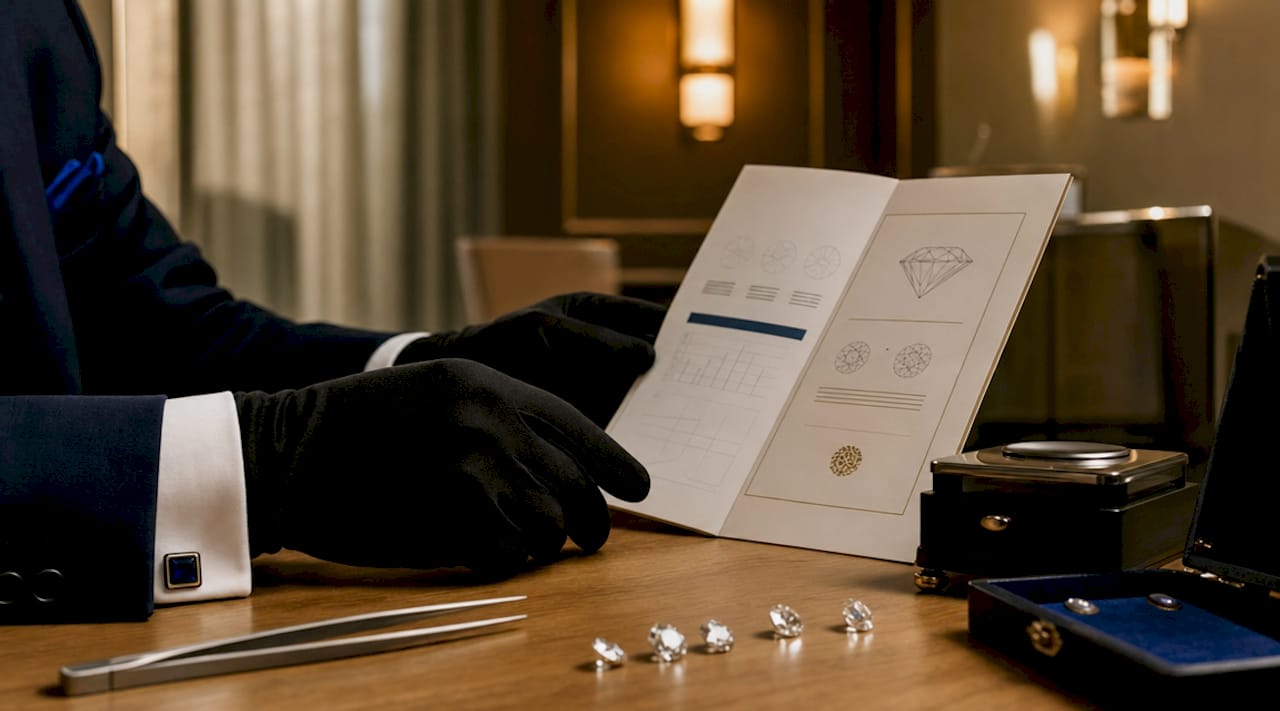
One thing worth knowing: the phrase “certified diamond” is technically a misnomer. GIA prefers “grading report” terminology, because labs grade rather than certify. No lab is endorsing the stone or guaranteeing its value. They’re recording facts. That distinction matters more than it sounds, especially when a seller uses “certified” as a selling point without specifying which lab produced the report.
For a deeper look at how the 4Cs work together, the complete 4Cs guide from Blackwelljewellers is genuinely useful reading before you start comparing stones.
How does a diamond certificate differ from an appraisal?
This is where a lot of buyers get confused, and honestly, it’s an easy mistake to make. The two documents look similar on the surface but serve completely different purposes.
| Document | What it records | Who produces it | Does it change over time? |
|---|---|---|---|
| Diamond certificate | Physical characteristics (4Cs, measurements, inclusions) | Independent gemological lab (GIA, IGI, AGS) | No. Physical traits are permanent. |
| Diamond appraisal | Estimated monetary replacement value | Jeweller or insurance valuator | Yes. Fluctuates with market conditions. |
A certificate records permanent physical attributes at the time of grading. An appraisal assigns a monetary replacement value and fluctuates with market dynamics. The two documents are complementary, not interchangeable.
Think of it this way. The certificate tells you exactly what the diamond is. The appraisal tells you what it would cost to replace it today. You need both if you’re insuring a piece, because the insurer wants the replacement value and the grading data. Both documents together offer comprehensive valuation and quality assurance that neither provides alone.
Appraisals are typically carried out by jewellers or insurance valuators, which means they are not independent in the same way a lab report is. A certificate from GIA or IGI carries no financial interest in the stone’s value. An appraisal, by contrast, is always produced in a commercial context. That doesn’t make appraisals unreliable, but it does mean you should treat them differently.
Why verifying diamond certificates matters
Fraud exists in the diamond trade. It’s not rampant, but it happens, and the most common form is a swapped or mismatched certificate. Someone buys a stone, swaps it for a lower-quality diamond, and presents the original certificate as if it still matches. Here’s how to protect yourself:
- Check the report number on the lab’s website. GIA, IGI, and AGS all have free online verification tools. Type in the report number and confirm the details match the certificate in front of you.
- Examine the laser inscription. Matching serial numbers on the girdle confirm the certificate belongs to the specific stone you’re purchasing. You’ll need a loupe (a small magnifying lens) to see it clearly.
- Confirm the lab’s reputation. GIA was founded in 1931 and grades anonymously without monetary endorsements. IGI, founded in 1975, is the largest for-profit lab and widely accepted, particularly for lab-grown diamonds. AGS (American Gem Society) is also highly regarded. Be cautious of certificates from obscure labs with no verifiable track record.
- Cross-reference the physical measurements. The certificate lists exact millimetre dimensions. If the stone’s measurements don’t match, something is wrong.
- Ask for photos or video. Reputable sellers, particularly online, should provide high-resolution imagery that you can compare against the inclusion diagram on the certificate.
Pro Tip: If you’re buying online and the seller can’t or won’t confirm the laser inscription matches the report number, walk away. That single check eliminates the most common form of certificate fraud.
For lab-grown stones specifically, the verification process for lab-grown diamonds follows the same principles but has a few additional nuances worth understanding before you buy.
What are the limitations of a diamond certificate?
Here’s the part most sellers won’t tell you, and it’s genuinely important. A certificate is not a beauty guarantee. Two diamonds can share identical grades across all 4Cs and look completely different to the naked eye.
Certificates do not assess light performance or visual beauty. Factors like scintillation (the sparkle you see when a diamond moves), fire (the coloured light dispersion), and overall brilliance are not captured in a grading report. The 4Cs are necessary but not sufficient indicators of a diamond’s perceived beauty, because unquantified factors like scintillation and fire play a significant role in how a stone actually looks.
Other things a certificate won’t tell you:
- Market value. The certificate records physical traits, not price. What a diamond is worth today depends on the market, the seller, and demand.
- Ethical sourcing. Ethical provenance requires separate documentation beyond standard quality grading certificates. The Kimberley Process certification is the relevant document for conflict-free assurance. A GIA or IGI report says nothing about where the stone came from or under what conditions it was mined.
- Condition of the setting. If the diamond is already set in a ring, the certificate describes the loose stone as it was when graded. The setting itself is not assessed.
“A certificate is a filter, not a final answer. Use it to eliminate unsuitable stones, then use your eyes and your judgement to choose the right one.”
Lab-grown diamonds receive the same quality certificates as natural stones. They are graded on identical criteria. The certificate will typically note whether the stone is natural or laboratory-grown, but the grading methodology is the same.
How to use a diamond certificate when buying
Right. You’ve got a certificate in front of you. Here’s how to actually use it rather than just nodding at it politely.
Start with the 4Cs, but don’t treat them as equally weighted. Cut has the biggest impact on how a diamond looks. A well-cut stone with slightly lower colour or clarity grades will often outshine a poorly cut stone with higher grades. The certificate as a filter works best when you use it to eliminate unsuitable stones, not to make the final call.
- For stones above 0.25 carats, always request a certificate from GIA, IGI, or AGS. Below that threshold, the cost of certification often exceeds its practical value.
- For lab-grown diamonds, IGI is the most commonly used lab and widely accepted by retailers and insurers. Check the clarity comparison between natural and lab-grown stones if you’re weighing up both options.
- Cross-reference with photos and video. A certificate tells you the grade. A high-resolution video tells you how the stone actually performs in light. Both together give you a complete picture.
- Check the seller’s return policy. A certificate is only useful if the stone you receive matches it. Reputable sellers offer returns and independent verification. If a seller resists either, that’s a red flag.
- Use the inclusion diagram. The plotted map of inclusions is your fingerprint for the stone. Keep it. If you ever need to verify the stone’s identity in future (for insurance, resale, or repair), this diagram is invaluable.
Pro Tip: Ask the seller to confirm the report number verbally before you pay. It takes ten seconds and eliminates any ambiguity about which stone the certificate refers to. A confident seller will do this without hesitation.
For a structured approach to the whole selection process, the step-by-step diamond selection guide from Blackwelljewellers walks you through each decision point in order.
Key takeaways
A diamond certificate is an independent grading report that records physical characteristics only. It does not assign value, guarantee beauty, or confirm ethical sourcing.
| Point | Details |
|---|---|
| Certificates record facts, not value | GIA and IGI reports document the 4Cs and physical traits without assigning a price. |
| Appraisals and certificates are different | Use both together for insurance and investment purposes, as each serves a distinct role. |
| Verification prevents fraud | Always match the laser inscription on the girdle to the report number via the lab’s website. |
| Certificates have real limits | Visual beauty, ethical sourcing, and market value all require separate assessment beyond the report. |
| Cut grade matters most | Of all the 4Cs, cut has the greatest impact on how a diamond actually looks in real life. |
James’s take: what certificates really tell you (and what they don’t)
I’ve seen buyers wave a GIA certificate around like it’s a golden ticket, and I understand why. It feels reassuring. Someone official has looked at this stone and written things down. But here’s what I’ve learnt from years of working with diamonds and the people who buy them: the certificate is the starting point, not the finish line.
The terminology alone trips people up. “Certified diamond” sounds like a stamp of approval, but as GIA themselves prefer to say, it’s a grading report. No one is certifying that you’re getting a good deal or a beautiful stone. They’re recording measurements. That’s genuinely useful, but it’s not the same thing.
What I’d tell any buyer is this: use the certificate to filter out the stones that don’t meet your minimum requirements, then use your eyes. Look at the stone in different lighting. Watch how it moves. Compare it to others at the same grade. The certificate can’t tell you which stone makes your heart do something funny when you look at it. Only you can do that.
Seller reputation matters enormously too. A certificate from a reputable lab attached to a stone from a seller you can’t verify is still a risk. The two things work together. Knowledge plus verification plus a trustworthy seller. That combination is what actually protects your investment.
— James
Certified diamonds at Blackwelljewellers
At Blackwelljewellers, every diamond piece in the collection comes with full transparency on provenance and grading. Whether you’re exploring certified second-hand diamonds with verified grading reports or considering a bespoke piece in Maidstone built around a stone you’ve chosen yourself, the team is on hand to walk you through every line of a certificate in plain English. No jargon, no pressure. Just honest advice from people who’ve been doing this for over 20 years across Kent and online. If you want to understand exactly what you’re buying before you commit, that’s precisely what Blackwelljewellers is here for.
FAQ
What is a diamond certificate?
A diamond certificate is an independent grading report produced by a gemological laboratory such as GIA or IGI that documents a diamond’s physical characteristics, including the 4Cs, without assigning a monetary value.
Is a certified diamond the same as a graded diamond?
Effectively yes, though the terminology differs. GIA prefers “grading report” over “certified diamond” because labs evaluate physical traits objectively rather than certifying value or quality in any commercial sense.
How do I verify a diamond certificate is genuine?
Enter the report number on the issuing lab’s official website (GIA, IGI, or AGS all offer free verification tools) and confirm the details match. Also check that the laser inscription on the stone’s girdle matches the report number.
Do diamond certificates cover ethical sourcing?
No. Standard grading reports from GIA or IGI record physical characteristics only. Ethical sourcing and conflict-free status require separate documentation, such as a Kimberley Process certificate.
Are diamond certificates necessary for smaller stones?
Certification is typically reserved for diamonds above 0.25 carats, as the cost of an independent report from a major lab is rarely justified for smaller stones. For significant purchases above that threshold, a certificate from GIA, IGI, or AGS is strongly advisable.
Recommended
- What is diamond clarity? A plain-English buyer’s guide – Blackwell Jewellers
- The 4 Cs of Diamonds: The Complete 2025 Guide for UK Buyers – blackwellonline
- Step-by-step diamond selection: A practical guide for UK buyers – blackwellonline
- Diamond buying tips for UK buyers: choose with confidence – Blackwell Jewellers